
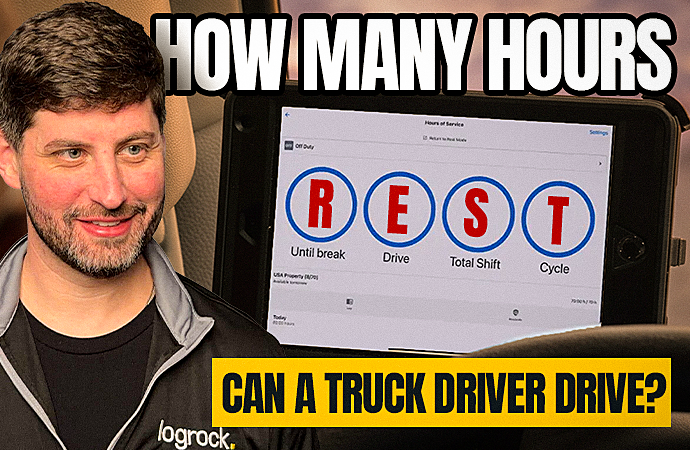
If you're behind the wheel or running trucks, let me hit you with a tough question: Are you 100% sure EVERY mile your team runs is legal-and covered? As an owner-operator, you're the business owner. Your focus is daily cash flow, because one unexpected breakdown or a slow-paying customer can wipe out the week's profit.
With the rules tightening in 2025, a single HOS slip-up isn't just a ticket. It can lead to an Out-of-Service (OOS) event, taking your truck and your cash flow off the road fast.
This article is a no-fluff guide. I'm breaking down the DOT Hours of Service (HOS), line by line, using real-life examples. This is just what you need to stay legal, protect your business, and keep more profit from every load.

Essential HOS Compliance for Profit
- The 14-Hour Killer: The clock that truly hurts your profit is the 14-Hour Window, which includes all on-duty time-driving, fueling, and most importantly, waiting. It doesn't pause.
- Detention Kills CPM: Unpaid waiting time (detention time) is a compliance threat and a profit drain. It counts against your HOS limit, directly reducing the miles you can drive for pay.
- The 70-Hour Trap: Watch your running total. Hitting 70 hours of on-duty time in 8 days means an immediate 34-hour off-duty reset, forcing you to sideline the truck when you could be earning.
- Protect Your Authority: HOS and Electronic Logging Device (ELD) violations cost you money through fines and higher trucking insurance premiums due to a bad safety score.
The Federal Basics: How Many Hours You Can Actually Drive
Let's start with the federal basics: These rules are the law and tracked by your ELD.
| Rule | What It Means (In Plain English) | The Owner-Operator Risk |
|---|---|---|
| 11-Hour Driving Limit | The maximum time you can spend actively driving after taking 10 consecutive hours off-duty. | Exceeding this is a major violation and the fastest way to get an OOS order and a big fine from a bear or Smokey. |
| 14-Hour Window | The maximum time from the moment you start your workday (pre-trip, paperwork) until you must stop driving. The clock doesn't stop. | This is the killer. If you spend two hours waiting at a shipper (detention), you only have 12 hours left to finish the day's job. |
| 30-Minute Break | Mandatory break required after 8 cumulative hours of driving time. | Failure to take this break is a simple, costly violation. Don't risk it to try and beat traffic. |
| 60/70-Hour Limit | Maximum on-duty time allowed over 7 or 8 consecutive days. | Hitting 70 hours means you are legally sidelined. You cannot drive again until you complete a full 34-hour off-duty reset. |
"The 14-hour clock is what really kills us. Waiting to load counts the same as driving."
Imagine you start your day at 6 AM, do your pre-trip, then wait for two hours to load. Now, it's 8 AM and your 14-hour clock has been running the whole time-you've only got until 8 PM to finish. Get delayed at a live unload for another hour? You might run out of legal drive time before making your next delivery. That's income gone.
The Gray Area: How Detention Time Kills Your Profitability
Here's what most owner-operators miss, but the best ones fight back against.
Detention Time: Unpaid Work and Lost Miles
Detention time-unpaid waiting at a shipper or receiver-eats into your on-duty window just like driving at hammer down speed.
- What It Is: Time spent waiting (on-duty, non-driving) for loading or unloading, typically after the first two hours.
- Why It's Essential (The Business Risk): It directly reduces your profitable drive time. If a broker delays you, they are taking money out of your pocket by consuming the 14 hours you need for earning.
- Pro Tip: Document every minute of detention. After two hours, aggressively push for the detention pay you are owed. You are a business owner; don't let brokers steal your time.
Tips to Claw Time and Profit Back
Three ways to take control and keep your business moving:
- 1. Prioritize Drop and Hook: Always try to plan loads that use drop and hook. This saves you hours compared to a live unload where you wait for a warehouse crew to move the freight.
- 2. Monitor Your 70-Hour Total: Monitor your HOS daily. If you're close to your 70-hour limit, pre-plan your 34-hour reset strategically. Don't be forced to idle at a random pickle park (rest area) when you could be relaxing at home.
- 3. Fight for Detention Pay: Keep a daily time log and use the ELD data to back up your claims. Push for fees after the first two hours; this is cash flow you earned.
Your Questions Answered: "People Also Ask" FAQs
A: HOS violations lead to an Out-of-Service (OOS) event, which hurts your safety score (known as the CSA score). Higher OOS rates and worse scores flag you as a bigger risk to insurance companies, which can raise your trucking insurance premiums significantly.

A: It is a mandatory 34 consecutive hours off-duty or in the sleeper berth. You need it to reset your 60- or 70-hour clock back to zero so you can start accumulating drive hours again.
A: No. Almost all commercial drivers running semi trucks and long-haul loads are required to use an FMCSA-approved Electronic Logging Device (ELD). Using a paper logbook is now largely obsolete and can lead to immediate fines.
The Logrock Difference: Insurance Built for Business Owners
You're a pragmatic problem-solver who values teamwork and clear expectations. You need a partner who understands the difference between a bobtail and a deadhead mile-not just another corporate broker.
At Logrock, we treat your risk as a business problem. We check your compliance 24/7 to ensure you don't have gaps that cost you a higher premium. We shop all the major markets with one application to find you the best possible rate, cutting the complexity out of getting commercial truck insurance.
Stop wasting your money and time.
Conclusion & Get Your Free Risk Analysis
Mastering HOS rules isn't about jumping through hoops-it's about protecting your time, maximizing your miles, and keeping your business on the road. You make the tough decisions daily. Let us handle the complexity of risk.
Tap the link below to get your personalized risk review and a quote in less than 5 minutes.





