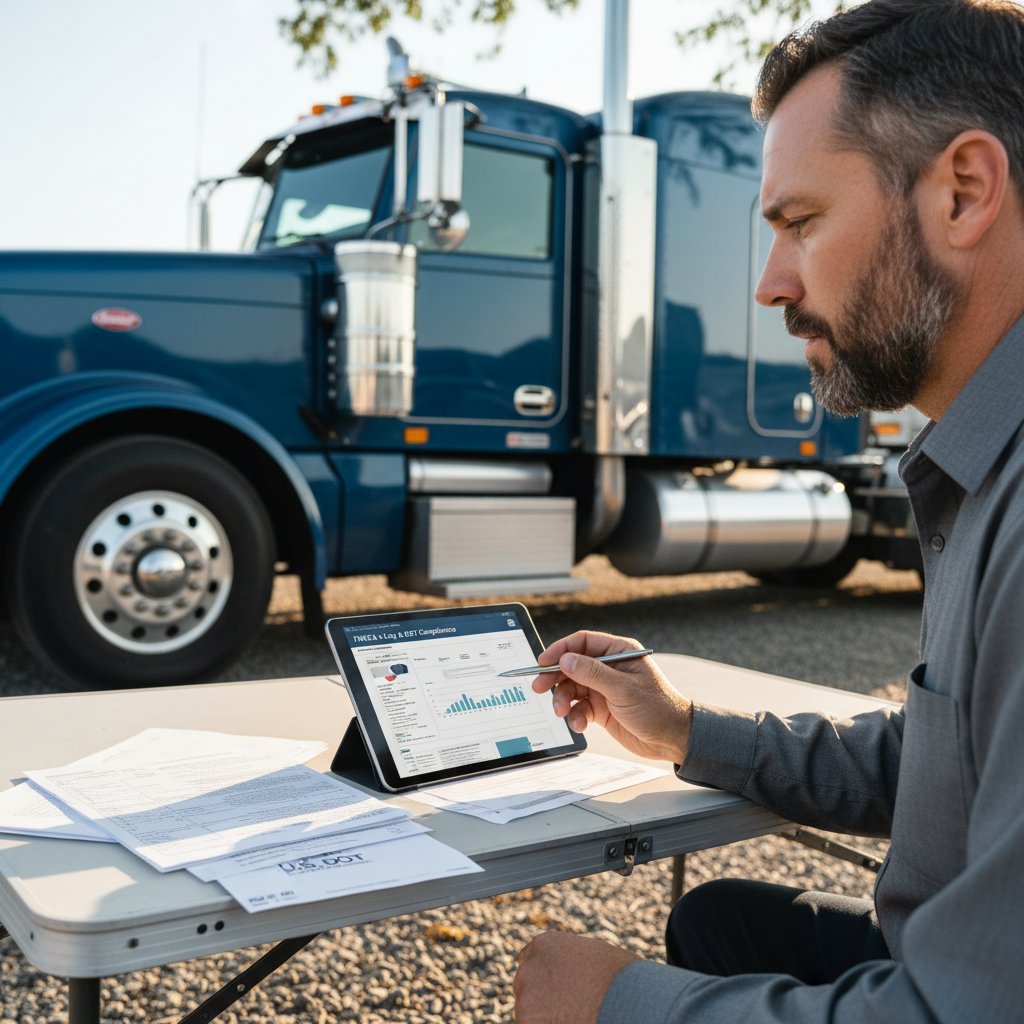
Learn what BIPD coverage means, what it pays for (and what it doesn’t), how limits like 25/50/25 work, and trucking/FMCSA compliance basics—so you can choose limits that protect your cash flow and keep your COI broker-ready.

BIPD coverage (Bodily Injury + Property Damage liability) pays for injuries to other people and damage to other people’s property when you’re at fault in an accident, including legal defense—up to your policy limits. It can cover medical bills, lost wages, pain and suffering, and repairs to vehicles/buildings, but it does not pay to repair your own truck.
If you want the broader context behind liability inside a commercial policy, start with commercial auto liability insurance basics—then come back and use this guide to sanity-check your limits.
Table of Contents
Reading time: 9 minutes
- What Does BIPD Stand For (and Why Trucking Uses the Term Differently)?
- How to Read BIPD Limits: 25/50/25 vs CSL (With a Real Payout Example)
- Is BIPD Coverage Required? State Minimums vs FMCSA vs Broker Contracts
- What BIPD Does NOT Cover (and What to Pair With It)
- Frequently Asked Questions
- Why Logrock: Practical Coverage That Won’t Get Your COI Rejected
- Conclusion: Set BIPD Limits Like a Business Owner
What Does BIPD Stand For (and Why Trucking Uses the Term Differently)?
BIPD in commercial auto and trucking insurance most commonly means Bodily Injury (BI) and Property Damage (PD) liability, which is the core “liability coverage” that pays third-party damages when you’re at fault.
Here’s the one misunderstanding that causes real damage: in some non-trucking conversations, “BIPD” can be used to mean business income/extra expense, but in trucking and commercial auto it almost always means BI/PD liability.
Bodily Injury Liability (BI)
Bodily Injury liability pays when you injure someone else in a crash and you’re found at fault, including items like medical bills, lost wages, and pain and suffering (subject to your limits and policy terms).
BI claims are also the ones most likely to turn into long-tail litigation, especially when there are multiple claimants or alleged permanent injuries.
- Typical split structure: BI is often shown as “per person” and “per accident.”
- Business risk: One multi-injury accident can push you into the per-accident cap fast.
- Practical note: If you’ve got assets (truck/trailer equity, business account, home equity), low BI limits can become personal exposure.
Property Damage Liability (PD)
Property Damage liability pays for damage you cause to someone else’s property—vehicles, buildings, dock doors, guardrails, and similar third-party property (subject to your limits and policy terms).
PD gets underestimated because people picture “a bumper,” but modern vehicle repairs and commercial property repairs can climb quickly.
- High-frequency PD situations: city work, tight yards, dock approaches, crowded customer lots.
- Common surprise: PD can include damage beyond the other vehicle (for example, fencing or a storefront).
How to Read BIPD Limits: 25/50/25 vs CSL (With a Real Payout Example)
BIPD limits are the maximum amount your insurer will pay for covered BI/PD claims (and often defense costs within the policy structure), and any amount above the limit becomes your financial exposure.
If you only remember one thing, make it this: “I have insurance” doesn’t mean “I’m protected,” because protection is defined by the limit structure.
What 25/50/25 Means (Simple Example)
25/50/25 is a split-limit format that usually means $25,000 BI per person, $50,000 BI per accident, and $25,000 PD per accident.
Here’s a clean payout example that shows where the gap comes from:
Mini scenario (split-limit math): You’re at fault in a crash with two injured people and a totaled vehicle.
- Person A BI: $35,000 claimed → policy can pay $25,000 → $10,000 potential out-of-pocket exposure
- Person B BI: $25,000 claimed → policy can pay $25,000
- BI per accident cap: $50,000 total → you’re at the cap once both BI payments hit
- Property damage: $40,000 claimed → policy can pay $25,000 → $15,000 potential out-of-pocket exposure
Split Limits vs Combined Single Limit (CSL)
Combined Single Limit (CSL) liability uses one limit per accident (for example, $1,000,000 CSL) instead of separate BI and PD buckets.
CSL is popular in trucking because it’s cleaner on Certificates of Insurance (COIs) and avoids the “wrong bucket” problem where BI is available but PD is capped (or the reverse).
If you want a deeper breakdown of why this matters in claim payouts, see split limits vs combined single limit (CSL).
Quick Rule of Thumb for Choosing Limits (Owner-Operator Edition)
A practical way to choose BIPD limits is to match the highest limit you routinely see in broker/shipper requirements, then verify it still protects your balance sheet if a real claim hits.
- Don’t compare apples to oranges: compare quotes with the same limits, radius, and deductible structure.
- Don’t buy on premium only: cheap limits can become expensive the first time you’re above the bucket.
- Think in downtime: one accident can also stall revenue even if the insurer pays the claim.
Bring your declarations page and we’ll translate your BIPD limits into plain-English risk.
Is BIPD Coverage Required? State Minimums vs FMCSA vs Broker Contracts
BIPD coverage requirements depend on whether you’re personal auto, intrastate commercial, or interstate for-hire trucking, because state minimums, federal rules, and contract terms can all apply at the same time.
This is where a lot of operators get burned: being “legal in your state” doesn’t automatically mean “compliant for the load you’re hauling” or “accepted by the broker.”
Personal Auto: State Minimum Liability
State minimum liability is the minimum BI/PD limit your state requires to drive legally, but those limits are designed for legal compliance—not for protecting a business after a severe loss.
Common split-limit formats you’ll see (examples only—always verify your state’s current minimums):
| Common Format | What It Means | Why It’s Often Too Low in 2026 |
|---|---|---|
| 25/50/25 | Split limits (BI per person / BI per accident / PD per accident) | Medical + repair costs can exceed the buckets quickly |
| 50/100/50 | Higher split limits | Still small in multi-injury accidents or commercial PD losses |
| 100/300/100 | Common “higher tier” split limits | Better protection, but may still fall short for commercial exposures |
Commercial Use: Contracts Often Matter More Than the State
Broker, shipper, and lease agreements can require higher liability limits than state minimums, and a COI that doesn’t match contract language can get a load rejected.

- Common contract pressure point: “$1,000,000 liability” wording, often requested as CSL.
- Operational reality: if you can’t meet requirements consistently, you lose revenue opportunities.
Interstate Trucking: FMCSA Financial Responsibility Basics (2026 Notes)
FMCSA financial responsibility rules commonly require $750,000 minimum public liability for interstate for-hire motor carriers transporting non-hazardous property, with higher minimums (often $1,000,000 or $5,000,000) for certain hazardous materials.
Federal requirements also tie into filings and proof of insurance, and the details vary by operation and cargo type—so don’t bind coverage on rumors.
Use this as your starting point, then verify your exact setup: FMCSA insurance requirements explained.
Reality check: A policy can be active and paid, but if the filing/limit/name on the COI doesn’t match what the broker requires, you can still lose the load.
What BIPD Does NOT Cover (and What to Pair With It)
BIPD coverage is third-party liability, which means it’s built to pay other people for covered injuries and property damage—not to repair your own equipment or replace your freight.
If you want “sleep at night” protection, BIPD is the foundation, but it’s not the whole program.
Your Own Truck Repairs (That’s Physical Damage)
BIPD does not pay to fix your truck after a collision, roll-over, animal strike, vandalism, or weather loss, because those are first-party physical damage claims, not third-party liability.
Physical damage is usually built from collision (crash/impact) and comprehensive (non-collision events like theft, fire, hail, animal strike).
If you’re comparing those two coverages, use: collision vs comprehensive for semi trucks.
The Freight You’re Hauling (That’s Cargo Insurance)
BIPD generally does not cover damage to the cargo you’re responsible for, because freight losses are typically handled under motor truck cargo coverage (and often come with exclusions and special conditions).
If you’ve ever had a broker packet ask for cargo limits without explaining why, that’s the gap they’re trying to close—freight exposure isn’t the same as BI/PD exposure.
FMCSA Filings and Endorsements (Not the Same as “Coverage”)
FMCSA filings and endorsements are proof-of-financial-responsibility mechanisms and policy conditions, and they’re not the same thing as adding more day-to-day “coverage” for your truck or your cargo.
A common confusion point is the MCS-90 endorsement; this explainer keeps it practical: what the MCS-90 endorsement does.
What Affects BIPD Premiums? (How to Keep It Affordable Without Getting Burned)
BIPD pricing is driven by exposure factors like operating radius, cargo type, driver history, loss history, and continuity of coverage, not just the truck you drive.
- New venture/new authority: often higher premiums until you build history
- Radius + mileage: more time on the road generally means more exposure
- Cargo and lanes: some commodities and lanes are priced differently
- Driver MVR/PSP and prior losses: underwriting looks at patterns
- Lapses in coverage: can trigger higher pricing or fewer options
Visuals to Add (Optional)
Frequently Asked Questions
BIPD coverage covers bodily injury to other people and property damage to other people’s property when you’re legally liable for an at-fault accident, up to your stated BI/PD limits (or CSL limit). It commonly pays third-party medical bills, lost wages, pain and suffering, vehicle/property repairs, and claim investigation and legal defense on covered losses. In trucking, this is the core public liability protection brokers expect to see on a COI. It typically does not pay to repair your truck, replace your cargo, or fix normal wear-and-tear issues.
Numbers like 25/50/25 are split limits that typically mean $25,000 bodily injury per person, $50,000 bodily injury per accident, and $25,000 property damage per accident. If an injury claim is $35,000 and your BI per person limit is $25,000, the policy can stop at $25,000 and the remaining $10,000 can become your responsibility. The same logic applies to the PD bucket if repairs or replacement costs exceed the PD limit. That’s why the format matters as much as the premium.
Yes—some level of BI/PD liability is required in most states to operate legally, and interstate for-hire trucking often has federal minimums that start at $750,000 public liability for non-hazardous property (with higher minimums like $1,000,000 or $5,000,000 for certain hazmat). On top of that, brokers and shippers frequently require $1,000,000 liability shown on a COI, regardless of state minimums. Your real requirement is the highest number that applies across state law, FMCSA rules, and your contracts.
No—BIPD is liability coverage for injuries and property damage you cause to others, so it does not pay to repair your own truck after a collision, deer hit, or weather loss. To protect your truck, you typically need physical damage coverage (collision and comprehensive), often with a deductible, and lenders commonly require it on financed equipment. If you want the practical breakdown of what physical damage covers (and what it doesn’t), read semi truck physical damage insurance.
Why Logrock: Practical Coverage That Won’t Get Your COI Rejected
A Certificate of Insurance (COI) is evidence of coverage that summarizes limits and named insured details, but it does not change the policy terms, which is why accuracy and correct structure matter.
Most owner-operator headaches aren’t “insurance talk” problems—they’re working-driver problems: the load won’t book because the COI wording is off, the limit format doesn’t match, or the filing doesn’t line up with the operation.
- Coverage built around how you actually run: radius, cargo, lanes, lease-on vs authority
- Broker- and shipper-friendly COIs: clear limits and clean documentation
- Plain-English trade-offs: premium vs deductible vs limit vs real-world risk
Conclusion: Set BIPD Limits Like a Business Owner
BIPD coverage is auto liability insurance that pays third-party bodily injury and property damage claims up to your stated limits, which is why it’s the foundation of a trucking insurance program.
Low limits can look “affordable” until the first real claim eats through the buckets. Pick limits that match your contracts and protect your balance sheet, then pair BIPD with the right first-party coverages for your truck and freight exposure.
Key Takeaways:
- BIPD pays others, not you: it’s third-party liability, not repair coverage for your truck.
- Limits decide survivability: split limits like 25/50/25 can leave you exposed; CSL is often cleaner for trucking.
- Compliance is layered: state rules, FMCSA requirements, and broker/shipper contracts can all apply.
If you want limits that protect your authority and your cash flow (not just the cheapest number), get a quote and we’ll align the policy structure with how you operate.