Learn box truck insurance requirements, FMCSA and state minimums, cargo limits, MCS-90/BMC-91X filings, and broker rules.
Box truck insurance requirements in 2026 come down to three different “minimums”: what’s required by FMCSA (federal), what your state requires for intrastate operations, and what brokers/shippers/lenders demand in contracts. The practical baseline for many for-hire operators is $1,000,000 CSL liability plus $100,000 cargo, even when the legal minimum can be lower.
If you’ve ever had a load delayed because the COI wording didn’t match the broker packet—or you found out after a claim that “minimum required” didn’t cover what you thought—this guide is built for you. We’ll cover the legal basics, the real-world contract asks, and the filings and proof that actually get you dispatched.
Plain-English summary (featured snippet): Minimum box truck insurance requirements depend on whether you operate interstate for-hire (FMCSA rules) or intrastate (state rules). Many interstate carriers need at least $750,000 auto liability for non-haz freight, while brokers often require $1,000,000. Cargo insurance is frequently contract-required (often $100,000+) even when it’s not federally required for every general freight move.
Key Takeaways: Essential Box Truck Insurance Requirements (2026)
- Interstate for-hire (non-haz): FMCSA financial responsibility often starts at $750,000, but $1,000,000 CSL is a common broker gatekeeper.
- Cargo: Often not federally required for every scenario, but commonly required by brokers/shippers at $100,000+.
- Filings & proof: Filings (often referenced as BMC-91/BMC-91X) and the MCS-90 come up constantly for interstate authority; COIs must match broker wording.
- Your true “requirements” change with for-hire vs. private, interstate vs. intrastate, GVWR, cargo type/value, radius, and contract terms.
Table of Contents
This guide covers 10 compliance sections plus FAQs, and most readers finish it in about 11 minutes.
- Minimum Box Truck Insurance Requirements at a Glance (2026)
- What Counts as a “Box Truck” for Insurance Requirements?
- Interstate vs. Intrastate: Which Rules Apply to You?
- Federal (FMCSA) Requirements for Interstate Box Trucks
- Proof of Insurance & Filings: MCS-90, BMC-91X, COIs
- Required vs Optional Coverages (What You’ll Actually Be Asked to Carry)
- State-Specific Liability Minimums: How to Find Yours + Example Table
- How Much Does Box Truck Insurance Cost in 2026?
- Typical Broker/Shipper Requirements (Real-World Contract Minimums)
- Why Logrock: Practical Insurance Built for Owner-Operators
- Frequently Asked Questions
- Conclusion: Get Compliant, Then Get Profitable
Minimum Box Truck Insurance Requirements at a Glance (2026)
Minimum box truck insurance requirements in 2026 are usually evaluated against three benchmarks: FMCSA financial responsibility (for interstate for-hire), state intrastate minimums, and broker/shipper contract minimums like $1,000,000 CSL liability and $100,000 cargo.
Use this table to sanity-check what you have versus what you’ll likely be asked for at onboarding.
| Operation Type | Typical Legal Baseline (High-Level) | What Brokers/Common Contracts Often Want |
|---|---|---|
| Interstate for-hire, non-haz property | Often starts at $750,000 auto liability (federal financial responsibility) | $1,000,000 CSL liability is commonly required |
| Interstate oil | Often $1,000,000 auto liability | Often $1,000,000+, sometimes umbrella |
| Interstate hazmat (varies by class) | Can be up to $5,000,000 auto liability | Often matches or exceeds legal baseline |
| Cargo (general freight) | Varies; often contract-driven | Commonly $100,000 cargo, higher by commodity |
| Physical damage | Not a law requirement | Required by lender/lease if financed; smart risk management if you can’t self-insure |
What Counts as a “Box Truck” for Insurance Requirements?
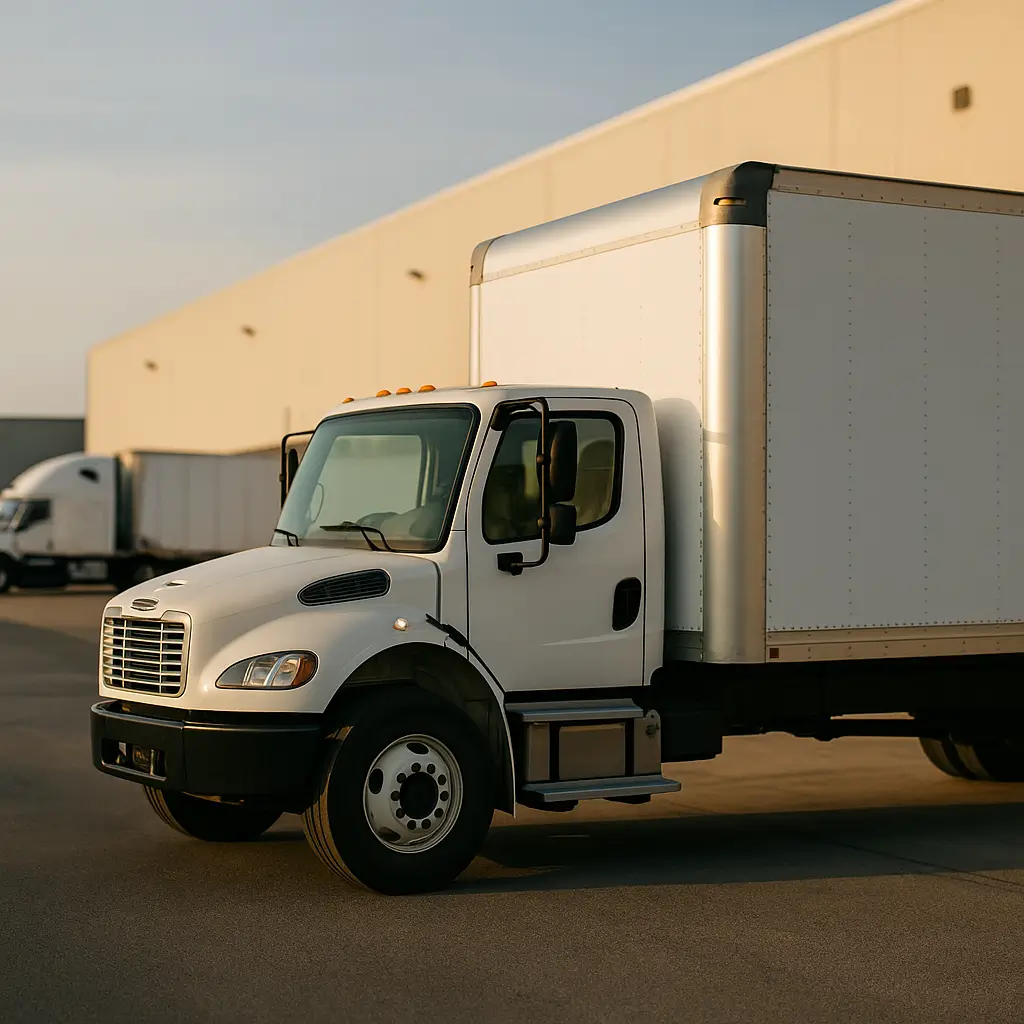
A “box truck” is typically a straight truck with an enclosed cargo box, often in the 12–26 foot range, and it’s insured based on risk factors like weight class, cargo, radius, and for-hire status rather than the body style alone.
Common box-truck use cases include local delivery (parcel/retail/appliances), moving/household goods, refrigerated straight trucks, and expediting operations that rack up more miles.
Why insurers and regulators care (it’s not the box—it’s the risk)
Underwriters price and restrict coverage based on things that directly change claim frequency and severity.
- GVWR thresholds: Weight class can affect regulations and underwriting appetite.
- For-hire vs private carriage: Getting paid to haul changes contractual exposure.
- Interstate vs intrastate: Different minimums, filings, and enforcement.
- Commodity: General freight vs HHG vs hazmat can trigger higher limits and exclusions.
- Radius and annual miles: Local routes price differently than regional/long-haul.
Quick glossary (so paperwork doesn’t slow dispatch)
- CSL: Combined Single Limit (one limit for bodily injury + property damage).
- COI: Certificate of Insurance (what the broker requests).
- FMCSA filings: Proof your insurer submits to FMCSA (separate from a COI).
- Physical damage: Comprehensive + collision for your truck (not liability).
- Motor truck cargo: Covers freight you’re responsible for (not “liability”).
Interstate vs. Intrastate: Which Rules Apply to You?
Interstate vs intrastate status can determine whether you must meet FMCSA financial responsibility requirements (often starting at $750,000 for non-haz property carriers) or only your state intrastate minimums, which can be lower than what brokers require.
This is where new owner-operators get burned: you can be “legal” under a state rule and still be unbookable because your broker packet says $1M and your COI doesn’t.
1) Interstate (FMCSA) — when federal rules apply
You’re generally in interstate territory if you cross state lines, or if your freight is part of interstate commerce even when your lane stays in one state. If you’re for-hire and operating under your own authority, you’ll typically need FMCSA-compliant liability and active FMCSA filings.
2) Intrastate — when state rules apply
If you operate only within one state and the freight is not part of interstate commerce, your state DOT/PUC rules control minimum liability. State minimums can be lower than broker minimums, so contract planning matters as much as legal compliance.
Federal (FMCSA) Box Truck Insurance Requirements for Interstate Operations
FMCSA financial responsibility minimums for for-hire interstate motor carriers are commonly cited as $750,000 for non-hazardous property, $1,000,000 for oil, and up to $5,000,000 for certain hazardous materials under 49 CFR Part 387 (FMCSA financial responsibility).
Owner-operators can also review the full overview of FMCSA insurance requirements for owner-operators for a more detailed compliance picture.
If you’re interstate for-hire, the non-negotiable foundation is auto liability, and the business reality is that many brokers treat $1,000,000 CSL as the true entry ticket even when the federal baseline is lower.
1) Minimum auto liability limits (federal baseline)
For a deeper breakdown of how these thresholds apply to your setup, see LogRock’s guide to box truck liability insurance requirements.
Auto liability pays for injury and property damage you cause to others; it does not pay for your truck or your freight. From an operations standpoint, liability is what keeps your authority active and your contracts intact.
- What it protects: Third-party bodily injury and property damage.
- What it doesn’t: Your own truck (physical damage) or your cargo (cargo policy).
- Real-world gatekeeper: Many broker packets require $1,000,000 CSL.
2) Cargo insurance: required vs expected
Motor truck cargo insurance pays for covered loss or damage to freight you’re responsible for, and brokers commonly require $100,000+ cargo limits even when federal rules don’t mandate cargo insurance for every general freight move.
Buy cargo based on your maximum load value and your lane realities, not just the cheapest line item. Common claim fights involve unattended theft, temperature variance for reefer loads, improper securement, and excluded commodities.
3) MCS-90 (and why it’s not “extra coverage”)
The MCS-90 endorsement is a federal endorsement connected to public liability financial responsibility and can function as a compliance backstop that may require payment to the public in specific circumstances even when coverage is disputed.
The operational mistake is treating MCS-90 like a blanket upgrade; it’s a regulatory mechanism, and misunderstanding it can lead to gaps you only discover after a serious crash.
Proof of Insurance & Filings (2026): MCS-90, BMC-91X, COIs, and What Actually Gets Filed
For interstate authority, insurers typically submit FMCSA proof-of-insurance filings electronically (commonly referenced as BMC-91 or BMC-91X for liability), while brokers rely on a COI, and confusing these documents is a top cause of dispatch delays and compliance surprises.
Most “we got shut down” stories aren’t about having zero insurance—they’re about the proof being wrong: wrong name, wrong DOT/MC, wrong wording, or filings not showing active when the broker checks.
1) Endorsements vs filings vs COIs (quick distinction)
- Endorsement: A policy modification (example: MCS-90).
- Filing: Proof your insurer files with a regulator (FMCSA for interstate authority).
- COI: A certificate you give a broker/shipper; it’s not the policy and it doesn’t replace filings.
2) Common FMCSA forms you’ll hear about (high level)
For a step-by-step walkthrough, see LogRock’s guide to the BMC-91X filing for small trucking companies.
- BMC-91 / BMC-91X: Commonly referenced for auto liability filing proof for motor carriers.
- BMC-34: Commonly referenced for cargo filing proof in certain regulated contexts.
3) Step-by-step: getting compliant proof for a broker without losing dispatch time
- Get the broker’s insurance requirements page (limits + required forms/wording).
- Confirm special wording (if required): additional insured, waiver of subrogation, primary & non-contributory.
- Request a COI issued exactly to the broker/shipper’s legal name.
- Verify the COI shows correct entity name, effective dates, and limits.
- Confirm filings are active before accepting the first load under your authority.
If you’re not sure what goes in a carrier packet or why brokers care so much about it, this video covers the essentials:
Practical tip: Keep a ready-to-send broker packet folder (COI, W-9, authority letter, voided check, safety/contact sheet). When dispatch calls, you can respond in minutes—not hours.
Required vs Optional Coverages for Box Trucks (What You’ll Actually Be Asked to Carry)
Most brokered box-truck operations are functionally built around a contract bundle of $1,000,000 CSL auto liability, $100,000 cargo, and often $1,000,000 general liability, while physical damage and injury coverage decisions depend on financing and your ability to self-insure.
Think of this section as a “what dispatch and your balance sheet care about” checklist.
Coverage Matrix (practical view)
| Coverage | What It Covers | Who Usually Requires It | Typical Limits You’ll See |
|---|---|---|---|
| Auto liability | Injury/damage you cause | FMCSA/state law, brokers | $750k / $1M / $2M (with umbrella) |
| Cargo | Damage/theft to freight | Brokers/shippers; some niches | $50k / $100k / $250k+ |
| Physical damage | Your truck (comp + collision) | Lender/lease; your balance sheet | Deductibles often $1k–$5k |
| General liability | Non-auto claims (premises/dock incidents) | Many contracts | Often $1M per occurrence |
| Hired & non-owned auto | Rented/borrowed autos used for business | Some contracts | Varies |
| Workers’ comp / Occ-Acc | Injury benefits | Some customers; state rules | Varies by state and setup |
| Uninsured motorist | Hit by uninsured driver | Optional; smart in some states | Often matches liability |
Before we walk through each coverage, this quick breakdown explains a distinction that trips up a lot of box truck operators:
1) Auto Liability (required)
Auto liability is the core commercial truck coverage for third-party injury and property damage. Even as a one-truck operation, one serious accident can trigger medical bills, litigation, and limits exhaustion—so it’s both a compliance item and a survival item.
2) Cargo Insurance (often contract-required)
For guidance on choosing the right amount, see LogRock’s breakdown of box truck cargo insurance limits.
Cargo covers covered loss/damage to freight while it’s in your care, custody, and control. If you haul brokered freight, assume cargo requirements will show up in onboarding, and match your cargo limit to your highest realistic load value.
3) Physical Damage (optional by law, mandatory by reality)
Physical damage (comp + collision) protects your truck. If you’re financed, it’s usually required by the lender; if you’re paid off, the real question is whether you can replace the truck immediately without wiping out the business.
4) General Liability + contract add-ons
For a full explainer on what’s covered and what to expect in contracts, see general liability for trucking businesses.

General liability covers many non-auto incidents (like dock/premises issues) that show up in delivery agreements. It’s also where contract wording can matter, especially when a customer asks for additional insured or waiver of subrogation language.
5) Workers’ comp vs occupational accident (owner-operators)
Workers’ comp is statutory employee coverage, while occupational accident is commonly used for independent contractor setups. Requirements depend heavily on state rules and customer contracts, and the business risk is simple: if you’re injured and can’t drive, revenue stops.
State-Specific Box Truck Liability Minimums: How to Find Yours + Example Table
Intrastate box truck liability minimums are set by state law and state regulations directory and can vary by GVWR tier, for-hire vs private status, and commodity, and many states allow limits below the $1,000,000 CSL that brokers commonly require.
State rules are messy because they change with weight class and carrier type, and household goods movers and hazmat can trigger separate requirements.
Example table (starter set — verify before relying)
This table is a planning framework, not legal advice. Always confirm with your state DOT/PUC and your written contracts.
| State | Common “Trigger” Notes | Practical Planning Baseline (If You Haul for Brokers) |
|---|---|---|
| California | Rules can vary by operation and weight; commercial enforcement is often strict | Budget for $1M CSL |
| Texas | Intrastate rules vary by carrier type and commodity | Budget for $1M CSL |
| Florida | Weight/commodity can change requirements | Budget for $1M CSL |
| New York | Commercial requirements can be strict depending on operation | Budget for $1M CSL |
| Georgia | Intrastate for-hire rules can differ by setup | Budget for $1M CSL |
If you can’t find your state rule in 5 minutes, do this
- Search: “[State] intrastate for-hire motor carrier insurance minimum”.
- Call the state agency line and ask what applies to your for-hire vs private status, GVWR, and commodity.
- Ask your agent for a written compliance summary (limits + filings + assumptions).
Operator reality: If you’re chasing broker freight, plan like a business—assume $1,000,000 is the working minimum even if the state says you can run lower.
How Much Does Box Truck Insurance Cost in 2026? (Realistic Ranges + What Drives Price)
Box truck insurance cost in 2026 for many owner-operators often falls around $700–$1,800/month for $1M liability only and roughly $1,200–$3,000+/month for a bundle like $1M liability + $100k cargo + physical damage, depending on state, losses, cargo, radius, and new-venture status.
For a more detailed breakdown with monthly and annual benchmarks, see LogRock’s guide to the average cost of box truck insurance.
No blog can price your account precisely, but you can budget intelligently and avoid apples-to-oranges comparisons by matching quotes on limits, deductibles, cargo terms, and driver info.
Budget ranges (use for planning, not as a quote)
- Liability only ($1M CSL), local/regional: often $700–$1,800/month
- Liability + cargo ($100k) + physical damage: often $1,200–$3,000+/month
- New venture / new authority / high-risk area or commodity: can push higher fast
The fastest premium drivers (what underwriters price hard)
- New venture or no prior commercial insurance
- Lapses in coverage
- High-theft ZIP codes and tough litigation venues
- High-value cargo and higher limits
- Long radius and high annual miles
- Multiple drivers and MVR issues
Before you request a quote, it helps to understand what limits you actually need — not just what you can get away with:
Pro tip: The cheapest premium isn’t a win if it causes dispatch delays (COI wording issues) or leaves a cargo gap you only discover after a backcharge.
Typical Broker/Client Insurance Requirements for Box Trucks (What Contracts Commonly Demand)
Typical broker insurance requirements for box trucks commonly include $1,000,000 CSL auto liability, $100,000 cargo, and often $1,000,000 general liability, with some customers requiring an umbrella to reach $2,000,000+ total limits.
Legal minimums keep you out of trouble with regulators; contract minimums are what get you tendered loads and paid.
The most common contract asks (even if the law allows less)
- Auto liability: $1,000,000 CSL
- Cargo: $100,000 (higher for certain commodities)
- General liability: $1,000,000 per occurrence
- Umbrella/excess: sometimes required to reach $2,000,000+
Contract wording that causes last-minute load failures
- Additional insured (and on which coverage?)
- Waiver of subrogation
- Primary & non-contributory
- Notice of cancellation language (commonly requested)
Business move: Before you sign, ask how quickly updated COIs can be issued if you change carriers or add a customer mid-term. Speed matters when you’re trying to keep the week profitable.
Why Logrock: Practical Insurance Built for Owner-Operators
Most owner-operators get judged by the same contract numbers—like $1,000,000 CSL liability and $100,000 cargo—and they also get judged by paperwork speed, because a COI mismatch can cost a load the same day.
Logrock is built around the way small carriers actually operate: tight timelines, broker packets that change by customer, and no room for coverage surprises.
See how LogRock structures commercial truck insurance for owner-operators — coverages, costs, and what to expect at onboarding.
- Bookable limits: Structure coverage to meet common broker minimums.
- Compliance-first setup: Align filings/proof with your operating authority and operation type.
- Practical guidance: Keep you from overbuying coverage that doesn’t match your lanes and freight.
Frequently Asked Questions
Federal (FMCSA) insurance requirements generally apply to interstate, for-hire box truck operations and center on public liability financial responsibility under 49 CFR Part 387.
For many non-hazardous property carriers, the commonly cited baseline is $750,000 auto liability, while oil is commonly cited at $1,000,000 and certain hazmat classes can require up to $5,000,000. In day-to-day operations, many brokers still require $1,000,000 CSL liability to onboard a carrier, even when the federal minimum is lower.
State-specific (intrastate) liability minimums for box trucks vary by state law and commonly change based on GVWR/weight class, for-hire vs private operation, and commodity (especially hazmat and household goods).
Because intrastate minimums can be lower than typical contract requirements, many carriers plan around a practical baseline of $1,000,000 CSL to stay bookable with brokers and customers. The fastest way to confirm your requirement is to check your state DOT/PUC intrastate for-hire rules and then compare them to the written insurance section of the broker/shipper contract you’re signing.
Cargo insurance is often contract-required for box truck operators hauling brokered freight, and a common requirement is $100,000 in motor truck cargo coverage even when it isn’t federally mandated for every general freight scenario.
From a business perspective, cargo is “required” any time you can’t afford to pay for a loss out of pocket or you’re signing agreements that allow backcharges. Set your cargo limit using your maximum load value (not the cheapest minimum), and review cargo terms for exclusions that frequently impact box trucks, such as unattended theft, temperature variance (reefer), or excluded commodities.
Interstate for-hire box truck operators commonly deal with the MCS-90 endorsement (linked to federal financial responsibility) and FMCSA proof-of-insurance filings for liability that are often referenced as BMC-91 or BMC-91X.
Operationally, the key requirement is that your insurer’s filings show as active for your DOT/MC before you accept loads under your authority, and that your COI matches the broker’s legal name, dates, and required wording (additional insured, waiver, primary & non-contributory) when requested. A correct policy with incorrect proof can still stop dispatch.
Yes — in most cases, you need an active insurance policy and the corresponding FMCSA filing before FMCSA will activate your operating authority. Your insurer submits proof of financial responsibility electronically; once it shows as active in FMCSA’s system, authority can be granted. Don’t wait until approval to start shopping: timing matters, and starting early makes the launch smoother.
Auto liability covers bodily injury and property damage you cause while operating your truck — it is the core commercial trucking coverage and what FMCSA and brokers require. General liability covers non-auto incidents, such as injury or property damage during loading, unloading, or on a customer’s premises. Many delivery agreements ask for both, and they are typically written as separate policies.
Yes, but your options and pricing will reflect new-venture risk. New authority operators have no loss history for underwriters to review, so expect higher premiums in the first one to two years, fewer willing markets, and sometimes stricter payment terms. A clean MVR, a clear business setup, and an agent experienced with new-authority accounts can improve your starting position.
If a covered loss occurs and your cargo limit is lower than the load value, you may be responsible for the difference out of pocket, and the broker or shipper can backcharge you. Set the limit based on your highest realistic single-load value, not the cheapest line item, and review excluded commodities before accepting specialty freight.
Physical damage is not legally required once a truck is paid off, but the real question is whether you can absorb the loss of the vehicle without wiping out your operation. If you have cash reserves to replace the truck immediately, self-insuring can be a defensible decision. If you do not, physical damage coverage is usually worth considering because the truck is the revenue engine of the business.
Conclusion: Get Compliant, Then Get Profitable
For most for-hire operators, “being compliant” in 2026 usually means planning beyond the legal minimum and carrying the limits brokers actually require—often $1,000,000 CSL liability and $100,000+ cargo.
Once the limits are right, the next profit lever is speed and accuracy: filings active, COIs issued correctly, and no surprise exclusions that turn a claim into an out-of-pocket loss.
Key Takeaways:
- Know your lane type: Interstate for-hire triggers FMCSA financial responsibility; intrastate triggers state minimums.
- Plan for contracts: Brokers commonly require $1M CSL and $100k cargo even if the law is lower.
- Proof matters: Filings (BMC-91/BMC-91X), endorsements (MCS-90), and COIs must align—or dispatch gets delayed.
If you want a simple checklist based on your state, GVWR, cargo, and radius, you can price it out and confirm what’s truly required before you sign the next broker packet.