
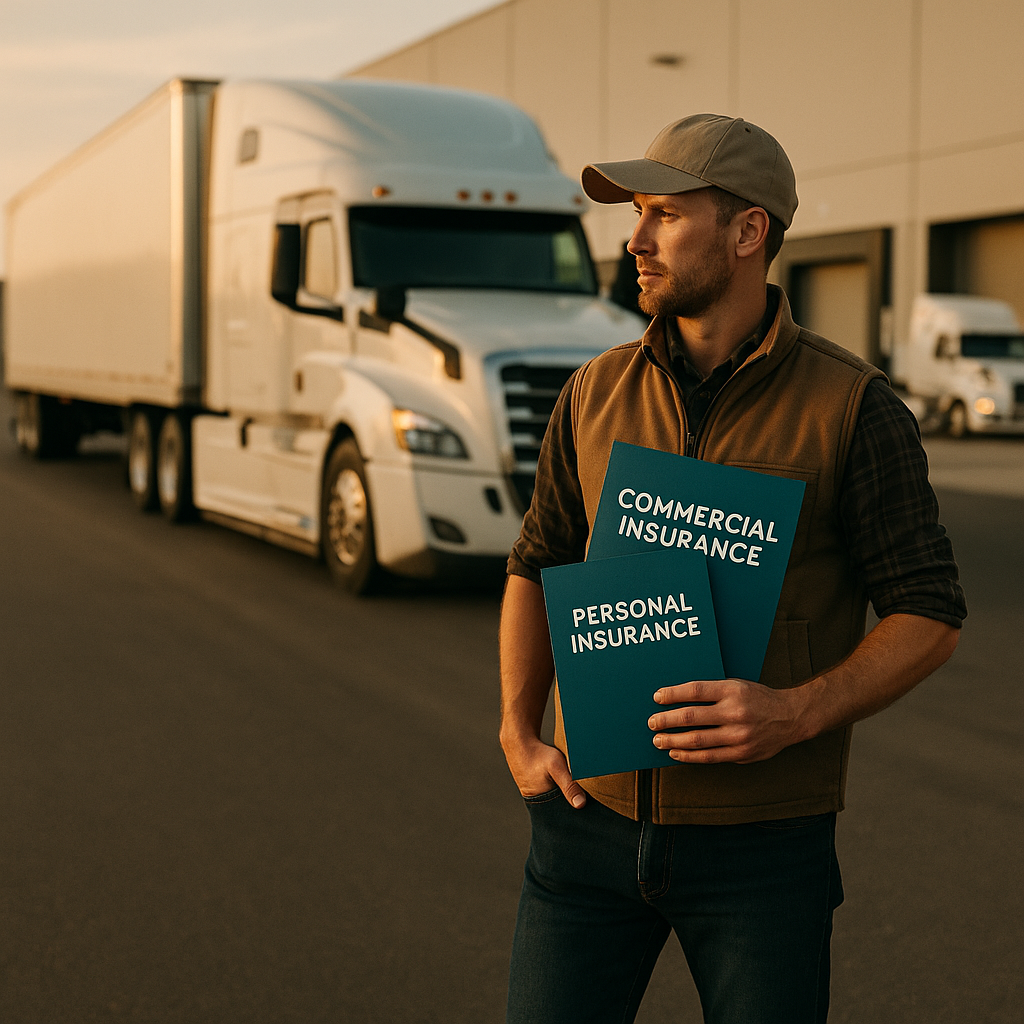

Commercial insurance vs personal insurance: compare coverage, exclusions, costs, and real-world triggers (auto, liability, property). Avoid denied claims—get the right policy. Get a quote.
Commercial insurance vs personal insurance comes down to one thing: whether the policy is built for household life or business operations. Personal insurance is designed for personal use and personal liability, while commercial insurance is designed for business use, contracts, and higher-limit lawsuits—so when an asset is used to earn money, personal policies often restrict or exclude the exact scenario that causes the claim.
You can run your business clean, keep your truck moving, and still get wrecked financially by one bad assumption: “My personal insurance will cover it.” The problem usually shows up at claim time—after the wrecker bill, after the ER visit, and right after the carrier asks the question that decides everything: “Were you using it for business?”
This guide breaks down the real differences, when you actually need commercial coverage, and how to avoid coverage gaps that crush cash flow (especially for owner-operators, hotshots, contractors, and small businesses using personal assets to make money).
Commercial vs Personal Insurance: The Real Differences That Matter
Commercial insurance is written and rated for business operations (often with $1,000,000+ liability requirements), while personal insurance is written for household risk and commonly limits or excludes delivery and for-hire use. If a vehicle, tool, building, or person is tied to earning revenue, you’re already in “commercial” territory—especially for auto.
A common failure point is how the policy defines vehicle use; this is why understanding commercial vs personal auto insurance differences matters before you haul, deliver, or show up at a job site with tools in the bed.
Key takeaways (fast, practical, claim-focused)
- Personal insurance fits personal-life risk. Once an asset is used to earn money, many personal policies narrow coverage.
- Commercial insurance is priced for higher exposure. More miles, more time on the road, heavier vehicles, and higher lawsuit severity change the math.
- Contracts force the issue. If a customer needs a COI or “additional insured,” personal insurance usually can’t meet the paperwork.
- Vehicle use is the #1 denial trigger. “Commuting” isn’t the same as deliveries, job-site travel, or for-hire hauling.
1) Quick side-by-side table (what changes in the real world)
| Category | Personal Insurance | Commercial Insurance |
|---|---|---|
| Who it’s designed for | Individuals/households | Businesses (including sole props/LLCs) |
| Main purpose | Protect personal assets + personal liability | Protect business operations + business liability |
| “Business use” handling | Often limited, excluded, or tightly defined | Designed to cover business use as described/underwritten |
| Typical limits | Often lower (or not structured for contracts) | Higher limits and structured for client/broker requirements |
| Who can be insured | You/household members | Entity + employees/drivers (and sometimes subs, depending) |
| Proof for clients | Rarely supports COI/additional insured | COIs, additional insured, and waiver language are normal |
| Claims complexity | Simpler exposures | More documentation, higher severity potential |
2) The “business use” trigger (the #1 reason personal coverage fails)
Personal auto and homeowners policies are priced for personal frequency and personal intent, and many forms restrict deliveries, for-hire hauling, or regular job-site use. Once your use changes, the risk changes—and the carrier may treat it as outside the policy’s intended purpose.
Common real-world triggers that push you into commercial:
- You use a vehicle to deliver, haul equipment/tools daily, or travel job sites all week.
- You run a hotshot setup (pickup + trailer) hauling for pay.
- You operate a semi under your own authority or leased on.
- You have signage, DOT numbers, or you’re clearly operating for business.
Even when a carrier allows “incidental business use,” that permission often doesn’t include the thing that causes big claims: regular deliveries, for-hire hauling, multiple drivers, or contract-level limits.
3) Contracts and “show me the paperwork” requirements
Many brokers, shippers, and job sites require proof of insurance in the form of a Certificate of Insurance (COI) with specific limits and endorsements before you can work. That’s not a “nice to have”—it’s access to revenue.
If you’ve ever been told “send your COI” or “add us as additional insured,” this guide explains what’s actually being requested and why it matters: proof of insurance / Certificate of Insurance (COI) for trucking.
4) Liability: personal liability isn’t built for business lawsuits
Personal liability is meant for personal-life incidents (like someone getting hurt at your home), while commercial liability is designed for third-party business claims tied to operations, contracts, and completed work. The moment money changes hands, claim scenarios change: job sites, customers, loads, and contract language become part of the loss.
- Personal liability: household exposures (guests, pets, personal negligence).
- Commercial liability: operations, completed operations, and contract-driven requirements (endorsements vary by policy).
If you’re an owner-operator, remember: your auto liability is one bucket, and your business liability may be another bucket depending on your operation and contracts.
5) Property and equipment: homeowners/renters policies have caps and carve-outs
Many personal property policies limit business property coverage (tools, inventory, equipment) or apply stricter conditions when items are used for work. That can matter a lot if you keep tools in a home office, store inventory in a garage, or carry equipment to job sites.
Commercial options are built for business contents, equipment, and (in some cases) income-related losses like business interruption—coverage depends on the form and endorsements.
6) People risk: employees and “helpers” change everything
Adding employees, occasional drivers, or regular helpers increases frequency and severity exposure, and it can change underwriting, eligibility, and required coverages. Even if you pay someone as a 1099, that doesn’t automatically remove insurance responsibility; state rules and classification issues can turn into denied claims and penalties.
7) Cost: is commercial insurance more expensive than personal?
Commercial insurance often costs more because it’s priced for higher-mileage use, higher claim severity, higher liability limits, and business litigation exposure. In trucking and delivery-heavy businesses, those are not small differences.
Here’s the business-owner truth: cheap insurance is only “cheap” until it doesn’t respond. The most expensive policy is the one that doesn’t pay when you need it.
Mini decision test (5 questions)
- Are you paid for the activity (delivery/hauling/service calls)?
- Is the vehicle/equipment used most days for work?
- Do you need a COI for customers/brokers/landlords?
- Would a claim involve a customer, job site, or load?
- Does anyone else drive or work under you?
If you answered “yes” to any of those, commercial coverage is worth quoting before you learn the hard way.

Why Logrock’s Approach Works for Business Owners Who Live on Cash Flow
Commercial insurance pricing is driven by measurable underwriting factors—vehicle use class, operating radius, driver MVR, loss runs, equipment value, and required limits (commonly $1,000,000 CSL for many contracts). If any of those are guessed wrong, you can end up overpaying, under-covered, or stuck fixing paperwork when a broker needs a COI today.
What we focus on is simple and practical:
- Classifying your operation correctly: use, radius, authority status, and equipment.
- Building coverage that matches contracts: COIs, limits, and (when applicable) filings and endorsements.
- Keeping premium tied to real risk: smart deductibles, right-sized limits, and clean documentation.
If you’re starting out, underwriting is typically tighter and pricing is usually higher until you build time in business and loss history. This breakdown is a good reality check: trucking insurance for new authority (new venture costs).
Frequently Asked Questions
These answers cover the most common commercial insurance vs personal insurance questions, including contract-driven COI requirements and trucking minimums like the FMCSA $750,000 federal liability requirement for many interstate for-hire carriers. Always confirm specifics with your agent and the policy form because definitions and endorsements vary by carrier.
Personal insurance is designed for household risk, while commercial insurance is designed for business operations, contracts, and higher-limit liability claims. In practice, commercial policies are written to handle business-use exposures (regular job-site driving, deliveries, employees/drivers) and to satisfy client requirements like COIs and “additional insured” wording. Personal policies can be fine for commuting and errands, but many forms restrict delivery/for-hire use and may not be structured for contract-level limits. The clean way to decide is to look at what triggers claims: business use, third parties (customers/job sites), and contractual obligations.
You need commercial insurance when the activity or asset is tied to earning revenue, involves regular business use, or must meet a contract’s insurance requirements. Common triggers include deliveries, hauling for pay, job-site travel most days, using multiple drivers, or hiring employees/helpers. You also typically need commercial coverage when a broker, shipper, or customer requires a COI, specific limits (often $1,000,000), or endorsements like additional insured. If a claim would involve a customer, a job site, or a load, you’re usually beyond what a personal policy is meant to cover.
Commercial insurance is usually more expensive because it’s rated for higher mileage, higher claim severity, higher liability limits, and business litigation risk. For example, many commercial contracts require $1,000,000 liability limits and COI endorsements, and those requirements alone can raise premium compared to a basic personal auto policy. That said, pricing still depends on driver history, vehicle type, radius, revenue, and loss runs, and some low-exposure businesses can get reasonable commercial rates. The risk-based view is simple: the “savings” from the wrong policy disappear instantly if a claim is denied or a contract is lost due to missing paperwork.
Personal auto insurance may cover limited, occasional business errands, but many personal policies exclude or restrict deliveries and for-hire hauling. Whether it’s covered depends on the carrier’s definition of “business use” and what you disclosed on the application. A quick rule: commuting to one office is different than job-site travel all week, delivering goods, hauling equipment daily, or running loads for pay. If your operation looks like a business (DOT numbers, invoices, load confirmations), treat it like a business and quote commercial. For deeper detail, see commercial vs personal auto insurance differences.
Non-trucking liability (bobtail) generally applies when you’re not under dispatch and not using the truck for business, while commercial truck insurance is designed to cover business operation under dispatch/authority. The confusion happens in the gray area—driving to get repairs, repositioning, or doing anything that could be considered “in the business of trucking.” If you’re leased on, the motor carrier’s liability may apply under dispatch, but your off-dispatch exposure still needs to be defined correctly. Getting this wrong can create gaps during the exact moment you’re most likely to have an accident. Read the plain-English breakdown here: non-trucking liability (bobtail) explained.
Conclusion: Match the Policy to the Risk (Not the Label on the Policy)
“Personal” vs “commercial” is a risk classification, and insurers underwrite it based on how an asset is used and what kind of claims it can generate. If you’re using personal assets to earn business income, make sure the policy is built for how you operate—not how you hope the claim will be handled.
Key Takeaways:
- Business use creates fast coverage gaps when a personal policy restricts deliveries, for-hire hauling, or job-site exposure.
- COIs and contract terms can force commercial coverage even when you’re a one-person operation.
- The right policy is cheaper than a denial because uncovered losses and lost contracts cost more than premium.
If you want to tighten this up quickly, write down your normal week (miles, radius, loads, job sites, helpers/drivers, contract requirements) and quote coverage based on that reality.
Related reading: semi truck insurance basics (physical damage, coverages) and non-trucking liability (bobtail) explained.





