
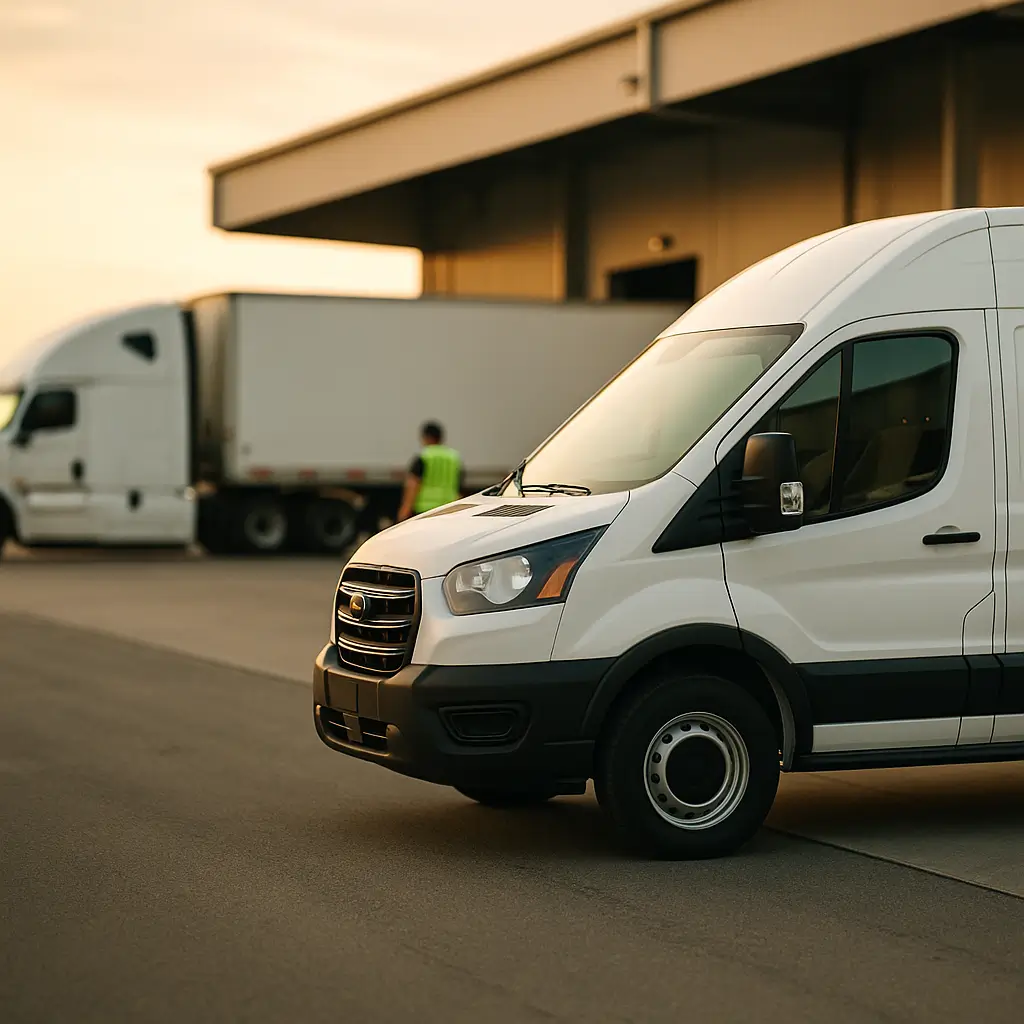
Learn 2026 cargo van insurance requirements, including FMCSA vs. state rules, liability minimums, cargo coverage, required filings, and cost ranges.

Cargo van insurance requirements in 2026 usually start with commercial auto liability, but most operators also need higher limits to stay “load-eligible.” If you haul brokered freight, the practical baseline is often $1,000,000 liability plus $100,000 cargo and a broker-ready COI, while FMCSA insurance filings generally matter only when you operate under interstate for-hire authority.
If you’re comparing “legal minimums” to what brokers actually accept, keep both in view—and cross-check against Logrock’s broader guide on commercial truck insurance requirements for commercial carriers.
Table of Contents
Reading time: 9 minutes
- Quick Answer: Minimum Cargo Van Insurance
- Required Coverage Types for Cargo Van Operations
- Vehicle Weight Matters: Under 10,001 lbs vs Heavier Vans
- Cargo Van Insurance Requirements: Federal vs State Rules
- FMCSA Cargo Van Insurance Requirements: When DOT/MC Authority Applies
- Required Filings & Forms (MCS-90, BMC, BOC-3)
- Cargo Van Insurance Cost (2026 Benchmarks + Real Scenarios)
- How to Lower Your Premium (Without Falling Out of Compliance)
- 2026 Update: Proposed FMCSA Liability Increase
- Why Logrock Operators Stay Covered (and Stay Booked)
- Frequently Asked Questions
- Conclusion: Confirm Requirements, Then Buy Coverage That Keeps You Rolling
Quick Answer: Minimum Cargo Van Insurance Requirements
Minimum cargo van insurance in the U.S. is determined by state financial-responsibility rules for intrastate driving and, when applicable, FMCSA financial-responsibility rules for interstate for-hire operations under 49 CFR Part 387.
At a minimum, most business-use cargo vans need commercial auto liability because personal auto policies commonly exclude “for-hire” or commercial delivery use. If you’re working with brokers and shippers, the practical baseline to avoid rejected onboarding is usually $1,000,000 auto liability and $100,000 cargo (even when that cargo limit isn’t a universal legal requirement).
Skimmer table (legal vs “real world”)
| Your situation | What you typically must have | Common “load-eligible” limits |
|---|---|---|
| Local/intrastate deliveries (no brokers) | Commercial auto liability per state rules | Often $500k–$1M depending on accounts |
| For-hire freight with brokers/shippers | Commercial auto liability + cargo | $1M liability + $100k cargo is common |
| Financed/leased van | Liability + physical damage (comp/collision) | Deductibles set by lender/lessor |
Not sure whether to buy the legal minimum or the load-eligible limit? Here’s how to think through it:
Required Coverage Types for Cargo Van Operations
Cargo van insurance programs are typically built from three core coverages—auto liability, physical damage, and cargo—and each one can be required by a different “boss” (law, broker, or lender).
Think of it like a stack: legal minimums keep you from getting shut down by enforcement, while contract and lender requirements keep you from getting shut down by the market.
1) Commercial auto liability (primary)
Commercial auto liability pays for bodily injury and property damage you cause to others in an at-fault crash while operating for business.
- Why it matters: One serious injury claim can exceed low limits fast, and personal auto policies commonly deny claims for delivery/for-hire use.
- Who needs it: Basically every cargo van used for deliveries, courier work, or for-hire hauling.
- Operational tip: Get the correct use/class (courier, expedited, final-mile, general freight, etc.) because a mismatched class can create claim problems and broker COI rejections.
2) Physical damage (comprehensive + collision)
Physical damage (comprehensive and collision) covers your van for theft, vandalism, weather losses, and crash damage, subject to deductibles.
- Why it matters: Lenders and lessors frequently require it, and downtime after a loss can be a bigger hit than the repair bill.
- Who needs it: Financed/leased vans and owner-operators who can’t replace a van out of pocket.
- Operational tip: Raise deductibles only to a number you can pay immediately—claims don’t wait for “a good week.”
3) Cargo insurance (often required by brokers/shippers)
Cargo insurance pays for covered loss or damage to the customer’s freight you’re transporting, subject to exclusions, conditions, and a deductible.
- Why it matters: Many brokers won’t tender loads until they see cargo coverage on your COI, and $100,000 is a common contract requirement.
- Who needs it: For-hire operators hauling other people’s goods, especially brokered freight.
- Operational tip: Match your policy to your real freight (commodity type, theft conditions, “unattended vehicle” language, and secure parking requirements).
Vehicle Weight Matters: Under 10,001 lbs vs Heavier Vans
Federal compliance triggers for commercial vehicles frequently reference 10,001 lbs GVWR/GCWR as a key threshold, so you should confirm your van’s rating on the door-jamb label before assuming what rules apply.
Many cargo vans are under 10,001 lbs, but certain Sprinter/Transit/ProMaster builds, upfits, or van-and-trailer setups can change how your operation is treated by enforcement, brokers, and underwriters.
Fast decision check
- Check GVWR: Use the door-jamb sticker (don’t guess).
- Define your work: Are you for-hire (paid to haul someone else’s property)?
- Know your lanes: Do you cross state lines (interstate)?
- Know your freight: Do you haul hazmat requiring placards?
GVWR checklist (don’t skip)
- Door sticker GVWR (and GCWR if towing)
- Registration weight class in your state
- Upfit changes (shelves, bulkhead, liftgate) that change usage and underwriting
- Trailer use (some “van + trailer” work starts pricing and compliance conversations that look more like hotshot)
Cargo Van Insurance Requirements: Federal vs State Rules
State insurance rules govern intrastate commercial driving, while federal FMCSA rules apply to certain interstate commercial operations and can require specific insurance filings when operating authority is involved.
Here are three truths that show up in real dispatch life:
- You can be “legal” and still not get freight: A broker can require higher limits than your state minimum.
- Having a policy isn’t the same as being compliant: If your operation requires authority filings, missing filings can shut you down.
- Rate confirmations can override your assumptions: Contracts often specify minimum limits and cargo requirements.
State nuance (examples to verify before you bind)
| Example state | What to watch for | What to verify |
|---|---|---|
| California | Strict enforcement and commercial classifications in some lanes | CA DMV/CPUC rules that match your operation type |
| Texas | Long distances and rating factors that swing by garaging ZIP and radius | Texas commercial auto requirements + customer contract limits |
| Washington | Intrastate routes that quickly turn into interstate runs | What triggers interstate compliance for your lanes and customers |
Bottom line: Don’t memorize a number from a random post. Confirm requirements with the right state agency and the brokers/shippers you plan to work with.
FMCSA Cargo Van Insurance Requirements: When You Need DOT/MC Authority
FMCSA financial responsibility minimums for for-hire interstate property carriers are set in 49 CFR §387.9 and are commonly cited as $750,000 minimum liability for general freight (with higher minimums for certain commodities and placarded hazmat).
This is where cargo-van operators get tripped up: FMCSA “requirements” don’t apply the same way to every van, but brokers and shipper networks may still require an authority-style insurance package to onboard you.
When FMCSA rules and filings tend to matter
- Interstate: You cross state lines.
- For-hire: You’re paid to haul someone else’s property.
- Operating authority: You’re operating under an MC number / authority category that requires proof of insurance and filings.
- Higher-risk triggers: Hazmat requiring placards or specific regulated operations.
Practical broker baseline (not a universal law): Many brokers start onboarding conversations at $1,000,000 auto liability and $100,000 cargo, because it reduces their risk and simplifies their compliance checklists.
Required Filings & Forms (MCS-90, BMC Forms, BOC-3): What Van Operators Miss
For carriers operating under FMCSA authority, compliance can require both insurance coverage and the correct filings—most commonly BMC-91/BMC-91X for liability and (when applicable) BMC-34 for cargo—submitted to FMCSA by the insurer.
A lot of new operators think they’re “good” because they paid the down payment. If your operation requires filings, the paperwork is part of being active.
1) COI (Certificate of Insurance)
A COI is the broker/shipper-facing proof of your limits and coverages, and it has to match your legal entity and operations.
- Common failure: Wrong entity name (LLC vs DBA), wrong address, wrong limit, missing cargo line item.
- Real cost: Lost dispatch day, rejected onboarding, and a damaged relationship with the broker.
2) MCS-90 (endorsement)
An MCS-90 is an endorsement used to meet federal financial responsibility requirements for certain regulated motor carriers and is not something you should assume is included “because it’s commercial.”
- Common failure: Buying a policy that isn’t structured for the operation that actually needs the endorsement.
- Fix: Tell your agent your authority status, lanes (interstate/intrastate), and commodities up front.
3) BMC filings (liability and cargo)
BMC-91X is the common FMCSA filing for liability, and BMC-34 is used for cargo when cargo filing is required for the authority type.
- Common failure: Coverage is purchased, but the insurer hasn’t filed (or filed incorrectly), so your authority can’t stay active.
- Key point: The insurer files; you should verify FMCSA shows the filing as accepted.
4) BOC-3 (process agent)
A BOC-3 designates process agents for legal service across states and is a standard step in authority setups.
If you’re working through authority filings for the first time, here’s a step-by-step walkthrough on completing your BOC-3:
Before you bind coverage (save this checklist)
- Entity match: Your legal name matches FMCSA/state records exactly.
- Garaging address: Correct ZIP and physical garaging (underwriting and price are sensitive here).
- Authority clarity: You know whether you need authority + filings (not just “commercial auto”).
- COI readiness: Limits and cargo match the brokers you want to work with.
- No lapse: Avoid coverage gaps—lapses often raise premiums and reduce market options.
Cargo Van Insurance Cost (2026 Benchmarks + Real Scenarios)
Typical cargo van insurance cost in 2026 often falls around $1,200–$3,500 per year for liability-only and $2,500–$7,500+ per year for a full package (liability + physical damage + cargo), with garaging ZIP and operation type driving most price differences.

For a deeper look at what drives pricing in your state, see Logrock’s full cargo van insurance cost breakdown.
Those are benchmarks, not a quote, and two “identical” vans can price completely differently based on radius, experience, cargo type, new-venture status, and whether filings are needed. For a deeper breakdown and quoting context, see Logrock’s cargo van insurance cost guide.
Scenario table (what you’ll actually see)
| Scenario | Typical coverages | What usually drives cost up |
|---|---|---|
| Local courier, small radius | Liability, maybe physical damage | Metro garaging ZIP, lots of stops/day, new-venture status |
| Interstate expedited freight | Liability + cargo | Higher limits, cargo class/value, broker onboarding, filings |
| Financed van + higher limits | Liability + physical damage + cargo | New venture + comp/collision + lower deductible requirements |
For a visual breakdown of what cargo van startup and insurance costs look like in practice, watch our complete walkthrough:
Cost-control levers that don’t kill your business
- Tighten radius: Less exposure usually underwrites better.
- Adjust deductibles: Higher deductibles can lower premium (if you can truly afford the out-of-pocket hit).
- Stay continuous: Avoid lapses that spike pricing.
- Protect the MVR: Tickets and at-fault accidents follow you into renewals.
How to Lower Your Premium (Without Falling Out of Compliance)
The safest way to lower cargo van insurance premium is to reduce underwriting red flags—like lapses, unclear operations, and mismatched classifications—without dropping limits your customers require.
Here are the moves that keep you eligible and profitable:
1) Don’t underinsure the limits your customers require
If the broker requires $1M/$100k and you buy less, you’re not saving money—you’re buying a policy that can’t book loads.
2) Use deductibles strategically
- Yes: Raise deductibles to lower premium when you have cash reserves.
- No: Set deductibles so high you can’t get back on the road after a claim.
3) Clean operations help underwriting
- Consistent lanes and radius (don’t tell underwriting “local” and then run multi-state)
- Documented procedures: photos at pickup/delivery reduce disputes
- Theft plan: secure parking and compliance with unattended-vehicle conditions
4) Keep compliance basics tight
Even van operators get evaluated like carriers when working for-hire, and sloppy paperwork (late renewals, entity mismatches, missing filings) shows up as “risk.”
2026 Update: Proposed FMCSA Liability Increase (What It Could Mean for Cargo Vans)
Industry proposals have discussed increasing federal minimum liability limits above the long-standing levels in 49 CFR §387.9, but any increase must go through the federal rulemaking process before it becomes enforceable.
If federal minimums rise, the market usually moves before the law does—brokers update contracts, insurers tighten underwriting, and new ventures feel it first.
What could change in the real world
- Premium pressure: Higher required limits generally cost more.
- Contract creep: Brokers/shippers may raise minimums early.
- New venture scrutiny: First-year operators may see fewer options.
Smart move: Build limit flexibility into your pricing so an insurance shift doesn’t break your margin.
Why Logrock Operators Stay Covered (and Stay Booked)
Broker onboarding for cargo vans often fails over fixable issues—like wrong business-use class, missing cargo language, or entity-name mismatches—so a “cheap policy” can become an expensive downtime event.
Logrock focuses on getting your program aligned with how you actually run: lanes, radius, commodity, authority status, and the COI details brokers look at first.
- Broker-ready limits: Set up for the freight you want to haul.
- Correct classification: Courier vs expedited vs final-mile isn’t just semantics.
- Fewer filing/COI mistakes: Less back-and-forth when you’re trying to get dispatched.
Frequently Asked Questions
In most cases, no. Personal auto policies commonly include exclusions for commercial use, for-hire operations, and business deliveries. If you’re hauling freight for pay — whether for a broker, shipper, or gig platform — and you file a claim while on a run, your personal insurer can deny coverage. The result is out-of-pocket liability, loss of the van, or both. Commercial auto liability written for your actual use class is the policy that responds when you need it.
The minimum insurance requirement for a cargo van is typically commercial auto liability at your state’s required limit for intrastate driving, and federal requirements apply only when your operation triggers FMCSA financial responsibility rules under 49 CFR Part 387. In practice, many brokers won’t onboard a for-hire cargo van unless the COI shows $1,000,000 auto liability and roughly $100,000 cargo, even if that cargo amount isn’t a universal legal mandate. The “right” minimum depends on intrastate vs interstate lanes, for-hire status, commodity, and whether you operate under authority that needs filings.
Cargo van insurance cost per year in 2026 is commonly around $1,200–$3,500 for liability-only and $2,500–$7,500+ for a full package that includes liability, physical damage, and cargo, though pricing varies by insurer and state. The biggest pricing drivers are garaging ZIP, operating radius, driver experience and MVR, claims history, cargo type/value, new-venture status, and whether you need authority-style filings. If you’re trying to stay load-eligible, higher limits like $1M liability and $100k cargo can raise premium but may be required to get consistent brokered loads.
Significantly. Garaging ZIP is one of the biggest pricing variables in commercial auto underwriting because it reflects accident frequency, theft rates, weather exposure, and litigation environment in your area. A van garaged in a dense metro market can cost 30–60% more to insure than the same van garaged in a rural ZIP — even with identical drivers, limits, and cargo. The garaging address on your policy must be accurate (where the van is physically kept overnight, not your mailing address) — misrepresenting this is considered material misrepresentation and can create serious claim problems.
Cargo van insurance requirements are both: states set financial responsibility and commercial auto rules for intrastate operations, while federal FMCSA rules can apply to certain interstate for-hire operations and can require proof of financial responsibility under 49 CFR Part 387. The third layer is contracts—brokers and shippers can require higher limits than either state or federal minimums, and they can refuse to tender freight if your COI doesn’t match their onboarding checklist. That’s why the “minimum” that keeps you legal isn’t always the “minimum” that keeps you booked.
Not always. If you operate entirely within one state (intrastate) and don’t haul certain regulated commodities, you may not need federal MC authority. But if you cross state lines for hire — meaning you’re paid to haul someone else’s property and your van meets the commercial vehicle definition — FMCSA registration and active authority become relevant. The 10,001 lb GVWR threshold matters here: vans under that weight used for intrastate work commonly avoid federal registration requirements, but state-level rules still apply. If you’re unsure, confirm your specific lanes and operation type before assuming you’re exempt.
An MCS-90 is a policy endorsement that certifies minimum financial responsibility to the federal government for regulated motor carriers. It doesn’t expand your coverage — it functions as a backstop that allows accident victims to be paid up to the minimum limit even if a policy defense would otherwise apply. Not every cargo van operator needs one: the endorsement is required for carriers that must maintain federal authority under 49 CFR Part 387. If your operation is intrastate-only or exempt from FMCSA authority, you likely don’t need it — but your agent should confirm based on your authority status, lanes, and commodities, not just your vehicle type.
Cargo vans do not always need cargo insurance by law, but cargo insurance is commonly required by brokers and shippers by contract, and $100,000 is a frequent onboarding minimum for general freight. Cargo coverage also has conditions and exclusions that matter in van work—especially theft language (secure parking, unattended vehicle conditions), commodity restrictions, and how the freight is secured. If you plan to haul brokered freight consistently, assume you’ll need cargo coverage that matches your commodity and operating area, and make sure it appears correctly on your COI before you try to book.
A rejected COI means you won’t get the load until the issue is fixed — and fixes take time. Common rejection reasons include the wrong legal entity name (an LLC vs. DBA mismatch), a garaging address that doesn’t match your policy, limits below the broker’s minimums, or a missing cargo line on the certificate. To avoid this, build your policy with the broker’s checklist in front of you before you bind — not after. Confirm entity name, garaging address, limits, and cargo language all appear correctly on the COI before your first dispatch attempt.
Conclusion: Confirm Requirements, Then Buy Coverage That Keeps You Rolling
Cargo van insurance requirements aren’t one-size-fits-all because compliance depends on where you run, how you run, and what your customers demand. Treat insurance like a revenue tool: the right limits and paperwork prevent shutdowns, rejected COIs, and lost loads.
Key Takeaways:
- Commercial auto liability is the baseline for business-use cargo vans, and personal auto often won’t respond to for-hire delivery claims.
- Cargo coverage is frequently a broker/shipper requirement (a common ask is $100,000 cargo), even when it’s not a universal legal mandate.
- If your operation requires authority and filings, missing or incorrect filings (and sloppy COIs) can shut down dispatch.
If you want to stay profitable, confirm your triggers (intrastate vs interstate, for-hire, GVWR, authority) and buy coverage that matches the loads you’re trying to book.
If you’re trying to get your cargo van coverage aligned with what brokers actually require — right entity, right limits, right cargo language on the COI — Logrock can help you review your operation and find a program that keeps you load-eligible. Talk to our team to ask questions, confirm your compliance triggers, and request a quote built for how you actually run.





