
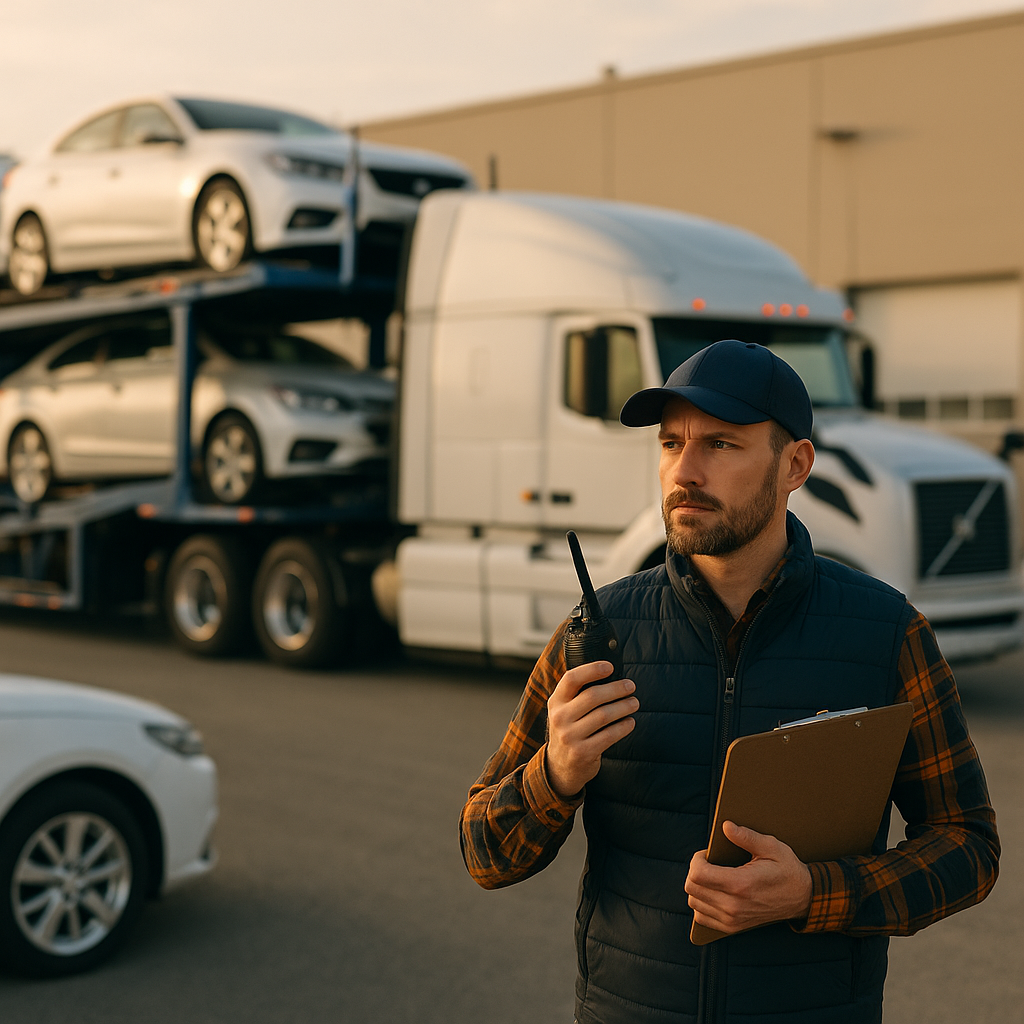

Vehicle transporter insurance (car hauler insurance) explained: FMCSA filings, liability vs cargo, loading/unloading, costs, and how to avoid gaps so your COI matches what brokers, auctions, and shippers actually require.
Vehicle transporter insurance (car hauler insurance) is the mix of commercial auto liability plus cargo-focused coverage that protects you when you’re hauling customer-owned vehicles for pay—especially during high-risk moments like loading/unloading and when one load can exceed $160,000 on an open carrier or $500,000+ on an enclosed trailer.
If you buy “generic” commercial truck insurance and assume it fits auto transport, you can end up with the wrong cargo sublimits, weak theft terms, or loading/unloading gaps that turn a single $90,000 SUV claim into an out-of-pocket hit. This guide lays out what keeps you legal, what gets you loads, and what it realistically costs in 2026.
Table of Contents
This guide is organized into 11 sections and is designed for a ~10 minute read.
- Who Needs Vehicle Transporter Insurance?
- FMCSA Requirements & Insurance Filings (2026)
- What Vehicle Transporter Insurance Covers
- Common Add-Ons Auto Haulers Should Price
- Do You Need “Public Liability” (General Liability) Coverage?
- Vehicle Transporter Insurance Cost (2026 Benchmarks)
- How to Lower Premium Without Creating Gaps
- Exclusions & Claims Scenarios (Covered vs Not)
- Choosing Cargo Limits by Vehicle Value (Simple Scenarios)
- Frequently Asked Questions
- Why Logrock’s Approach (Business-First Insurance)
- Conclusion & Quote Checklist

Who Needs Vehicle Transporter Insurance?
Any U.S. for-hire carrier that transports customer-owned vehicles for compensation—whether you run a 7–9 car open wedge, a 1–2 car enclosed setup, or a hotshot-style 3–4 car rig—needs vehicle transporter insurance that includes commercial auto liability and vehicle-specific cargo protection.
Auto transport isn’t “just another lane” because the loss drivers are different: higher cargo concentration, more handling events, tight delivery sites, and customers who inspect every panel in daylight.
Common operations that need it
- For-hire auto carriers (open or enclosed): auctions, dealerships, OEM moves, consumer shipments, relocations.
- Dealer-to-dealer transfers: frequent loading/unloading events and strict appointment windows increase handling risk.
- Driveaway/towaway and delivery operators: the insurance structure differs because you may drive the vehicle, but the liability exposure is still real.
Owner-operators vs fleets (what changes)
- Owner-operators: you must satisfy (1) legal requirements and (2) contract requirements; being “legal” doesn’t matter if your COI gets rejected.
- Fleets: more units can mean better per-unit pricing, but underwriting scrutinizes safety programs, driver controls, and claims management.
Practical step before you shop: write a one-page “load profile” with your max vehicles per load, average value, highest single vehicle value, open vs enclosed, radius/lanes, and whether you park loaded overnight. Underwriters price your worst-day exposure—not your best week.
FMCSA Requirements & Insurance Filings (2026)
FMCSA financial responsibility rules require interstate for-hire motor carriers to maintain minimum public liability coverage—commonly referenced at $750,000 for non-hazardous property—and insurers typically prove that coverage using filings such as BMC-91 or BMC-91X, depending on how the policy is structured.
Auto transport adds a second reality: legal minimums keep your authority active, but contract minimums (brokers/shippers/auctions) determine whether you get loads.
1) Commercial auto liability: what’s required vs what’s typical
Many brokers and shippers require $1,000,000 CSL even when a lower federal minimum applies, because $1M is the market norm for for-hire trucking.
- Legal requirement: depends on authority type and what you haul.
- Contract requirement: what the rate confirmation, broker packet, or shipper agreement demands.
2) MCS-90 endorsement: what it is (and isn’t)
The MCS-90 is a federal endorsement tied to your auto liability policy intended to protect the public, and it is not motor truck cargo insurance for the vehicles you’re hauling.
3) FMCSA filings: why paperwork matters
FMCSA filings can fail in the real world because of non-pay cancellation, legal entity/DBA mismatches, or limits on file that don’t match what a broker requires—any of which can get you rejected at setup and stall cash flow.
- Lapse risk: one missed payment can trigger a cancellation and filing withdrawal.
- Name mismatch: “John Smith LLC” vs “Smith Auto Transport” can cause onboarding headaches.
- Limit mismatch: your filing may show a limit that’s below the broker’s COI requirement.
4) The $75,000 bond: broker vs carrier confusion
The $75,000 bond/trust requirement is generally associated with brokers/forwarders (arranging transportation), not carriers that physically haul vehicles.
If you operate as both a broker and a carrier, you may need both broker compliance and carrier insurance/filings.
Vehicle transporter compliance snapshot (US, 2026)
| Business role | What you do | Typical “legal” requirement | Common contract requirement (real world) |
|---|---|---|---|
| Carrier (auto hauler) | You physically transport the vehicles | Auto liability + FMCSA filing | $1M CSL often expected + cargo limit that matches vehicle values |
| Broker/forwarder | You arrange transport, don’t haul | Broker bond/trust requirement | COI from carriers + contingent cargo (sometimes requested) |
| Carrier + Broker | You arrange and also haul | Both sets apply | Higher scrutiny: filings + cargo + contract language |
What Vehicle Transporter Insurance Covers (Liability vs Cargo vs “Goods in Transit”)
Vehicle transporter insurance is typically built from separate coverages—commercial auto liability, motor truck cargo, and physical damage—because one policy rarely addresses third-party crashes, customer vehicle damage, and your own equipment loss in a single form.
When people say “goods in transit” for auto transport, they usually mean cargo coverage for customer vehicles while those vehicles are in your care, custody, and control.
1) Auto liability (damage you cause to others)
What it does: pays third-party bodily injury and property damage if you cause a crash.
Reality check: liability protects others; it does not automatically pay for damage to the vehicles you’re hauling.
2) Motor truck cargo (customers’ vehicles)
What it does: covers damage to the vehicles you’re transporting, subject to limits, deductibles, exclusions, and how “care, custody, and control” is written.
- Per-load (aggregate) limit: the total payout cap per loss event.
- Per-vehicle sublimit: the sleeper issue—one $90,000 unit can exceed a $50,000 sublimit even if your policy says “$200,000 cargo.”
- High-value disclosure: exotics and luxury units typically must be declared and underwritten correctly.
3) Loading and unloading: where disputes happen
Loading/unloading coverage depends on policy language, and claims involving ramps, winches, and tight staging areas are among the most frequently disputed auto-hauler losses.
- Ramp scrape: low-clearance sports cars and steep approaches.
- Securement failure: strap/chain issues, anchor point failures, tension checks missed.
- Lot damage: door dings or contact damage during staging at dealerships/auctions.
- Weather while parked loaded: hail exposure can trigger coverage questions (cargo vs comp interplay).
Common Add-Ons Auto Haulers Should Price
Most auto transport insurance programs add physical damage, trailer-related coverage, and off-dispatch liability options because auto liability and cargo alone won’t protect your tractor, trailer, or certain non-dispatch movements.
These coverages often decide whether a bad week is a repair bill or a business-ending cash crunch.
1) Physical damage (tractor and trailer)
What it does: comprehensive + collision for your equipment.
What to watch: make sure your trailer value is accurate; undervaluing to save premium can leave you short when you need repairs fast.
2) Trailer interchange (if you pull someone else’s trailer)
What it does: physical damage coverage for a non-owned trailer in your care under an interchange agreement.
Who needs it: carriers swapping trailers or operating under interchange terms.
3) Non-trucking liability / bobtail (owner-operator gap filler)
Non-trucking liability and bobtail coverages can apply when you’re not under dispatch, but the triggers vary by policy wording, so you need to confirm how “under dispatch” and “business use” are defined.
- Common use case: off-duty driving, maintenance runs, repositioning (depending on policy).
- Lease agreements: many leases require it even if you think you “won’t need it.”
Do You Need “Public Liability” (General Liability) Coverage?
In the U.S., “public liability” in contracts often refers to general liability (GL), which typically covers non-auto third-party injuries and property damage arising from your business operations rather than crashes.
GL is usually a contract checkbox for yards, terminals, or customer-facing operations—but it can also protect you from common claims that have nothing to do with your truck moving.
What GL typically covers
- Premises claims: slip-and-fall at your yard/office.
- Operational property damage: damage caused by your operations that isn’t an auto accident.
- Personal/advertising injury: depends on the GL form and endorsements.
What GL typically does not cover
- Auto accidents: that’s commercial auto liability.
- Customer vehicles while hauling: that’s cargo/CCC language.
- Employee injuries: that’s usually workers’ comp (state-specific requirements apply).
Vehicle Transporter Insurance Cost (2026 Benchmarks)
In 2026, vehicle transporter insurance pricing in the U.S. commonly falls in the low four figures per month for a single-truck operation, with enclosed and high-value auto hauling often pricing significantly higher because underwriters rate cargo concentration and handling frequency.
These are planning ranges—not a promise—because state, radius, vehicle values, driver MVR/PSP, claims history, and equipment all move the needle.
Typical monthly ranges (liability + cargo, before optional add-ons)
- Single-truck open carrier (new venture): ~$1,200 to $3,000+ per month
- Single-truck open carrier (experienced, clean loss history): ~$900 to $2,200 per month
- Enclosed / high-value operations: ~$2,500 to $6,000+ per month
- Small fleet (3–10 units): total spend increases, but per-unit pricing can improve with strong safety controls
Top pricing drivers specific to auto transport
- Open vs enclosed: enclosed often means higher vehicle values; open means more weather/road debris exposure.
- Highest single vehicle value + total load value: underwriters care about your worst-day exposure.
- Radius/lanes: dense metro drops and unpredictable lanes tend to price higher.
- Driver quality: one high-risk driver can raise the entire policy.
- Risk controls: securement SOPs, photos, telematics, dash cams, and ELD data can reduce frequency and improve claim defense.
How to Lower Your Premium Without Creating Coverage Gaps
Lowering vehicle transporter insurance premiums usually comes from reducing predictable loss drivers—deductible strategy, lane discipline, and documentation—not from underinsuring your cargo when one enclosed load can exceed $500,000 in value.
If you want “affordable,” the goal is to remove waste while keeping the protections that make a claim payable.
Cost-control moves that usually work
- Raise deductibles strategically: especially cargo, but only if you can float the deductible without missing payroll or payments.
- Stop “surprise” high-value loads: if you occasionally haul $250,000 vehicles, your policy must match—or you need to decline those loads.
- Tighten lanes and radius: predictable regional work is often easier to underwrite than random high-theft metro runs.
- Build a claim-proof pickup/drop routine: timestamped photos, clear BOL condition notes, and a securement checklist.
- Use modern tools: dash cams and telematics help defend claims and reduce fraud exposure.
The “don’t do this” list
- Don’t understate vehicle values to buy cheaper cargo coverage.
- Don’t rely on “shipper’s insurance” as your plan.
- Don’t assume loading/unloading is covered—confirm the wording in writing.
Exclusions & Claims Scenarios (Covered vs Not)
Auto hauling claims are often decided by policy language—especially exclusions and sublimits—so two policies that both say “cargo” can produce very different outcomes for the same ramp scrape or theft loss.
When a claim gets denied, it’s usually because the cause of loss falls into an exclusion, a limitation, or a documentation gap.
Frequent exclusions that surprise vehicle transporters
- Improper securement / failure to follow procedures: some forms deny handling-related losses tied to negligence.
- Wear and tear / mechanical breakdown: not an insurance event.
- Prior damage: if you didn’t document it at pickup, you may be fighting uphill later.
- Unattended theft limitations: parking loaded overnight can trigger restrictions depending on the form.
- Cosmetic damage disputes: chips/scratches on open transport can get contentious without photos and BOL notes.
Real-world examples (why paperwork matters)
- Example A: Rock chip on open carrier: customer wants a full repaint; photos + BOL condition notes are your best defense.
- Example B: Ramp scrape during unloading: this is the classic “loading/unloading coverage” fight; wording decides whether it’s payable.
- Example C: Hail while parked loaded: facts matter (where parked, reporting timeline, how the policy treats weather losses).
Field-proven habit: clean, consistent documentation (photos + BOL notes) is one of the cheapest “coverages” you can add to your operation.
Choosing Cargo Limits by Vehicle Value (Simple Scenarios)
Cargo limits for auto transport should be set to your maximum load exposure—often $160,000+ for an 8-car open load or $500,000+ for a 2-car enclosed luxury load—because a single loss event can affect every vehicle on your trailer.
Don’t choose a cargo limit based on the largest broker requirement you’ve seen once; choose it based on the math of your worst day.
Quick cargo limit scenarios (simple math)
| Hauler type | Vehicles per load | Avg value | Highest value | Total exposure | Suggested cargo limit to discuss |
|---|---|---|---|---|---|
| Open carrier (typical retail mix) | 8 | $20,000 | $30,000 | $160,000 | $200,000+ (watch per-vehicle sublimit) |
| Open carrier (mixed w/ 1 high unit) | 7 | $35,000 | $90,000 | $300,000+ | $300,000–$500,000 (confirm sublimits) |
| Enclosed (luxury/exotic) | 2 | $250,000 | $300,000 | $500,000+ | $500,000+ (tight underwriting, higher deductibles) |
What to prepare before you request quotes
Bring a one-page load profile so your quote matches your real exposure and your cargo form isn’t built for a different type of freight.
- Max vehicles per load
- Max total value per load
- Highest single vehicle value
- Open vs enclosed
- Overnight parking while loaded
- Lanes/radius + pickup staging locations (auctions, dealers, ports)
Frequently Asked Questions
Vehicle transporter insurance typically covers (1) commercial auto liability for third-party injury/property damage and (2) motor truck cargo for customer-owned vehicles in your care, custody, and control, with optional physical damage for your tractor/trailer. In practice, coverage depends on your per-load limit, any per-vehicle sublimit, deductibles, theft limitations, and whether the cargo form treats loading/unloading as a covered cause of loss or a restricted handling exposure. For auto hauling, the “fine print” matters because a single claim can involve multiple vehicles on one trailer.
Any for-hire carrier transporting customer-owned vehicles for money needs vehicle transporter insurance because FMCSA compliance requires liability coverage and brokers/shippers typically require cargo limits that match vehicle values. This includes open multi-car carriers, enclosed luxury/exotic haulers, and smaller 1–4 car operations running under authority. Even driveaway-style operations still need properly structured liability because you can cause third-party injury/property damage, and you may need a form of cargo/bailee protection depending on contracts. The key is matching the policy to your load profile, not to generic freight assumptions.
“Goods in transit” for auto transport usually means motor truck cargo coverage, and the right limit is driven by your maximum load value and your highest-value single vehicle. Many contracts start at $100,000+, but an 8-car open load can easily reach $160,000–$300,000+, and a 2-car enclosed luxury load can exceed $500,000. The most common mistake is ignoring per-vehicle sublimits, because a $200,000 per-load limit doesn’t help if the policy caps any one vehicle at $50,000.
Loading and unloading is sometimes covered under cargo insurance, but it depends on the cargo form’s “care, custody, and control” language and any exclusions for handling errors or improper securement. Ramp scrapes, winch damage, and low-speed contact claims are common in auto transport, and those are the exact scenarios where wording differences matter most. Before you assume you’re protected, confirm in writing whether the policy responds to damage that occurs during loading/unloading, what deductibles apply, and whether there are special limitations for high-value vehicles or unattended/overnight situations.
In the U.S., “public liability” commonly refers to general liability (GL), and it is separate from commercial auto liability and cargo coverage. GL can cover non-auto third-party claims like a slip-and-fall at your yard, or certain property damage caused by your operations that isn’t the result of a crash. It typically does not cover auto accidents (commercial auto does) or damage to customer vehicles while hauling (cargo/CCC does). If your contracts require GL or you have a yard, office, or customer traffic, it’s usually worth carrying.
Auto transport carriers generally do not need the $75,000 broker bond/trust unless they are operating as a broker/forwarder that arranges transportation rather than physically hauling it. The $75,000 requirement is commonly tied to broker/forwarder compliance, while carriers must focus on maintaining liability coverage and proper FMCSA filings (often via BMC-91/BMC-91X) to keep authority active. If you both broker loads and haul them under the same business, you may need to satisfy both sets of requirements—bond/trust for brokerage activity and carrier insurance/filings for hauling.
Why Logrock’s Approach (Business-First Insurance)
Auto transport is priced and underwritten differently than many trucking segments because the exposure is driven by high-value cargo concentration, frequent loading/unloading events, and strict COI requirements from brokers, auctions, and shippers.
Insurance shouldn’t be a checkbox—it’s a cash-flow protection tool. A transporter-friendly program is built to do three things well:
- Keep you compliant: filings and limits set up correctly for your authority.
- Keep you contract-ready: COIs that match what the broker packet and rate confirmations demand.
- Keep you claim-ready: cargo limits, sublimits, and wording that align with how damage actually happens in auto hauling.
If you want a lower premium, the best starting point is an underwriter-friendly operation: clear lanes, tight processes, good driver controls, and honest vehicle value disclosure.
Conclusion: Vehicle transporter insurance is about being legal, contract-ready, and claim-ready
Vehicle transporter insurance works when your liability and FMCSA filings keep your authority active, your cargo limits match your load values, and your policy wording supports real-world losses like ramp scrapes, theft exposure, and weather events.
If you set limits based on your worst-day load profile and keep documentation tight, you’ll avoid the most common gaps that turn “cheap insurance” into expensive downtime.
Key Takeaways:
- Liability keeps you operating; cargo keeps you solvent when customer vehicles get damaged.
- Choose cargo limits by max load exposure (and confirm per-vehicle sublimits), not by your average week.
- Loading/unloading wording matters because many auto-hauler claims happen at low speed during handling.
When you’re ready, quote it around your real lanes, equipment, drivers, and max vehicle values so your COI won’t get rejected and your coverage won’t fail on the worst day.





