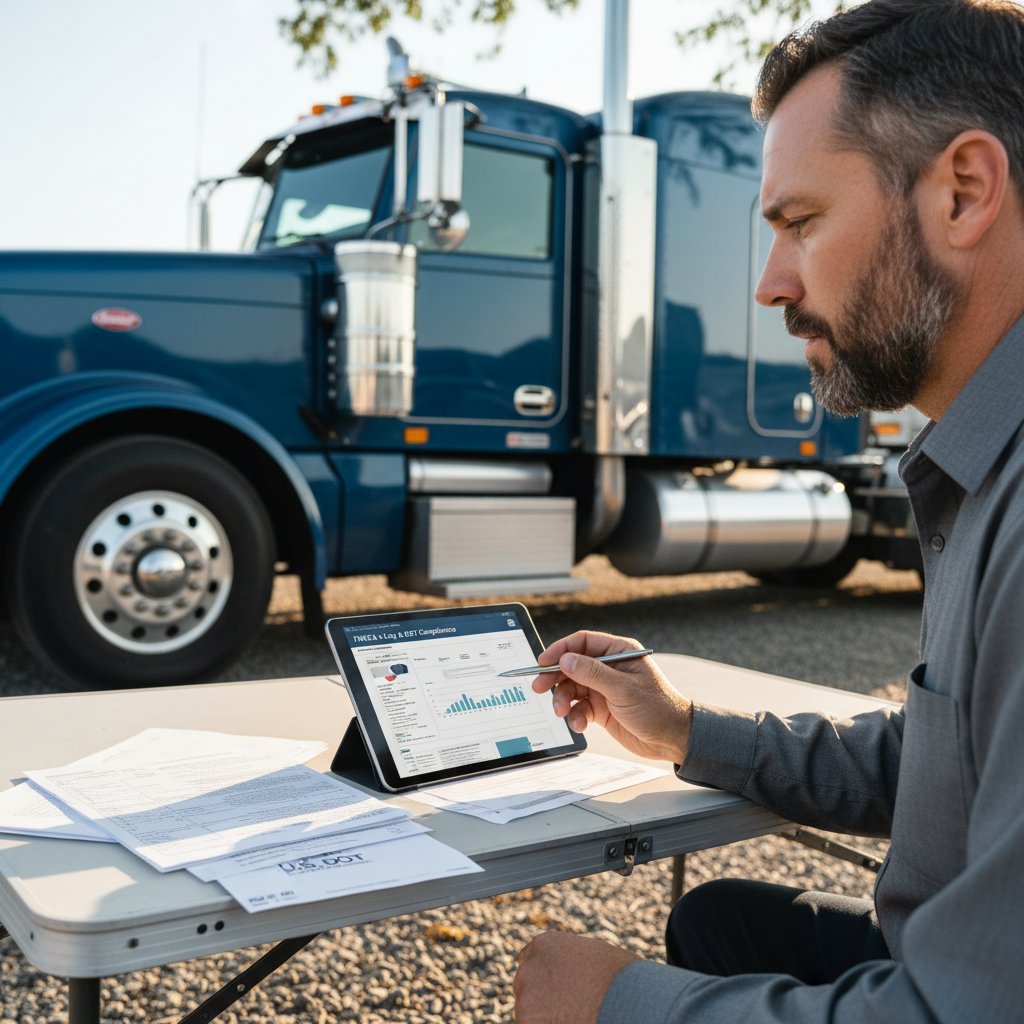
Commercial auto insurance Colorado: learn 25/50/15 minimums, 2026 cost ranges, key add-ons, and a checklist—get quotes today.

Commercial auto insurance Colorado rules start with the state’s 25/50/15 liability minimums, but most real-world businesses end up carrying higher limits (often $1,000,000 CSL) to satisfy contracts and protect cash flow after a serious crash. If you’re running vehicles to jobsites on the Front Range, doing deliveries in Denver traffic, or hauling tools up I-70, a single claim can stack repairs, medical costs, and downtime at the same time.
This guide breaks down Colorado requirements, realistic 2026 cost ranges, and the add-ons that close common gaps. For a quick foundation on how commercial differs from personal, start with commercial auto insurance basics.
Key takeaways:
- Colorado’s minimum liability limits are 25/50/15, but many contracts require $1M CSL to access jobsites and vendor accounts.
- Pricing is driven by garaging ZIP, driver records (MVRs), vehicle class/use, and claims history—not a single “Colorado average.”
- The most common gaps are HNOA (employees’ personal cars/rentals), downtime coverage (rental/towing), and underinsured limits.
- Incorrect details (garaging, drivers, usage) can create coverage disputes when you need the policy most.
Table of Contents
Reading time: 8 minutes
- Do you need commercial auto insurance in Colorado (or will personal auto work)?
- Colorado commercial auto insurance requirements (2026 minimum limits)
- How much does commercial auto insurance cost in Colorado? (2026 benchmarks)
- Coverages to consider beyond Colorado minimums (the stuff that prevents surprises)
- Frequently Asked Questions
- Conclusion: Get compliant—then buy like a business owner
Do you need commercial auto insurance in Colorado (or will personal auto work)?
Commercial auto insurance is designed for business use (work vehicles, multiple drivers, higher miles, and contract-driven proof), while personal auto policies often restrict or exclude business activities like delivery or regular jobsite use.
The risk isn’t just “paying more.” The expensive problem is a denied or restricted claim because the policy form doesn’t match how you actually use the vehicle.
What it is (plain English)
Commercial auto is built around business realities: changing drivers, scheduled routes, jobsite driving, tool/material exposure, and vehicles titled to an LLC or corporation. Personal auto is priced for personal use and may treat business driving as an exception, not the rule.
Why it’s essential (business risk)
One crash can bring a liability “tail” that lasts months: medical bills, attorney involvement, lost wages, and multi-vehicle chain reactions. Low limits can also force you to pay out-of-pocket to keep a contract or customer relationship intact.
Who typically needs it in Colorado
- Vehicles titled to the business (LLC/corp), or primarily used for work
- Businesses with employees driving (even “sometimes”)
- Delivery/service routes with frequent stops (higher claim frequency)
- Contractors hauling tools, ladders, materials, or pulling trailers
- Any business that must provide proof to a GC/vendor via a COI
Pro tip: contracts + COIs
A lot of commercial customers won’t accept a personal auto declarations page. They’ll ask for a Certificate of Insurance (COI) showing limits, dates, and sometimes additional insured language—so it’s worth knowing what matters before you’re on a deadline.
Keep this certificate of insurance (COI) guide handy so you don’t lose a job over paperwork.
Colorado commercial auto insurance requirements (2026 minimum limits)
Colorado requires liability insurance at 25/50/15 minimum limits—$25,000 bodily injury per person, $50,000 per accident, and $15,000 property damage—while many business contracts require $1,000,000 CSL to start work.
Colorado DMV insurance requirements are published here: https://dmv.colorado.gov/insurance.
Colorado minimum limits (25/50/15), translated
| Limit type | Colorado minimum | What it means in real life |
|---|---|---|
| Bodily injury (per person) | $25,000 | One injured person’s medical bills and related damages can exceed $25,000 quickly. |
| Bodily injury (per accident) | $50,000 | Two injured people in one crash can blow past $50,000 fast—especially with imaging, PT, and follow-ups. |
| Property damage | $15,000 | Many newer vehicles (and most work trucks) can exceed $15,000 in damage alone. |
Reality check: State minimums may satisfy registration, but they often don’t satisfy a GC, broker, property manager, or municipal contract. For many trades and service fleets, $1M CSL is the practical baseline.
Proof of insurance, enforcement, and why lapses cost you twice
Colorado expects drivers and businesses to maintain financial responsibility and provide proof when required (for example, during a traffic stop, after an accident, or during registration/verification).
- Pricing impact: Lapses can raise renewal pricing because carriers view inconsistent coverage as higher risk.
- Underwriting friction: Expect more questions, fewer carrier options, and slower turnaround on quotes.
- Operational disruption: Lapses can delay adding vehicles or meeting contract requirements on short notice.
Trucking callout: when federal rules may also apply
FMCSA financial responsibility rules can apply to certain for-hire motor carriers and may require federal filings beyond standard commercial auto, depending on your operation and authority.
FMCSA overview: https://www.fmcsa.dot.gov/registration/insurance-filing-requirements.
If you’re running regulated trucking (owner-operator, for-hire, higher GVW, or authority), start here: trucking insurance in Colorado. This comes up a lot for Semi truck insurance setups and for many hotshot operators.
How much does commercial auto insurance cost in Colorado? (2026 benchmarks + what moves the needle)
Commercial auto insurance cost in Colorado typically ranges from about $150 to $1,200+ per month per vehicle depending on garaging ZIP, vehicle class and use, driver MVRs, limits, deductibles, and prior claims.
No honest advisor should promise one “average” that fits everyone, because two businesses can buy the same limit and still see wildly different pricing based on underwriting details.

Typical 2026 cost ranges (use as a sanity check)
| Business/vehicle profile | Typical monthly range (per vehicle) | Why it prices that way |
|---|---|---|
| Light service pickup/van (low annual miles, clean MVRs) | ~$150–$400 | Lower claim frequency and lower repair exposure. |
| Contractor/service routes (tools, jobsite driving, mixed drivers) | ~$250–$700 | More time in traffic and more claim frequency. |
| Delivery/courier-style use (high stops, high miles) | ~$400–$1,200+ | Stop-and-go loss patterns drive premiums up. |
| Heavier trucks / higher GVW / specialized use | Case-by-case | Underwriting depends heavily on class, radius, and driver experience. |
Important: These are planning ranges, not quotes. Your final price depends on your underwriting file and how accurately the application matches your day-to-day operations.
Regional variation: Denver vs Front Range vs mountains vs rural
- Denver metro (Denver/Aurora/Lakewood): more congestion, higher claim frequency, and higher repair costs.
- Colorado Springs/Pueblo: often moderate, but still traffic-driven.
- Northern CO (Fort Collins/Greeley): mixed commuter and industrial driving patterns.
- Mountain corridors/resort towns: weather, tight roads, tourism traffic, and slower towing/repair logistics.
- Rural plains/Western Slope: fewer crashes, but longer tows and downtime can hit harder.
What affects your rate most (and how to lower it without getting underinsured)
- Garaging ZIP: where the vehicle sleeps at night matters; misstatements can create claim problems.
- Driver quality: MVRs, years licensed, onboarding, and documented standards.
- Vehicle use: delivery frequency, radius, passenger transport, trailer towing.
- Limits and deductibles: raising deductibles can help, but cutting liability too low creates catastrophic downside.
- Loss history: prior claims and loss runs follow the business and shape underwriting appetite.
For a deeper, apples-to-apples breakdown you can use when shopping, see commercial auto insurance cost drivers.
No-BS quoting checklist (copy/paste)
- Vehicles: VINs, model years, ownership (owned/leased/financed), and any trailers.
- Garaging: exact address where each vehicle is kept overnight (not just the office).
- Driver list: every driver, DOB, license, years experience, and who can take vehicles home.
- Use details: service vs delivery, radius, estimated annual miles, and jobsite/off-road exposure.
- Limits: confirm if you need 25/50/15, $1M CSL, or higher due to contracts.
- Loss runs: prior 3–5 years if available (commercial carriers often ask).
- COI needs: certificate holder info + any additional insured or waiver wording in the contract.
Coverages to consider beyond Colorado minimums (the stuff that prevents expensive surprises)
NAIC explains that commercial auto policies commonly include liability and can add physical damage, medical payments, and other options that should match how the business actually operates.
Reference (NAIC consumer overview): https://content.naic.org/consumer/commercial-auto-insurance.
Coverage matrix (what to add and who needs it)
| Coverage | What it protects | Who should strongly consider it | Common choice points |
|---|---|---|---|
| Higher liability limits (often $1M CSL) | Your business if you injure someone or damage property | Anyone with contracts, jobsites, or significant public exposure | CSL vs split limits; umbrella/excess above it |
| Collision + comprehensive (physical damage) | Your vehicle (wreck, hail, theft, glass, animal strike) | Financed/leased vehicles; operations where downtime kills revenue | Deductibles; ACV vs agreed value (where available) |
| UM/UIM (uninsured/underinsured motorist) | Your people/vehicle when the other driver can’t pay | Fleets in heavy traffic corridors; anyone worried about low-limit drivers | Often chosen to align with liability where practical |
| Medical payments | Medical expenses regardless of fault (varies by policy) | Useful as a buffer layer; coordinate with health/work comp | Small limits; coordination matters |
| Towing/labor + rental reimbursement | Keeps you operating when the vehicle is down | Owner-ops and small businesses where one truck down = revenue down | Daily rental cap; tow mileage; service networks |
| Tools/equipment (usually separate) | Tools in the vehicle (often not covered by auto) | Contractors hauling expensive tools daily | Typically inland marine/contractor equipment, not auto |
The #1 small-business gap: Hired & Non-Owned Auto (HNOA)
Hired and non-owned auto coverage addresses liability when employees use their personal vehicles for work errands or when the business rents or borrows vehicles.
If you’re not sure whether you have this gap (or whether it’s sitting on your general liability policy instead), read: hired and non-owned auto insurance (HNOA).
How to lower premiums without cutting coverage
The most reliable way to reduce premiums is to reduce losses: better driver selection, consistent coaching, and fewer preventable claims.
A quality telematics program can help reduce losses and sometimes earns discounts, but it works best when you set a written policy (what’s tracked, how coaching works, and what happens after repeated events).
Quick note for trucking operators (hotshot / semi / commercial truck insurance)
Trucking insurance programs often stack auto liability, physical damage, cargo, and other coverage to meet shipper and broker requirements, which is different than a basic local commercial auto policy.
If that’s your world, related reading: Hotshot insurance and Semi truck insurance.
Frequently Asked Questions
Colorado DMV publishes the state’s minimum auto liability limits as 25/50/15, but business contracts frequently require $1,000,000 CSL for jobsite or vendor access.
Colorado’s minimum liability limits are 25/50/15: $25,000 bodily injury per person, $50,000 per accident, and $15,000 property damage, as listed by the Colorado DMV (https://dmv.colorado.gov/insurance). Those limits may keep you legal for registration, but they’re often not enough for real business risk or contract requirements. Many GCs, property managers, and vendors require $1,000,000 CSL before you can access a jobsite or start work, and they’ll usually want proof via a COI.
Commercial auto insurance in Colorado can cost roughly $150 to $1,200+ per month per vehicle depending on garaging ZIP, vehicle class and use (service vs delivery), driver MVRs, limits, deductibles, and prior claims. Two businesses can buy the same $1M liability limit and still get very different pricing because underwriting is driven by exposure and loss history, not a statewide average. For a fair comparison, shop multiple carriers using identical inputs: the same limits, deductibles, drivers, vehicles, and garaging addresses.
Personal auto insurance may allow limited incidental business use, but many policies restrict or exclude higher-risk business activities like delivery, frequent jobsite driving, multiple drivers, or business-titled vehicles. The biggest risk isn’t the premium—it’s a coverage dispute after a claim if your real-world use doesn’t match the policy form or what was disclosed. If you’re using the vehicle to generate revenue, carrying tools/materials daily, or letting employees drive, a commercial form is typically the safer, clearer option.
The easiest way to lower premiums without cutting coverage is to improve the factors insurers price the most: driver quality (clean MVRs), documented safety processes, and fewer preventable losses, while choosing deductibles you can actually afford. Telematics can also help by reducing risky driving behaviors and sometimes earning discounts; it works best when you have a written policy on what’s tracked and a consistent coaching process. If you want a practical overview of what insurers monitor and how savings work, review this telematics program guide.
Conclusion: Get compliant—then buy like a business owner
Colorado’s 25/50/15 minimums are the legal floor, but many businesses need higher limits (often $1M CSL) to meet contracts and protect themselves from a serious loss. Quote it like a pro: accurate garaging, accurate drivers, accurate usage, and identical limits across carriers.
Key Takeaways:
- Start with compliance (25/50/15), then price out the limit your contracts and risk actually require (often $1M CSL).
- Close common gaps: HNOA, downtime add-ons (rental/towing), and UM/UIM where it fits your exposure.
- Reduce premiums the right way: better drivers, better process, and telematics—before you cut liability limits.
If you’re also operating in trucking lanes (hotshot, higher GVW, for-hire authority), make sure you’re shopping the right category—often a trucking program, not a thin auto-only policy.