
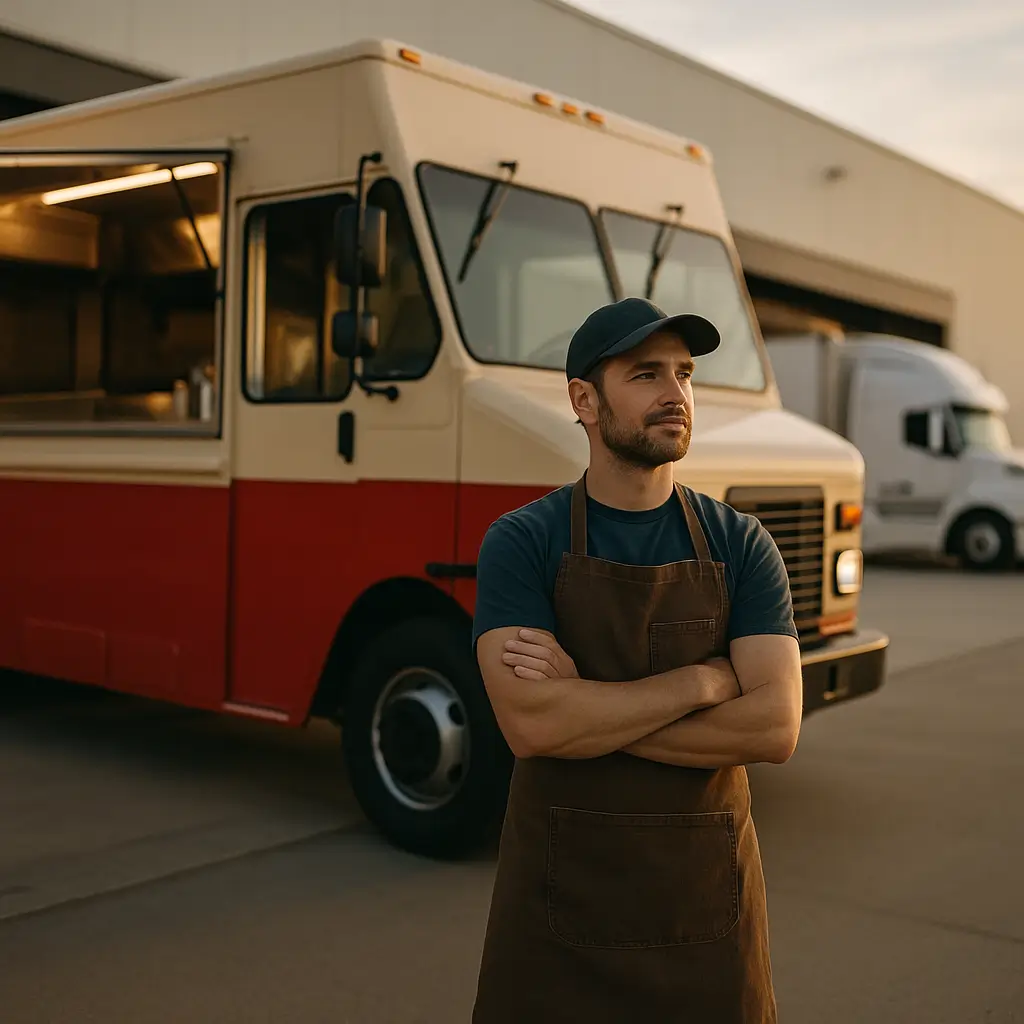

Compare food truck insurance options, 2026 costs, required coverages, COI tips, pricing factors, and quote checklist.
Best food truck insurance in 2026 isn’t one “magic policy”—it’s a stack of coverages (usually commercial auto + general liability + equipment/property) that matches your truck, your events, and your contracts. Most food truck owners pay about $70–$400+ per month, with the low end often being basic liability and the higher end including commercial auto, property/equipment, workers’ comp, and higher limits for festivals.
A single claim can wipe out a profitable weekend: a fender-bender on the way to a festival, a slip-and-fall at the service window, or a generator failure that forces you to dump inventory. If you need the “venue-ready” foundation, start with General liability insurance for food trucks and build from there.
Table of Contents
Reading time: 8 minutes

Food Truck Commercial Truck Insurance Basics: What You’re Actually Buying
Food truck insurance is typically a multi-policy package (commercial auto, general liability, and property/equipment coverage) because no single policy covers driving risk, customer injuries, and your kitchen build-out at the same time.
Food trucks are priced and underwritten a lot like other business-use vehicles, which is why it helps to understand how commercial policies are structured. If you want a quick framework for how insurers “stack” coverage, read Commercial truck insurance basics (how policies are structured).
Why it’s usually a package (not one policy)
You’re combining coverage for three different exposures: (1) driving to/from events, (2) serving the public at a window, and (3) protecting the equipment that produces revenue.
- Driving exposure: crashes, backing incidents, and damage to other vehicles/property.
- Customer exposure: slip-and-falls, alleged food-related injury, and third-party property damage.
- Business property exposure: theft, fire, vandalism, and equipment failure that shuts you down.
What a “coverage gap” looks like in real life
A gap isn’t just paperwork—it’s cash leaving your business account. Common gaps include relying on personal auto for a business-use truck, buying general liability but skipping equipment/property, or missing contract language that gets your COI rejected.
Coverage Checklist: From General Liability to Commercial Auto (Trucking Insurance Must-Haves)
Most food trucks need commercial auto + general liability as the base, then add property/equipment, workers’ comp (if you have staff), and umbrella limits when venues require more than your standard policy provides.
You’ll almost always need Commercial auto insurance (food truck liability + physical damage) because a food truck is a business-use vehicle that drives, parks, and serves in high-traffic areas.
Risk reality check: transportation incidents are consistently a major category in workplace fatality data, which is why commercial vehicle exposure is treated seriously by insurers (see BLS CFOI: https://www.bls.gov/iif/oshcfoi1.htm).
Core policies most food trucks buy
Not sure where auto liability ends and general liability begins? This short breakdown explains the difference.
1) Commercial Auto (liability + physical damage)
Commercial auto liability pays for injury/property damage you cause in an accident, and physical damage (comp/collision) can pay to repair or replace the truck after a covered loss.
If your truck is financed or leased, physical damage coverage is often required by the lender, and your deductible choice can move the premium a lot.
- Verify: listed drivers, garaging address, annual mileage, deductibles, and any food-truck-specific endorsements.
- Operational tip: one bad MVR can increase the premium for the entire operation, so be strict about who drives.
2) General Liability (GL) + Product/Completed Operations
General liability covers third-party bodily injury and property damage (like a slip-and-fall), and product/completed operations is where many food-related allegations land.
Many venues, markets, and corporate clients won’t let you vend until they see GL on a certificate of insurance.
- Verify: product/completed ops is included, and ask about exclusions tied to cooking methods (open flame, fryers) or events.
- Don’t assume: “food poisoning” claims are automatically covered; confirm the coverage form and exclusions.
3) Property / Inland Marine (equipment, build-out, tools)
Inland marine/property coverage can protect your cooking equipment, POS, smallwares, and sometimes the build-out—depending on the policy form and what’s scheduled.
This is the coverage that keeps a “truck is fine but business is down” situation from becoming a multi-week revenue disaster.
- Verify: theft limits, off-premises coverage, and whether items are paid at replacement cost vs actual cash value (ACV).
4) Workers’ Comp (if you have employees)
Workers’ compensation pays for employee injuries and related costs, and the requirement is driven by state law and payroll classification rules. Check your state’s workers’ compensation board for the exact threshold; the U.S. Department of Labor maintains a state workers’ compensation officials directory.
If you have staff (even part-time), don’t ignore this—out-of-pocket medical and wage costs add up fast, and misclassification can backfire at audit or during a claim.
5) Liquor Liability (only if you serve alcohol)
Liquor liability covers alcohol-related liability claims and is commonly required when you serve alcohol at events, even if alcohol is a small part of the menu.
If alcohol is occasional, ask whether it can be added per-event or per-season rather than all year.
Scannable coverage checklist (print this)
| Coverage | What it protects | When you typically need it | What to verify in the quote |
|---|---|---|---|
| Commercial Auto | Accidents + truck damage | Any driving/business use | Driver list, garaging address, physical damage deductibles |
| General Liability | Slip/fall + property damage | Virtually all vendors | Product/completed ops included, event coverage |
| Property/Inland Marine | Equipment + build-out | If equipment value matters | Replacement cost vs ACV, theft limits |
| Workers’ Comp | Employee injuries | If you have staff (state rules) | Correct payroll class codes, estimated payroll accuracy |
| Liquor Liability | Alcohol-related claims | If alcohol is served | Any exclusions, venue-required limits |
| Umbrella/Excess | Higher liability limits | Festivals, big contracts | Which underlying policies it sits over |
Food Truck Insurance Cost in 2026: How to Get Affordable Trucking Insurance Rates
Food truck insurance in 2026 commonly costs $70–$400+ per month depending on limits, vehicle value, drivers, payroll, events/festivals, and whether you add commercial auto, property/equipment, workers’ comp, and umbrella coverage.
The cheapest quote isn’t “best” if the insurer can’t issue COIs quickly, excludes your cooking setup, or leaves you underinsured when a venue contract requires higher limits.
If you want practical levers that reduce premium without creating coverage gaps, use How to lower business insurance premiums (without underinsuring) as your playbook.
Typical 2026 cost ranges (realistic framing)
- General liability: often tens of dollars to a couple hundred per month depending on limits, revenue, and event exposure.
- Commercial auto: commonly one of the biggest line items due to drivers, territory, mileage, and vehicle value.
- Property/equipment: driven by how much equipment/build-out you schedule and whether claims are paid at replacement cost or ACV.
- Workers’ comp: payroll- and state-driven, and sensitive to correct class codes.
- Umbrella: can be cost-effective when venues demand higher limits than base policies provide.
What underwriters price (the inputs that move your premium)
Insurance carriers rate food trucks using concrete underwriting variables such as garaging ZIP, driver MVRs, annual mileage, vehicle customization value, cooking methods, claims history, and payroll.
If you want a true apples-to-apples comparison, keep your quote inputs consistent across carriers.
- Garaging state/ZIP and where you operate (dense downtown vs rural routes)
- Driver experience and MVRs
- Vehicle value, custom build-out, and theft exposure
- Annual mileage and frequency of events/festivals
- Cooking methods (open flame, frying) and suppression systems
- Prior claims (auto and liability)
- Payroll, staff count, and job duties (workers’ comp)
Here’s a plain-English rundown of the variables that move your premium.
Bundling vs standalone (quick math that keeps you honest)
A BOP-style bundle can reduce admin and sometimes premium, but savings aren’t automatic—compare coverage forms, limits, deductibles, and exclusions before you call it “cheaper.” For plain-English definitions of limits, deductibles, and common terms, see the NAIC insurance basics guide.
| Option | What you’re buying | Good for | Watch-outs |
|---|---|---|---|
| Standalone GL + standalone property | Separate policies | Very small ops with minimal equipment | More admin, more chances for gaps between forms |
| BOP (GL + property) + commercial auto | Bundled business package + auto | Many single-truck owners with meaningful equipment value | Eligibility depends on cooking setup, revenue, and underwriting appetite |
Best Food Truck Insurance Providers + COI/Permit Tips (Where Semi Truck Insurance & Hotshot Insurance Rules Overlap)
Food truck insurance shopping should prioritize COI speed, correct additional insured wording, and event-friendly endorsements because many markets and festivals require proof of coverage before you can vend.
If a venue or event contract is asking for higher limits, this walkthrough can help you think through what you actually need.
Before you compare carriers, tighten your paperwork process with Certificate of insurance (COI) checklist and wording so you don’t lose spots over a certificate error.
Permit & event requirements: a simple checklist (not legal advice)
Venue and city requirements often come from contracts and permit rules (limits, additional insured status, primary/noncontributory wording), not just “state law,” so you need a repeatable way to confirm what each event requires.
COI worksheet (copy/paste into your notes app):
| Venue / City | GL limit required | Auto limit required | Additional insured? | COI due date | Special wording requested |
|---|---|---|---|---|---|
| Farmers market | |||||
| Brewery | |||||
| Festival | |||||
| Corporate catering |
COI timing that avoids last-minute panic
- Request COIs 7–10 days before big events so you have time to fix wording.
- Save templates for repeat markets (same certificate holder details every time).
- Confirm: additional insured, event dates, venue address, and any “primary/noncontributory” language.
Edge case: If you cross state lines frequently for catering and you operate more like a motor carrier, you may want to verify whether any federal registration tools apply; SAFER is the FMCSA’s public lookup tool used across trucking (FMCSA SAFER).
7 “best food truck insurance” options (2026) — who each is best for
There isn’t one universal “best” insurer; the best pick is the one that can insure your cooking setup, issue COIs fast, and price your risk fairly at renewal.
| Pick (category) | Best for | Strengths to look for | Watch-outs to check |
|---|---|---|---|
| 1) Digital-first small business insurer | Newer operators who want speed | Fast online quote, easy COIs | Cooking exclusions, event endorsements |
| 2) Specialty vendor program | Markets/festivals focus | Built for vendor requirements | Coverage may be narrower; read forms |
| 3) Major commercial auto carrier | Heavy driving exposure | Strong commercial auto options | GL/property may still be separate |
| 4) Traditional business insurer | Higher equipment value | Strong property + GL packages | Stricter underwriting |
| 5) Carrier with strong umbrella options | High-traffic events | Easier path to higher limits | Underlying limits must match requirements |
| 6) Independent agent access (multiple markets) | “Non-standard” risks | Finds niche/surplus options | Agent quality varies |
| 7) Regional insurer (where available) | Local operations | Sometimes competitive pricing | Limited state availability |
How to compare quotes apples-to-apples (non-negotiable)
- Same GL limits and the same auto limits
- Same deductibles
- Same listed drivers
- Same garaging address
- Confirm exclusions (open flame/fryer, festivals, alcohol)
Real 2026 operator scenarios (mini case studies)
Case A: New truck, weekend markets, no employees
Priority: GL + commercial auto. Add property/equipment if the build-out is expensive. Operational win: build COI templates for recurring markets.
Case B: Festival-heavy schedule + 2 part-time employees
Priority: GL with event-friendly endorsements + workers’ comp. Consider an umbrella if venues demand higher limits. Operational win: request COIs 7–10 days ahead.
Case C: Catering/private events + alcohol add-on
Priority: contract requirements + COIs + liquor liability (if serving). Operational win: review insurance clauses before you price the job.
Frequently Asked Questions
Food truck insurance in 2026 commonly costs $70–$400+ per month, depending on whether you’re buying only general liability or a full stack that includes commercial auto, property/equipment coverage, workers’ comp (if you have employees), and higher limits for festivals. The fastest way to get misled is comparing quotes with different limits and deductibles. Ask each carrier for the same GL limit, the same auto limit, the same deductible, and the same driver list so the pricing is truly apples-to-apples.
Most food trucks need general liability and commercial auto as the foundation, because venues require proof of liability and the truck is a business-use vehicle. Many owners also add property/inland marine to cover cooking equipment and the build-out, workers’ compensation when they have employees (state rules vary), and an umbrella/excess policy when a festival or corporate client requires higher limits than the base policies provide. If you serve alcohol, liquor liability may be required by the event contract.
Yes, most food trucks need commercial auto insurance because the vehicle is used for business and operates in public-facing, high-traffic areas. Personal auto policies are typically not designed for commercial use, frequent stops, event travel, or employee drivers, which can create coverage problems when you need it most. Commercial auto also lets you carry physical damage (comprehensive and collision) for the truck itself, which is often required if the vehicle is financed or leased.
After an accident or customer injury, you should document the incident immediately (photos, location, time, witness names, and what happened) and notify your insurer as soon as possible using the reporting instructions on your policy. Save receipts and repair estimates, preserve any video footage, and keep a brief incident log for renewal discussions. For a step-by-step workflow that reduces delays and denial risk, follow Insurance claims process (what to do after an incident) and stick to the carrier’s guidance on statements and repairs.
Often yes — if alcohol is served at all, many venue contracts require liquor liability regardless of how small the menu item is. Ask your insurer whether it can be added per-event or per-season instead of all year, which can lower cost when alcohol is occasional. For adjacent event coverage considerations, see event catering insurance.
It depends on your state and payroll. Many states require workers’ comp once you have employees, sometimes even one part-timer, and misclassifying staff as contractors can backfire at audit or during a claim. Check your state’s workers’ compensation board for the exact threshold before you hire.
Generally no. Personal auto policies are not designed for business use, frequent event travel, or employee drivers, and a claim can be denied on those grounds. A food truck is a business-use vehicle, so commercial auto is the right base.
With most insurers, you can get a COI the same day or within a day or two, but festivals and corporate clients often require specific wording such as additional insured or primary/noncontributory language. Request COIs 7–10 days before big events so there is time to fix wording, and save templates for repeat venues.
Common gaps include cooking-method exclusions, open flame or fryer exclusions without suppression, equipment breakdown of a generator or refrigeration unit, spoiled inventory, and liability above your policy limit at large events. Read the coverage form and ask specifically about these before you assume they are included.
Conclusion: Choose the “Best” Food Truck Insurance Stack for Your Operation (Not Someone Else’s)
The best food truck insurance in 2026 is the coverage stack that gets you accepted at venues with clean COIs, protects the truck and equipment that generate revenue, and stays affordable at renewal.
If you want a simple next step: set your standard limits, standardize COI wording, then shop three quotes using identical inputs (limits, deductibles, drivers, garaging address) so the differences are real.
Key Takeaways:
- Start with commercial auto + general liability, then add equipment/property, workers’ comp, and umbrella limits based on contracts and staffing.
- COI speed and wording matter as much as price; request certificates 7–10 days ahead of major events.
- Compare quotes with identical inputs (limits, deductibles, drivers, garaging) to avoid fake “cheap” pricing.
To tighten coverage fast, consider whether a bundled policy fits your operation via Business owners policy (BOP) explained, and if your generator/refrigeration is mission-critical, read Equipment breakdown insurance (refrigeration/generator/cooking equipment).
If you’re building the right food truck insurance stack — commercial auto, general liability, equipment/property, and the limits your venues actually require — LogRock can help you review your operation, spot coverage gaps, and compare options on an apples-to-apples basis. Talk to our team to ask questions, get COI wording right, and request a quote built around how you actually operate.





