
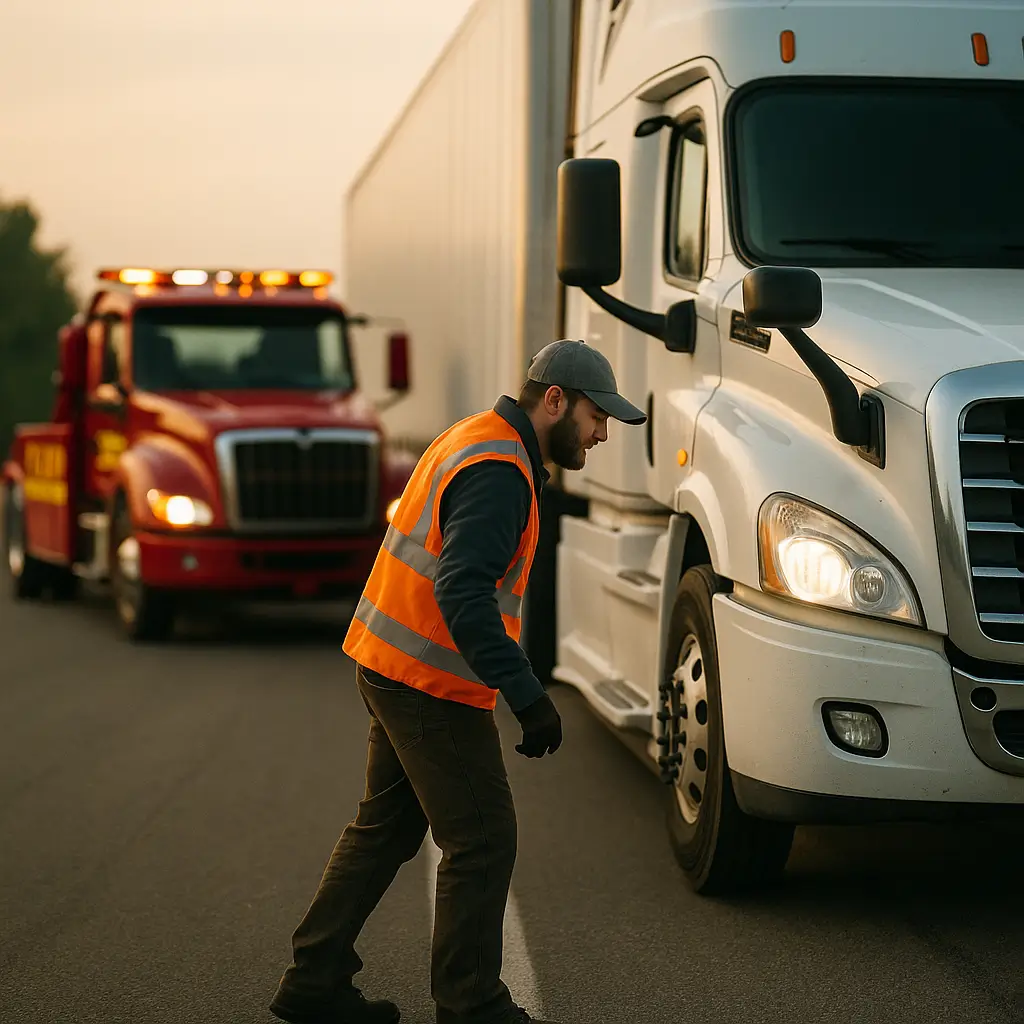

See 2026 heavy duty roadside assistance costs from $300–$1,000+ per call, heavy towing costs of $2,500–$5,000+, plan options, and ways to cut downtime.
In 2026, heavy duty roadside assistance typically costs $300–$1,000+ for a standard service call, while a heavy-duty tow or recovery commonly lands at $2,500–$5,000+—and the “+” is where budgets get wrecked (after-hours, loaded miles, winch-out time, rotator needs).
A key point most drivers learn the hard way: roadside programs and insurance aren’t the same thing. Before you assume your policy saves you, review your options and limits in Commercial truck insurance basics for owner-operators.
This guide is built for owner-operators and fleets who want cost control: what you’re paying for, what to ask before the truck rolls, and how to choose coverage that matches your lanes.
Table of Contents
Reading time: 7 minutes

Key Takeaways
For 2026 budgeting, heavy duty roadside assistance is most often $300–$1,000+ for non-tow calls and $2,500–$5,000+ for heavy towing, with recoveries frequently exceeding that range.
- Budget reality: Plan on $300–$1,000+ for common calls; $2,500–$5,000+ for heavy towing/recovery—more if it’s a complicated scene—and review your breakdown coverage options for owner-operators before the next incident.
- Invoice “shock” usually comes from miles, after-hours rates, recovery time, and wrong equipment (second dispatch).
- Membership isn’t “free”: it’s a contract with caps, limits, and definitions—especially around recovery/winch-outs.
- Pair roadside with risk planning: insurance, maintenance, and downtime all hit your cost-per-mile.
What Counts as Heavy Duty Roadside Assistance (and What Doesn’t)
Heavy duty roadside assistance is commercial roadside service for Class 7–8 trucks and combinations, where labor, tooling, and safety requirements are materially different than light-duty “car club” coverage.
Heavy duty vs. light duty (plain English)
Heavy duty calls often require higher-capacity jacks, service trucks that can handle air systems and wheel-end work, and vendors equipped for tractor-trailer weights and roadway hazards. That’s why pricing swings so hard by location, time, and scene complexity.
What it usually includes
- Tire service: air-up, repair/replace (if the right casing is available), TPMS issues
- Jump/battery service: jumpstart, battery replacement (battery cost is extra)
- Fuel/DEF delivery: emergency gallons, misfuel support (diesel vs. DEF mistakes can get expensive fast)
- Lockouts: limited; depends on truck and hardware
- Minor roadside repairs: air line fittings, hoses, lights—only if safe and feasible roadside
The expensive category: towing, winch-outs, recovery
The biggest billing surprises happen because “tow,” “recovery,” and “rotator work” are different services with different rates and equipment needs.
- Tow: moving a disabled unit from A to B on wheels
- Winch-out / recovery: pulling you out of a ditch, mud, snow, soft shoulder, or correcting a bad angle
- Uprighting / rotator work: specialized recovery for rollovers or severe jackknifes
If you want to understand how towing providers think about pricing and dispatch — and why recovery calls get billed so differently — this breakdown is worth watching:
If you want the deeper breakdown (and how to talk about it with dispatch), start with Semi truck towing and recovery basics.
Who needs it (including hotshots)
- Owner-operators: one breakdown can wipe out the week’s profit.
- Fleets: standardization and billing control matter as much as response time.
- Hotshot operators: you can be in a gray zone — make sure the plan matches your truck, trailer, and lane reality. Review hotshot trucking insurance requirements before signing up for any commercial roadside program.
How Much Does Heavy Duty Roadside Assistance Cost in 2026? (With a Real-World Cost Table)
In 2026, most heavy duty roadside service invoices are built from dispatch/base fees + labor + travel/mileage + equipment type + time-on-scene, which is why the same “tow” can be $2,500 in one lane and $7,500 in another.
Downtime is the multiplier: the invoice hurts, but the missed appointment, reschedule, and lost utilization hurt more. Industry research from the American Transportation Research Institute (ATRI) consistently flags repair/maintenance and operational disruption as major carrier cost drivers (see ATRI’s Operational Costs of Trucking research).
2026 cost ranges by service type (typical market ranges)
These are planning ranges, not quotes; your lane, time of day, and equipment needs can swing totals significantly.
| Service Type | Typical 2026 Range | What usually drives the high end |
|---|---|---|
| Basic service call / dispatch + labor | $300–$1,000+ | Rural response, after-hours, long on-scene diagnostics |
| Tire service (repair/replace) | $400–$1,200+ (plus tire) | Tire availability, wheel-end issues, steer tire, unsafe location |
| Jumpstart / battery service | $300–$900+ (plus battery) | After-hours, battery type/size, access issues |
| Fuel/DEF delivery | $300–$800+ (plus fuel/DEF) | Remote areas, spill precautions, wrong-fluid situations |
| Heavy-duty towing | $2,500–$5,000+ | Loaded miles, hookup complexity, traffic control needs |
| Recovery / winch-out | $3,000–$10,000+ | Multiple units, rotator, time-on-scene, weather/terrain |
| Storage / lot fees (if applicable) | Varies | Impound rules, weekends/holidays |
The 5 cost components to ask about before authorizing (when possible)
If you can safely do it, get clarity on these five line items before anyone hooks up.
- Base/hookup fee
- Loaded miles rate (and what counts as “loaded”)
- After-hours/holiday surcharge
- Recovery hourly rate (if there’s any chance it’s more than a straight tow)
- Storage/yard fees (and when they start)
Cash-flow framing for owner-operators
Roadside isn’t just a random expense—it’s a line item you can plan for, just like tires and PMs. To budget it realistically, tie call frequency and downtime exposure into your operating-cost model using Owner-operator expenses and cost-per-mile breakdown.
Membership vs Pay-Per-Use: Which One Wins for Your Trucking Business?
Membership roadside plans trade a fixed fee for contracted dispatch access and defined benefits, but the real decision comes down to incident caps, definitions (tow vs recovery), and the lanes you run.
What membership plans usually do well
- Fast dispatch: one number, 24/7
- Some included towing miles: depending on plan
- Basic non-tow services: tires, fuel, battery support (often with limits)
Common membership limitations that create surprise bills
- Incident caps: “covered up to $X” (you pay the rest)
- Towing vs recovery definitions: winch-out/recovery is often excluded or tightly capped
- Network gaps: “nearest qualified provider” can mean delays or higher cost in rural areas
- Parts are extra: tires and batteries are usually billed separately
Pay-per-use makes sense when…
- You have low call frequency
- You run lanes where “nationwide” networks are thin
- You want more control over vendor choice (especially for heavy recovery)
For a quick look at how towing providers think about their own costs and operations — which helps you negotiate better and ask smarter questions:
How this ties into insurance (and controlling total risk spend)
Roadside planning is part of your bigger risk budget: physical damage exposure, cargo exposure, downtime exposure, and cash-flow stability. If you’re trying to reduce your fixed monthly burn without creating coverage gaps, use the same discipline you’d use when comparing Affordable trucking insurance strategies.
Response Time, Dispatch, and Prevention: How to Get Help Faster and Avoid “Second Dispatch” Mistakes
Wrong equipment is one of the biggest drivers of heavy duty roadside assistance delays and inflated invoices, because a “second dispatch” adds extra travel, extra time, and sometimes extra scene risk.
Dispatch script (copy/paste into your Notes app)
When you call, send this up front to reduce back-and-forth:
- Exact location: mile marker, direction of travel, nearest exit, truck-safe access point
- Unit details: tractor + trailer, loaded/empty, gross weight estimate
- Problem: “won’t build air,” “steer tire blew,” “won’t crank,” “stuck in soft shoulder,” etc.
- Tire info: size (e.g., 11R22.5), position, how many down
- Scene hazards: narrow shoulder, curve, blocking lane, fuel leak smell, etc.
- Photos/video: tire/wheel-end, angle in ditch, trailer position, clearance
What to keep in the truck (compliance + safety)
FMCSA requires specific emergency equipment for CMVs under 49 CFR §393.95, including warning devices and a fire extinguisher (source: eCFR §393.95).
For a walkthrough of what DOT inspectors actually look for in your cab — including the emergency equipment required under federal regulations — this checklist video covers the bases:
If you want the plain-English version of what inspections and required gear get picky about, bookmark DOT compliance essentials for truckers — and keep a DOT compliance binder checklist in the cab.
Pro tip: convert “tow events” into “service events”
Most operators don’t get crushed by one $600 tire call; they get crushed by tow + recovery plus missed appointment plus load risk plus waiting overnight for a shop. The prevention goal is simple: fewer breakdowns, and less severe breakdowns. A commercial vehicle inspection checklist is the fastest way to build that habit.
Frequently Asked Questions
These answers reflect typical 2026 heavy duty roadside assistance pricing mechanics, including common non-tow calls in the $300–$1,000+ range and heavy towing often starting around $2,500+ depending on lane and conditions.
A tow moves your disabled unit from point A to point B on wheels. A recovery — also called a winch-out or uprighting — involves extracting the vehicle from a ditch, soft shoulder, mud, or rollover position. These are billed as separate services, often at different hourly rates and with different equipment requirements. Recovery work is frequently excluded or tightly capped in roadside membership plans, which is why an incident that looks like “just a tow” can quickly become a $6,000+ invoice once a winch line is attached.
In 2026, heavy duty roadside assistance typically costs $300–$1,000+ for non-tow service calls (tires, fuel, battery) and $2,500–$5,000+ for heavy-duty towing.
Recovery/winch-outs can go higher based on time-on-scene, loaded miles, after-hours surcharges, and whether special equipment (multiple units or a rotator) is required. Before you authorize, ask for the base fee, loaded-mile rate, and the hourly recovery rate so you’re not surprised after the truck is already hooked.
Response times vary widely by location, time of day, and equipment availability. Urban and highway-corridor calls can see a service truck in 60–90 minutes; rural or off-highway situations — especially those requiring a rotator or heavy wrecker — can extend to 3–6 hours or more. After-hours and holiday calls add wait time and cost. The best way to reduce actual wait time is to give dispatch the correct equipment specs and scene details upfront so the right truck rolls the first time.
Get as far off the road as safely possible, activate your four-way flashers, and set out your triangle warning devices immediately — FMCSA requires them for a reason. Stay in the truck or behind a guardrail if you’re on a high-speed highway; the shoulder is more dangerous than it looks. Keep dispatch updated on any scene changes (fuel smell, traffic building, weather). Don’t let anyone hook up until you’ve confirmed their equipment class and have a verbal or written estimate.
A “second dispatch” — when the first truck can’t handle the job — is one of the most expensive roadside scenarios. You typically pay a second base fee, a second mileage charge, and additional time-on-scene for the delay. The way to minimize this risk is to send the dispatcher your unit details (tractor + trailer, loaded or empty, gross weight estimate) and photos of the scene before anyone rolls. If you’re calling through a membership program, confirm the provider is rated for your combination’s weight class before authorizing.
Yes, meaningfully. Most national “commercial” roadside plans are written around Class 7–8 combinations. Hotshot operators — running Class 3–5 trucks with gooseneck or bumper-pull trailers — often fall into a gray zone: too heavy for light-duty consumer programs, but not always covered under heavy-duty commercial plans. Before signing up for any membership, confirm the plan covers your specific truck class, trailer type, and GCWR, not just the tractor alone.
Yes. Several national providers offer fleet-specific programs with centralized billing, per-unit or per-incident reporting, and account management features that individual owner-operator plans don’t include. Fleet programs typically allow you to set authorization limits by unit or driver, which helps control unexpected recovery charges. If you run five or more trucks, it’s worth comparing a fleet roadside account against the cost of per-unit memberships — the per-incident billing transparency alone can justify the switch. See commercial roadside assistance plans for a current cost and options breakdown.
In some cases, yes — especially on recovery work where hourly billing is involved. The most effective leverage points are itemized invoices (request one on-scene if possible), documented time-on-scene, and whether the appropriate equipment was sent on the first dispatch. If a scene ran longer because of provider error or equipment mismatch, that’s a legitimate dispute. Membership programs have a formal dispute process; pay-per-use calls require direct negotiation with the provider. Always pay under protest if you plan to dispute — walking away unpaid creates a lien risk on your unit.
Heavy duty towing is sometimes included partially in memberships, usually as limited towing miles or a dollar cap per incident.
The biggest gotcha is definitions: towing (moving the unit) and recovery (winch-out, uprighting, ditch work) are often billed differently, and recovery is frequently capped or excluded. Always read the plan’s incident limits and the exact language around “recovery,” “winch-out,” and “special equipment.”
Roadside assistance may be covered by a truck insurance policy only if it’s specifically included as an endorsement, and the limits and definitions vary by carrier and form.
Some policies help with towing, but many won’t cover recovery, long-distance towing, or after-hours surcharges the way drivers assume. Get the endorsement details in writing, confirm any caps per incident, and keep that info accessible so you can make a fast decision during a breakdown.
No — roadside assistance and towing programs do not cover cargo damage. If your load is damaged during a tow or recovery event, that falls under your cargo insurance policy, not your roadside plan. This distinction matters especially during recovery operations: a winch-out or uprighting that shifts or damages freight is a cargo claim, not a service call. Make sure your cargo policy is active and you know the claims contact before you need it.
The best way to prevent expensive roadside calls is to reduce breakdown frequency and severity with a consistent weekly inspection routine that targets tires, air loss, batteries, lights, and air lines.
A simple checklist turns many “tow events” into cheaper “service events” and protects uptime, especially in bad weather lanes. Use Truck maintenance checklist for preventing breakdowns as a baseline, then adapt it to your season, loads, and routes. For a structured approach, LogRock’s preventive maintenance program guide covers how to build a routine that fits your season, loads, and routes.
Your CSA score doesn’t directly affect roadside plan pricing, but it has a knock-on effect on your insurance premiums — and a higher insurance cost changes how you budget for roadside coverage overall. More importantly, a history of vehicle maintenance violations (BASIC 5) signals that your truck is breakdown-prone, which is a reason to invest more in both a stronger roadside plan and a tighter PM schedule, not less.
Not exactly. Roadside assistance is a dispatch service: someone comes to you, performs a service or tow, and you pay per call or through a membership. Breakdown coverage is an insurance product — typically an endorsement on a commercial trucking policy — that reimburses certain breakdown-related costs, including towing, up to a stated limit per incident. Some policies combine both; many don’t. If your policy includes a breakdown endorsement, verify the per-incident cap, whether recovery is included, and how it coordinates with any roadside membership you’re already paying for.
Conclusion: Choose Coverage That Matches Your Lanes (Not the Marketing)
Heavy duty roadside assistance is a cash-flow and uptime tool, and in 2026 the planning math starts around $300–$1,000+ for common calls and $2,500–$5,000+ for heavy towing before recovery complexity is added.
The smart move is to pick a model (membership or pay-per-use) that fits your lanes, your weather exposure, and your real call history from the last 12 months.
Key Takeaways:
- Ask for pricing components up front: base fee, loaded miles, after-hours, recovery hourly, and storage terms.
- Match definitions to your risk: “tow” and “recovery/winch-out” are not the same line item.
- Prevent the big bills: a tighter maintenance routine reduces tows and improves response decisions.
If you want to tighten operations and cut dispatch delays, keep your visibility and location-sharing clean with ELD requirements and operational visibility.
And if you’re comparing roadside spend against your total risk budget, use Truck insurance cost for owner-operators to put the numbers in context.
If you’re trying to control roadside costs, reduce downtime exposure, or make sure your breakdown coverage actually covers the recovery scenarios your lanes create — LogRock can help. Talk to our team to review your current setup, identify gaps in your tow and recovery coverage, and get a quote that reflects your real operation.
Speak with LogRock and request a quote




