
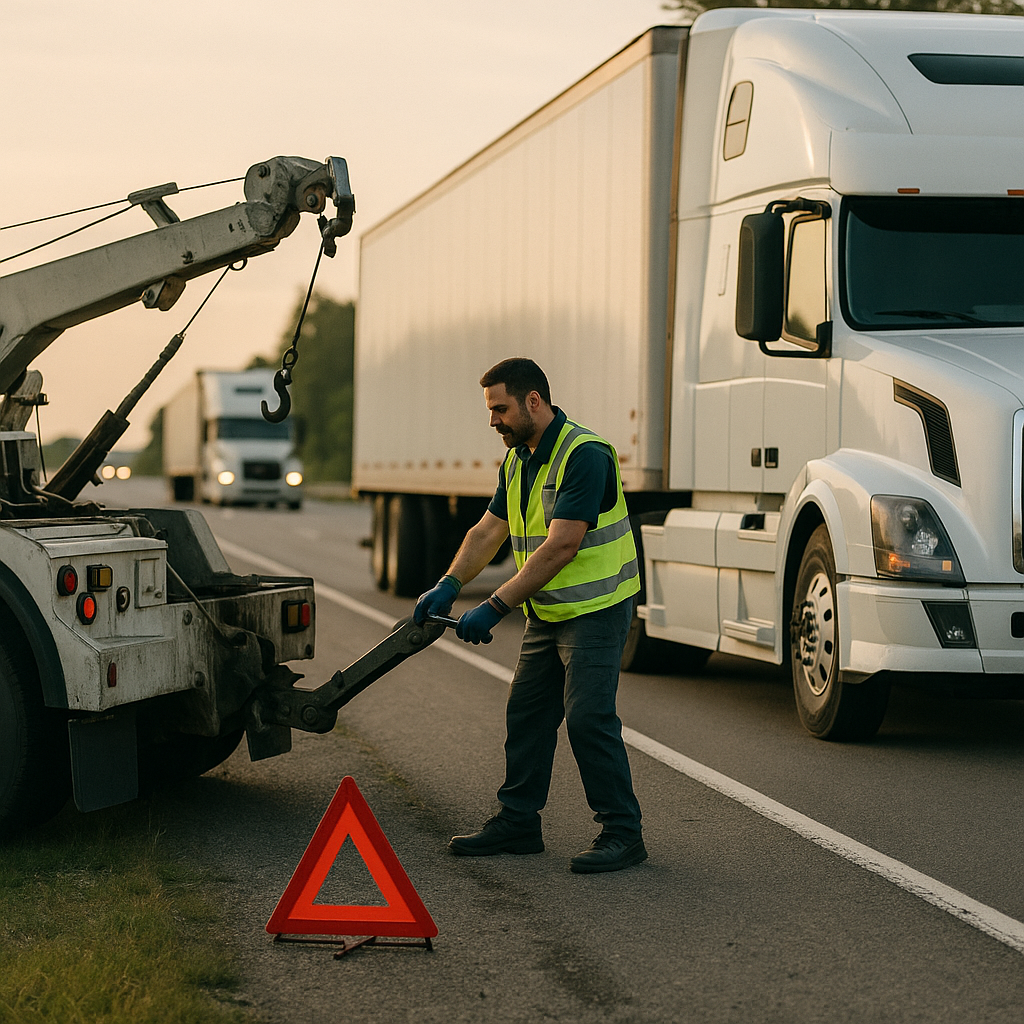
2026 cost ranges for 18 wheeler roadside assistance—tow, tire, jump, fuel & lockout—plus a dispatch checklist and anti-scam questions for owner-ops. Save it now.

18 wheeler roadside assistance typically costs $150–$350 for jump starts, lockouts, or fuel delivery, $250–$1,200+ for tire service (more if a tire is replaced), and $500–$2,000+ for towing in 2026; recovery and winch-out work can climb into $2,000–$5,000+ and, in worst cases, higher based on equipment and minimum hours. Those ranges are why a single shoulder call can erase the profit on a load.
If the event escalates into a claim, it can affect renewals and premiums—so it’s smart to treat breakdown response as part of your risk plan alongside your commercial truck insurance.
Table of Contents
Reading time: 8 minutes
- Introduction: Breakdowns Don’t Care About Your Margin
- What Counts as 18 Wheeler Roadside Assistance (and What Doesn’t)
- How Much Does 18 Wheeler Roadside Assistance Cost in 2026? (Service-by-Service)
- Most Common Roadside Calls + “Near Me” Dispatch Checklist
- How to Choose Reliable Heavy Duty Truck Roadside Assistance (Avoid Scams) + Safety Basics
- Frequently Asked Questions
- Conclusion: Get Help Faster and Pay Less
Introduction: Breakdowns Don’t Care About Your Margin
An on-shoulder breakdown can turn into a high-cost event in minutes because heavy-duty service often bills by call-out fee + hourly labor + mileage/deadhead + minimum hours. When you’re loaded, the pressure to “approve it and move” is real—and that’s when surprise charges show up.
Most drivers aren’t price-shopping in that moment; they’re searching “18 wheeler roadside assistance near me” and trying not to sign a blank check. The goal of this guide is simple: help you get the right help fast, with a quote structure you can defend later.
What Counts as 18 Wheeler Roadside Assistance (and What Doesn’t)
18 wheeler roadside assistance is typically “get me rolling” service such as jump starts, lockouts, fuel delivery, and minor air/electrical help, while mobile repair, towing, and recovery are separate categories with different pricing and minimums.
If you run your truck like a business (because it is), build this into your operating plan the same way you track lanes, maintenance, and cash flow in an owner-operator guide.
Roadside vs Mobile Repair vs Heavy-Duty Towing
Knowing the category keeps you from approving the wrong service (or the wrong price model) while you’re stressed.
- Roadside assistance: Quick on-scene support like jump starts, lockout service, and fuel delivery.
- Mobile repair: Diagnosis and repair at the scene, usually billed hourly with minimums plus parts.
- Heavy-duty towing: Moving a disabled tractor/trailer on-road to a shop or safe location.
- Recovery: Winch-outs, uprighting, off-road pulls, rollovers, and load-shift situations that require specialized equipment (and bigger minimums).
Common Exclusions and Surprise Charges
Surprise charges are usually not “mystery fees”—they’re line items that were never explained before the truck rolled.
- After-hours/holiday surcharges: Higher labor rates and/or higher minimum hours.
- Mileage + deadhead: Travel to you and sometimes travel back to base.
- Minimum labor hours: Common on rural calls where the provider is far away.
- Parts markups: Tires, batteries, fittings, hoses, shop supplies.
- Storage fees: If you get towed to a yard instead of a shop.
Practical rule: If they won’t put the rate structure in writing (text/email) before dispatch, treat it like a red flag.
How Much Does 18 Wheeler Roadside Assistance Cost in 2026? (Service-by-Service)
In 2026, common heavy-duty roadside calls range from $150–$350 for small services to $500–$2,000+ for towing, while recovery work often starts around $1,000 and can exceed $5,000 when specialized equipment and minimum-hour billing apply.
Roadside costs hit cash flow immediately, and repair/maintenance is consistently a major operating-cost category for fleets and owner-operators (ATRI, Operational Costs of Trucking): https://truckingresearch.org/2025/10/operational-costs-of-trucking/.
Typical Price Ranges (2026) — Quick Reference
| Service Type | Low | Typical | High (after-hours / remote / complex) |
|---|---|---|---|
| Jump start / no-start assist | $150 | $200–$350 | $500–$700 |
| Fuel delivery (service + fuel) | $150 | $200–$400 | $500–$800 |
| Lockout | $150 | $200–$350 | $450–$650 |
| Tire service (service call only) | $250 | $350–$500 | $600–$900 |
| Tire replacement (service + tire) | $650 | $800–$1,200+ | $1,500+ |
| Mobile mechanic (diagnosis/call-out) | $300 | $450–$800 | $1,200+ |
| Tow (on-road, local) | $500 | $900–$1,800 | $2,500+ |
| Recovery / winch-out / rotator | $1,000 | $2,000–$5,000+ | $10,000+ possible |
Reality check: The “$150–$2,000+” range covers common calls; true recovery can blow past that fast. Don’t approve recovery work without written rates and minimums.
What Changes the Price the Most
- Where you are: Metro is usually faster; rural can mean long deadhead charges.
- When you call: Nights/weekends often add surcharges and longer ETAs.
- What equipment is required: Service truck vs heavy wrecker vs rotator.
- Loaded vs empty: Weight affects safety, time, and required gear.
- Trailer situation: Dropped trailer, reefer, hazmat placards, axle configuration, clearance issues.
Will Insurance Pay—or Is It Out of Pocket?
Whether towing and roadside are covered depends on your policy language, endorsements, limits, deductibles, and exclusions, and many policies cap towing reimbursement even when coverage exists. Before you assume you’ll be reimbursed, review the practical “who pays” breakdown here: truck towing insurance coverage.
Paperwork matters: Take photos, get a detailed invoice, and make sure the charges match what you authorized in writing.
Most Common Roadside Calls + “Near Me” Dispatch Checklist (Save This)
A complete dispatch intake for a semi truck roadside assistance service should include your exact location, truck/trailer details, load status, symptoms, scene hazards, and payment authorization so the correct equipment is sent the first time.
If you’re under load, speed matters—but documentation protects you if cargo is delayed or damaged, so keep this reference handy: cargo insurance basics.
What Happens on Scene (So You Don’t Get Upsold)
Jump start / no-start: A solid tech checks batteries, connections, and charging issues; if it’s alternator/starter, it becomes mobile repair fast.
Tire service: Cost depends on tire position and inventory; a steer tire can change the job, the wait, and the bill.

Fuel delivery: You’ll typically pay a service charge plus fuel; if you misfuel, don’t crank it—towing and containment can be cheaper than engine damage.
Lockout: Legit vendors ask authorization questions because they don’t want a stolen-unit problem.
Dispatch Checklist: What to Tell Them (Copy/Paste)
- Exact location: Mile marker, direction of travel, nearest exit, GPS pin.
- Truck info: Year/make/model, unit number, and a callback number that works.
- Trailer/load: Loaded/empty, trailer type, axle count, and any hazmat placards.
- Symptoms: “No crank,” “cranks/no start,” air leak location, tire position, dash codes (if safe).
- Scene conditions: Shoulder width, traffic speed, mud/ditch, bridge/overpass clearance, lane closure needed.
- Payment/authorization: Card, fleet PO, invoice email, and who can approve over $X.
Hard rule: Ask dispatch to text you the ETA and the quote structure before they roll a truck.
How to Choose Reliable Heavy Duty Truck Roadside Assistance (Avoid Scams) + Safety Basics
Reliable commercial truck roadside assistance providers should offer a written rate structure and an itemized invoice that lists labor hours, mileage/deadhead, minimums, parts, and any storage or environmental fees.
Verification & Transparency Signals (Quick Checklist)
These signals help you spot real operators and avoid price-trap middlemen.
- Clear quote structure: Call-out + hourly + mileage/deadhead + minimum hours.
- Written authorization: Text/email approval before work starts (especially for towing/recovery).
- Itemized invoice: Hours, parts, supplies, and all additional fees listed.
- Real-time comms: ETA updates and a tech contact number.
If you need to verify a towing carrier’s operating details, the FMCSA SAFER portal can help you check USDOT/MC information when applicable: https://safer.fmcsa.dot.gov/.
Towing vs Recovery: The Question That Saves You Thousands
“Tow” and “recovery” are priced differently because recovery can require rotators, winch systems, traffic control coordination, and higher minimum-hour billing.
- Ask: “Is this a tow or a recovery?”
- Ask: “What equipment are you sending (heavy wrecker, rotator, service truck)?”
- Ask: “What’s the hourly rate and minimum hours?”
- Ask: “Where are you taking it, and what are storage fees?”
Safety Steps While You Wait (Compliance + Common Sense)
Federal motor carrier regulations require CMVs to carry specific emergency equipment and warning devices under 49 CFR §393.95, and missing equipment can turn a breakdown into a roadside violation: https://www.fmcsa.dot.gov/regulations/title49/section/393.95.
For a broader operations view, tie your roadside procedure back to your safety program here: DOT compliance requirements.
- Get as far out of traffic as safely possible; hazards on; set brakes.
- Deploy warning devices per training and company policy.
- Wear high-vis and avoid standing on the traffic side.
- Take photos/video if towing/recovery or cargo damage is possible.
Roadside Planning = Affordable Trucking Insurance Over Time
Breakdowns can create claims, citations, CSA risk, and litigation exposure that can influence renewals and premiums, which is why owner-operators treat roadside response as part of keeping affordable trucking insurance over time. The most effective approach is a simple playbook: who you call, what you authorize, and what you document—every time.
Frequently Asked Questions
Most 2026 calls for 18 wheeler roadside assistance land around $150–$350 for jump starts, lockouts, or fuel delivery, $250–$1,200+ for tire service depending on whether a tire is replaced, and $500–$2,000+ for towing. The biggest price drivers are location (deadhead mileage), after-hours rates, loaded weight, and whether the job is a tow or a recovery. Recovery and winch-out work often starts around $1,000 and can exceed $5,000 when specialized equipment and minimum-hour billing apply. Always get the rate structure in writing before dispatch.
Yes, 24/7 18 wheeler roadside assistance is common along major freight corridors, metro areas, and interstates, but rural ETAs can be long because the closest heavy wrecker or service truck may be 60–150 miles away. After-hours coverage also depends on staffing, so weekend or overnight calls may involve higher minimums and travel fees. When you call, ask for the provider’s ETA, deadhead mileage policy, and minimum-hour billing, and get those terms texted or emailed before you approve dispatch.
You should provide a semi truck roadside assistance dispatcher with your exact location (mile marker and GPS pin), truck and trailer details, whether you’re loaded, and clear symptoms like “no crank” vs “cranks/no start” or the exact tire position. You should also describe scene conditions such as shoulder width, traffic speed, mud/ditch risk, and clearance issues, because that determines whether they send a service truck, heavy wrecker, or recovery equipment. Finally, give payment and authorization details (card or PO, approval limit, and invoice email) so you don’t lose time on the back end.
Towing moves a disabled tractor or tractor-trailer on-road to a shop or safe location, while recovery involves extracting, uprighting, or managing off-road/complex situations like a ditch, load shift, or rollover. Recovery is usually more expensive because it can require rotators, winches, rigging, traffic control coordination, and higher minimum-hour billing. Before you approve work, ask whether the job is being billed as a tow or a recovery, what equipment is being sent, the hourly rate, the minimum hours, mileage/deadhead charges, and whether storage fees apply at the destination yard.
Roadside tire service usually includes the service call and labor, but the tire itself is often billed separately unless your specific plan includes tire replacement. Total cost commonly runs $250–$500 for service-only and $800–$1,200+ when a tire is replaced, with higher prices after-hours or in remote areas. Steer tires can increase cost and delay because safety requirements and limited inventory matter, especially outside major markets. For a reality check on pricing by tire position, use this reference: semi truck tire cost guide.
Conclusion: Get Help Faster and Pay Less
Roadside isn’t just a bill—it’s downtime, risk, and leverage. If you know the 2026 price ranges, insist on written rate structure, and keep a dispatch checklist ready, you’ll avoid the worst surprises and get moving faster.
Key Takeaways:
- Get the quote structure first: Call-out fee, hourly rate, mileage/deadhead, minimum hours, parts markup, after-hours charges.
- Confirm tow vs recovery: That single classification can change the invoice by thousands.
- Document everything: Photos, written authorization, and itemized invoices protect you for disputes and claims.
To reduce how often you ever need that shoulder call, keep your maintenance and cost-control plan tight with Preventive maintenance checklist and How to save money on trucking costs.





