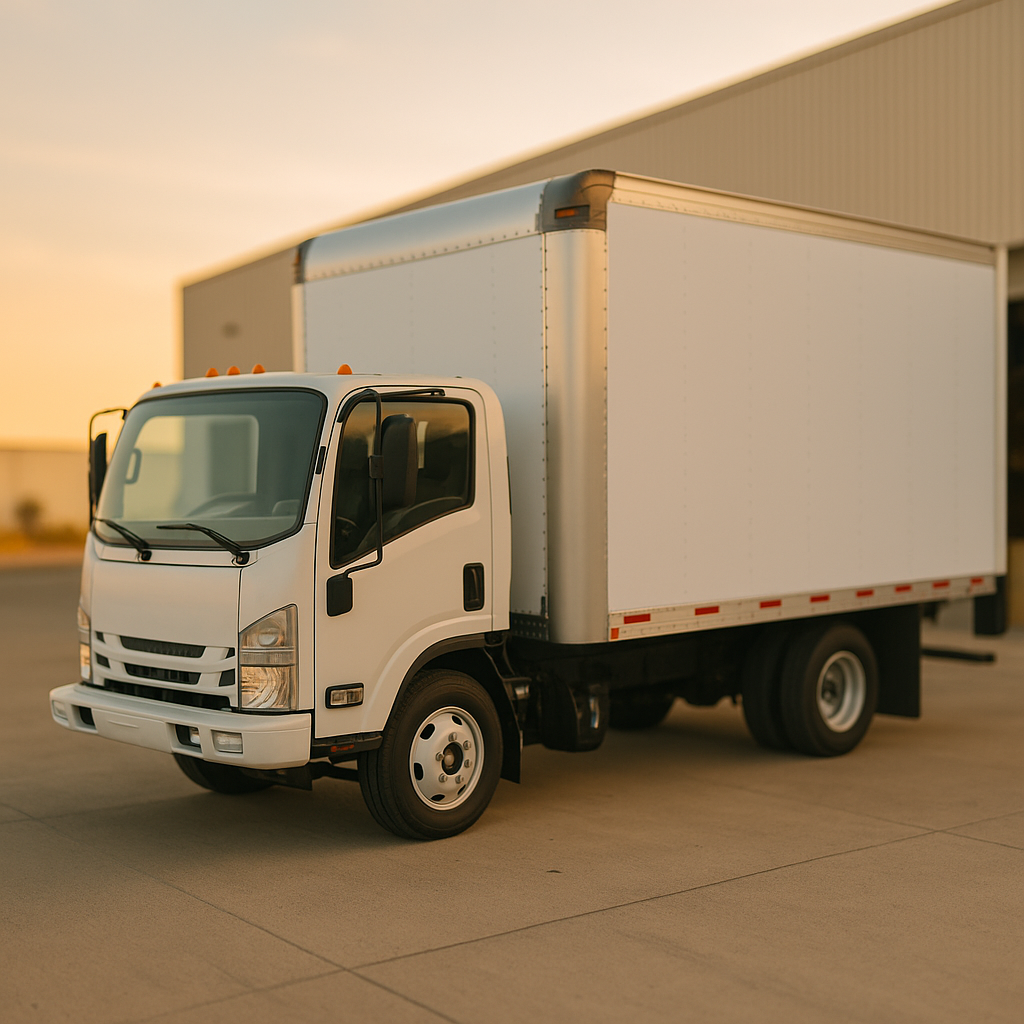
16 foot box truck insurance cost in 2026 typically runs $250–$950/mo; new ventures $650–$1,600+. See cost drivers + quote checklist—get quotes.

16 foot box truck insurance cost in 2026 is commonly $250–$950 per month for established operators, while new ventures and higher-risk setups often land around $650–$1,600+ per month. The biggest pricing levers are your garaging ZIP, operating radius, cargo, driver record (MVR), and whether you’re buying liability-only or a “full coverage” package (liability + physical damage, often cargo).
Before you treat any quote like truth, sanity-check it against broader market benchmarks like box truck insurance price in 2026—because paying for the wrong limits (or getting misclassified) is one of the fastest ways to donate margin to premiums.
Table of Contents
Reading time: 7 minutes
Introduction (real numbers, no fluff)
In 2026, a typical 16-foot box truck insurance budget is $250–$950/month for many established operators and $650–$1,600+/month for new ventures or higher-risk operations, depending on ZIP code, radius, cargo, and driver history.
“16 feet” matters less than the exposure you create every day: how often you stop, where you park, what you haul, and how clean your paperwork looks to an underwriter.
This guide breaks down what you’re actually paying for, why rates swing so hard, and how to get affordable trucking insurance without cutting the coverage that keeps you in business.
Key Takeaways
In 2026, many established 16-foot box truck operators fall in the $250–$950/month band, while new ventures commonly price in the $650–$1,600+/month band when quoting comparable limits and deductibles.
- Typical 2026 range: $250–$950/mo for many established operators; $650–$1,600+/mo for new ventures or higher-risk setups.
- Length matters less than risk: insurers price use, radius, ZIP/garaging, cargo, and loss history more than “16-foot vs. 20-foot.”
- “Full coverage” is a package: in commercial auto it usually means liability + physical damage (and often cargo), not the personal-auto definition.
- Stop overpaying: quote apples-to-apples, tighten your radius, avoid coverage lapses, and document operations clearly to reduce underwriting uncertainty.
2026 Baseline: Typical 16-Foot Box Truck Insurance Costs (Monthly + Annual)
In 2026, typical commercial insurance pricing for a 16-foot box truck often ranges from $250–$1,900+ per month depending on whether you buy liability-only or a full package (liability + physical damage + cargo) and whether you’re a new venture.
Insurance is one of the big fixed costs that can quietly wreck cost-per-mile if you let it drift; research organizations like the American Transportation Research Institute (ATRI) consistently track insurance as a major operating-cost category for motor carriers.
Practical cost table (typical market bands)
| Common Setup (16-ft box truck) | What’s Included | Established Operator (Monthly) | New Venture / Higher-Risk (Monthly) | Annual Range (Ballpark) |
|---|---|---|---|---|
| Liability-focused local work | Auto liability (often $1M CSL on contracts) | $250–$600 | $650–$1,200+ | $3,000–$14,400+ |
| “Full coverage” for financed truck | Liability + physical damage (comp/collision) | $400–$850 | $900–$1,600+ | $4,800–$19,200+ |
| For-hire freight w/ cargo requirement | Liability + physical damage + cargo | $550–$950 | $1,100–$1,900+ | $6,600–$22,800+ |
Plain English: These are typical market ranges, not guarantees. Two operators with the same 16-foot box truck can be hundreds per month apart because insurers price exposure, not just the unit.
If you want a “what am I actually buying?” breakdown for box truck packages, keep this reference open: box truck business insurance guide.
What Actually Drives 16 Foot Box Truck Insurance Cost (More Than the Truck Length)
Commercial truck insurers rate box trucks primarily on measurable exposure—such as GVWR/class, garaging territory, operating radius, driver MVR, and cargo—which is why two “16-foot” operations can price wildly differently.
A 16-foot box can rate like “light commercial” or like serious for-hire exposure depending on how you run it.
Size vs. weight class vs. use (how insurers really think)
“16-foot” is a body length, while rating and eligibility are often more sensitive to weight class (GVWR), vehicle value, territory, and operations (for example, final-mile in tight neighborhoods vs. predictable dock-to-dock lanes).
Final-mile and moving work tends to mean more stops, more backing, and more time in crowded lots—frequency risk that shows up in claims.
The top pricing drivers (ranked, real-world)
- New venture status (new business, limited history, sometimes new authority)
- Garaging ZIP (where it sleeps) + theft/vandalism exposure
- Operating radius and states traveled
- Driver MVR + experience (tickets, at-faults, years driving commercially)
- Cargo type/value (electronics vs. general freight vs. household goods)
- Loss runs / claims history and coverage lapses
- Truck value + deductible strategy (paid-off vs. financed, $1k vs $5k deductibles)
If you want the underwriting logic (and how misclassification happens), read: what affects commercial truck insurance rates.
Real-world scenario callouts (sanity-check your quote)
Scenario A (lower band): Paid-off 16-ft box, local delivery within a 50-mile radius, clean MVR, consistent prior coverage. Operator shops apples-to-apples and lands near the lower-middle of the range.
Scenario B (higher band): New venture, financed truck, statewide radius, moving/final-mile, limited prior commercial history, metro garaging ZIP. Quote comes back high—not because “16 feet,” but because the operation signals frequency + uncertainty.
Pro tip: Your cheapest premium usually comes from a clean story: tight radius, stable garaging, consistent coverage, and accurate operations. “Close enough” on the application is how you end up with a cheap quote that becomes a painful audit or non-renewal.
Liability vs. “Full Coverage” + Requirements + Mini Estimator (Practical, Not Gimmicky)
A commercial “full coverage” box truck policy typically includes auto liability plus physical damage (comprehensive and collision), and many for-hire operations also add motor truck cargo to meet broker/shipper requirements.
This is where a lot of owners get burned: they think they’re comparing quotes, but they’re actually comparing different limits, deductibles, and assumptions.
Liability-only vs. “full coverage” (commercial reality)
- Auto liability: Pays for bodily injury/property damage you cause to others (contracts commonly ask for $1,000,000 CSL).
- Physical damage (comp/collision): Pays to repair/replace your truck; often required if financed or leased.
- Cargo: Covers the freight you’re responsible for (often required by brokers/shippers).
- Common add-ons: General liability, hired/non-owned auto, non-trucking liability (depends on how you run and contract).
Legal vs. contract requirements (don’t confuse the two)
FMCSA publishes federal guidance on insurance filings and requirements for regulated interstate operations, and filings (proof to the government) are not the same thing as contract limits (proof to your customer).

You can review the FMCSA resource here: FMCSA insurance filing requirements, and for a plain-English walkthrough read: FMCSA insurance filing requirements (explainer).
Mini cost estimator (simple framework you can use today)
This framework helps you pressure-test quotes and spot what’s actually driving the price.
Step 1 — Pick your baseline band
- Established operator: $250–$950/month
- New venture / higher-risk: $650–$1,600+/month
Step 2 — Add the “modules” you actually need
- Add physical damage if the truck is financed/leased (or if you can’t self-insure the unit).
- Add cargo if hauling freight for others (or if your contract requires it). If you’re unsure how cargo limits and exclusions work, see cargo insurance for box trucks.
- Increase limits only when required—or when the risk justifies it.
Step 3 — Apply reality adjustments (illustrative)
| Adjustment | Typical Direction | Why it changes the premium |
|---|---|---|
| Metro garaging ZIP | +10% to +25% | More theft/claims frequency, higher repair costs |
| Broad radius / multi-state | +10% to +30% | More exposure, more variance |
| New venture | +20% to +50%+ | Less operating history; uncertainty priced in |
| Clean prior coverage (no lapses) | -5% to -15% | Underwriter confidence |
| Higher deductibles | -5% to -20% | You retain more risk (only do this if cash flow supports it) |
Deductible reality check: If you can’t comfortably float a $2,500–$5,000 deductible without missing a payment, don’t “buy” a cheaper premium that breaks you on the first claim.
Market context: Commercial auto pricing is influenced by claims costs, risk pooling, and state regulation; the NAIC is a useful starting point for understanding how U.S. insurance markets and regulation work.
Frequently Asked Questions
For 2026 shopping, these FAQs summarize the most common 16-foot box truck insurance questions using the same pricing bands—$250–$950/month (established) and $650–$1,600+/month (new venture/higher risk).
In 2026, 16 ft box truck insurance commonly costs $250–$950 per month for established operators and $650–$1,600+ per month for new ventures or higher-risk operations when quoting comparable limits and deductibles. Your final price is usually driven by garaging ZIP, operating radius, states traveled, cargo, driver MVR, and whether you’re buying liability-only or a package that includes physical damage (and often cargo). If a quote feels off, compare it to broader benchmarks in box truck insurance price in 2026.
Truck size can change price indirectly through GVWR/class and vehicle value, but insurers mostly price your risk profile (territory, radius, cargo, claims, and MVR). A 16-ft box truck doing high-mile, congested metro, multi-state for-hire work can cost more than a larger unit running tight-radius local routes with stable garaging and a clean record. If you want the underwriting “why” behind this, read what affects commercial truck insurance rates.
If you’re hauling freight for others (for-hire), most brokers and shippers expect cargo insurance and may require proof on your COI before they tender a load. Cargo also has exclusions that matter in day-to-day box truck work (for example, unattended vehicle situations, high-theft items, and special-handling requirements), so the “cheapest” cargo limit isn’t always the safest choice. For limit guidance, exclusions, and when it’s commonly required, see cargo insurance for box trucks.
You can often lower box truck premiums fastest by (1) quoting apples-to-apples (same limits and deductibles), (2) tightening your stated radius to what you actually run, and (3) avoiding coverage lapses, which can trigger higher pricing at renewal or when shopping. Bring clean, consistent underwriting info (VIN, garaging address, driver list/MVR details, cargo, and contracts) to reduce re-rating surprises. Use this commercial truck insurance checklist to speed up accurate quotes.
Next Steps: Get Accurate Quotes for Your 16-Foot Box Truck (and Keep More Profit)
Accurate commercial truck insurance quotes are easiest to get when you can provide a complete submission—VIN, garaging address, driver details, radius, cargo, and requested limits (often $1,000,000 liability on contracts)—in one pass.
Define your operation first (radius, cargo, where it’s garaged, who’s driving), then set limits, then shop apples-to-apples. That’s how you stop overpaying without creating a coverage gap that costs you the truck, the contract, or the business.
Related reading to keep tightening your costs
- If you’re just starting out, read new venture truck insurance to understand why startups pay more and what reduces the “new venture” penalty.
- For practical levers (deductibles, safety habits, operations cleanup), use how to save on truck insurance.
Working-operator note: Whether you run a box truck, hotshot, or semi, the rule stays the same—control risk, control paperwork, control cash flow.
Conclusion: Price the Operation, Not Just the Truck
In 2026, most 16-foot box truck insurance quotes fall into predictable bands—$250–$950/month for established operators and $650–$1,600+/month for new ventures—but your ZIP, radius, cargo, MVR, and coverage structure decide where you land.
If you shop apples-to-apples and tell a clean, verifiable story to underwriting, you can usually cut waste without cutting protection.
Key Takeaways:
- Use the right baseline: Start with $250–$950/month (established) or $650–$1,600+/month (new venture), then adjust for your operation.
- Match requirements: Don’t confuse FMCSA filings with contract limits; many contracts require $1M liability and specific COI wording.
- Prevent re-quotes: Clean submissions (VIN, drivers, radius, cargo, prior coverage) reduce surprises and keep pricing stable.
If you want the fastest path to an apples-to-apples comparison, gather your details, decide your limits, and get quotes that reflect how you actually run.