
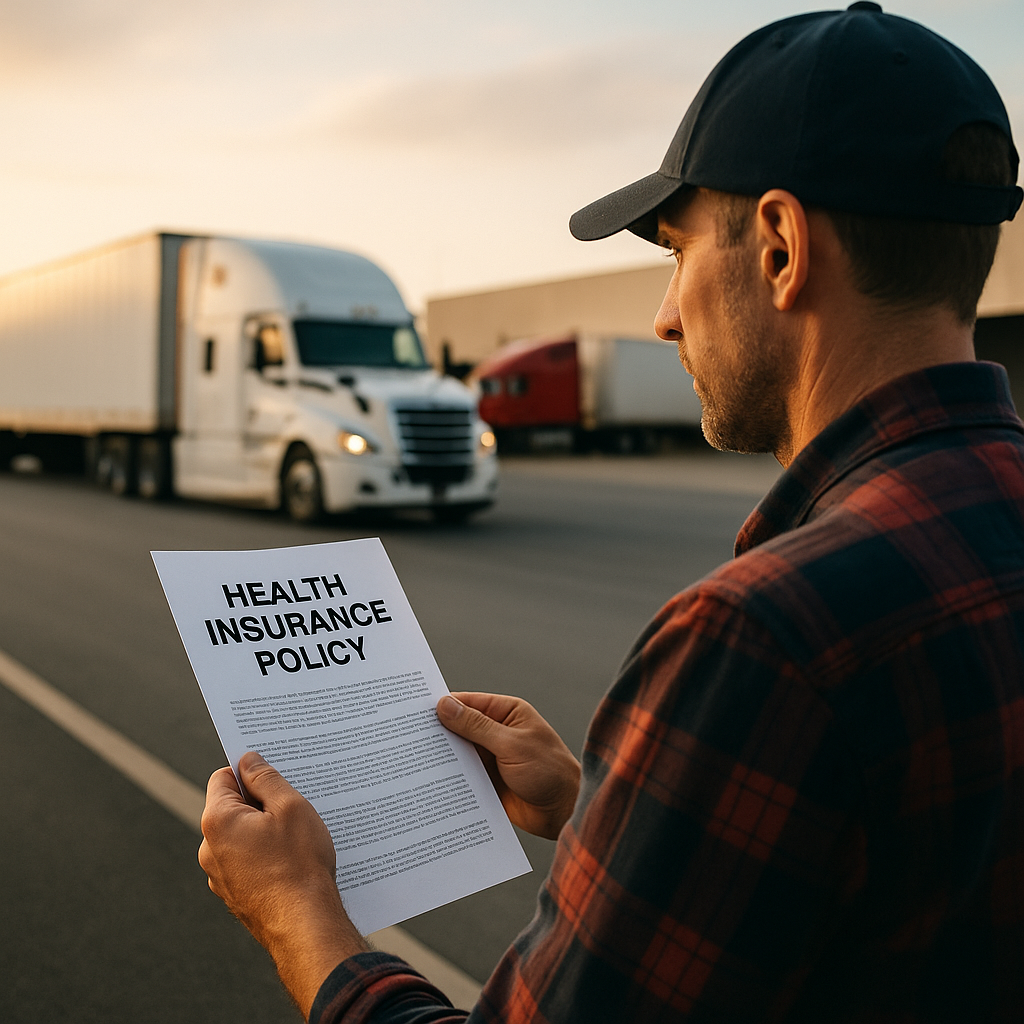

Uninsured motorist coverage for truck drivers explained: what UM/UIM covers, limits, claims, and typical 2026 cost ($100–$400/yr). Get protected.
Uninsured motorist coverage for truck drivers (UM/UIM) is an optional part of a commercial auto policy that can pay for injuries (and sometimes truck damage) when you’re hit by a driver with no insurance—or not enough insurance. Depending on your state and policy form, UM/UIM may also apply to certain hit-and-run claims when you have proper documentation (especially a police report).
If you run tight margins, UM/UIM isn’t a “nice-to-have.” It’s a cash-flow tool. One not-at-fault crash can trigger tow bills, storage fees, medical visits, and days (or weeks) off the road while the at-fault party dodges responsibility. This guide shows where UM/UIM fits inside your commercial truck insurance coverage basics, what to buy (and what not to overpay for), and how to file a clean claim when it matters.
Hero image placeholder
Alt text: Truck driver reviewing uninsured motorist coverage options on a commercial auto policy
Key takeaways (owner-operator friendly)
Uninsured motorist (UM) applies when the at-fault driver has no insurance, and underinsured motorist (UIM) applies when the at-fault driver’s limits are too low to cover your damages.
- UM = no insurance. UIM = not enough insurance. Both are designed to protect you after a not-at-fault crash.
- UM/UIM is usually state-driven—not FMCSA-required—but it can be a smart add-on for protecting your body, income, and business.
- Typical 2026 add-on cost is often about $100–$400/year for many trucking policies (varies by state, limits, and loss history).
- Claims are won or lost on documentation: police report, photos, dashcam/telematics, proof of uninsured status, and clean wage-loss records.

Table of Contents
Reading time: 10 minutes
- What uninsured/underinsured motorist coverage is (and why truckers feel it more)
- Is UM/UIM required for commercial trucks?
- What UM/UIM covers for trucking (and what it doesn’t)
- Buying UM/UIM the smart way: limits, multi-state exposure, claims, and premium impact
- Frequently Asked Questions
- Conclusion: UM/UIM is often a low-cost, high-impact add-on for truckers
What uninsured/underinsured motorist coverage is (and why truckers feel it more)
Uninsured and underinsured motorist coverage exists because many drivers either carry no insurance or carry limits too low to fully pay for injuries and property damage after a crash.
When that happens, UM/UIM can step in (subject to your limits, state rules, and policy language) so you’re not stuck waiting on an at-fault driver who can’t pay. For a plain-English overview from an insurance regulator perspective, see the NAIC resource: https://content.naic.org/cipr-topics/uninsured-motorists.
UM vs. UIM (quick definitions)
UM (Uninsured Motorist) means the at-fault driver has no insurance, while UIM (Underinsured Motorist) means the at-fault driver has insurance but their limits aren’t enough to cover your damages.
- UM (Uninsured Motorist): The at-fault driver has no insurance (and in many states/policies, certain hit-and-run scenarios can qualify).
- UIM (Underinsured Motorist): The at-fault driver has insurance, but the limits are too low to cover your losses.
Truckers feel this harder because your “small” crash can still involve expensive recovery, long repair delays, and time off the road.
Why truck drivers face outsized risk
Truck driver losses can stack fast because towing/recovery, storage, repair backlogs, and medical care can run concurrently while revenue stops.
- Tow + recovery: Especially costly when you’re loaded or disabled off-road.
- Storage fees: Often billed daily while liability is sorted out.
- Repair delays: Parts, labor, and shop scheduling can stretch timelines.
- Medical + rehab: Even a “minor” injury can keep you from passing a DOT physical.
Pro tip for hotshot operators
Hotshot operators commonly run in metro traffic where uninsured drivers are more frequent, and a personal auto UM endorsement may not be written correctly for commercial exposure.
If you’re running a 1-ton/dually with a trailer, review hotshot insurance policy options and confirm your UM/UIM is rated and endorsed for how you actually operate.
Is UM/UIM required for commercial trucks?
FMCSA financial responsibility rules focus on public liability filings for for-hire carriers (like BMC-91/91X), not optional first-party coverages like UM/UIM.
In trucking, “required” usually falls into three buckets:
- Federal authority filings: Liability requirements tied to your operating authority and filings.
- State rules: Some states require UM/UIM to be offered, and some require written rejection to remove it.
- Contracts: Lenders, brokers, and shippers can require coverages even when laws don’t.
Federal vs. state rules (what’s actually “required”)
FMCSA’s insurance filing requirements address liability coverage evidence for regulated motor carriers and do not mandate UM/UIM as a federal filing coverage.
You can review FMCSA’s overview here: https://www.fmcsa.dot.gov/registration/insurance-filing-requirements.
For the liability baseline (the coverage that pays others when you’re at fault), see trucking liability insurance requirements by authority/type.
“Must offer” vs. “must carry” (state reality)
Many states require insurers to offer UM/UIM, and some states effectively include it unless you reject it in writing.
If you (or your agent) signed a rejection form years ago, you may be running with zero UM/UIM today and not find out until you need it.
Practical tip: If you reject UM/UIM, keep that rejection document with your policy records—because disputes get decided by paperwork.
What UM/UIM covers for trucking (and what it doesn’t)
UM/UIM is a first-party coverage that can pay covered injury damages (and sometimes vehicle property damage) after a not-at-fault crash caused by an uninsured or underinsured driver, subject to your limits and state rules.
UM/UIM isn’t magic money—it has triggers, definitions, and exclusions that matter when you’re trying to get back on the road.
Image placeholder
Alt text: Chart showing what UM/UIM covers vs what it does not cover for trucking
Covered vs. not covered (quick table)
| Typically covered (when triggered) | Not covered / usually not covered |
|---|---|
| Bodily injury: medical bills, rehab | Damage you cause to others (that’s liability) |
| Bodily injury: wage loss (per policy terms) | Your cargo (usually a separate cargo policy) |
| Pain/suffering (varies by state/claim handling) | Wear/tear, mechanical breakdown |
| Sometimes property damage to your truck (UMPD/UIMPD, where offered) | Business interruption unless specifically endorsed |
Bodily injury UM/UIM (UMBI/UIMBI)
Bodily injury UM/UIM can pay injury-related damages for covered people in a covered accident caused by an uninsured or underinsured driver.
If you can’t pass a DOT physical because of crash-related injuries, your revenue shuts off. UMBI/UIMBI helps keep a bad crash from turning into a business-ending spiral.
Hit-and-run note: Many policies require prompt notice and a police report, so don’t “handle it later” if you can avoid it.
Property damage UM/UIM (UMPD/UIMPD) vs. collision/comprehensive
Uninsured/underinsured motorist property damage (UMPD/UIMPD) may help pay for truck repairs after a not-at-fault crash, but availability and rules vary by state and carrier.
Even when you did nothing wrong, you can still eat a deductible and lose time proving the other driver’s insurance status. If you already carry collision/comprehensive (physical damage), UMPD may be less critical—but it can still matter in the right scenario.
To compare deductibles and how repairs get paid, review physical damage coverage for semi truck repairs.
Common misunderstandings that cost truckers money
The three most expensive UM/UIM misconceptions are: (1) UM replaces liability, (2) UM covers cargo, and (3) not-at-fault means automatic payment without proof.
- “UM replaces my liability.” It doesn’t—liability is for damage you cause to others.
- “UM covers my load.” Cargo is usually handled by a separate cargo policy.
- “If I’m not at fault, everything’s automatic.” UM/UIM claims still require evidence and documentation.
Buying UM/UIM the smart way: limits, multi-state exposure, claims, and premium impact
Choosing UM/UIM is a renewal decision about risk tolerance, because your UM/UIM limit is the maximum the policy can pay for covered damages after an uninsured/underinsured loss.
This is where truckers get burned: the coverage exists on paper, but limits, who’s insured, and claims documentation don’t match how the operation actually runs.
Owner-operator vs. leased-on vs. fleet (who should carry what)
UM/UIM may sit on the motor carrier’s policy, your own commercial auto policy, or both, depending on your structure and state.
- Leased-on drivers: Ask for the declarations page and confirm UM/UIM limits, who is insured, and whether it’s BI-only or includes PD where available.
- Own authority: UM/UIM is often one of the best ROI add-ons in your commercial auto stack.
- Fleets: UM/UIM can help reduce drawn-out recovery fights and improve driver retention by protecting drivers.
Choosing UM/UIM limits (simple decision framework)
Picking a UM/UIM limit is choosing how much injury and downtime risk your business can absorb after a not-at-fault crash.
Image placeholder
Alt text: Decision tree for choosing UM/UIM limits for a commercial truck policy
- Start with worst-case time off: Think “serious injury + weeks/months off,” not “average fender bender.”
- Include household reality: Mortgage/rent, bills, and dependents still need to be covered.
- Match your lanes: Metro/interstate exposure with lots of four-wheelers often justifies higher limits.
Multi-state note: “Offer/rejection” and “stacking” rules vary by state and policy language. If you run multiple power units, ask your agent how stacking works in your garaging state and how the policy defines covered autos and insureds.
2026 cost: how much does UM/UIM add to commercial truck insurance?
In 2026, basic UM/UIM on many trucking policies commonly prices as an add-on around $100–$400 per year, but the final cost depends on state, limits, driver count, power units, loss history, and whether property damage is included.
This isn’t a promise or a quote—just a practical range truckers often see when UM/UIM is added at modest limits. UM/UIM is one of the few coverages where the premium increase can be small compared to the downside risk.
Keep it affordable the right way: Before you delete protection, rebuild the policy intentionally and look for real levers (deductibles, safety tech, driver selection, radius). Use ways to lower your trucking insurance premium as a checklist.
How a UM/UIM claim works (step-by-step + documentation checklist)
UM/UIM claims require you to prove the other driver is uninsured or underinsured, which usually means documentation like a police report and written confirmation of coverage denial or low limits.
For a broader claim walkthrough beyond UM/UIM, keep this handy: how to file a commercial truck insurance claim.
Step-by-step claim flow (the “don’t mess this up” version)
- Call law enforcement and get the report number (especially for hit-and-run).
- Notify your insurer fast. Same day if possible—don’t wait until you’re home.
- Document uninsured status / low limits:
- UM: denial-of-coverage letter, proof of lapse, or written confirmation they’re uninsured
- UIM: declarations/limits confirmation from the at-fault carrier
- Lock in evidence: photos, witness names, dashcam, and any ELD/telematics snapshots.
- Track damages cleanly: medical records, work restrictions, and wage-loss proof.
Copy/paste UM/UIM documentation checklist
- Police report + incident number
- Photos: vehicles, plates, DOT numbers, scene, skid marks, traffic controls
- Witness names + phone numbers
- Dashcam footage + telematics/ELD location/time screenshots
- Tow bill + storage invoices + recovery receipts
- Repair estimates + supplement approvals
- Medical bills + treatment notes + “no work” restrictions
- Wage-loss proof: rate cons, settlement statements, invoices, 1099 history (whatever fits your operation)
Real-world example (what this protects)
You’re deadheading out of a receiver, get sideswiped by a hit-and-run, and your steer tire blows. Now you’ve got a tow, a fender/hood repair, alignment, and a doctor visit. The other party disappears. A clean UM claim file can be the difference between a fast resolution and weeks of delays while bills stack up.
Will a UM/UIM claim increase your premium?
Not-at-fault claims can still affect pricing depending on state rating rules and underwriting guidelines, but frequency and severity usually matter more than a single event.
What typically moves the needle most is repeated losses, severe payouts, and patterns tied to territory, exposure, or weak controls.
The downtime math truckers actually care about
Insurance is consistently cited as a major trucking operating cost category, and downtime can create immediate cash-flow pressure even before net profit is calculated.
- ATRI (industry cost research): https://truckingresearch.org/
- BLS pay data benchmark (earnings context): https://www.bls.gov/oes/current/oes533032.htm
Illustrative example: If a crash puts you down 10 working days, that can easily mean two weeks of missed revenue potential. UM/UIM can protect injury-related damages (and sometimes truck damage), but timing and paperwork still matter, so plan for downtime with a reserve and clean documentation.
Frequently Asked Questions
Uninsured motorist (UM) coverage helps pay for your damages when you’re hit by a driver who has no auto insurance, and underinsured motorist (UIM) applies when the at-fault driver’s limits are too low to cover your losses. UM/UIM can include bodily injury damages (medical bills, rehab, wage loss, and sometimes pain and suffering depending on state rules) and, where offered, property damage (UMPD/UIMPD) for your vehicle. Hit-and-run eligibility and proof requirements vary by state and policy form, but a police report and prompt notice are commonly required.
Many truck drivers benefit from UM/UIM because a not-at-fault crash can still create medical bills, missed work, and a long fight to get paid when the other driver has no insurance or low limits. Owner-operators under their own authority often buy UM/UIM as a high-ROI add-on because income depends on staying DOT-qualified and rolling. If you’re leased on, you might have UM/UIM through the motor carrier, but you should verify limits, who is an insured, and whether coverage is BI-only or also includes PD where available.
Sometimes, because uninsured/underinsured motorist property damage (UMPD/UIMPD) depends on your state and your policy form. Even when UMPD/UIMPD is available, it can come with limits, deductibles, or restrictions that make it less comprehensive than collision coverage. If you carry collision and comprehensive (physical damage), your truck can usually be repaired regardless of fault, but you’ll likely pay the deductible upfront. That’s why it’s smart to compare UM property damage options against your physical damage setup and deductible strategy.
UM/UIM usually does not cover cargo, because it’s primarily designed for injuries (and sometimes vehicle damage), not the value of the load. Cargo losses are typically handled under a motor truck cargo policy and depend on the cargo form, bill of lading, exclusions, and contract terms with the shipper or broker. If you want to prevent gaps and misunderstandings at claim time, review cargo insurance for owner-operators and confirm exactly how your cargo coverage responds to theft, damage, and claims documentation.
Conclusion: UM/UIM is often a low-cost, high-impact add-on for truckers
Uninsured motorist coverage for truck drivers can protect your body and your business when the other driver can’t (or won’t) pay. The key is to confirm who’s insured, choose limits that match real injury risk, and keep documentation tight so claims don’t drag out while bills stack up.
Key Takeaways:
- UM = no insurance; UIM = not enough insurance—and both can matter after a not-at-fault crash.
- UM/UIM isn’t FMCSA-filed liability; it’s a state-driven add-on that can protect you directly.
- Documentation drives outcomes: police report, photos, dashcam/telematics, and proof of uninsured/low limits.
If you want a fast reality check at renewal, price your policy with UM/UIM both ways and compare the difference—then decide using your worst-case downtime scenario. For related coverage planning, keep these handy: owner-operator insurance checklist and ways to lower your trucking insurance premium.





