
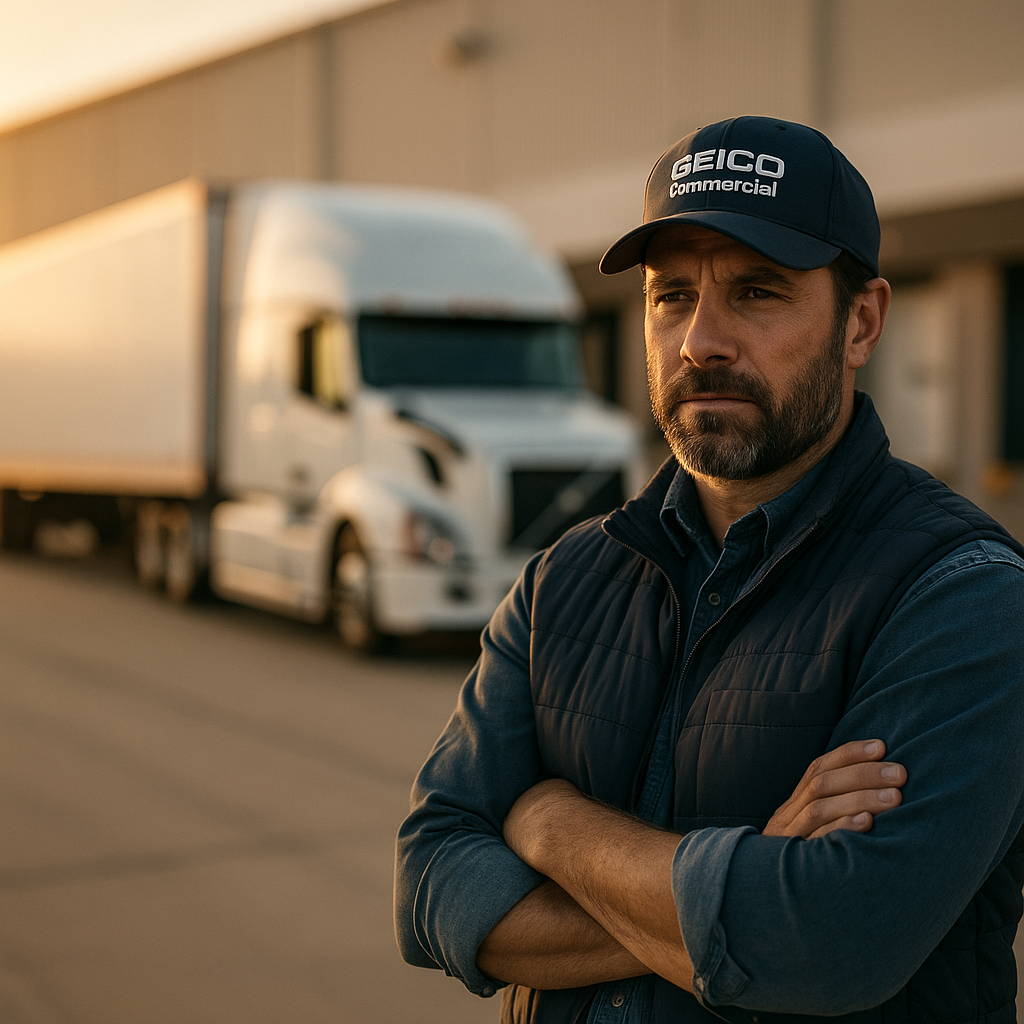

GEICO commercial truck insurance for owner operators—6 key coverages, 2026 cost ranges, filings vs COIs, and leased vs own-authority tips. Compare quotes now.
If you’re searching GEICO commercial truck insurance for owner operators, you’re usually trying to prevent one wreck, one cargo claim, or one paperwork mistake from crushing cash flow. The key is building the right coverage stack for how you run: permanently leased to a motor carrier vs operating under your own authority.
Quick answer: Most owner-operators build a stack around liability, physical damage, and (for many) cargo, then add non-trucking liability, general liability, or trailer interchange if their lease, lanes, or broker packets require it. If you want a fast baseline before comparing GEICO to other options, start with commercial truck insurance basics so you can spot gaps.
Key takeaways:
- Leased vs. own authority drives the policy: leased operators often need physical damage + non-trucking liability; own-authority operators usually need liability + cargo + filings.
- “Filings” aren’t an ID card: filings go to regulators; COIs go to brokers/shippers.
- Costs swing on a few big levers: authority age (new venture), radius, cargo class, loss history, and truck value move most premiums.
- Affordable trucking insurance is a cash-flow decision: pick deductibles you can pay quickly and avoid lapses.
Table of Contents
Reading time: 9 minutes
- GEICO trucking insurance for owner-operators: who it’s for (leased vs. own authority)
- What does GEICO owner-operator insurance cover? The 6 coverages to know
- Filings vs. COIs: what “filings” really means
- GEICO owner-operator insurance cost in 2026: budgeting ranges + savings levers
- Next steps: build the right stack, then compare apples to apples
- Frequently Asked Questions

GEICO trucking insurance for owner-operators: who it’s for (and what changes when you’re leased)
Owner-operators are typically either permanently leased to a motor carrier (running under the carrier’s DOT/MC) or operating under their own authority (their DOT/MC), and that single difference determines which coverages, limits, and filings apply.
If you want a quick framework for “what’s usually on you vs. on the carrier,” review the standard owner-operator insurance coverage stack before you compare quotes.
Two common setups: permanently leased vs. own authority
- Permanently leased to a carrier: You haul under their authority, and they often provide primary auto liability (confirm in writing).
- Own authority: You are the motor carrier, and you’re responsible for meeting FMCSA minimums and broker/shipper requirements.
Operations that can change underwriting (and pricing)
Underwriters typically rate your risk on exposure (miles/radius), cargo, and claims history—not just your CDL time.
- Local vs. regional vs. long-haul: More road time generally means more exposure.
- Hotshot insurance scenarios: A dually + gooseneck, power-only, or lighter-duty setup may be rated differently than a Class 8 tractor.
- Reefer or high-theft freight: Cargo exclusions, theft conditions, and limit requirements can get stricter.
Practical caution: Don’t describe your operation “optimistically” just to chase a cheaper premium; mismatches between the application, COIs/filings, and claim facts can create serious claim problems.
What does GEICO owner-operator insurance cover? The 6 coverages to know
A typical owner-operator coverage stack includes primary auto liability, physical damage, motor truck cargo, non-trucking liability (often for leased operators), general liability, and trailer interchange (when pulling non-owned trailers under a written interchange agreement).
Availability, forms, and endorsements vary by state and insurer, so use this as a decision framework—not a promise that any one carrier (including GEICO) will offer every coverage in every situation.
Coverage cheat sheet (who usually buys what)
| Coverage | What it protects | Usually needed when… |
|---|---|---|
| Primary liability | Injury/property damage you cause to others | Own authority (and sometimes higher limits by contract) |
| Physical damage (comp + collision) | Your tractor (and sometimes scheduled equipment) | Leased or authority if you own/finance the unit |
| Motor truck cargo | Certain loss/damage to freight (subject to exclusions/conditions) | Common with own authority; sometimes leased depending on contract |
| Non-trucking liability (NTL) / “bobtail” | Liability that may apply off dispatch | Common for permanently leased owner-operators |
| General liability | Non-auto business liability | Often required by brokers/terminals |
| Trailer interchange | Damage to non-owned trailers in your care under an interchange agreement | Power-only, some dedicated lanes, some leased setups |
Primary liability (especially if you have your own authority)
Primary auto liability typically responds when you’re legally liable for bodily injury or property damage to others from an at-fault covered auto accident.
For many for-hire interstate carriers, FMCSA financial responsibility minimums are tied to cargo/operations (often discussed as $750,000 for many general freight operations, with higher requirements for certain hazardous materials under 49 CFR Part 387), and brokers frequently require $1,000,000 liability by contract.
Physical damage (comprehensive + collision)
Physical damage coverage generally includes comprehensive (theft, vandalism, weather, animal strikes) and collision (impact/rollover), subject to your deductible and policy form.
A deductible only helps if you can actually pay it quickly; choose a number that matches real cash flow, not a “hope it never happens” plan.
Motor truck cargo (cargo insurance)
Motor truck cargo insurance can cover certain cargo loss or damage while in your care, custody, and control, but exclusions (temperature, unattended theft conditions, wear/tear, improper securement, etc.) can matter as much as the limit.
If you routinely haul higher-theft or higher-value loads, read the policy conditions closely and align the COI wording with what your broker packet requires.
Non-trucking liability (NTL) / “bobtail” (common for leased operators)
Non-trucking liability is designed to cover certain liability exposures when a permanently leased owner-operator is not operating in the business of the motor carrier, and the definition of “dispatch/off-dispatch” is a common source of claim disputes.
If you want concrete examples (home time, shop runs, deadhead with/without dispatch), read non-trucking liability (bobtail) explained before you buy—because wording and lease language are where gaps happen.
General liability + trailer interchange (when required)
General liability (GL) covers certain non-auto business exposures, and trailer interchange covers physical damage to a non-owned trailer you’re responsible for under a written interchange agreement.
- GL: Common broker/terminal requirement (and sometimes needed for leased operators depending on the contract).
- Trailer interchange: Common for power-only, some dedicated lanes, and operations that regularly take possession of customer/carrier-owned trailers.
Filings vs. COIs: does GEICO help with filings (and what does that mean)?
FMCSA insurance filings are electronic proof of financial responsibility submitted to regulators for operating authority, while a Certificate of Insurance (COI) is a document you provide to brokers and shippers to show limits, dates, and key coverages.
Filings (regulators) are not the same as certificates (brokers/shippers)
- Filings: Often discussed in the context of FMCSA proof of financial responsibility (for example, BMC filings) tied to an active authority.
- COIs: What brokers/shippers request so they can load you and pay you.
If you want a deeper compliance overview from a trucking-insurance perspective, start with FMCSA insurance requirements overview, then cross-check the official FMCSA page: https://www.fmcsa.dot.gov/registration/insurance-filing-requirements.
Quick process to avoid authority delays
Small documentation delays can keep an otherwise ready operator from booking the first load.
- Confirm your authority status: Verify DOT/MC details and company name/address if anything changed (SAFER lookup: https://safer.fmcsa.dot.gov/).
- Ask one clarity question: “What coverage do I carry, and what coverage does the carrier carry—on dispatch and off dispatch?”
- Prepare a COI holder list: Brokers/warehouses/factoring (if applicable) so certificates don’t become a weekly bottleneck.
GEICO owner-operator insurance cost in 2026: budget ranges + ways to lower the premium
Owner-operator premiums commonly vary by state, authority age (new venture vs established), radius/miles, cargo class, loss history, and truck value/deductibles, so two operators with the same truck can see very different pricing.
Industry cost research also shows insurance remains a meaningful operating expense line item for trucking businesses (ATRI cost research: https://truckingresearch.org/2024/10/an-analysis-of-the-operational-costs-of-trucking-2024-update/).
Typical 2026 budgeting ranges (planning numbers, not a quote)
These ranges are meant for budgeting and cash-flow planning; your actual premium may land outside these bands based on underwriting details.
| Setup | Typical coverages | Rough budgeting range (annual) |
|---|---|---|
| Leased owner-operator | Physical damage + NTL (and sometimes GL) | ~$4,000–$12,000+ |
| Own authority (general freight) | Primary liability + cargo + physical damage (+ GL) | ~$12,000–$30,000+ |
| Higher-risk profiles (new venture, long-haul, certain cargo) | Same as above + endorsements/limits | ~$20,000–$45,000+ |
What moves price the most
- New venture authority: Brand-new authority can price differently than established authority.
- Long radius/long-haul: More exposure often means higher premium.
- Loss history: Frequency and recency of claims matter.
- Cargo type: Theft-prone or specialized freight can change eligibility, conditions, and price.
- Truck value + deductibles: Higher values and lower deductibles generally increase physical damage premium.
- Garaging ZIP/state: Location can significantly affect rates.
If you want a deep dive on rating variables underwriters actually use, read what affects the cost of truck insurance.
Three quick real-world scenarios
- Scenario A (leased, off-dispatch exposure): You drive the tractor home, to the shop, and for personal errands—this is where NTL definitions can create a gap if everyone assumes “the other policy” covers it.
- Scenario B (own authority, regional general freight): Dry van, regional radius, clean MVR, established authority—often a more straightforward underwriting story.
- Scenario C (long-haul + tougher freight): More miles, more docks, more overnight parking risk, more cargo theft exposure—premiums and exclusions often tighten up.
How to lower your premium without cutting protection
Cost control is usually about removing preventable “risk signals,” not stripping coverages that keep you in business.
- Avoid lapses: Coverage lapses can increase pricing and reduce options.
- Pick deductibles that match cash flow: If you can’t pay it fast, it’s not a real deductible plan.
- Build a provable safety story: Maintenance records, dash cam use, ELD/HOS habits, clean driver qualification files.
- Match radius/cargo to reality: Your ELD and invoices should support what you told underwriting.
For state-specific benchmarks, see Texas commercial truck insurance cost. For practical savings tactics that don’t create coverage gaps, use the affordable trucking insurance savings playbook.
Next steps: build the right coverage stack for your authority status (then compare apples to apples)
The most reliable way to compare truck insurance quotes is to match the same limits, deductibles, listed vehicles, cargo, and endorsements across carriers, because “cheap” often means “different coverage.”
A simple checklist for a clean, fast quote
- Confirm leased vs. own authority responsibilities (in writing): especially on-dispatch vs off-dispatch liability.
- Get your core details ready: VIN, garaging ZIP, radius, cargo type, prior coverage, loss runs (if available).
- Compare structure, not just monthly payment: limits, deductibles, exclusions, and conditions (cargo theft conditions are a common surprise).
If you’re running under your own authority, your safety and compliance profile can affect renewals and pricing over time; learn how it connects in DOT compliance record and trucking insurance.
Frequently Asked Questions
GEICO commercial truck insurance for owner operators can include a coverage stack such as primary auto liability, physical damage, motor truck cargo, non-trucking liability (often for permanently leased operators), general liability, and trailer interchange when a written interchange agreement applies. Your lease agreement, broker packets, and shipper contracts usually determine which limits and endorsements you must carry (for example, many brokers require $1,000,000 liability). Always verify which policy applies on-dispatch vs off-dispatch so you don’t accidentally create a gap.
GEICO owner-operator pricing in 2026 is risk-based, so the best approach is to budget with ranges and then quote using your real lanes, cargo, and history. Many leased owner-operators budget roughly $4,000–$12,000+ annually (often physical damage + non-trucking liability), while many own-authority operators budget roughly $12,000–$30,000+ annually (liability + cargo + physical damage), with higher-risk profiles sometimes budgeting $20,000–$45,000+. State, garaging ZIP, authority age (new venture), and losses can move the premium significantly. NAIC consumer overview: https://content.naic.org/consumer/commercial-auto-insurance.
Many permanently leased owner-operators do need non-trucking liability because it may apply when you’re off dispatch, such as driving home, going to a shop, or running personal errands. The catch is that “dispatch,” “in the business of,” and “covered auto use” are defined by your policy form and your lease language, and those definitions can change whether a claim is covered. Get the carrier’s coverage responsibilities in writing and compare them directly to your NTL wording so you don’t end up with a coverage gap during deadhead or personal-use trips.
FMCSA filings are proof of financial responsibility submitted electronically to regulators for an active operating authority, and insurers/agents typically coordinate the filings when they’re required for your operation. If you’re running under your own authority, you may need filings tied to that authority; if you’re permanently leased, the motor carrier generally handles filings tied to the carrier’s authority and you’ll mostly deal with COIs for brokers and shippers. FMCSA reference: https://www.fmcsa.dot.gov/registration/insurance-filing-requirements. SAFER status checks: https://safer.fmcsa.dot.gov/.
Conclusion: The best “GEICO vs. not GEICO” move is getting your stack right
GEICO trucking insurance may be a fit for some owner-operators, but the real win is matching your coverage stack to your authority status, lanes, and contracts. Once your limits, deductibles, and endorsements are aligned, quote comparisons become clean—and you can avoid expensive gaps.
Key Takeaways:
- Start with status: permanently leased vs own authority changes liability, cargo responsibility, and filings.
- Build the stack intentionally: liability, physical damage, cargo, and (if needed) NTL, GL, trailer interchange.
- Budget with ranges, then verify: pricing depends on radius, cargo, losses, location, and authority age.
If you want to move fast, gather your VIN, garaging ZIP, radius, cargo type, and prior coverage details, then compare quotes with matching limits and deductibles.





