GEICO dump truck insurance coverage explained—liability, physical damage, filings, and 2026 cost ranges. Build the right policy fast—compare quotes.
If you run a dump truck, GEICO dump truck insurance coverage can look straightforward on the quote, but the expensive surprises usually come from missing endorsements, incorrect classifications, or paperwork that doesn’t match a jobsite contract.
GEICO dump truck insurance coverage is typically a commercial auto policy built around auto liability, with optional add-ons like physical damage (comp/collision), UM/UIM, med pay/PIP (state-dependent), and—depending on your operation—filings, hired/non-owned, and other endorsements. Exact availability and limits vary by state, truck class, and how you operate (own authority vs leased-on).
For real-world budgeting and a checklist that helps you prep underwriting info, see Dump truck insurance quote (2026 cost ranges).
Table of Contents
Reading time: 8 minutes
- Introduction: the fastest way to burn profit is being “almost covered”
- Key takeaways
- How GEICO dump truck coverage fits into commercial truck insurance (and who it’s for)
- GEICO dump truck insurance coverage: what’s typically included (and what you should add)
- 2026 costs, filings, discounts, and a “don’t-get-stalled” checklist
- Frequently Asked Questions
- Conclusion: build the right GEICO dump truck policy (without overpaying)
👉 Prefer watching a quick video about dump truck insurance?
Watch the video below for a quick overview of dump truck insurance rules, how much it costs, and practical ways to save. Or give us a call: (704) 290-3630
Introduction: the fastest way to burn profit is being “almost covered”
Insurance gaps in dump trucking most often show up as downtime, out-of-pocket deductibles, rejected certificates of insurance (COIs), or inactive filings when a contractor or regulator checks your status.
If you run a dump truck, you already know the real risk isn’t just the wreck—it’s the jobsite contract that kicks your bid because your COI is missing one line, or the filing that isn’t active when the scale house (or a prime contractor) checks.
Practical goal: set up liability to meet legal/contract requirements, then add the coverages that protect your cash flow (truck value, medical exposure, and paperwork speed).

Key takeaways
Dump truck insurance decisions usually come down to liability limits, physical damage strategy, and whether your contracts require filings, additional insureds, or special wording.
- “Dump truck insurance” is commercial truck insurance tailored to heavier vehicles, jobsite exposure, and short-haul/backing risk.
- Liability is the base. Profit protection typically comes from physical damage + realistic deductibles + the right optional coverages.
- Filings and contracts drive your limits. Legal minimums aren’t the same as what contractors, brokers, or municipalities require.
- To get more affordable trucking insurance, control what you can: continuous prior coverage, clean MVRs, correct radius/usage, and complete documentation.
How GEICO dump truck coverage fits into commercial truck insurance (and who it’s for)
GEICO dump truck insurance coverage is generally written as commercial auto (commercial truck insurance) and then tailored to your operation (weight class, jobsite exposure, radius, and authority setup).
Dump truck policies are usually adjusted for risk factors that matter in the field: frequent backing, tight jobsites, seasonal work, short-haul routes, and whether you’re hauling for-hire.
For a clear baseline on how liability, physical damage, endorsements, certificates, and compliance typically fit together, start with Commercial truck insurance basics (pillar).
What it is (plain English)
Think of it as: auto liability to stay legal + optional protection to keep one bad day from wiping out your cash flow.
Why it’s essential (business reality)
Dump work is “high-frequency exposure,” especially compared to long-haul:
- Tight jobsites + backing + pedestrians/equipment everywhere
- Short hops (more starts/stops = more chances for fender-benders)
- Higher claim severity because of vehicle weight and impact
Who usually needs it
- Owner-operators (1–2 trucks) hauling gravel, asphalt, aggregates, or demo haul-off
- Small fleets (2–10 units) bidding subcontract work that requires COIs
- Any operator who needs additional insureds, jobsite certificates, or state/federal filings to get paid
Pro tip: Ask for insurance requirements before you bind. It’s usually cheaper to set limits/wording correctly up front than to rewrite mid-job.
GEICO dump truck insurance coverage: what’s typically included (and what you should add)
Most dump truck insurance setups start with commercial auto liability and then add optional coverages like physical damage, UM/UIM, medical coverages (state-dependent), and compliance-related endorsements based on how you operate.
Below is the coverage stack many dump truck operators build because it matches the way claims actually happen: collisions in tight spaces, windshield/comp claims, uninsured drivers, and contract-driven paperwork demands.
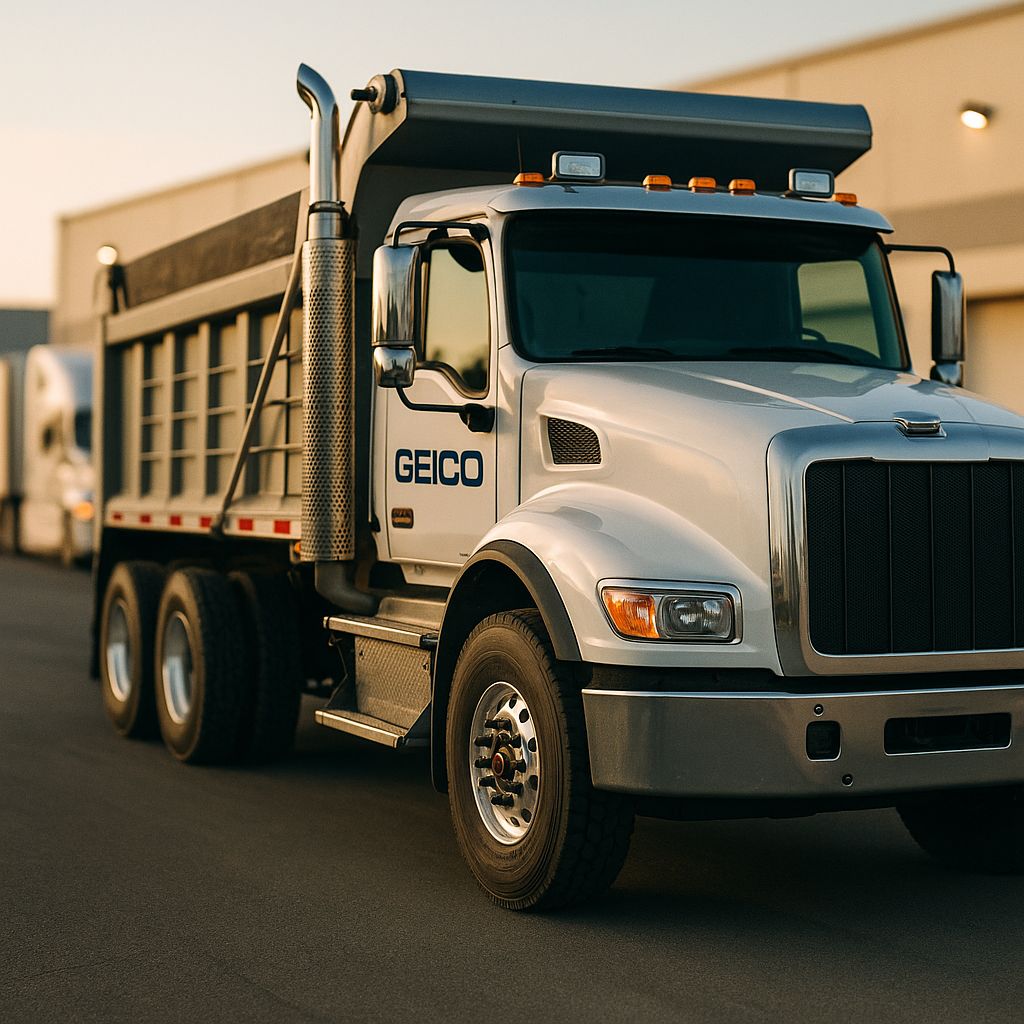
Image placeholder (hero): Dump truck owner reviewing GEICO commercial insurance coverage options
Alt text: Dump truck owner reviewing GEICO commercial insurance coverage options
Coverage menu (quick table)
Image placeholder (table graphic): Table of GEICO dump truck insurance coverage types and what each covers
Alt text: Table of GEICO dump truck insurance coverage types and what each covers
| Coverage | What it protects | When you typically need it | Watch-outs |
|---|---|---|---|
| Auto liability | Injuries/property damage you cause | Always (base coverage) | Contracts often require higher limits than legal minimums |
| Physical damage (comp/collision) | Your truck (wreck, theft, hail, vandalism) | Financed/leased trucks; anyone protecting cash flow | Deductible choice can make/break affordability |
| UM/UIM | If a driver hits you with no/low insurance | High traffic, urban/local work | Availability/limits vary by state |
| Med pay / PIP | Medical for driver/occupants (state-dependent) | Local operations where injuries happen even in minor wrecks | Options and rules vary by state |
| Non-trucking / bobtail | Liability when not under dispatch (wording matters) | Common when leased-on | Not the same as “I’m empty” |
Auto liability (the required core)
Auto liability pays for bodily injury and property damage to others when you’re at fault, and it’s the foundation of most dump truck insurance policies.
- Why it’s essential: It’s what keeps you legal and protects the business after a serious accident.
- Who needs it: Everyone operating a dump truck commercially.
- Pro tip: Match your limit to your contracts—municipal and prime contractor work often requires higher limits than minimums.
Physical damage (comp + collision): the “stay in business” coverage
Physical damage coverage typically includes comprehensive and collision to help repair or replace your truck after covered losses like crashes, theft, hail, vandalism, or fire.
If your truck is down, revenue often goes to zero while expenses don’t. For financed equipment, lenders frequently require physical damage.
Before choosing a deductible just to drop premium, read Physical damage coverage for trucks for a plain-English breakdown of comp vs collision, deductibles, and valuation basics.
UM/UIM + Med Pay/PIP (often overlooked in local dump work)
Uninsured/underinsured motorist (UM/UIM) helps when another driver causes an accident but doesn’t have enough insurance, and med pay/PIP can help with medical expenses depending on state rules.
Dump trucks spend a lot of time around distracted drivers, tight merges, and jobsite traffic patterns where minor crashes can still produce injuries.
Cargo and “stuff you’re hauling” (set expectations)
Cargo coverage is not automatically included on many commercial auto policies, and dump truck operators often need to clarify contract responsibility for materials.
Plain-English reality: Policy language and exclusions matter if you’re hauling aggregates, asphalt, demo debris, or other materials—especially if your contract makes you responsible once it’s loaded.
Pro tip: If your customer contract says you’re responsible for the material after loading, address it directly (coverage option, risk transfer, or contract change). Don’t guess.
Does GEICO cover semi-truck insurance and hotshot insurance, too?
GEICO offers commercial truck insurance products, and eligibility can vary by state and underwriting program for different vehicle types and operations.
- If you’re running a tractor-trailer and shopping semi truck insurance, eligibility and pricing can vary widely by state and operation.
- If you’re running a pickup + trailer configuration (often shopped as hotshot insurance), underwriting appetite can be very different than dump work.
Bottom line: When you quote, be precise about GVWR, radius, for-hire vs private, and whether you’re under your own authority.
2026 costs, filings, discounts, and a “don’t-get-stalled” checklist
A realistic 2026 budgeting range many dump operators see is roughly $400–$1,200+ per month per truck, with higher costs common for new ventures, dense metro work, higher limits, poor loss history, or prior-coverage lapses.
How much does GEICO dump truck insurance cost per month in 2026?
Carriers don’t publish a simple rate sheet because pricing is based on drivers, loss history, garaging ZIP, radius, truck value, limits, deductibles, and how the truck is used.
If you want a cost breakdown that’s built specifically for dump operations and quote prep, start with Dump truck insurance quote (2026 cost ranges).
Industry research also shows insurance is a major operating cost line item; ATRI’s “Operational Costs of Trucking” resources are a useful benchmark for how meaningful that spend can be across the industry. Source: https://truckingresearch.org/
To understand premium levers you can control before accepting a number, read What affects the cost of truck insurance.
Practical levers for more affordable trucking insurance
- Continuous prior coverage: Lapses are typically expensive in underwriting.
- Deductible strategy: Choose a deductible you can actually pay, and make sure it matches your cash reserves.
- Accurate radius and usage: Misclassification can create claim and audit headaches.
- Driver quality: Clean MVRs and documented experience help.
How to get filings for dump truck insurance (and verify they’re active)
FMCSA and some state programs require insurance filings for certain for-hire operations, and inactive filings can delay loads, contracts, or authority activation.
What filings are: proof of insurance submitted to a regulator (or sometimes a contract holder) showing you meet required financial responsibility.
- FMCSA insurance filing requirements: https://www.fmcsa.dot.gov/registration/insurance-filing-requirements
- Verify authority/insurance status (where applicable) via FMCSA SAFER: https://safer.fmcsa.dot.gov/
For a plain-English breakdown of filing types, timing, and common mistakes, see Truck insurance filings (FMCSA/state).
Image placeholder (filings checklist): Step-by-step checklist for requesting FMCSA or state insurance filings for dump trucks
Alt text: Step-by-step checklist for requesting FMCSA or state insurance filings for dump trucks
Step-by-step (keep it tight)
- Get your info right: legal entity name, DBA, garaging address, VINs, driver list, USDOT/MC (if applicable).
- Bind the policy correctly: wrong entity name = filing delays and rejected certificates.
- Request the exact filing needed: FMCSA/state filing or jobsite COI with additional insured if required.
- Verify before you haul: check SAFER (if applicable) and keep proof saved for jobsites, scales, or audits.
Discounts: what to ask about (without guessing program names)
Discount availability can vary by state and underwriting program, so the best approach is to ask targeted questions and provide proof.
For a full list of common levers (paid-in-full, safety, multi-unit, and documentation-based discounts), see Trucking insurance discounts.
- Multi-vehicle / fleet rating
- Paid-in-full
- Continuous prior insurance (no lapses)
- Experienced drivers / clean MVRs
- Safety programs and documentation (sometimes telematics-based, depending on availability)
Quote-speed checklist (reduces re-quotes and delays)
- VIN(s), year/make/model, stated use, annual mileage
- Garaging ZIP, radius (local vs regional), seasonal use
- Driver list with DOB + license info + years of experience
- Loss runs (if available) and prior insurance declarations
- Contract requirements: limits, additional insured, waiver of subrogation, primary/noncontributory wording
Quick comparison: GEICO vs other trucking insurance options
Comparing carriers is most accurate when you compare the same limits, deductibles, and classifications—not just the monthly price.
- Are we quoting the same liability limit and the same deductibles?
- Is the truck classified correctly for dump/construction use vs general hauling?
- How fast can you issue COIs and additional insureds for jobsites?
- Are there exclusions that hit dump work (jobsite operations, dumping, or off-road use)?
If you want a consumer-oriented place to research insurer information and complaint basics, the NAIC has general resources here: https://content.naic.org/
Frequently Asked Questions
These FAQs give direct answers about GEICO dump truck insurance coverage, typical optional coverages, 2026 cost bands, and how filings are usually requested and verified.
GEICO dump truck insurance coverage typically starts with commercial auto liability, and you can often add options like physical damage (comprehensive and collision), UM/UIM, and med pay/PIP (state-dependent). Depending on whether you’re for-hire, leased-on, or operating under your own authority, you may also need endorsements for filings, hired/non-owned exposure, or non-trucking/bobtail situations. Limits and availability vary by state and operation, so the only accurate answer is what’s listed on your declarations page and endorsements for your specific quote.
Many dump operators budget roughly $400–$1,200+ per month per truck in 2026, depending on drivers, radius, garaging ZIP, truck value, liability limits, deductibles, and loss history. New ventures, heavy jobsite exposure in dense metros, higher limits required by contracts, and prior-coverage lapses commonly push premiums above that range. The fastest cost levers are usually continuous prior coverage, clean MVRs, and choosing deductibles you can afford without leaving the truck under-protected.
You typically get filings by binding the policy under the correct legal entity name and then requesting the exact filing required (FMCSA, state, or a contract-holder certificate/COI with specific wording). For many regulated operations, you should verify status before hauling by checking public tools like FMCSA SAFER where applicable (https://safer.fmcsa.dot.gov/). If you want the filing types and common mistakes explained step-by-step, see Truck insurance filings (FMCSA/state).
Bobtail and non-trucking liability both generally address liability when a truck is not under dispatch, but the trigger depends on the policy wording and your lease/dispatch arrangement, so they’re not interchangeable. This issue shows up most often when you’re leased on to a motor carrier, because the carrier’s liability may apply while you’re dispatched, and your non-trucking/bobtail coverage may apply only during defined personal use. For the clean definitions—and the common “I’m empty so I’m covered” misconception—read Bobtail insurance explained.
Conclusion: build the right GEICO dump truck policy (without overpaying)
A job-ready dump truck insurance policy usually comes down to three checks: liability limits that match contracts, physical damage that matches truck value and cash reserves, and the right endorsements/filings for how you operate.
Your “core three” to sanity-check before you bind:
- Auto liability (meets legal + contract requirements)
- Physical damage (keeps one wreck from killing cash flow)
- Operations-driven add-ons (UM/UIM, med pay/PIP, filings, bobtail/non-trucking if leased-on)
Key Takeaways:
- Compare quotes using the same limits and deductibles so you’re not comparing apples to oranges.
- Use filings and COIs as a checklist item, not an afterthought—paperwork delays can stop work.
- Ask about discount levers you can prove with documentation (prior coverage, safety, multi-unit, paid-in-full).
If you want to tighten pricing and avoid compliance delays, these two guides are worth bookmarking: Trucking insurance discounts and Commercial truck insurance in Texas (example state guide).