
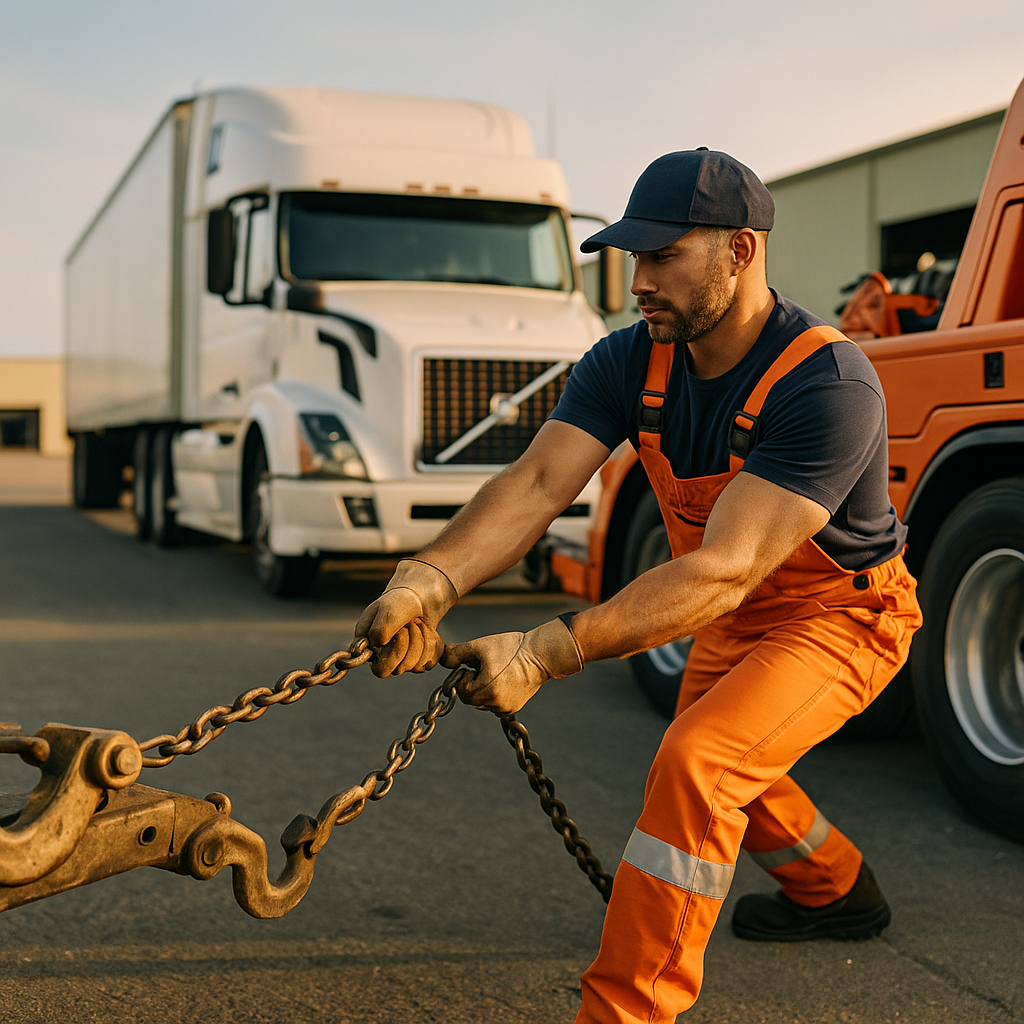
Semi truck towing limits often run $5K–$25K. See what towing & labor covers, exclusions, and claim steps for 2026. Protect cash flow—check yours before renewal.
Semi truck towing and labor coverage is typically an optional trucking insurance endorsement that helps pay heavy-duty towing and certain roadside labor when your tractor is disabled, with common limits around $5,000, $10,000, or $25,000 depending on the carrier and form. The catch is that some policies only pay towing after a covered physical damage loss (comp/collision), while others respond to a plain breakdown—so the wording matters as much as the limit.
This guide breaks down what towing & labor usually pays, what gets denied, how limit structures work (per event vs annual aggregate), and how to file a clean claim. For the big-picture context on how endorsements fit into a policy, start with commercial truck insurance basics.
Table of Contents
Reading time: 9 minutes
- Introduction: One Breakdown Can Torch a Week’s Profit
- Quick answer: What towing & labor typically includes
- What Is Semi-Truck Towing and Labor Coverage (and What It Isn’t)?
- What Towing and Labor Coverage Typically Includes (Plus the Gotchas)
- Towing & Labor vs Roadside Assistance vs Physical Damage (Not the Same Tool)
- Typical Semi-Truck Towing Limits (2026): $5K, $10K, $25K—How to Choose
- Is Towing & Labor Coverage Worth It? Real-World Cost Examples + Premium Impact
- Frequently Asked Questions
- Conclusion: Match Your Towing Limit to Your Lanes
Introduction: One Breakdown Can Torch a Week’s Profit
A heavy-duty tow for a disabled semi can cost thousands of dollars once you add hook-up, mileage, after-hours rates, and (sometimes) recovery time. When a tractor is stuck on the shoulder at night, on a mountain pass, or miles from a qualified shop, the wrecker bill can spike fast—and it lands as a surprise cash expense.
That surprise expense is exactly why semi truck towing and labor coverage exists. But on many policies it’s either limited, triggered only after a covered physical damage loss, or offered as an optional endorsement you have to add on purpose.

Quick answer: What towing & labor typically includes
Semi-truck towing and labor benefits typically pay for heavy-duty towing and certain roadside labor up to a stated limit (often $5,000 to $25,000), while recovery/winching is frequently excluded or sublimited unless the endorsement specifically grants it. Here’s the fast, featured-snippet-friendly breakdown.
| Coverage piece | What it pays for (typical) | Common limit examples |
|---|---|---|
| Towing | Heavy-duty tow to a repair facility (sometimes nearest qualified shop) | $5,000 / $10,000 / $25,000 |
| Roadside labor | On-site labor to get you rolling (often labor-only; parts usually excluded) | Included in limit or a small sublimit |
| Recovery / winching | Winch-out, uprighting, off-road extraction (varies widely) | Often excluded or separate sublimit |
Key takeaways
- “Labor” is usually roadside-only and labor-only: Don’t assume it pays for parts or shop time.
- Limits commonly run $5K–$25K: The wording may be per disablement (per event) or per policy period (aggregate).
- Many delays/denials trace back to paperwork: Non-authorized vendors (when authorization is required) and non-itemized invoices are common problems.
- Your lanes should drive your limit: Remote long-haul, mountains, and heavy recovery can burn through low limits fast.
What Is Semi-Truck Towing and Labor Coverage (and What It Isn’t)?
Towing & labor is typically an optional endorsement that helps pay for towing and certain roadside services when your truck is disabled, with triggers and limits that vary by carrier and policy form. You’ll see it on many semi truck insurance programs and sometimes on hotshot insurance setups, but the details are not standardized.
For a broader look at add-ons that change how your policy responds, review common truck insurance endorsements.
Plain-English definition
- What it is: Coverage (often by endorsement) that pays for heavy-duty towing and certain roadside labor when your power unit can’t move under its own power—or, on some forms, only after a covered loss.
- Why it matters: A tow bill is pure cash-flow pain: it’s not planned fuel, not scheduled maintenance, and it usually hits under load when you can least afford downtime.
- Who usually benefits: Owner-operators and small fleets running long-haul lanes, rural routes, mountain/snow states, or any operation where a basic light-duty tow is unrealistic.
What it isn’t (common confusion)
- Not liability insurance: Auto liability is for damage/injury you cause others; it doesn’t pay your wrecker bill.
- Not cargo insurance: Cargo covers the freight (subject to terms), not towing the tractor.
- Not automatically a roadside membership plan: Some roadside programs dispatch a provider; insurance endorsements often reimburse or pay subject to claim rules and documentation.
What Towing and Labor Coverage Typically Includes (Plus the Gotchas)
Most towing & labor forms split benefits into towing, roadside labor, and sometimes recovery/winching, and the biggest surprise bills happen when drivers assume recovery is included. In practice, “towing” and “recovery” can be treated as different services with different limits (or an outright exclusion).
To see how towing often connects to physical damage coverage, read physical damage insurance for semi trucks.
Towing (the heavy-duty part)
Towing typically pays to move the disabled tractor from the breakdown location to a repair facility, sometimes restricted to the nearest qualified shop or subject to a mileage/dollar cap. Heavy-duty tow pricing often stacks multiple line items, including hook-up/service call fees, mileage, after-hours rates, and time-based charges.
- What to confirm: Does the limit apply per disablement/event or as an annual aggregate?
- Common restriction: Some forms require dispatch/authorization before you hire a tow provider.
Labor (what “labor” usually means)
Roadside labor usually means on-site work intended to get the truck moving again, and it is commonly labor-only (with parts, fluids, and tires often excluded). If labor coverage solves the problem on the shoulder, it can prevent a full tow—but it’s not a blank check for shop repairs.
- Typical examples: Simple troubleshooting, jump/start assistance, minor air line fixes, or labor for a basic hose/line replacement (labor portion only).
- Documentation that speeds payment: Itemized invoice separating towing vs labor vs mileage vs after-hours vs recovery/winch charges.
Recovery / winching / uprighting (often restricted)
Recovery generally means winching out of a ditch, uprighting, off-road extraction, or other work needed before towing can even start, and it’s the category most likely to blow past a low towing limit. Many policies exclude recovery entirely or apply a separate sublimit, so you want the endorsement language in writing.
- Higher-risk operations: Mountain routes, winter lanes, oilfield/logging access roads, and any off-pavement exposure.
- Reality check: “Towing” doesn’t always mean “recovery.”
What’s commonly excluded (frequent denial triggers)
Common towing & labor exclusions include parts/fluids/tires, major mechanical breakdown repairs performed in a shop, and recovery services not explicitly granted by endorsement. Claims can also be reduced or denied when policy conditions aren’t met, such as using a non-authorized vendor when authorization is required.
- Often excluded: Parts, fluids, tires; major shop time; off-road extraction/uprighting unless explicitly covered.
- Operational mismatch: Operating outside the declared radius or materially changing operations without updating the policy can create problems.
How to file a towing & labor claim (clean, fast checklist)
A towing and labor claim is usually handled as reimbursement or direct pay depending on the program, and quick payment depends on authorization and an itemized invoice. When you’re stranded, you still want to leave a paper trail that a claims adjuster can verify without guessing.
- 1) Call first (when required): Use the policy claims/roadside number to confirm authorization and vendor rules.
- 2) Document the scene: Photos of truck position and surroundings (when safe), plus unit/VIN information.
- 3) Get an itemized invoice: Separate towing, labor, recovery/winch, mileage, and after-hours charges.
- 4) Keep proof of payment: Receipt and payment method for reimbursement claims.
- 5) Submit promptly: Include dispatch notes (location, time, load status) and keep copies.
Towing & Labor vs Roadside Assistance vs Physical Damage (Not the Same Tool)
Towing & labor coverage, roadside assistance programs, and physical damage (comp/collision) are three different tools with different triggers, payment methods, and exclusions. Mixing them up is how drivers end up paying twice for overlapping benefits—or worse, expecting coverage that only applies after a covered loss.
If you want a service-plan perspective (dispatching help for lockout, jumpstart, small service calls), compare with semi truck roadside assistance coverage.
Side-by-side comparison
| Feature | Towing & labor (insurance) | Roadside assistance (program) | Physical damage (comp/collision) |
|---|---|---|---|
| Trigger | Disablement and/or covered loss (varies) | Service call request (plan terms) | Covered loss (collision/comp) |
| How it pays | Claim-based reimbursement/direct pay | Benefit/service dispatch | Claim payment tied to loss + deductible |
| Best for | Big tow bills + documented reimbursement | Small-to-medium service needs | Damage to your truck from covered perils |
Required vs optional (keep it straight)
FMCSA financial responsibility rules focus on liability filings (not towing endorsements), so towing & labor is usually optional from a regulatory standpoint. However, towing or physical damage may be effectively required by a lender, a lease agreement, or a shipper/broker contract depending on your situation.
Reference (FMCSA): Insurance filing requirements
Typical Semi-Truck Towing Limits (2026): $5K, $10K, $25K—How to Choose
Typical towing limits for semi trucks are commonly listed as $5,000, $10,000, or $25,000, but the practical value depends on whether the limit is per event or an annual aggregate and whether recovery/winching is included. A $10,000 annual aggregate can disappear after one heavy recovery, while a $10,000 per-disablement benefit may reset each time.
Common limit structures (what to look for)
- Per disablement/event: A new limit applies each time the truck is disabled (subject to policy wording).
- Annual aggregate: One bucket for the full policy term; once it’s used, later events may be out-of-pocket.
- Sublimits: Separate caps for towing, labor, and recovery/winch.
If you’re comparing carriers, read the endorsement form, not just the declarations page. General consumer guidance on policy forms and endorsements is available through NAIC: https://content.naic.org/consumer.
Practical limit recommendations by operation type
- Local/regional (mostly interstate corridors): $5K–$10K is often a workable baseline if recovery language is clear.
- Long-haul + remote lanes/mountains: $10K–$25K is more realistic, especially if you want recovery/winch protection.
- Hotshot/off-pavement exposure: Focus less on the headline limit and more on whether off-road recovery is excluded or sublimited.
Is Towing & Labor Coverage Worth It? Real-World Cost Examples + Premium Impact
Towing and labor coverage is often worth it because one heavy-duty tow or recovery can cost more than multiple years of endorsement premium, especially for long-haul and remote operations. The goal is to buy a limit that matches your lanes and your downtime risk, not the cheapest number on a quote.
ATRI consistently tracks repair and maintenance as a major operating cost category, and roadside events can spike that cost unpredictably. ATRI research hub: https://truckingresearch.org/.
Real-world style scenarios (numbers vary by market)
- Scenario A — simple disablement tow: Shoulder breakdown, no recovery needed, tow 20–40 miles to a shop; a $5K limit may be fine unless after-hours pricing hits.
- Scenario B — remote lane + long tow: Nearest qualified shop is far (or you insist on a specific dealer), and mileage pushes past $5K quickly.
- Scenario C — recovery + tow: Winching/uprighting is needed before towing starts; this is where $10K–$25K and explicit recovery language matter.
What it typically costs to add (how pricing usually works)
Towing & labor pricing is usually a modest add-on compared to the exposure, but it’s still rated like other commercial truck insurance: state, garaging, radius, loss history, unit value, and class of operation can all affect premium. If you’re trying to keep affordable trucking insurance without buying gaps, the clean approach is confirming trigger + structure first, then choosing the limit.
When you shop, skip “Do you include towing?” and ask: Is it breakdown/disablement towing or only after a covered loss, what’s the limit structure, and do you require prior authorization? For the bigger pricing picture, see what affects truck insurance costs.
Frequently Asked Questions
Towing and labor coverage typically includes heavy-duty towing to a repair facility and certain roadside labor intended to get the truck moving again, usually up to a stated limit like $5,000, $10,000, or $25,000 per event or per policy period (depending on the endorsement). “Labor” is commonly labor-only (parts are often excluded) and often limited to on-site services rather than shop repairs. Recovery/winching may be covered, excluded, or sublimited, so you want to read the endorsement language and confirm whether authorization or specific vendors are required.
Towing & labor coverage is often worth it for owner-operators because a single heavy-duty tow or recovery can cost thousands and disrupt cash flow, especially on long-haul, remote, or mountain routes where service is expensive. The key is matching the limit to your lanes and confirming whether the benefit resets per disablement or is capped by an annual aggregate. If you already pay for a roadside assistance program, compare overlaps (dispatch/service vs reimbursement and recovery rules) so you’re not paying twice for the same type of event.
Physical damage coverage may include a basic towing amount, but it commonly applies only after a covered comprehensive or collision loss and may be limited compared to real-world heavy-duty tow costs. A towing & labor endorsement can increase the towing limit and/or broaden coverage to breakdown/disablement events depending on the form. If you want fewer surprises, confirm the trigger (covered loss vs disablement), the deductible interaction (if any), and the invoice requirements; for claim workflow and documentation, see truck insurance claims process.
Towing & labor coverage is generally not required by FMCSA/DOT because FMCSA financial responsibility rules focus on liability insurance filings, not towing endorsements. FMCSA’s insurance filing requirements overview is here: https://www.fmcsa.dot.gov/registration/insurance-filing-requirements. That said, lenders, leasing companies, and shipper/broker contracts can require physical damage coverage and may effectively require certain endorsements to protect their collateral or meet contract terms, so always verify your agreements before you set limits.
Conclusion: Match Your Towing Limit to Your Lanes
Semi truck towing and labor coverage is simple in concept—help with towing and certain roadside labor—but the payout depends on the trigger, the limit structure, and whether recovery/winch is included. If your routes include remote lanes, mountains, or frequent after-hours exposure, a low limit can turn one breakdown into a major cash-flow hit.
Key Takeaways:
- Confirm the trigger: breakdown/disablement vs only after a covered physical damage loss.
- Confirm the limit structure: per event vs annual aggregate, plus any towing/labor/recovery sublimits.
- Prevent claim slowdowns: get authorization when required and insist on an itemized invoice.
Keep building the rest of your program the right way: freight protection is separate from towing, so review cargo insurance for owner-operators, and for the full coverage stack, see the owner-operator insurance guide.





