
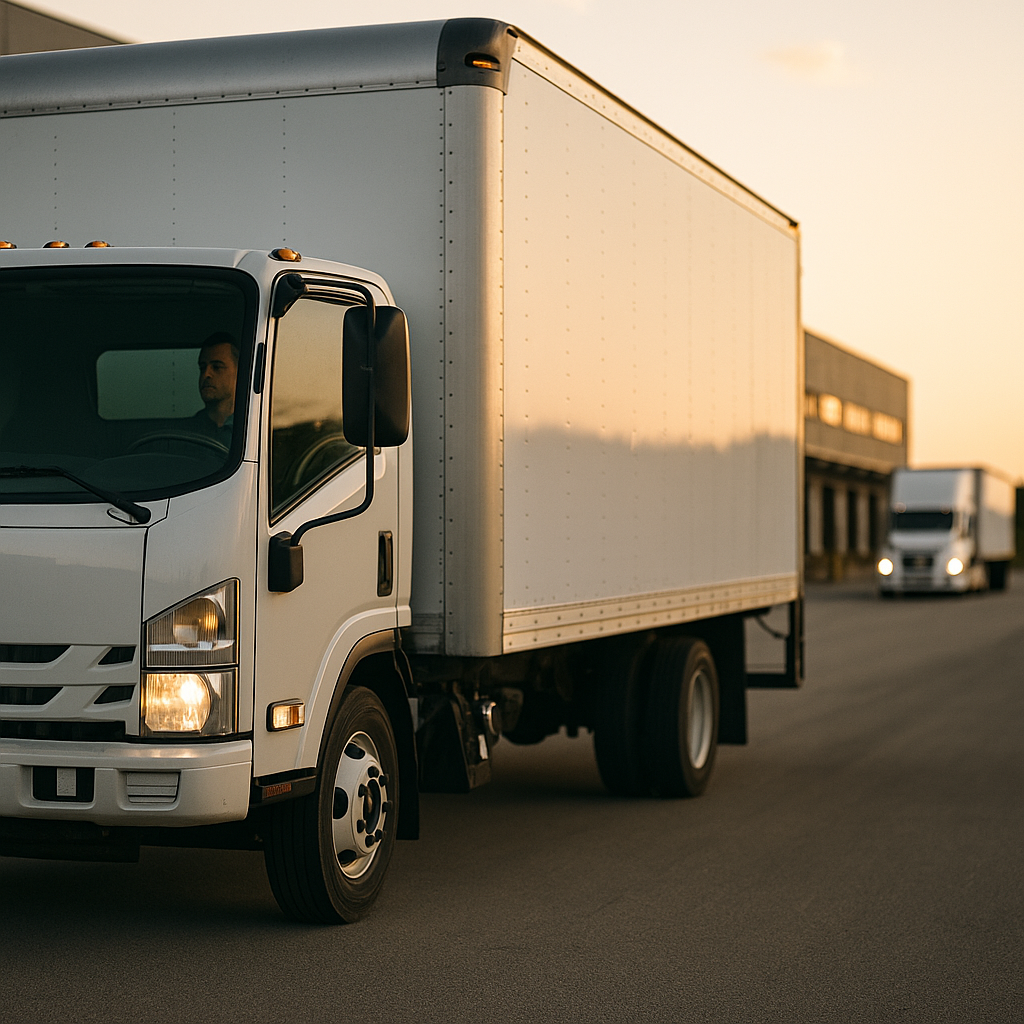

Box truck cargo insurance limits are often $100K for brokers, $250K+ for high-value freight. See legal vs contract rules and cost—get a quote.
Box truck cargo insurance limits usually fall between $50,000 and $500,000+, and the “right” number is typically driven by broker/shipper contracts and your maximum at-risk load value. In practical terms, $100,000 is a common baseline because many brokers won’t tender general freight below that, while $250,000+ shows up more often with higher-value freight, expedited, or dedicated accounts.
Cargo claims can be a one-incident cash-flow killer (theft, rollover, water damage, load shift), and brokers don’t care what you “usually” haul—they care what your policy shows on the certificate. Before you pick a cargo limit, make sure you understand how it fits into the full compliance/contract stack (liability, physical damage, filings, etc.). Start here if you need the full picture: box truck insurance requirements.
👉 Ready to save on your box truck insurance?
Watch the video below for a quick overview of box truck insurance rules, how much it costs, and practical ways to save. Or give us a call: (704) 290-3630
Table of Contents
Reading time: 7 minutes
- Typical box truck cargo insurance limits (quick view)
- What a cargo insurance “limit” really means
- Typical motor truck cargo limits (and when $100K isn’t enough)
- Is cargo insurance required? (Legal vs broker/shipper reality)
- Cargo cost by limit (and a practical way to choose)
- Frequently Asked Questions
- Conclusion
Typical box truck cargo insurance limits (quick view)
Most box truck motor truck cargo policies are written in common tiers—$50,000, $100,000, $250,000, and $500,000+—because those numbers map to the most frequent broker and shipper contract minimums.
| Cargo limit | Most common requirement source | Best fit (typical box-truck ops) |
|---|---|---|
| $50,000 | Some local shippers / final-mile | Low-value goods, short radius |
| $100,000 | Many brokers (baseline) | General freight, courier, light industrial |
| $250,000 | Higher-tier brokers / dedicated accounts | Higher-value B2B, electronics, expedited |
| $500,000+ | High-value freight programs | Strict procedures + heavier underwriting |
40–60 word summary: $100,000 is the most common baseline because many brokers require it to tender general freight. If your loads can spike above $100K (electronics, medical devices, multi-stop mixed freight), you’ll often need $250K or more. $500K+ is usually contract-driven and comes with tighter rules and underwriting.
Key takeaways
- $100K cargo is “required in practice” in many lanes because broker packets and shipper contracts set the bar, even when the law doesn’t.
- Pick your limit using maximum at-risk load value (not your average) and add a buffer for multi-stop/mixed freight.
- Higher limits can cost more, but the bigger risk is buying a limit you can’t comply with (parking rules, unattended vehicle language, documentation).
- Cargo is only one line item—limit choices affect your overall commercial insurance budget, not just cargo.

What a cargo insurance “limit” really means (in plain English)
A cargo insurance limit is typically the maximum amount the policy will pay for one covered cargo incident (for example, a theft, fire, or collision loss), minus your deductible.
What it is
Think of the limit as your per-incident “cap” for covered freight damage or theft while the cargo is in your care, custody, and control—subject to policy terms, exclusions, and conditions.
Why it’s essential
Brokers and shippers often use your cargo limit as a fast pass/fail filter. If you show up with $50K cargo and the load value can hit $120K, you’ll either be blocked from the load or you’ll be taking on a gap you may not survive financially.
Who needs to understand this
Any box truck owner-operator (new venture or established) running under their own authority—or leased on—who’s signing rate confirmations, broker packets, or shipper contracts should understand how limits, deductibles, and conditions work together.
Pro tip (common misunderstanding): A higher limit doesn’t mean “everything is covered.” Limits and deductibles only matter if the claim is covered under the policy wording. If you want a quick refresher on how payout mechanics work, read insurance limits & deductibles explained.
Typical motor truck cargo insurance limits for box trucks (and when $100K isn’t enough)
Motor truck cargo insurance is the coverage that can pay for covered freight loss or damage while you’re hauling it, and it is separate from auto liability and physical damage.
Why $100K is common (and why it breaks fast)
In 2026, $100,000 is common because it’s often the lowest limit that clears many broker packets for general freight. But it can become insufficient quickly when:
- You do expedited (higher value, tighter timelines, more scrutiny)
- You haul electronics, medical supplies, specialty retail, or B2B inventory
- You run multi-stop with mixed consignees (one trip can equal multiple invoices and a higher total at-risk value)
Who usually needs higher limits
- Owner-operators moving from local final-mile into brokered general freight
- Carriers chasing dedicated accounts with higher-value product
- Anyone whose shipper/BOL values routinely exceed $100K
If you want the deeper breakdown of what cargo often covers (and what it often doesn’t), see motor truck cargo insurance explained.
Where this fits: Cargo limits are part of your overall commercial package, and the same contract-driven logic shows up across truck classes—your required cargo limit follows the load value, not the size of your truck.
Is cargo insurance required for box trucks? (Legal vs broker/shipper reality)
For many general freight box truck operations, cargo insurance is not mandated by one universal federal minimum the way auto liability financial responsibility is, but it is often required by brokers and shippers to haul loads.
Compliance requirement vs contract requirement (why people get confused)
- Compliance: FMCSA insurance filings focus primarily on liability/financial responsibility for operating authority, not broker-required cargo minimums. FMCSA overview: https://www.fmcsa.dot.gov/registration/insurance-filing-requirements
- Contract: Brokers/shippers set cargo minimums based on their customer agreements, commodity value, and risk tolerance.
If you’re sorting out what’s “law” versus “broker packet,” this walkthrough helps: DOT and FMCSA compliance + insurance filings.
The federal exception worth knowing: household goods (HHG)
Household goods (HHG) carriers have specific cargo coverage requirements under 49 CFR Part 387. You can verify the framework here: https://www.ecfr.gov/current/title-49/subtitle-B/chapter-III/subchapter-B/part-387.
If you touch HHG—even occasionally—don’t guess. Match your authority type, commodities, and contract language to the correct coverage and filings.
Cargo insurance cost by limit (and a quick way to choose the right number)
A practical way to choose a cargo limit is to base it on your maximum at-risk shipment value and then compare quotes across $100K vs $250K vs $500K using the same operation details.
Step 1: Choose your limit using your maximum at-risk load
Use your worst-case load value (the one that would hurt the most), not the average week.
Quick formula:
Cargo limit target = max shipment value you might accept + buffer (10–25%)
Example (common box-truck reality):
You usually haul $30K–$60K loads, but once a week you see 12 pallets at $9,000 each.
12 × $9,000 = $108,000 → a $150K (if available) or $250K limit is usually a safer decision than $100K.
Step 2: Understand how cost usually moves as limits increase
Cargo premium doesn’t scale perfectly with limits because commodity, theft exposure, radius, garaging ZIP, and claims history can matter as much as the limit itself, but the pattern below is a reliable starting point.
| Cargo limit | Typical use case | Expected price impact (relative) | Notes |
|---|---|---|---|
| $50,000 | Local / low-value final-mile | Lowest | May block you from many brokered loads |
| $100,000 | General freight baseline | Baseline | Common broker minimum |
| $250,000 | Higher-value freight / dedicated | Moderate increase | More underwriting questions; stricter procedures |
| $500,000+ | High-value programs | Underwriting-driven | Expect tighter rules (parking, tracking, dispatch controls) |
Cargo is only one line item in the full premium, so it helps to budget using total package benchmarks: commercial box truck insurance cost.
Business reality check: ATRI regularly lists insurance among the major operating cost categories for trucking, which is why dialing-in limits (without overbuying) matters to cost-per-mile. Reference: https://truckingresearch.org/research/operational-costs-of-trucking/
Frequently Asked Questions
For most box truck carriers hauling general freight, the “required” cargo limit is usually set by broker/shipper contracts rather than one universal federal minimum for every operation. A very common broker baseline is $100,000 cargo, while higher-value accounts often require $250,000+ (and some high-value programs push $500,000+). The real decision should be based on your maximum at-risk load value—the biggest load you might accept—not your average week, because one incident is typically a single claim event.
Typical cargo limit tiers for box trucks are $50,000, $100,000, $250,000, and $500,000+, because those match common broker packet requirements and shipper contract minimums. $100,000 is a frequent starting point for brokered general freight, while $250,000+ is more common for expedited, dedicated accounts, or higher-value commodities like electronics and medical supplies. If you do multi-stop deliveries, remember your “one load” can be multiple invoices stacked into a higher total value, which can justify moving up a tier.
Cargo insurance often covers theft, but it’s frequently conditional based on policy language and the facts of the loss (not just your limit). Many policies require basics like locked doors, documented chain-of-custody, and compliance with “unattended vehicle” or parking requirements (for example, where the truck was parked and whether it was left overnight). If a claim is denied due to an exclusion or a condition you didn’t meet, a higher limit won’t help. Always match your operating habits—parking, dispatch controls, tracking, and documentation—to the wording you’re buying.
Box truck cargo insurance cost per month depends on your cargo limit (for example $100K vs $250K vs $500K), commodity type, operating radius, garaging ZIP, claims history, and deductible, so the only accurate number comes from quoting your exact operation. The clean way to budget is to request the same quote with multiple limit options so you can see the real price difference for your lanes and freight mix. For a cash-flow view of monthly spend across the whole policy package, see box truck insurance cost per month.
Conclusion: Match your cargo limit to your contracts (and your max load)
$100K is common because many brokers require it, but your best limit should be driven by your maximum at-risk load and the contracts you want access to. The biggest mistake isn’t always “buying too little”—it’s buying a high limit you can’t operationally comply with when a claim happens.
Key Takeaways:
- Choose a limit based on max shipment value + 10–25% buffer, not your average load.
- Expect more scrutiny as you move from $100K → $250K → $500K+ (procedures, parking, theft controls).
- Compare multiple limits side-by-side to understand the true premium impact on your total insurance budget.
If you’re trying to lower premium without creating claim-denial traps, use these levers: cheapest commercial box truck insurance. When you’re ready to compare limit options quickly, start here: get a box truck insurance quote.





