
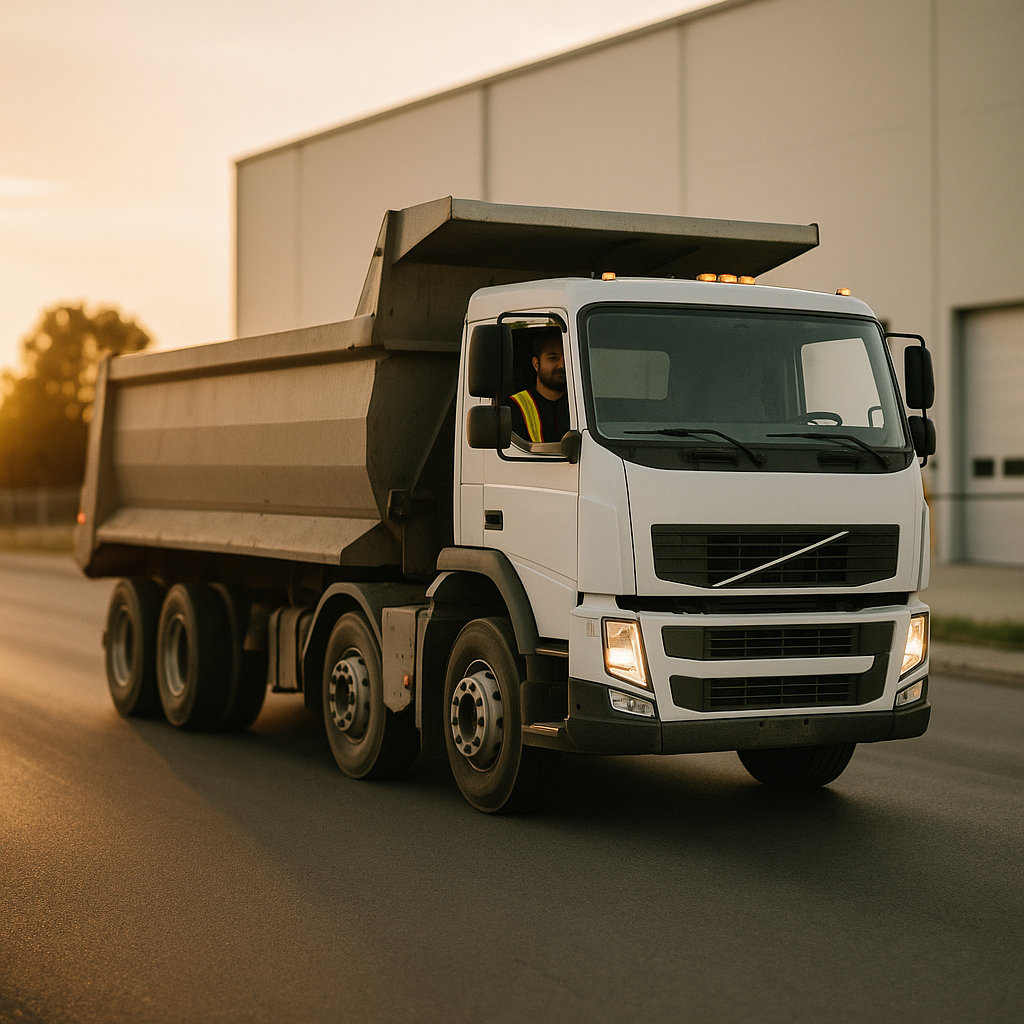
Asphalt hauling dump truck insurance in 2026: costs, required limits, COI endorsements, and ways to cut premiums for owner-ops. Get a quote today.
Asphalt hauling dump truck insurance typically costs about $600–$1,800+ per month per truck in 2026, with price driven by hot-mix frequency, operating radius, driver/loss history, truck value, and contract-required limits. The expensive part usually isn’t “the asphalt” itself—it’s jobsite severity (tight backing, property damage, burn injuries) plus COI and endorsement requirements that come with paving work.
Before you even talk “hot mix,” it helps to compare against the baseline for dump operations: baseline dump truck insurance cost ranges. Then you can adjust your budget for asphalt jobsite exposure and contractor limits.
Table of Contents
Reading time: 9 minutes
Key takeaways (save this before you renew)
Asphalt hauling dump truck insurance in 2026 often lands between $600 and $1,800+ per month per truck, and the biggest cost swing usually comes from jobsite exposure and contract limits rather than the truck alone.
- Budget reality: Expect $600–$1,800+/mo per truck, with pricing heavily affected by backing losses, dense jobsite work, and required endorsements.
- Regulatory vs. contract limits: FMCSA minimums and “what the GC requires” are not the same thing; many paving jobs want $1M CSL and specific endorsements.
- Common insurance stack: Asphalt operations often need Commercial Auto + Physical Damage + General Liability, then add WC/Occ-Acc, umbrella, and spill coverage based on contracts.
- Fastest path to better pricing: Reduce backing/jobsite losses and present a clean underwriting story (radius, hot-mix %, safety controls, loss runs, contract requirements).

Why hot asphalt hauling costs more to insure (it’s severity + jobsite chaos)
Hot-mix asphalt hauling is priced as a higher-severity vocational exposure because jobsite operations create more frequent close-quarters incidents and injuries can be more severe than typical dump work.
Heat, burns, and property damage exposure
- Bodily injury severity: Hot mix incidents can become high-dollar injury claims fast, especially when burns are involved.
- Property damage at the pour: Spills can damage base, curbs, forms, or finished surfaces, and rework is expensive when a project schedule is tight.
- Tight jobsite movement: Backing into pavers and working around flaggers, laborers, and passenger vehicles is often higher-frequency than wide-open pit work.
Equipment stress and downtime risk
Hot mix work also beats on dump bodies, hoists, tarping systems, hydraulics, brakes, and tires—so the “truck value” part of underwriting matters more than many owner-ops expect.
If you’re newer to vocational trucking, start with the structure of a typical commercial program (auto vs. GL vs. optional coverages): commercial truck insurance basics for new operators.
2026 cost: asphalt hauling dump truck insurance (monthly + annual ranges)
Asphalt hauling dump truck insurance price ranges below are per truck and assume a true commercial setup (not minimum-limit-only quotes that don’t meet contractor requirements).
Reality check: Ultra-low numbers you see online are often missing key coverages, assume very light local use, or ignore contract-required limits and endorsements.
Typical price ranges by risk tier (per truck)
| Operation profile (what underwriters “see”) | Likely monthly range (2026) | Likely annual range | What drives it |
|---|---|---|---|
| Lower tier: local, limited hot mix, clean MVR, small radius, strong safety controls | $600–$900/mo | $7,200–$10,800/yr | Low claims + low congestion + predictable work |
| Middle tier: steady hot mix work, mixed jobsites, moderate traffic density, endorsements required | $900–$1,400/mo | $10,800–$16,800/yr | Jobsite backing + higher limits + equipment values |
| Higher tier: municipal/GC work, dense metro, more drivers, prior losses, higher limits + umbrella | $1,400–$1,800+/mo | $16,800–$21,600+/yr | Severity risk + contractual requirements + loss history |
Hot mix vs. cold mix: what changes pricing
Insurers rate your operation and your contracts, so “hot mix vs. cold mix” matters most when it changes jobsite severity, schedule pressure, and endorsement/limit requirements.
- Hot mix (HMA): often viewed as higher severity due to injury potential, tighter jobsite conditions, and higher contractor requirements.
- Cold mix: can still be risky, but may be viewed as less severe if jobsites and contract limits are simpler.
Why rates vary (without guessing unsupported state averages)
Two operators running the same truck can pay very different premiums because territory and loss patterns change the expected claim frequency and severity.
- Traffic density and local loss frequency
- Repair costs (parts and labor rates)
- Litigation environment
- How underwriters view vocational risk in that market
For the broader dump-truck framework (then apply asphalt modifiers), see: commercial dump truck insurance coverage overview.
Coverage checklist: 7 insurance coverages asphalt haulers commonly need
Asphalt hauling dump truck insurance programs commonly combine Commercial Auto, Physical Damage, and often General Liability, then add WC/Occ-Acc, umbrella, cargo-related requirements, and pollution coverage as contracts demand.
1) Commercial Auto Liability (and is $750K enough?)
Commercial auto liability pays for bodily injury and property damage you cause while operating the truck, and it’s the backbone coverage for any asphalt dump operation.
- Why it matters: It’s usually required for operating authority and almost always required by contractors.
- Limits reality: FMCSA minimums are a regulatory floor; many paving contracts commonly require $1,000,000 CSL plus endorsements.
- Primary source: FMCSA insurance filing requirements
2) Physical Damage (comprehensive + collision)
Physical damage coverage pays to repair or replace your truck after collision, theft, vandalism, or weather losses (subject to deductible and policy terms).
- Who needs it: Anyone financing a unit, and any owner-op who can’t replace the truck out of pocket immediately.
- Common mistake: Not properly accounting for dump body/hoist/tarping value can create ugly surprises at claim time.
If you want a deeper breakdown of comp/collision decisions and deductibles, see: physical damage coverage explained (comp/collision).
3) General Liability (GL) for jobsite / non-auto claims
General liability insurance covers certain third-party injuries or property damage that are not caused by auto use, which is why many paving sites require it alongside auto liability.
- Why contractors care: It helps address non-auto jobsite allegations (for example, certain slip-and-fall or premises-style claims, depending on facts and policy language).
- COI risk: Many COIs get rejected because GL is missing or endorsements can’t be issued in time.
More detail here: general liability insurance for truckers.
4) Workers’ Comp (WC) or Occupational Accident (Occ/Acc)
Workers’ comp is typically required by state rules for employees, while occupational accident is commonly used in certain independent-contractor setups when allowed and when contracts accept it.
- Why it matters on asphalt jobs: Jobsite injuries happen—climbing, tarping, chains, slips, and burns.
- Contract reality: Even true owner-ops may be asked to show Occ/Acc by a GC or broker.
5) Motor Truck Cargo (often “not really cargo,” but contract language matters)
Motor truck cargo coverage is designed for freight in transit, but some hauling agreements require a “cargo” limit even when the real exposure is different.
- What to do: Read the contract language before you sign, then align the coverage form to the requirement.
- Pro tip: If the agreement is really about “property of others” or jobsite damage, your agent should solve the actual coverage problem, not just add a random cargo limit.
6) Pollution / Environmental (spills)
Pollution coverage can help with cleanup costs and certain liabilities from fuel or hydraulic spills, which are common enough in vocational operations to show up in job requirements.
- Why it’s practical: Leaks happen, and cleanup invoices can be significant even without a major accident.
- Where it comes up: Municipal work, GC-controlled sites, or any contract that specifies pollution coverage.
7) Umbrella / Excess Liability
An umbrella policy increases your liability limit above your auto (and often GL) policies, and it’s frequently the simplest way to meet higher-limit contracts.
- When it’s common: Municipal/GC work, higher severity exposure, or when your contracts require limits above $1M.
- Important: Umbrellas usually require certain underlying limits and endorsements, so you can’t bolt it on last-minute.
Note: If you run a different setup (like a dually + trailer), you may be rated as a different class (often “hotshot”), with different pricing variables than dump truck asphalt hauling.
Contracts, COIs, and endorsements: what paving jobs usually require
Contractor insurance requirements for asphalt hauling usually fail at the paperwork level—because the COI, limits, entities, and endorsements don’t match the contract—even when the operator “has insurance.”
COI basics (why certificates get rejected)
COI rejections are common in paving because contractor onboarding is strict and timelines are tight.
- Named insured doesn’t match the contract entity (LLC vs. DBA vs. personal name)
- Limits don’t match the requirement (or the wrong policy is shown)
- Policy effective dates don’t cover the job window
- Endorsements requested but not actually issued on the policy
For a deeper checklist, see: certificate of insurance (COI) for trucking + endorsements.
Common endorsements on asphalt jobs
Additional insured, waiver of subrogation, and primary and noncontributory wording are common endorsement requests on paving projects, and each can impact eligibility, timing, and cost.
- Additional Insured (AI): Adds the GC/contractor to your policy when required.
- Waiver of Subrogation: Limits your carrier’s ability to recover from the other party (when required by contract).
- Primary & Noncontributory: Your policy responds first, before the other party’s insurance (when required).
Quick verification: authority and carrier info
FMCSA public tools let anyone verify a carrier profile and basic operating status, which is why contractors often ask you to “prove” your information before you roll to the job.
- Check a carrier profile via the FMCSA SAFER system.
- Bookmark the filing and limit basics: FMCSA insurance filing requirements.
Practical ways to lower premiums (without gutting coverage)
Insurance pricing improves fastest when you reduce the losses underwriters see most often: backing incidents, jobsite hits, and preventable injury claims.
- Reduce backing losses: spotter rules, backup cams, cones, and written jobsite procedures.
- Use safety tech: dash cams/telematics, and show you coach drivers on what the data finds.
- Control driver quality: clean MVRs, consistent onboarding, documented training.
- Choose deductibles on purpose: don’t buy a deductible you can’t absorb in a slow month.
- Tell a clean renewal story: radius, hot-mix %, job types, garaging, loss runs, and contract limits/endorsements.
ATRI (American Transportation Research Institute) routinely lists insurance as a major operating cost category in trucking; small operational improvements can produce real premium impact over time. Source: ATRI.
Frequently Asked Questions
Most asphalt hauling dump trucks need commercial auto liability, physical damage, and often general liability for jobsite/non-auto claims, because paving contracts commonly require both auto and GL to stay dispatchable. Add workers’ comp when you have employees (state rules apply) or occupational accident when a contractor requires it for an owner-op/IC arrangement. Many municipal or GC-controlled projects also require $1,000,000 CSL and may ask for an umbrella plus endorsements like additional insured, waiver of subrogation, and primary/noncontributory. The right mix depends on your contracts, radius, and jobsite operations.
In 2026, asphalt hauling dump truck insurance often runs about $600–$1,800+ per month per truck, with the final number driven by hot-mix frequency, operating radius, territory, driver MVR, prior losses, and truck/equipment value. Premiums also jump when your contracts require $1M CSL, specific endorsements, or an umbrella policy. If you want a realistic starting point before adding asphalt-specific jobsite exposure, compare against baseline dump truck insurance cost ranges. The fastest way to get an accurate quote is to bring your radius, hot-mix %, and contract requirements up front.
The biggest premium drivers are loss history (frequency and severity), driver MVR, operating radius, jobsite backing exposure, territory/traffic density, and truck plus equipment values (dump body, hoist, tarping). Contract requirements can matter just as much as operations because higher limits and endorsements increase the carrier’s exposure and change underwriting appetite. If you’re trying to cut cost without creating coverage gaps, start with process improvements that reduce backing losses, then review your program design and deductibles. For broader tactics, see how to save on truck insurance without coverage gaps.
FMCSA’s $750,000 public liability minimum is a regulatory floor for many for-hire interstate carriers hauling non-hazardous property, but it’s often not enough to satisfy paving contractors and municipalities. Many asphalt hauling contracts commonly require $1,000,000 CSL and may also require an umbrella plus endorsements (additional insured, waiver of subrogation, primary/noncontributory). The practical rule is to carry the limits and endorsements that match the highest contract requirements you routinely accept, not just the minimum you can file. For the primary source on filings and requirements, use: FMCSA insurance filing requirements.
Conclusion: Buy insurance like you buy equipment—spec’d for the job
Asphalt hauling pays well, but one severe jobsite claim or one rejected COI can cost weeks of revenue and future bids. The goal isn’t just cheap coverage—it’s a program that keeps you dispatchable and protects cash flow when something goes sideways.
Key Takeaways:
- Plan for $600–$1,800+/month per truck in 2026, with jobsite exposure and contract limits doing most of the damage.
- Match limits to contracts (often $1M CSL and endorsements), not just the FMCSA minimum.
- Lower cost by reducing backing losses and presenting clean documentation (radius, hot-mix %, loss runs, safety controls).
If you’re quoting or renewing, come prepared with your radius, hot-mix frequency, truck/equipment values, and contract requirements (limits + endorsements) so you get accurate options fast. Related reading: DOT compliance requirements checklist.





