
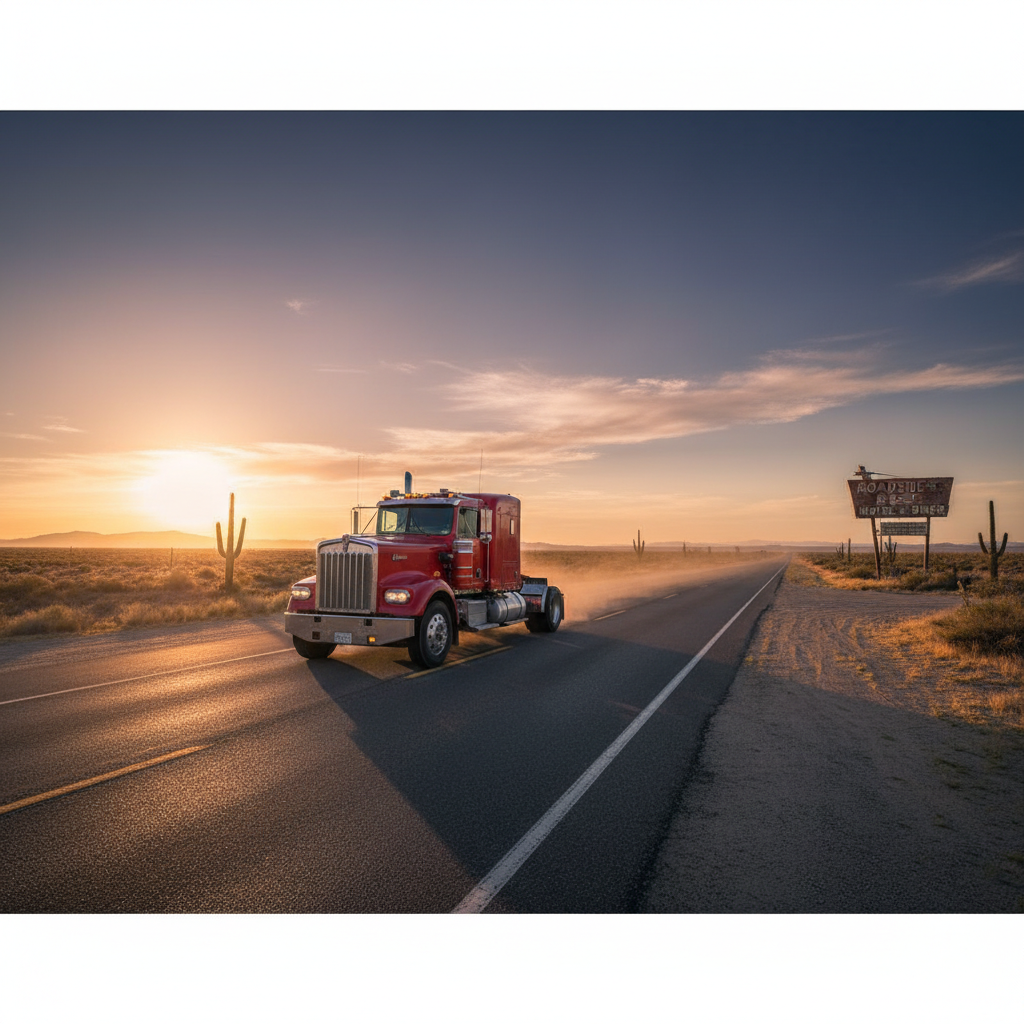
As an owner-operator, you know that some roads just feel different. You've heard the stories at the fuel island or over the radio: a highway where you always get a clean inspection, a bypass that seems to eat tires, or a dark stretch of two-lane that feels like it's actively working against you. This is trucker folklore.
But for a business owner, folklore isn't just superstition-it's a cultural dataset. Before apps like Trucker Path, these stories were a critical, word-of-mouth survival guide. They were shared business intelligence on high-risk zones, weigh station ("chicken coop") habits, and real-world dangers that don't show up on a map.
In this guide, we'll decode some of America's most legendary "lucky" and "cursed" roads and translate that folklore into the practical, bottom-line business lesson it represents.
Decoding Trucker Folklore
- Folklore is Veteran Data: "Cursed" roads are almost always a code for high-risk operations. The superstition is just a warning about high congestion, aggressive enforcement, extreme weather, or high accident rates.
- "Lucky" Means "Profitable": A "lucky" route is typically one that's good for your business. It means smooth pavement, predictable enforcement, and good facilities all factors that protect your Hours of Service (HOS) clock and your Cost-Per-Mile (CPM).
- Risk is Not a Superstition: You can't rely on luck to protect your rig. A "cursed" road is just a high-risk road. Your commercial truck insurance policy is the only business tool designed to protect your assets when you run out of luck.
Decoding "Cursed" Roads: Folklore as a Risk Warning
When you hear a road is "cursed" or "bad luck," it's a veteran's way of telling you to stay sharp. These roads are often high-risk, low-profit, or just plain dangerous.
1. The Legend: US-491 (Formerly US-666), The "Devil's Highway" (NM, CO, UT)
- The Folklore: As the draft mentioned, this road's original "666" designation earned it a dark reputation. Stories of phantom trucks, lost time, and an unusually high rate of fatal, unexplained accidents were so common that the highway was officially renumbered to US-491 in 2003. Even with the new name, some drivers still avoid it at night.
- The Business Reality (The Logrock Angle): This "curse" is a perfect storm of tangible risks. It's an isolated, high-desert highway with long stretches of total darkness, few services, and a high population of deer and elk. It's a textbook recipe for fatigue-related and animal-strike accidents. A breakdown here isn't just an inconvenience; it's a massive financial hit due to extreme tow distances and long downtimes.
2. The Legend: 1-95 (The Northeast Corridor, VA to MA)
- The Folklore: Not haunted by ghosts, but by the "ghosts" of dead logbooks. This is the road where good HOS clocks go to die. It's known for "fraying nerves" and turning a 300-mile run into a 10-hour nightmare.
- The Business Reality (The Logrock Angle): This isn't folklore; it's a financial drain. The "curse" is a combination of four profit-killers:
1. Extreme Congestion: You're burning fuel at 0 mph in gridlock.
2. High Tolls: This stretch has some of the highest tolls in the nation, destroying your CPM.
3. Aggressive "Four-Wheelers": Impatient drivers and dense traffic create a high-risk environment for accidents.
4. Aggressive Enforcement: This corridor is known for tough inspections and high-violation states.
3. The Legend: US-285 (West Texas / New Mexico)
- The Folklore: Known in the oil patch as "Death Highway." It's a two-lane road many experienced drivers will run hundreds of miles to avoid, citing a "bad feeling" and too many close calls.
- The Business Reality (The Logrock Angle): This is a data-driven "curse." The road is the main artery for the Permian Basin oil boom, one of the most intense freight markets in the world. It's a crumbling, two-lane road that is completely overloaded with heavy trucks, fatigued workers on 24-hour cycles, and civilian traffic. The "curse" is over-capacity infrastructure meeting a high-stress, high-fatigue freight market, resulting in one of the highest fatal accident rates in the nation.
4. The Legend: 1-70 (Colorado Mountains)
- The Folklore: A road that "tests your truck and your nerve." Veterans warn rookies that the mountains will "find your weakness," whether it's bad brakes or a lack of experience.
- The Business Reality (The Logrock Angle): This isn't a superstition; it's a mechanical and skills-based challenge. The "bad luck" here is a direct result of physics:
- Extreme Grades: You have the Eisenhower Tunnel (11,158 ft) and the long, steep descent into Silverthorne.
- Brake Failure: This is where brake fade happens. The "curse" is simply an unprepared driver failing to gear down, smoking their brakes, and ending up in a runaway truck ramp.
- Extreme Weather: You can face chain laws and snow in June.
A run on I-70 is a test of your pre-trip inspection and your skill as a professional driver.
Decoding "Lucky" Routes: Folklore as a Sign of Profitability
"Lucky" routes are almost always the ones that are good for business. They're predictable, efficient, and let you run your miles without interruption.
1. The Legend: 1-80 (Nebraska / Wyoming)
- The Folklore: As the draft noted, this is "smooth sailing." It's known as a place to "make up time and make peace with your logbook." The scales are seen as fair and professional.
- The Business Reality (The Logrock Angle): This is a low-stress, high-efficiency route. It's flat, straight, and generally well-maintained. "Friendly scales" just means predictable, by-the-book enforcement. The "luck" here is excellent fuel efficiency (less shifting, steady RPMs) and maximum HOS utilization. You can run your clock out with minimal stress, which is good for your bottom line.
2. The Legend: 1-10 (West of San Antonio to El Paso)
- The Folklore: The famous "shooting star" route, where there's nothing but you and the road for hours.
- The Business Reality (The Logrock Angle): This is a high-mileage, low-interruption run. It's famous for being one of the longest, straightest, flattest stretches of interstate in the country. The "luck" here isn't a shooting star; it's the ability to set your cruise control and run maximum legal miles against your 11-hour clock. It's a "lucky" road because it's a highly profitable one, letting you maximize your revenue per day.
Your Questions Answered: "People Also Ask" FAQs
A: "Chicken coops" is common, veteran slang for weigh stations or DOT inspection stations. The term comes from the coop-like structures and the feeling of being "cooped up" during an inspection. Using the term shows you've been around the block.
A: There isn't just one. A "dangerous" road has specific business risks. It could be I-95 for its high congestion and accident frequency, I-70 in Colorado for its extreme grades, or US-285 in Texas for its poor infrastructure and high-fatigue traffic. The "most dangerous" road is any road that over-matches your equipment, your experience, or your schedule.
A: Yes, but not by name. An insurance underwriter doesn't have a "Devil's Highway" surcharge. But they absolutely charge for the factors that create the legend. Your premium is based on your garaging zip code (higher rates for metro areas), your radius of operation (driving in high-congestion zones like I-95 costs more), and your claims history. If you have an accident on one of these high-risk roads, your premium will go up.
A: Because as an owner-operator, you don't get paid for "short." You get paid for "profitable." A shorter route that's full of steep grades (burning more fuel), stop-and-go traffic (killing your HOS), low bridges (requiring re-routes), or high tolls (like the PA or NJ Turnpikes) is less profitable than a slightly longer, flat, free highway.
The Logrock Difference: Data, Not Superstition
We're not superstitious; we're business partners. We respect the culture and the wisdom passed down in trucker folklore. We also know that at the end of the day, you can't rely on luck to protect your business.
We don't guess. We analyze your actual routes, your radius, your cargo, and your HOS needs to build a commercial truck insurance policy that's based on data, not superstition. We protect you on every road-the "lucky" ones and the "cursed" ones.
Luck is Not a Business Strategy
Trucker folklore is a valuable part of the job and a powerful oral tradition of shared wisdom. But it's not an insurance policy. A "lucky" day can be ruined by one "four-wheeler" not paying attention. A "cursed" road is just another day at the office for a professional. Your only real protection on any road is a solid, comprehensive semi truck insurance policy built by specialists who understand your business.
Superstition is optional. Peace of mind is not. Get the quote that covers your business for real.



