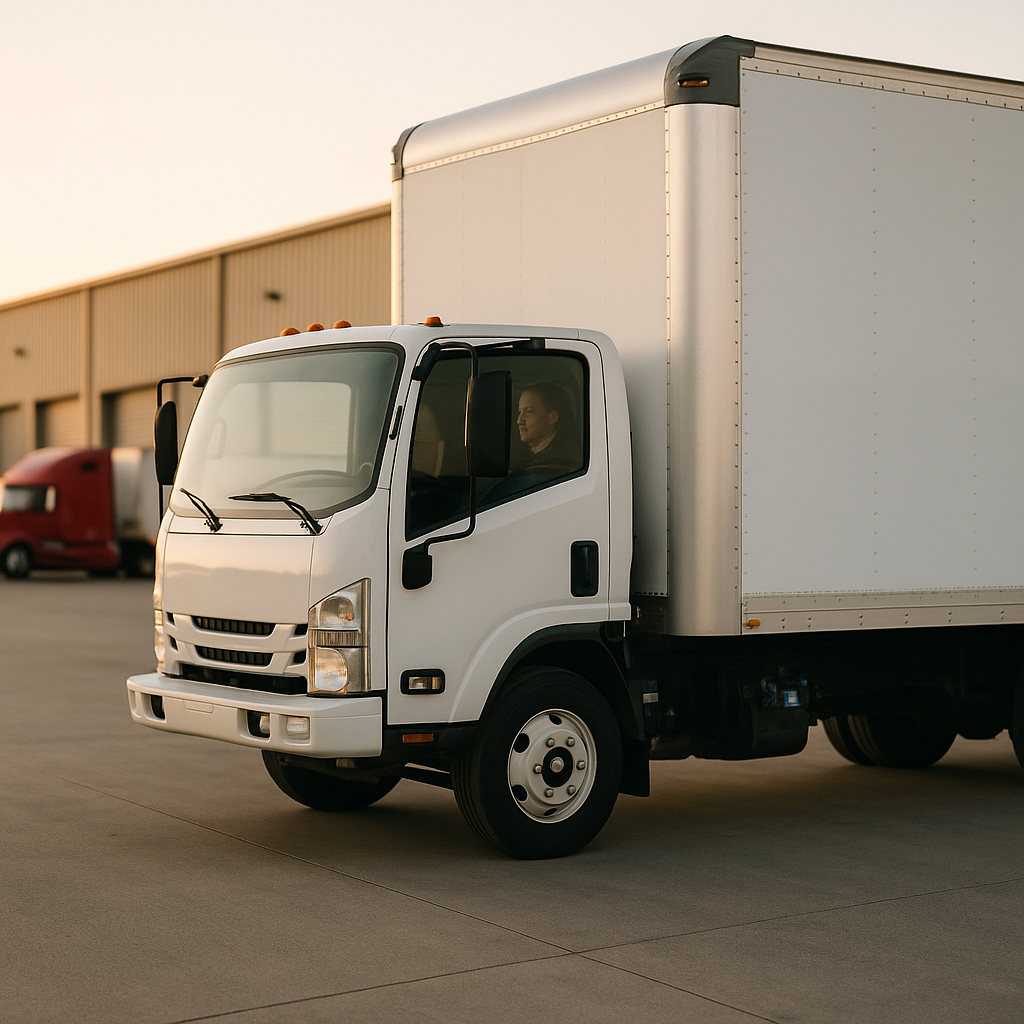
2026 26 foot box truck insurance cost explained: typical monthly ranges, what’s included, key price drivers, and ways to pay less. Get quotes.

If your premium is keeping your routes parked, you’re not alone—26 foot box truck insurance cost can swing wildly based on ZIP code, what you haul, and how your operation is classified. In 2026, 26-foot box truck insurance commonly runs about $230–$950 per month for basic liability-only and $800–$2,600+ per month for a fuller commercial package (liability + physical damage, often plus cargo and endorsements).
If you want a broader benchmark before drilling into 26-foot specifics, start with these ranges and examples: box truck insurance price benchmarks (2026).
Table of Contents
Reading time: 8 minutes
- Introduction (Quick Answer + What This Guide Does)
- Key Takeaways
- Average 26 Foot Box Truck Insurance Cost (Per Month & Per Year)
- What’s Included in a Typical 26-Ft Box Truck Insurance Package?
- What Drives 26 Foot Box Truck Insurance Cost (And Why State + ZIP Changes Everything)
- 2026 Trends: Why Trucking Insurance Still Feels Expensive
- How to Lower Your 26 Foot Box Truck Insurance Cost (10 Practical Tips)
- Frequently Asked Questions
- Conclusion: Expect Wide Ranges—But You Can Control the Inputs
Introduction (Quick Answer + What This Guide Does)
In 2026, 26 foot box truck insurance cost commonly ranges from about $230–$950/month for liability-only and $800–$2,600+/month for a fuller commercial package, with pricing driven by garaging ZIP, new venture status, driver history, truck value, and cargo type.
If your 26-footer is sitting because your broker needs a COI by 5 PM, that’s not just annoying—it’s lost revenue. Tight margins don’t leave room for surprise renewals.
This guide breaks down what’s driving your number, what coverages actually matter, and which levers can get you to more affordable trucking insurance without leaving gaps that bite you later.
Key Takeaways
Most 26-foot box truck premiums vary by thousands per year because underwriting is driven by territory, operations, limits, and loss history—not just truck length.
- Expect wide ranges: A new venture doing moving/household goods in a dense metro can pay multiples of an established operator hauling general freight locally.
- Your “package” matters more than the truck length: Limits, deductibles, cargo type, radius, and garaging ZIP often move pricing more than “26-foot” alone.
- You get priced on risk controls: Continuous coverage, clean MVR, secure parking, and dashcams/telematics can reduce premiums with many markets.
- Don’t buy blind: Match liability/cargo limits to contracts and verify COIs and filings before you roll.
Average 26 Foot Box Truck Insurance Cost (Per Month & Per Year)
In 2026, realistic planning ranges for a 26-foot box truck are roughly $2,800–$11,400 per year for liability-only and $9,600–$31,200+ per year for a “working package” that includes physical damage and common endorsements.
You’ll see two different conversations online: “cheap liability” versus “I need to work with brokers, lease/finance the truck, and survive a claim.” Those are not the same policy.
What it is (plain English)
Your monthly premium is the price for a commercial auto policy (and often a small stack of add-ons) that covers damage you cause, damage to your truck, and sometimes the customer’s cargo.
Typical 2026 ranges (realistic planning numbers)
| Operator / Setup | What you’re usually buying | Typical monthly range | Typical annual range |
|---|---|---|---|
| Established operator, liability-only | Auto liability (basic limits) | $230–$700 | $2,800–$8,400 |
| New venture, liability-only | Auto liability, higher risk rating | $450–$950 | $5,400–$11,400 |
| Established operator, “working package” | Liability + physical damage (+ common endorsements) | $800–$1,600 | $9,600–$19,200 |
| New venture or higher-risk ops (moving, multi-driver, dense metro) | Full package + higher limits and/or higher loss exposure | $1,500–$2,600+ | $18,000–$31,200+ |
Want to see why one operator lands at $900/month and another at $2,400/month with the “same truck”? This breakdown of what affects the cost of truck insurance helps you spot what underwriters are really rating.
Why it’s essential (business reality)
Insurance isn’t optional if you want to satisfy a shipper/broker, keep a lender/lessor happy, and protect cash flow when a claim hits.
Who needs this pricing framework?
- Owner-operators running 26-ft box trucks (final-mile, regional, moving)
- New authorities/new ventures trying to budget
- Small fleets adding another straight truck
What’s Included in a Typical 26-Ft Box Truck Insurance Package?
A typical 26-foot box truck “working package” commonly combines commercial auto liability plus physical damage, and many operators also add cargo and general liability to meet contract requirements.
A lot of headaches come from thinking you’re “insured,” then finding out the policy doesn’t match your contract—or your operation.
For a baseline on coverages and terminology, use: commercial truck insurance basics.
Commercial auto liability (the “must-have” for most paid work)
Commercial auto liability pays for bodily injury and property damage you cause while operating the truck, and it’s the first coverage most brokers and customers check on a COI.
If you operate for-hire interstate, FMCSA financial responsibility requirements vary by operation and cargo type, so don’t assume one minimum fits every business. Reference: FMCSA insurance filing requirements.
- Pro tip: Many contracts require $1,000,000 even when legal minimums differ by operation.
- Reality check: Price your business around what your customers demand—not around the cheapest legal line.
Physical damage (comprehensive + collision)
Physical damage coverage (comprehensive and collision) pays to repair or replace your truck after theft, vandalism, weather losses, or an at-fault collision.
If you’re financed or leased, it’s usually required. Even if you own the truck outright, a total loss can end your business if you can’t replace it quickly.
- Pro tip: Deductibles are one of the few knobs you can control; don’t pick a $2,500 deductible if you don’t actually have $2,500 set aside.
Motor truck cargo (often contract-required)
Motor truck cargo insurance covers damage to the freight you’re hauling, subject to exclusions, limits, and how your contracts define responsibility.
If you’re unsure what limits you really need (or what exclusions can burn you), read: cargo insurance for owner-operators.
General liability (GL) + common add-ons
General liability (GL) covers certain non-auto claims, such as property damage at a job site or “slip-and-fall” allegations that aren’t caused by operating the truck.
This matters most for moving, white-glove, and final-mile work where you’re entering homes, offices, and docks. For a GL-specific breakdown, see: general liability insurance for truckers.
Where hotshot insurance / semi truck insurance fit
Hotshot insurance (pickup + trailer) and semi truck insurance (tractor-trailer) are priced differently than a 26-ft straight truck because equipment values, loss patterns, and contract requirements differ.
The shopping logic is similar, but the premiums won’t match across equipment classes.

What Drives 26 Foot Box Truck Insurance Cost (And Why State + ZIP Changes Everything)
Insurers price 26-foot box truck policies using territory (garaging ZIP), operating radius, commodity, driver history, and truck value, and territory is often the biggest swing factor.
Two operators can both say “26-ft box truck” and still land in completely different underwriting buckets.
What it is (how insurers rate you)
- Garaging ZIP/territory: Theft frequency, traffic density, and litigation environment
- Radius & mileage: Local vs regional exposure
- Commodity and handling: General freight vs household goods/moving
- Driver quality: MVR, experience, prior claims
- Truck value: A major driver of physical damage premium
Why it’s essential (avoid getting re-rated mid-term)
Misstating radius or commodity can trigger re-rating, non-renewal, or claim complications because the policy was priced on different risk assumptions.
If you tell the agent “local,” then start running regional lanes, or you say “general freight” but you’re actually moving household goods, you can get re-rated mid-term—or worse, fight coverage during a claim.
Who needs to pay extra attention?
- New ventures (limited loss history)
- Urban operators (higher theft/claim severity)
- Moving/furniture/household goods exposure
- Multi-driver setups (more seat time = more risk)
State example (without pretending one state number fits everyone)
State impacts premium, but ZIP/territory inside the state can matter even more because theft, congestion, and claim severity vary by metro area.
Here’s a reference point many operators ask about: Texas commercial truck insurance cost.
Pro tip: Secure parking (fenced yard, cameras, well-lit lot) can materially improve physical damage/theft pricing in many territories.
2026 Trends: Why Trucking Insurance Still Feels Expensive
Commercial auto insurance pricing remains elevated in 2026 largely due to claim severity, higher repair costs, theft trends, and tighter underwriting appetite across many carriers.
If it feels like premiums don’t match your revenue reality, you’re not imagining it.
What it is (market forces)
- Claims severity (large injury payouts)
- Higher repair costs (parts + labor)
- Theft trends (especially in certain metros)
- Tighter underwriting and fewer “easy” markets for new ventures
ATRI’s operational cost research consistently shows insurance is a meaningful line item in trucking’s cost structure, and it moves year to year: ATRI: Operational Costs of Trucking.
Why it’s essential (your plan can’t be “hope it goes down”)
You can’t control the market cycle, but you can control underwriting inputs like documentation, driver quality, deductibles, and operational accuracy on applications.
Who needs to act on this now?
Anyone renewing in the next 60–90 days. Waiting until the last week usually means fewer markets and worse terms.
How to Lower Your 26 Foot Box Truck Insurance Cost (10 Practical Tips)
The most reliable ways to reduce 26-foot box truck premiums are to eliminate coverage lapses, improve driver quality, tighten radius/commodity accuracy, and create underwriting-friendly proof like dashcam or telematics data.
For a deeper playbook you can apply at renewal, use: how to save on truck insurance.
10 ways to chase affordable trucking insurance without getting underinsured
- Shop multiple markets (don’t take the first quote).
- Avoid lapses—continuous coverage is a pricing weapon.
- Match limits to contracts (not ego, not fear).
- Pick deductibles based on real cash reserves (not wishful thinking).
- Run clean drivers only—MVR issues get expensive fast.
- Use dashcams/telematics and keep the data organized.
- Tighten radius and territory if you can (local often rates differently than regional).
- Be honest about commodity (moving vs general freight is a big deal).
- Improve parking/security (theft/vandalism losses drive pricing).
- Pay-in-full if possible (fees add up; financing can cost more than you think).
Practical verification step
FMCSA SAFER can be used to verify company snapshots and authority details when you need quick operational validation for a broker or customer. Reference: FMCSA SAFER.
Frequently Asked Questions
These FAQs give citation-ready answers for 2026 box truck insurance pricing, with ranges and the biggest underwriting drivers.
For a 26-foot box truck in 2026, liability-only commonly runs about $230–$950 per month, while a working commercial package (liability + physical damage, often plus cargo/endorsements) is often $800–$2,600+ per month. The biggest reasons for the spread are garaging ZIP/territory, new venture status, driver MVR/claims, truck value, operating radius, and commodity (general freight vs moving/household goods). To compare quotes fairly, keep the same limits, radius, and cargo description across carriers so you’re not comparing different policies.
The biggest drivers of box truck pricing are usually garaging ZIP/territory, new venture vs established operating history, MVR/claims history, radius/miles, commodity (moving vs general freight), truck value, and your limits and deductibles. If your quote looks out of line, audit those inputs first—especially territory, radius, and commodity—because misstating them can trigger re-rating or problems at claim time. Comparing multiple markets with identical details is often the fastest way to find out what’s “normal” for your risk class.
Yes, but mostly indirectly: a 26-ft box truck often signals higher replacement value, more work in congested delivery zones, and job types like final-mile or moving that can increase claim frequency and severity. Underwriters generally price those risk signals—territory, commodity, and exposure—more than the physical length itself. Two 26-foot trucks can price very differently if one is garaged in a low-theft rural ZIP with local general freight and the other runs household goods in a dense metro with multiple drivers and longer radius.
You can lower box truck insurance costs without risking a denial by keeping your application accurate (true radius, true commodity, correct driver list) and then improving the factors carriers actually rate, such as continuous coverage, driver MVR quality, and secure parking. Shopping multiple markets with the same limits and deductibles can also reduce premium without reducing protection. Before binding, review avoidable errors that lead to re-rating or coverage gaps—this checklist is worth it: common truck insurance mistakes that increase costs.
Conclusion: Expect Wide Ranges—But You Can Control the Inputs
The 2026 26 foot box truck insurance cost range is wide because underwriting inputs—territory, commodity, radius, drivers, and limits—create a wide spread of real-world risk.
The owner-operator doing clean local routes with secure parking and consistent paperwork isn’t priced like a new venture doing moving jobs in a high-claim metro with multiple drivers.
Key Takeaways:
- Budget roughly $230–$950/month for liability-only and $800–$2,600+/month for a working package, then refine with real quotes.
- Territory (garaging ZIP), commodity (moving vs general freight), and driver history often move the price more than “26-foot” by itself.
- Lower premiums by preventing lapses, tightening operations details, and using risk controls like secure parking and dashcams/telematics.
If you want to tighten your coverage decisions around contracts, these two are worth reading next: cargo insurance for owner-operators and general liability insurance for truckers.