
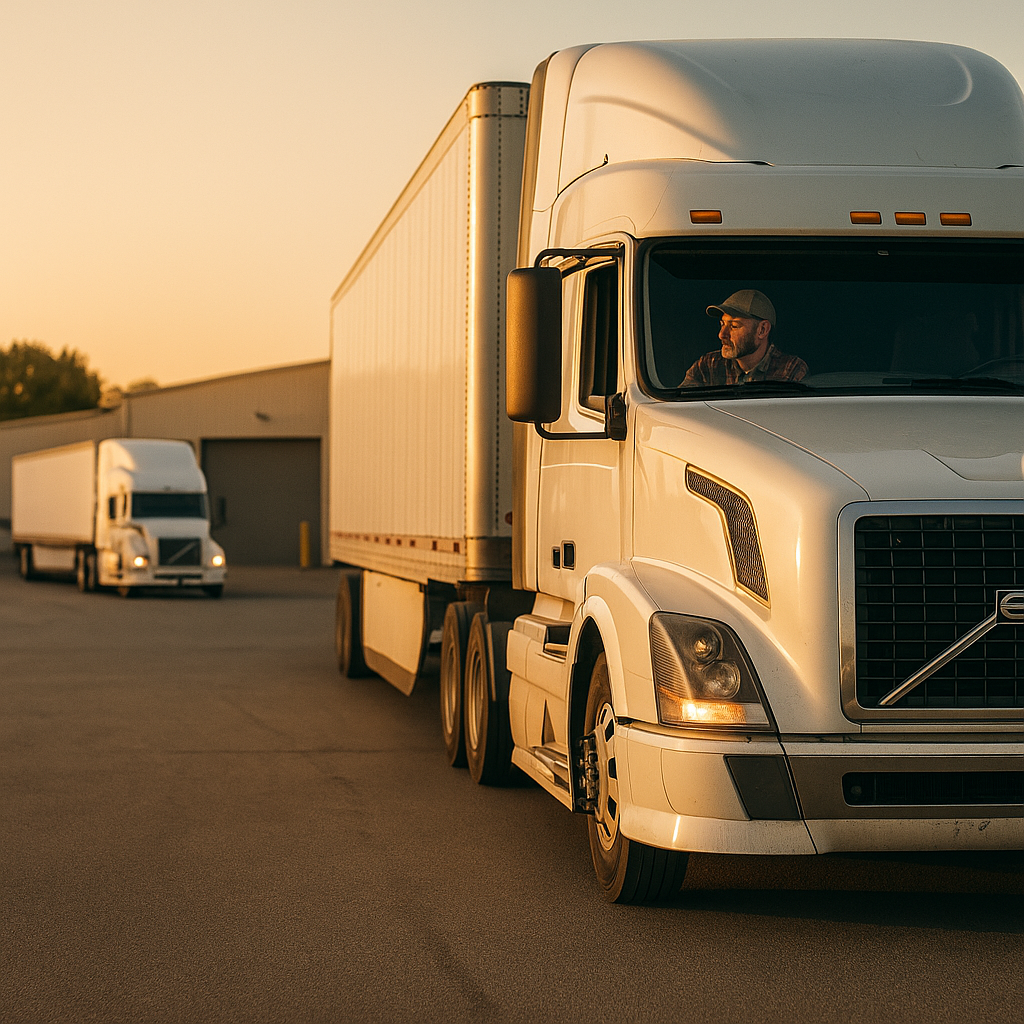

2026 Alabama small fleet truck insurance rates run about $8,000–$18,000 per truck/year. See 2–10 truck budgets, CPM, and savings tips—get a quote.
Alabama small fleet truck insurance rates in 2026 often land around $8,000–$18,000 per truck per year for standard for-hire, non-hazmat operations, while higher-risk profiles can run $20,000+ per truck. If you’re running 2–10 trucks, one claim can spike your renewal, one driver hire can swing your pricing, and insurance still drafts every month—slow freight or not.
For broader statewide context on costs and common requirements, start with Alabama commercial truck insurance benchmarks, then use the tables below to turn “per-truck ranges” into a real monthly budget and a simple cost-per-mile KPI.
Table of Contents
Reading time: 8 minutes
- Key takeaways (save this for renewal season)
- 2026 Alabama small fleet rate snapshot (per truck)
- 2–10 truck budgets in Alabama + insurance CPM
- Minimum requirements, filings, and the “new authority” trap
- Coverages Alabama small fleets usually carry (and smart ways to lower premiums)
- Next steps: get accurate Alabama small fleet rates
- Frequently Asked Questions

Key takeaways (save this for renewal season)
In 2026, many Alabama small fleets can expect to budget roughly $670–$1,500 per month per truck for standard for-hire, non-hazmat operations, with $1,700+/month being common for new ventures or higher-risk setups.
- Budget reality: Plan roughly $670–$1,500/month per truck for many standard Alabama small fleets; $1,700+/month for new ventures or higher-risk ops.
- Fleet size doesn’t automatically lower per-truck cost: Underwriters usually care more about loss history, driver quality, cargo, and operating radius than truck count.
- Track insurance like fuel: Annual premium ÷ annual miles = insurance CPM; when miles drop, CPM rises even if premium stays flat.
- Fastest sustainable savings: Tight hiring, documented safety, no lapses, and clean renewals started 45–60 days early.
2026 Alabama small fleet rate snapshot (per truck)
For planning purposes, Alabama small fleet truck insurance rates in 2026 commonly fall in the $7,500–$15,700 per truck per year range for established non-hazmat operations, with $20,000–$30,000+ showing up for new ventures or tougher risk profiles.
These are planning ranges, not a quote—your drivers, radius, commodity, filings, and loss runs will move the number. Use this as a sanity check before you spend time comparing proposals.
| Tier (typical underwriting bucket) | Annual premium (per truck) | Monthly equivalent | Who tends to land here |
|---|---|---|---|
| Low-risk / strong history | $7,500–$10,500 | $625–$875 | Experienced drivers, clean loss runs, standard freight, consistent mileage |
| Typical for-hire, non-hazmat | $9,900–$15,700 | $825–$1,310 | Most established small fleets with average lanes/radius |
| High-risk | $20,000–$30,000+ | $1,667–$2,500+ | New venture authority, prior losses, major violations, hazmat/high-theft freight, tough metros |
A “small fleet” often means 2–20 trucks in insurance terms, but this guide focuses on 2–10 because cash flow and premium swings tend to hit harder. For broader context on how insurers commonly price 2–20 units, use small fleet insurance cost per truck (2026) as a baseline, then layer Alabama specifics on top.
2–10 truck budgets in Alabama (monthly + annual) + insurance CPM
A realistic Alabama small fleet insurance budget for 2–10 trucks often falls between $1,650 and $13,500 per month depending on per-truck pricing, which makes cost-per-mile tracking essential when freight volume changes.
A practical 2–10 truck budget table (planning ranges)
Assumptions for these planning numbers:
- For-hire operation, non-hazmat
- Reasonable driver experience (not brand-new CDL across the roster)
- Mix of intrastate/regional/interstate lanes typical for Alabama carriers
- Limits and add-ons vary (cargo/physical damage can swing totals)
| Fleet size | Estimated per-truck monthly range | Estimated fleet monthly budget | Estimated fleet annual budget | Common underwriting flags |
|---|---|---|---|---|
| 2 trucks | $825–$1,500 | $1,650–$3,000 | $19,800–$36,000 | New venture + 2 trucks, thin safety process, driver turnover |
| 3–5 trucks | $800–$1,450 | $2,400–$7,250 | $28,800–$87,000 | Mixed MVR quality, inconsistent garaging/security, messy loss runs |
| 6–8 trucks | $775–$1,400 | $4,650–$11,200 | $55,800–$134,400 | Claim frequency starts to matter more than one big claim |
| 9–10 trucks | $750–$1,350 | $6,750–$13,500 | $81,000–$162,000 | Growth outpacing controls (hiring too fast, weak onboarding) |
Reality check: Adding trucks can improve consistency, but it won’t “bulk-discount” you out of bad loss runs. Underwriters worry about frequency in small fleets: several backing claims across 10 units can rate worse than one ugly claim on a one-truck account.
If you want a deeper breakdown of what’s moving quotes (and what you can control), keep what affects the cost of truck insurance open while you compare proposals.
Cost-per-mile (CPM): the simplest insurance KPI for small fleets
Insurance cost-per-mile (CPM) is calculated as annual premium per truck ÷ annual miles per truck, and it rises automatically when miles fall—even if your premium doesn’t change.
Insurance is consistently listed as a major operating cost category in industry cost research like ATRI’s annual operational cost studies.
Source: American Transportation Research Institute (ATRI), Operational Costs of Trucking — https://truckingresearch.org/
Formula:
Insurance CPM = (Annual premium per truck) ÷ (Annual miles per truck)
| Miles per truck/year | Example annual premium | Insurance CPM | What can make CPM misleading |
|---|---|---|---|
| 80,000 | $12,000 | $0.150 | If miles drop due to breakdowns/slow freight, CPM spikes fast |
| 100,000 | $12,000 | $0.120 | CPM looks “better” even if you’re running harder lanes/metros |
| 120,000 | $12,000 | $0.100 | Higher mileage can increase exposure (and future claims risk) |
Pro tip (cash flow): If you finance your premium monthly, the real punch is usually the down payment plus the first installment. Build that into load planning—especially if you’re fighting detention and slow-pay brokers.
Minimum requirements, filings, and the “new authority” trap (AL fleets)
If you run interstate, FMCSA requires minimum financial responsibility levels and insurance filings based on your operation and cargo category, and mistakes in filings can delay authority activation even when you already paid for coverage.
Interstate (FMCSA) minimums: what’s required to activate/keep authority
FMCSA minimum liability levels vary by operation and cargo (for example, general freight vs certain hazardous materials), so you should confirm your category before you shop limits.
FMCSA reference: FMCSA insurance filing requirements
- Contract reality: Many brokers and shippers require higher limits than the legal minimum.
- Common add-on: Cargo coverage is often required by contract even when it’s not legally mandated for your authority type.
Intrastate-only Alabama fleets
Intrastate-only operations can fall under different state rules than FMCSA, so you should confirm which regulator and rule set applies before binding coverage.
If your lanes or customers can change mid-year, build your policy to match how you actually operate (not how you wish you operated), because a “we’re intrastate” assumption can create gaps if you end up crossing state lines.
New authority checklist: avoid preventable delays
New venture pricing is already higher in most markets, so avoid paperwork errors that create extra downtime while trucks sit.
- Confirm your agent has your exact legal entity name and correct USDOT/MC.
- Confirm required filings are submitted on time for your authority type.
- If you need it for authority activation, understand BOC-3 filing basics so you don’t get stuck in “pending.”
Coverages Alabama small fleets usually carry (and how to lower premiums without getting exposed)
Most Alabama small fleets build their trucking insurance program around primary auto liability plus cargo and physical damage, because those three coverages typically drive both contract compliance and the largest premium swings.
The core coverage stack (plain English)
Primary liability (commercial truck insurance)
- What it is: Pays for bodily injury and property damage you cause to others.
- Why it’s essential: Required for authority and commonly demanded by broker/shipper contracts.
- Who needs it: Essentially every for-hire carrier; it’s the foundation of commercial truck insurance.
Cargo insurance
- What it is: Covers the freight you’re hauling (subject to terms, limits, and exclusions).
- Why it’s essential: A common contract requirement; being underinsured can be business-ending after a large loss.
- Where to go deeper: cargo insurance explained
Physical damage (comp/collision) + trailer coverage
- What it is: Covers your equipment (comprehensive and collision), and often trailer physical damage depending on how your policy is set up.
- Why it’s essential: Lenders commonly require it, and a total loss can wipe out a year of profit if you’re leveraged.
- Who needs it: Any fleet with financed trucks, newer equipment, or a balance sheet that can’t absorb a $60k–$180k hit.
Hotshot insurance (if applicable)
Hotshot operations (dually + gooseneck/flatbed) can be rated differently than semi truck insurance because equipment, cargo mix, and loss patterns differ, so you’ll want apples-to-apples quotes built for the correct vehicle class.
How Alabama small fleets lower premiums (without playing games)
Lowering premium sustainably usually comes from quote timing, clean submissions, and fewer avoidable losses—not from cutting coverage that your contracts or lenders will require anyway.
- Market moves (quote strategy): Start renewal 45–60 days early; last-minute renewals usually cost more.
- Compare apples-to-apples: Same limits, same deductibles, same vehicle schedule—otherwise you’re comparing coverage, not rates.
- Risk moves (what underwriters reward): Tight hiring standards, documented onboarding, and enforceable policies (phones/seatbelts).
- Claims defense: Dash cams/telematics credits vary, but the bigger win is often documentation and claim defense.
- Avoid lapses: Lapses signal cash flow or risk management issues and can hammer pricing.
- Deductibles: Raise deductibles only to a number you can pay during a bad week.
If you want a deeper renewal-focused checklist, use Affordable trucking insurance: how to save.
Next steps: get accurate Alabama small fleet rates (without overpaying)
The fastest way to get accurate Alabama small fleet truck insurance rates is to submit clean driver/equipment data, keep limits consistent across quotes, and shop early enough for underwriters to review you correctly.
- Build a tight submission: Drivers, VINs, garaging ZIPs, operating radius, commodities, and loss runs.
- Decide non-negotiables: Limits, cargo requirements, and lender requirements for physical damage.
- Shop early: Compare proposals with the same structure (limits/deductibles/schedules).
- Pick one enforceable safety control: Something you can actually measure and enforce, not a “paper policy.”
Related reading:
- Hotshot insurance guide (if you run hotshot units alongside semi truck insurance)
- Affordable trucking insurance: how to save (renewal strategy + cost control)
Frequently Asked Questions
In 2026, many Alabama small fleets (2–10 trucks) see about $8,000–$18,000 per truck per year for standard for-hire, non-hazmat operations, with $20,000+ per truck common for new ventures or higher-risk profiles. The biggest drivers of the final price are your driver quality (MVR/PSP trends), loss runs, operating radius (metro density), and cargo type. Use the range as a planning benchmark, then validate your specific exposure and required limits with a clean submission and apples-to-apples quotes.
The biggest pricing factors for Alabama small fleets are typically driver MVR/PSP trends, at-fault losses, new venture status, operating radius and lane mix (metro exposure), cargo type (theft-prone or higher severity), and equipment value (especially when physical damage is required). In small fleets, claim frequency can hurt more than one large claim because it suggests repeatable process issues. For a deeper underwriting-variable checklist, see what affects the cost of truck insurance.
Sometimes, but only when the fleet is more consistent than a one-truck operation—standardized hiring, documented safety controls, stable routes, and clean loss runs. More trucks can also mean more exposure, and scaling too fast with mixed driver quality can raise per-truck costs. Underwriters often prefer a smaller fleet that runs tight processes over a larger fleet with frequent minor claims and inconsistent driver screening.
You can often reduce financed-truck physical damage costs by confirming the unit value is accurate, selecting deductibles your cash flow can actually handle, and matching comp/collision terms to your real-world garaging and operating patterns. Shopping early (ideally 45–60 days before renewal) also gives underwriters time to review details instead of pricing you as a last-minute risk. For a plain-English breakdown of what comp/collision includes and what typically drives the price, read physical damage coverage (comp/collision).
Conclusion: Budget Alabama small fleet truck insurance like a KPI, not a bill
Alabama small fleet truck insurance rates in 2026 commonly sit in the $8,000–$18,000 per-truck range for standard non-hazmat operations, but the real story is how your drivers, lanes, cargo, and claims discipline move you inside that band. Build a budget, track CPM, and shop early enough to control the outcome.
Key Takeaways:
- Use planning ranges: $8,000–$18,000 per truck/year for many standard small fleets; $20,000+ for higher-risk/new ventures.
- Convert premium to CPM: Annual premium ÷ annual miles per truck to keep decisions grounded when freight slows.
- Win renewals early: Start 45–60 days out, submit clean data, and compare apples-to-apples limits and deductibles.
If you want pricing that matches your exact operation, get your driver list, VINs, garaging ZIPs, radius, and commodities together first—then request quotes with consistent limits so the numbers actually mean something.





