
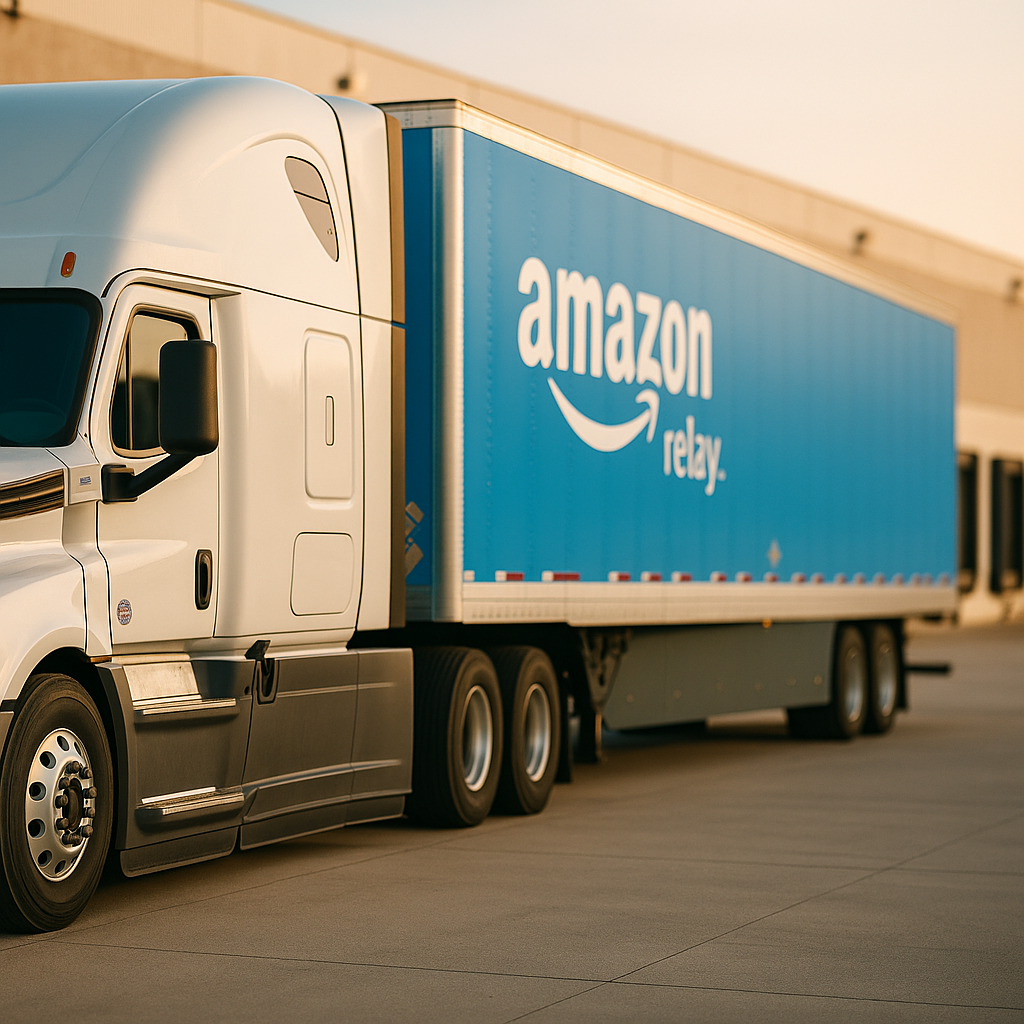

5 required policies + COI tips to avoid RMIS delays. 2026 limit table ($1M auto, $100K cargo, $50K interchange) + small-fleet cost ranges. Get the checklist.
Amazon Relay insurance requirements for small fleets usually include $1,000,000 commercial auto liability, $100,000 motor truck cargo, $1,000,000 per occurrence / $2,000,000 aggregate general liability, and (often) $50,000 trailer interchange—plus a COI that displays the limits, dates, and wording exactly as the verifier expects. Always confirm the current requirements inside Relay/RMIS and on Amazon’s official guidance before you submit.
If you’re a 1–20 truck operation, one wrong COI field can stall onboarding while truck payments, insurance, and IFTA keep moving. If you want a quick reset on the fundamentals before you troubleshoot Relay paperwork, start with commercial truck insurance basics.
Table of Contents
Reading time: 7 minutes
- Key Takeaways (Small-Fleet Version)
- Amazon Relay insurance requirements (2026): limits small fleets must match
- COI + RMIS: the exact stuff that causes delays (and how to fix it)
- Amazon Relay insurance cost for small fleets: realistic per-truck budgeting (ranges)
- Optional coverages + state-by-state nuances (the stuff that keeps small fleets alive)
- Downloadable: Small-Fleet Amazon Relay Insurance Readiness Checklist
- Frequently Asked Questions

Key Takeaways (Small-Fleet Version)
Amazon Relay’s published insurance guidance commonly lists $1,000,000 auto liability, $100,000 cargo, $1,000,000/$2,000,000 general liability, and $50,000 trailer interchange, and the COI has to show those items cleanly to pass verification (verify current limits before submitting).
- Relay compliance is paperwork-precise: having trucking insurance isn’t enough—your COI must display the correct coverage types, limits, and dates.
- Most RMIS delays are fixable: insured name mismatch, wrong “trailer” coverage type, missing aggregate limit, and future-effective dates are common.
- Budgeting reality: small fleets typically pay more per truck than large carriers, so compare matched limits (not mismatched quotes).
Amazon Relay insurance requirements (2026): limits small fleets must match
Amazon’s Relay guidance commonly requires $1,000,000 commercial auto liability, $100,000 motor truck cargo, $1,000,000 per occurrence / $2,000,000 aggregate general liability, and $50,000 trailer interchange (confirm inside your Relay workflow and Amazon’s official page before binding or submitting).
These are platform requirements (to haul Relay loads), not the same thing as federal minimums to operate. For the federal filing baseline and general filing overview, see FMCSA here: https://www.fmcsa.dot.gov/registration/insurance-filing-requirements.
Quick limit table (verify against Relay on submission day)
The table below reflects commonly published Relay limits/structure; use it as a working checklist, then verify requirements the day you submit.
| Coverage type | Common minimum shown in Relay guidance | What it’s protecting (plain English) |
|---|---|---|
| Commercial Auto Liability | $1,000,000 per occurrence | Injuries/property damage you cause with the truck |
| Motor Truck Cargo | $100,000 | The freight you’re responsible for (damage/theft, subject to exclusions) |
| General Liability | $1,000,000 each occurrence / $2,000,000 aggregate | Non-auto claims (dock/yard slip-and-fall, premises-type exposure) |
| Trailer Interchange | $50,000 | Damage to a trailer you don’t own while it’s in your care/custody/control under an interchange agreement |
Source: Amazon Relay official guidance — https://relay.amazon.com/blog/intro-to-amazon-relay/understanding-amazon-relay-insurance-requirements
What it is (the “why Relay cares” version)
Relay is managing claim risk across a huge volume of shipments, so they standardize minimum limits and COI presentation to reduce uncertainty when a crash or cargo loss happens.
Why it’s essential (cash-flow reality)
If your insurance submission doesn’t match what Relay/RMIS expects, your account can stall or get restricted and you can miss revenue windows—painful when you’re running 1–5 trucks.
- Approval can stall: onboarding gets stuck in “needs correction” loops.
- Loads can be missed: dispatch opportunities don’t wait for paperwork.
- Resubmits burn time: small fleets feel this immediately in cash flow.
Who needs to pay extra attention
- New authority / new venture fleets
- Fleets adding Amazon as a new customer
- Anyone running power-only or hooking third-party trailers (where interchange comes up)
- Hotshot operators expanding into heavier freight (classification and use can change quote structure)
Pro tip: trailer interchange is the #1 “we thought we had it” problem
“Non-owned trailer” language is commonly misunderstood and often isn’t the same as true interchange coverage shown on a COI. If Relay requires interchange, make sure you have the correct endorsement and the COI explicitly lists it. For a clearer breakdown, see trailer interchange insurance explained.
COI + RMIS: the exact stuff that causes delays (and how to fix it)
RMIS-style insurance verification is typically a field-by-field check of your COI for the correct insured name, active dates, required coverage types, and required limit formats (like “per occurrence” vs “aggregate”).
You can be properly insured and still fail verification if the certificate is issued with the wrong wording, missing limits, or mismatched insured information.
COI fields small fleets should double-check before submitting
Give this list to your agent and have them re-issue the COI if anything is off (don’t self-edit certificates):
- Insured legal name: matches your authority records exactly (LLC/Inc, punctuation, spacing).
- Policy numbers: present and correct on the certificate.
- Effective dates: active (not future-dated), with no gaps.
- Limits shown correctly: per occurrence vs aggregate where required.
- Coverage types listed: Auto, Cargo, General Liability, Trailer Interchange (as required).
- Certificate holder / wording: matches the instructions inside your Relay workflow.
- Agent contact info: included so verification calls/emails don’t dead-end.
For a deeper walkthrough of what a clean truck COI should look like (and what causes rejects), use certificate of insurance (COI) requirements for trucking.
RMIS verification timeline (what to expect)
The usual flow looks like this:
- You bind/activate policies (or confirm current policies match the Relay limits).
- Your agent issues the COI with correct coverage types, limits, and wording.
- You submit through the Relay portal/workflow you’re directed to use.
- The verifier checks the COI fields against required coverage types, limits, and dates.
- You pass—or you get a request to correct a mismatch and resubmit.
In practice, “fast approval” usually means the COI was clean the first time; most delays are basic mismatches like missing aggregate limits, insured name errors, or the wrong trailer coverage type.
Amazon Relay insurance cost for small fleets: realistic per-truck budgeting (ranges)
Commercial auto liability is usually the biggest cost line for a small fleet, and a common budgeting range for auto liability alone is roughly $800–$2,500+ per truck per month (with wide variation by drivers, radius, lanes, and loss history).
ATRI’s operational cost studies consistently show insurance is a meaningful cost category for carriers: https://truckingresearch.org/2024/10/an-analysis-of-the-operational-costs-of-trucking-2024-update/
No one can quote you accurately from a table—your premium depends on authority age, driver history, loss history, operating radius, commodity, lanes, equipment, and garaging ZIP.
Illustrative per-truck ranges (budgeting only)
These are rough planning ranges many small fleets see when shopping coverage that meets common shipper/broker standards; your actual results can be lower or higher.
| Line item | Monthly per truck (rough range) | Annual per truck (rough range) |
|---|---|---|
| Commercial Auto Liability | $800–$2,500+ | $9,600–$30,000+ |
| Motor Truck Cargo | $50–$250 | $600–$3,000 |
| General Liability | $40–$150 | $480–$1,800 |
| Trailer Interchange | $50–$200 | $600–$2,400 |
| Physical Damage (optional but common) | $150–$600+ | $1,800–$7,200+ |
Why small fleets pay more per truck than big carriers
- Less risk spread: one claim can hit your loss ratio harder.
- Less leverage: fewer options and less negotiating power.
- New venture pricing: the first 12–24 months are often the most expensive.
To understand why two similar fleets can get very different quotes, read what affects the cost of truck insurance.
How to reduce premiums without failing Relay compliance
You don’t save money by dropping required coverage; you save money by tightening the risk profile and shopping apples-to-apples.
- Adjust deductibles where you can actually absorb the loss (often physical damage).
- Improve driver quality (MVR/PSP patterns and experience matter to underwriting).
- Maintain continuous coverage (lapses can trigger higher pricing).
- Audit underwriting inputs: radius, garaging ZIP, commodity, annual miles.
- Consider cameras/telematics if your market offers credits.
Optional coverages + state-by-state nuances (the stuff that keeps small fleets alive)
Relay’s checklist focuses on a few required policies, but many of the coverages that protect your cash flow—like physical damage, towing, and occupational accident—are separate decisions and can be state- and contract-dependent.
Physical damage, towing, downtime (cash-flow protection)
- Physical damage (comp/collision): protects your tractor and is often required by lenders.
- Towing and labor: can keep a small breakdown from becoming a five-figure event.
- Downtime/rental reimbursement: matters because one truck down can wipe out a week of revenue.
Workers’ comp vs occupational accident (don’t guess)
Workers’ comp rules vary by state and by how your drivers are classified (W-2 employee vs independent contractor), and occupational accident is not a 1:1 replacement where workers’ comp is required.
If you run mixed driver setups, read workers’ comp vs occupational accident for owner-operators before you assume you’re covered.
Leased-on vs running under your own authority
If you’re leased onto a carrier, the carrier’s primary auto liability may apply while dispatching under their authority—but that doesn’t automatically cover your physical damage, bobtail/non-trucking liability, or lease-created gaps. Know which DOT/MC is being used for Relay onboarding and whose insurance is being submitted.
Downloadable: Small-Fleet Amazon Relay Insurance Readiness Checklist
A Relay-ready COI typically needs to show the required policy types and limits clearly, with active dates and insured details that match your authority records.
- Auto Liability: $1,000,000 shown on COI (verify required format)
- Cargo: $100,000 shown on COI
- General Liability: $1,000,000 occurrence / $2,000,000 aggregate shown on COI
- Trailer Interchange: $50,000 shown on COI (if required)
- Insured legal name: matches authority records exactly
- Policy dates: active (no gaps, not future-effective)
- Certificate holder / wording: matches Relay instructions
- Agent contact info: included for verification
- Renewal reminders: set for 30/15/7 days before expiration
Frequently Asked Questions
Commonly published Amazon Relay minimums include $1,000,000 commercial auto liability, $100,000 motor truck cargo, $1,000,000 per occurrence / $2,000,000 aggregate general liability, and $50,000 trailer interchange, but you should verify the exact requirements inside Relay/RMIS before submitting. If any coverage type, limit format, or COI field is missing or mismatched, verification can be rejected or delayed even if you “have insurance.” For the current published overview, see Amazon’s page: Relay insurance requirements.
If your Relay work involves pulling trailers you don’t own under interchange conditions, trailer interchange coverage is often required and must be shown on the COI at the required limit (commonly $50,000). The most common mistake is assuming “non-owned trailer” wording automatically satisfies interchange requirements; it often doesn’t. The safest approach is to confirm what Relay is asking for in your onboarding workflow, then have your agent add the correct endorsement and list it clearly on the certificate. For a deeper explanation, see trailer interchange insurance explained.
Approval time depends primarily on COI accuracy, not just how fast you upload documents. If your policies are active and the COI shows the correct insured legal name, coverage types, limits (including aggregate vs per occurrence where required), active effective dates, and the correct certificate-holder wording, verification can move quickly. If any of those fields are wrong—like a future-effective date, missing GL aggregate limit, or trailer coverage listed as non-owned instead of interchange—you can get stuck in resubmission loops until the COI is reissued. For a field-by-field primer, see certificate of insurance (COI) requirements for trucking.
There isn’t one fixed “Amazon Relay insurance” price, but small fleets often see commercial auto liability as the largest cost, commonly ranging from about $800 to $2,500+ per truck per month depending on drivers, radius, lanes, and loss history. Cargo, general liability, and trailer interchange are usually smaller line items, but the required limits still need to match the onboarding checklist. Cargo pricing also depends heavily on commodity, limits, deductibles, and exclusions. For a cargo-specific breakdown, see motor truck cargo insurance.
Conclusion: match the limit table, fix the COI, then submit (in that order)
Relay compliance is straightforward but not forgiving: correct policy types, correct limits, and a COI that matches the verifier’s checklist exactly.
If you want to cut costs without breaking compliance, focus on underwriting inputs and risk controls—not removing required coverages.
Key Takeaways:
- Verify Relay’s current minimums before you submit (limits and formats can change).
- Most RMIS delays come from COI details: insured name, dates, aggregates, and trailer wording.
- Shop quotes apples-to-apples: same limits, same use/class, same radius, and the needed endorsements.
For next steps, these two deep-dives help you tighten the budget while keeping required limits intact: how to lower commercial truck insurance premiums and auto liability insurance for trucking.





