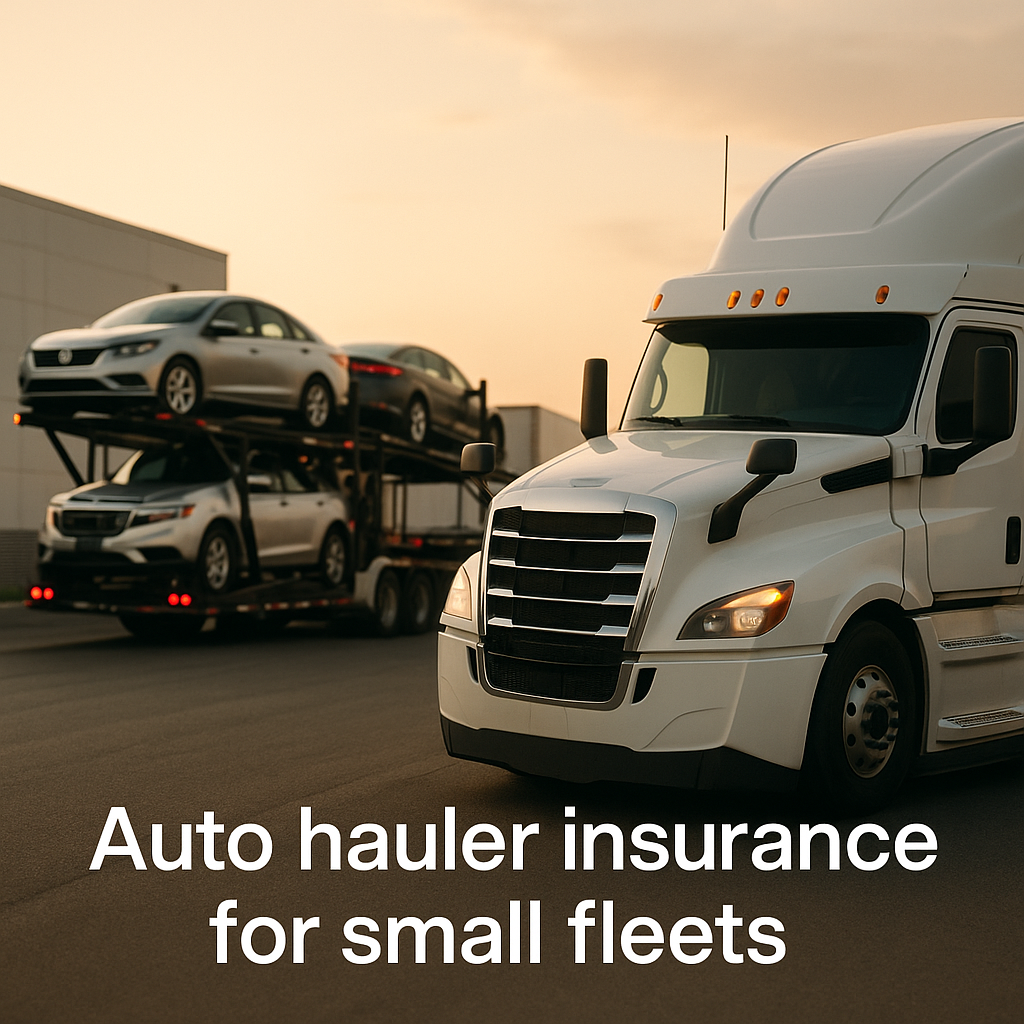
2026 auto hauler insurance for small fleets: typical $7K–$18K+ per truck. Coverages (on-hook & DV), FMCSA filings, tips—get quotes.
Auto hauler insurance for small fleets is specialized coverage built for 2–10 truck operations where a single deck claim can erase weeks of profit. If you’re running car hauls, you already know the math: one preventable incident—load shift, a low-bridge mistake, or a four-wheeler cutting in—can wreck cash flow.
Quick answer (budget range): In 2026, many small fleets see roughly $7,000–$18,000+ per power unit per year for auto hauler insurance, with pricing driven by open vs enclosed, operating radius, maximum deck value (on-hook limit), driver experience/MVR, and loss history. Auto hauling is a specialized form of trucking coverage within Commercial truck insurance basics, and small fleets often feel the pricing swing the most.
This guide breaks down the coverages auto haulers actually need (including on-hook and diminished value), real-world cost ranges you can budget around, and a simple compliance checklist so you can bind without delays.
Table of Contents
Reading time: 8 minutes
- Key takeaways
- What counts as a “small fleet” auto hauler (and why it changes underwriting)
- 7 coverages small-fleet auto haulers commonly need
- 2026 cost: auto hauler insurance per truck for small fleets
- Programs + compliance: how to bind without delays (FMCSA filings included)
- Frequently Asked Questions
- Conclusion: Get the right auto hauler coverage without overpaying
Key takeaways
Auto hauler insurance for small fleets is commonly budgeted in 2026 at $7,000–$18,000+ per power unit per year, with enclosed and high-value operations trending higher.
- Auto hauling is priced on severity, not just mileage—your max deck value and driver controls matter as much as radius.
- On-hook / care-custody-control is where small fleets get underinsured (or incorrectly insured) most often.
- Expect $7K–$18K+ per truck annually as a directional range; enclosed, high-value, or new authority operations trend higher.
- You can improve pricing by tightening driver screening, securement SOPs, and claim reporting discipline—underwriters will credit what you can prove.

What counts as a “small fleet” auto hauler (and why it changes underwriting)
In trucking insurance underwriting, a “small fleet” commonly means 2–10 power units (some markets stretch it to 15), and that size changes how insurers evaluate consistency, controls, and loss trends.
Small fleets are big enough that one driver or one claim trend can swing the account, but not big enough to average losses out across 50–100 trucks. For a broader fleet-focused overview beyond auto hauling, reference this Small fleet trucking insurance guide.
Small fleet definition for underwriting
What it is (plain English): You’re big enough that one risky hire or one preventable trend can move your renewal, but too small to “absorb” it across lots of units.
- Renewals are judged on trend lines: frequency + severity over time matters more than explanations.
- Insurers want consistency: hiring standards, training, maintenance records, and incident reporting.
- Who needs this lens: any owner-operator who added a second truck, and any small carrier trying to grow without getting crushed by renewals.
Open vs enclosed hauling (risk profile)
Open auto hauling usually has more weather/road-debris exposure, while enclosed hauling typically brings higher vehicle values and higher-severity theft/fire claims.
- Open hauler: claims may be more frequent, often lower per unit.
- Enclosed hauler: higher values, bigger severity when something goes wrong, and often stricter underwriting.
If you’re switching from lighter-duty vehicle moves into true multi-car operations, make sure the policy form actually matches what you do (especially the on-hook/care-custody-control wording and the commodity language on cargo).
7 coverages small-fleet auto haulers commonly need
A typical small-fleet auto hauler insurance stack includes primary liability, on-hook/care-custody-control, and often physical damage, with optional layers like general liability and umbrella depending on contracts.
Image placeholder: Alt text: Chart of 7 auto hauler insurance coverages including on-hook and diminished value
1) Primary liability (auto liability)
Primary liability covers bodily injury and property damage you cause to others, and it’s the foundation coverage for most for-hire trucking operations.
Regulatory note: Federal financial responsibility requirements are governed under 49 CFR Part 387 (eCFR): https://www.ecfr.gov/current/title-49/subtitle-B/chapter-III/subchapter-B/part-387. Shipper/broker contracts often require limits above federal minimums.
Who needs it: any for-hire carrier operating under its own authority.
2) Motor truck cargo (know what it does and doesn’t do for autos)
Motor truck cargo insurance is designed to cover freight you’re hauling, but many cargo forms limit or exclude autos, high-value units, or specific causes of loss.
Auto hauling is where people get burned by assumptions: you need to read the cargo form, not just the certificate. For a deeper breakdown, see Motor truck cargo insurance explained.
Who needs it: auto haulers working with brokers/shippers that require cargo (and any fleet hauling non-vehicle freight part-time).
3) On-hook / carrier’s legal liability (auto-hauler-specific)
On-hook coverage (often described as carrier’s legal liability for autos) is designed for vehicles in your care, custody, or control while loading, unloading, or transporting.
This is where “cheap” becomes expensive: if your on-hook limit doesn’t match your maximum deck value, you can pay premium for a false sense of protection.
Pro tip (limits): Set on-hook limits from the top down:
- Max number of units you can haul
- Worst-case value per unit (not “average”)
- Total maximum deck value (plus buffer if contracts impose penalties)
4) Diminished value (DV) endorsements (auto-hauler-specific)
Diminished value (DV) is the loss in resale value after a vehicle is repaired, because the accident history still shows up in the market.
DV claims show up more with newer vehicles, luxury brands, and enclosed operations. Availability varies by carrier and state, so ask directly whether DV is included, excluded, or available by endorsement.
5) Physical damage (tractor & trailer)
Physical damage covers your equipment (comprehensive + collision), and deductibles and stated values can materially change both premium and claim outcomes.
Who needs it: anyone financing equipment, and anyone who can’t replace a tractor/trailer out of pocket without wrecking cash flow.
6) General liability (GL)
General liability covers non-auto liability exposures like yard operations and slip-and-fall claims that aren’t triggered by operating a covered auto.
Who needs it: fleets with a yard/loading area, and fleets with contracts that require GL even when you’re not on-site often.
7) Umbrella / excess
Umbrella insurance provides additional limits over underlying policies (commonly liability and sometimes GL), which can be a cost-effective way to meet higher contract requirements.
Who needs it: fleets hauling into metros, dealing with higher-value third-party property exposure, or signing contracts requiring higher limits.
2026 cost: auto hauler insurance per truck for small fleets
In 2026, many small fleets budget auto hauler insurance at $7,000–$18,000+ per power unit per year, with enclosed/high-value and new-venture operations often pricing above that range.
Auto hauling is one of the most “spread out” classes pricing-wise: two fleets with the same truck count can land very different premiums based on what they haul, where they run, and who’s behind the wheel.
Image placeholder: Alt text: Table showing 2026 auto hauler insurance cost per truck for small fleets by open vs enclosed
Typical annual premium ranges (directional, not a promise)
| Operation | Radius | Fleet profile | Estimated annual premium per power unit |
|---|---|---|---|
| Open hauler | Local/Regional | Established, clean loss runs | $7,000–$12,000 |
| Open hauler | Regional/Longer lanes | Mixed experience, higher limits | $10,000–$16,000 |
| Enclosed hauler | Regional | Higher vehicle values, tighter underwriting | $12,000–$20,000+ |
| Enclosed hauler | Longer lanes / high-value | Higher severity exposure | $18,000–$30,000+ |
What moves the needle fastest
The fastest drivers of premium in auto hauling are tied to claim severity and uncertainty.
- Higher on-hook limits (because max deck value is higher)
- Enclosed/high-value vehicles (severity)
- New venture / new authority (uncertainty pricing)
- Driver MVR/PSP issues, preventable losses, poor claim documentation
If you want the deeper breakdown of why two quotes can be $10K apart, see What affects truck insurance cost.
Where small fleets usually get surprised
- Limits don’t match the deck value: a $250K on-hook limit on a $400K load is a business-ending mismatch.
- “Affordable” isn’t affordable after a claim: lowest premium often means higher deductibles, narrower coverage, or exclusions that show up at the worst time.
- Driver turnover is expensive: one risky hire can haunt your renewal, even if you terminate quickly.
Programs + compliance: how to bind without delays (FMCSA filings included)
FMCSA insurance filing requirements can prevent a for-hire interstate carrier from activating authority even after a policy is bound, which is why filings and COIs must be treated as separate steps.
Most “specialized auto hauler programs” are simply carriers with a consistent appetite and prebuilt forms for auto hauling—but they still require clean submissions and fast responses to underwriting questions.
What “program” usually means (and what it’s not)
A true “program” typically means the carrier underwrites auto haulers routinely and has predictable requirements (experience thresholds, preferred safety controls, max radius, and pre-negotiated forms).
- Why it helps: you’re less likely to get hit with last-minute exclusions that don’t fit auto hauling.
- Who needs it: small fleets that can’t burn a week going back-and-forth on underwriting.
Fast-binding submission checklist (what to have ready)
A complete submission is the fastest “discount” you can earn because it reduces underwriting uncertainty.
- Unit list: year/make/VIN, stated values, garaging ZIPs
- Trailer details: configuration, capacity, specialty equipment
- Driver list: DOB, CDL state, years experience, auto-hauler experience, hiring date
- Loss runs (3–5 years) or letter of no-loss if truly none
- DOT/MC, operating radius, lanes, % metro driving, states you run
- What you haul: auctions, dealers, OEM, private owners, exotics/classics
- Your securement process: who checks, when, and how it’s documented
FMCSA filings vs proof of insurance (the common bottleneck)
FMCSA distinguishes between having coverage and having required insurance filings on record, and many for-hire interstate carriers need filings submitted before authority is active.
FMCSA’s overview is here: https://www.fmcsa.dot.gov/registration/insurance-filing-requirements. If you keep getting stuck at “active authority” vs “bound policy,” review Insurance filings (BMC-91/91X) so you’re not losing loads to paperwork.
Image placeholder: Alt text: Compliance checklist for FMCSA filings and proof of insurance for auto haulers
Practical compliance checklist (simple version)
- Bind coverage with correct legal entity name and DOT/MC info
- Confirm required filings are submitted (if applicable)
- Get COIs issued to brokers/shippers with correct language
- Verify limits match contract requirements (especially on-hook)
- Don’t dispatch until compliance is actually green-lit
Frequently Asked Questions
Most auto haulers need primary auto liability plus on-hook/care-custody-control coverage sized to the maximum deck value they can carry at one time. Many small fleets also carry physical damage (tractor and trailer), general liability for non-auto premises/operations exposures, and sometimes an umbrella to meet broker or shipper contract limits. If you haul newer or higher-value units, ask whether the market offers a diminished value (DV) endorsement and whether it’s included, excluded, or limited.
A common 2026 budgeting range is $7,000–$18,000+ per power unit per year, with enclosed and high-value operations often higher. Premiums swing most based on open vs enclosed, operating radius and metro exposure, maximum vehicle values on the deck (which drives on-hook limits), driver experience and MVR/PSP, prior losses, and whether you’re a new venture/new authority. For the rating variables that swing quotes the most, see What affects truck insurance cost.
Yes, many insurance markets have a consistent appetite for auto haulers, but eligibility is usually stricter than general freight because auto hauling is a higher-severity class. Underwriters commonly expect documented safety controls such as driver screening, securement procedures, maintenance discipline, and prompt claim reporting, plus acceptable loss runs. If you’re operating multiple units, this Small fleet trucking insurance guide can help you align your submission with what underwriters consider “fleet-like” controls.
Yes, owner-operators can access auto hauler coverage either leased-on to a motor carrier or operating under their own authority, and the insurance setup changes based on that status. If leased-on, the carrier’s liability may apply while dispatched, but you may still need coverages like physical damage and bobtail/non-trucking liability depending on the agreement. If you have your own authority, you’ll typically need primary liability and any required filings. This guide on Owner-operator truck insurance helps you sort out what’s carrier-provided vs what you still need to buy.
Conclusion: Get the right auto hauler coverage without overpaying
Auto hauling is a niche where “close enough” insurance can bankrupt a small carrier, especially when on-hook limits don’t match real deck value. If you want premiums that make sense, focus on what underwriters reward: documented hiring standards, securement SOPs, and clean, fast claim reporting.
Key Takeaways:
- Budget realistically: many small fleets land around $7K–$18K+ per truck in 2026, with enclosed/high-value and new ventures higher.
- Size on-hook from maximum deck value: limits should match your worst-case load, not your average load.
- Submit like a “real fleet”: clean unit/driver data, loss runs, and written procedures reduce delays and surprises.
Related reading (build your cost plan):
If you’re ready to move quickly, build a complete submission package first—then quote. It’s the fastest way to bind cleanly and avoid coverage gaps that show up after a loss.