
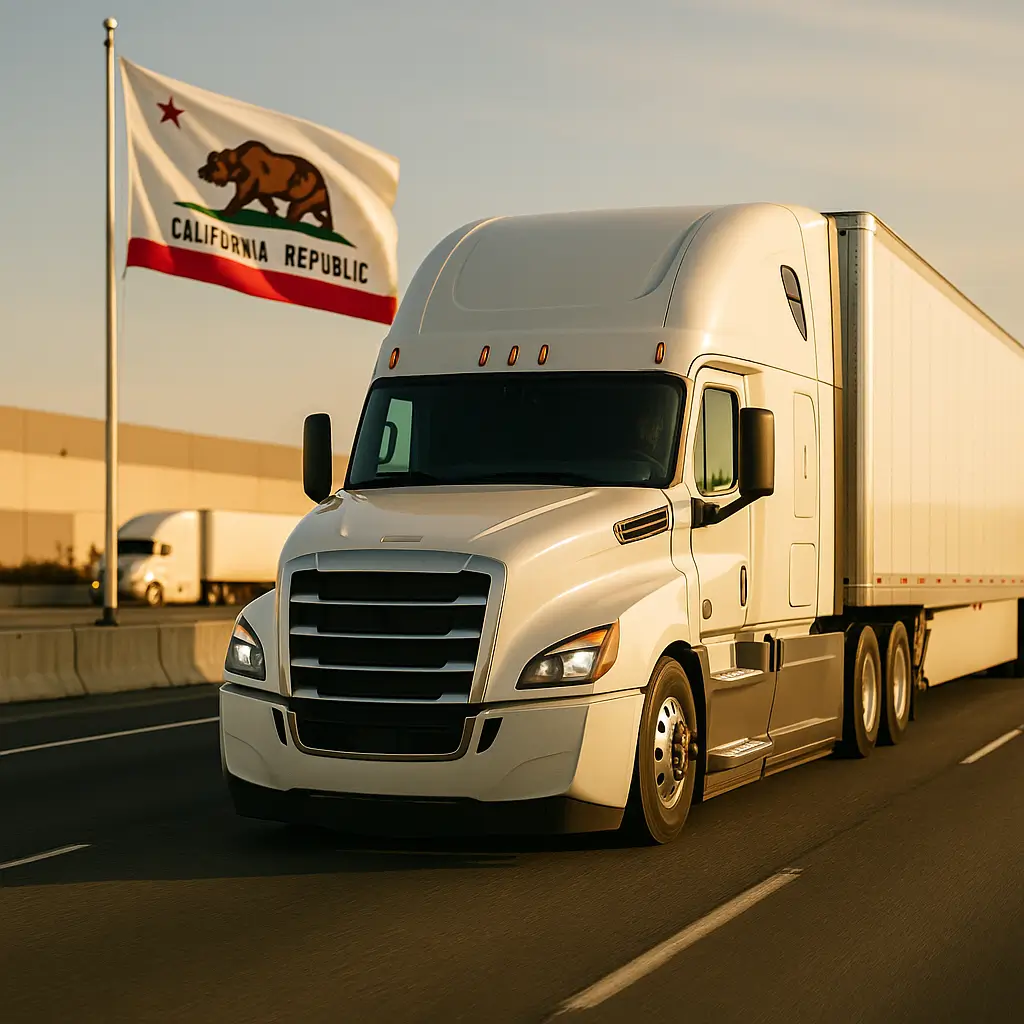

See California commercial auto requirements, 30/60/15 minimums, MCP, CPUC, FMCSA rules, penalties, and proof.
California commercial auto insurance requirements can shut down a job, a load, or an entire fleet when the paperwork or limits don’t match your operation. The baseline liability minimum in California is $30,000/$60,000/$15,000, but many businesses need higher limits because of MCP (DMV), CPUC passenger rules, FMCSA authority, hazmat, vehicle weight classes, or contract requirements.
If you want a quick refresher on what commercial auto covers (and what it doesn’t), start with commercial auto insurance basics before you compare quotes or issue COIs.
Table of Contents
Reading time: 8 minutes
- 2026 minimum limits in California (2025 change + 2035 planning)
- Who needs commercial auto insurance in California (and when personal auto won’t work)
- MCP, CPUC passenger rules, hazmat, and FMCSA (how “real requirements” are set)
- Proof of insurance, COIs, renewals, and penalties (how to stay compliant)
- Frequently Asked Questions
- Conclusion

California commercial auto insurance requirements in 2026: minimum limits (what changed in 2025—and what’s coming in 2035)
As of January 1, 2025, California’s minimum auto liability limits increased to $30,000/$60,000/$15,000 under SB 1107, and another increase is scheduled for 2035 (verify the current statute and dates at leginfo.legislature.ca.gov by searching “SB 1107”).
These minimums are the “financial responsibility” floor for liability coverage, but they’re not automatically enough for motor carriers, passenger carriers, or most commercial contracts.
Quick answer: California baseline liability minimums
California’s baseline liability minimums are 30/60/15, meaning $30,000 bodily injury (per person), $60,000 bodily injury (per accident), and $15,000 property damage (per accident).
| California baseline liability minimums | Amount |
|---|---|
| Bodily injury (per person) | $30,000 |
| Bodily injury (per accident) | $60,000 |
| Property damage (per accident) | $15,000 |
What these minimums are (and what they are not)
These minimums are liability limits—they pay for injuries and property damage you cause to others, up to the policy limit.
- They do cover: third-party bodily injury and third-party property damage (up to limits).
- They don’t replace: comprehensive/collision (physical damage), cargo, general liability, or workers’ compensation.
- They don’t guarantee contract acceptance: many shippers, brokers, and general contractors require $1,000,000 liability and specific endorsements.
Why “minimum” often isn’t enough for a business
A single California loss can exceed 30/60/15 quickly once you add medical bills, multiple vehicles, and legal costs, especially when the vehicle is branded with a business name.
If you’re hauling freight, treat this as part of your full trucking insurance stack, not a personal-auto-style checkbox. For a trucking-first overview, see semi truck insurance.
Who should pay extra attention before renewal
- Contractors and service fleets: vans and pickups at jobsites often trigger higher contractual limits.
- Owner-operators and small fleets: one claim can create a renewal crisis if limits and filings don’t match permits.
- Hotshot setups: pickup + trailer operations still need correct commercial truck insurance structure, not “just a pickup policy.”
- Passenger-for-hire: CPUC insurance tables can require different limits than baseline 30/60/15.
Practical tip: If you’re going to increase limits, it’s usually smoother (and often cheaper) to do it at renewal than mid-term when a customer rejects your COI.
Who needs commercial auto insurance in California (and when personal auto won’t work)
Commercial auto insurance is typically required by insurers and contracts when a vehicle is used “in the course of business,” and many personal auto policies exclude or restrict coverage for delivery, hauling for a fee, or regular business use.
People usually learn this after a claim, when the adjuster asks: Who owns the vehicle, who was driving, what was the purpose of the trip, and were you being paid for that trip?
Common triggers that push you into commercial auto
- Ownership/title: the vehicle is titled to an LLC or corporation.
- Work use: deliveries, pickups, hauling tools or materials, or transporting property for compensation.
- Daily operations: shop-to-jobsite driving all day (not simple commuting).
- Drivers: employees, multiple drivers, or drivers outside your household.
- Visibility: signage/branding, DOT numbers, or regular worksite access requirements.
Real-world “if X, then Y” examples
- If you haul freight or pull a trailer for pay: you’re likely in commercial truck insurance territory, not just basic commercial auto.
- If you run hotshot loads: you still need the right hotshot insurance structure (liability, physical damage, and often cargo, depending on how you’re dispatched and what you haul).
- If you do local service work: commercial auto is usually the foundation for jobsite and customer-property exposure.
If you use rentals or employee-owned cars: HNOA is the common gap
Hired and non-owned auto insurance (HNOA) is designed to address liability when employees drive their own vehicles for work or when you rent/borrow vehicles for business, and it’s often added as an endorsement to a business policy.
HNOA is usually about liability (injuries/property damage to others). It generally does not pay for the employee’s vehicle repairs unless you structure separate coverage.
Practical tip: If your job tickets, dispatch system, or CRM show the driver was “on the clock,” assume the accident will be treated as business-related.
California commercial auto insurance requirements beyond 30/60/15: MCP, CPUC passenger rules, hazmat, and FMCSA
California and federal compliance can require higher limits and insurer filings—such as FMCSA filings (e.g., BMC-91/BMC-91X)—based on whether you operate under DMV MCP, CPUC passenger authority, hazmat classifications, vehicle weight, or interstate FMCSA authority.
This is where most “we have insurance” problems come from: the policy exists, but the limit, filing, named insured, or vehicle class doesn’t match the permit or contract.
A 60-second decision tree (use this before renewal)
- Is the vehicle used for business in California? If yes, start with baseline liability and proper commercial classification.
- Do you transport property for compensation or operate in a DMV motor carrier category? If yes/maybe, check MCP requirements.
- Do you transport passengers for hire (charter, limo, shuttle, TCP)? If yes, check CPUC insurance tables.
- Do you operate interstate or under federal authority? If yes, check FMCSA insurance filing requirements.
- Do your customers require higher limits or endorsements? Treat the contract requirement as your “real minimum.”
DMV Motor Carrier Permit (MCP): what it is and why it matters
California’s Motor Carrier Permit (MCP) program is administered by the California DMV and commonly applies to carriers transporting property for compensation or operating in regulated motor carrier categories.
Start with the DMV MCP page to confirm whether you need the permit and what documents are required.
If you want the insurance-and-paperwork side in one place, use California Motor Carrier Permit (MCP) insurance requirements as a walkthrough.
Passenger transportation (CPUC): different rules and tables
CPUC passenger carrier compliance is based on service type and seating capacity, and CPUC can reject your submission if the limits, named insured, or required wording are wrong.
Use the CPUC site to navigate to the current passenger carrier/charter-party carrier (TCP) insurance requirements.
- Don’t copy another operator’s COI: their seating class and authority might not match yours.
- Expect paperwork: CPUC insurance compliance is often documentation-heavy and time-sensitive.
Cargo and hazmat: when higher financial responsibility applies
Hazmat classifications and certain interstate operations can trigger higher federal financial responsibility requirements than California’s baseline minimums.
For federal guidance on when filings are required and what forms apply, use the FMCSA’s official resource.
Practical tip: Even when the law doesn’t force higher limits, many brokers and shippers do, so the contract often becomes your operating minimum in practice.
Proof of insurance, COIs, renewals, and penalties: how to stay compliant in California
Compliance failures usually come from mismatched proof or missing filings—because a COI is not the same thing as a regulator-required insurer filing, and a lapse can trigger permit interruptions and immediate downtime.
If you’ve ever had a load pulled or a jobsite badge denied because a document was “wrong,” you already know the pattern: the insurance exists, but the paperwork doesn’t line up with what the customer or regulator needs.
Proof vs. filing (not the same thing)
- Proof: what you carry in the vehicle and provide to customers (often an insurance card and a COI).
- Filing: what your insurer files with a regulator (when required) to keep a permit/authority active.
For common COI errors—wrong named insured, missing additional insured, outdated limits—keep certificate of insurance (COI) guide bookmarked.
Renewal checklist (copy/paste to your calendar)
60 days before renewal
- Pull loss runs (if available).
- Update driver list; confirm MVR needs and driver qualification files.
- Update vehicle schedule (VINs) and confirm registered weight where it matters.
- Re-check contracts for required limits and endorsements.
30 days before renewal
- Request updated COIs for customers, GCs, brokers, and landlords.
- Confirm required regulatory filings (if your operation needs them).
- Set payment controls (autopay + backup card/account) to prevent accidental lapse.
Day 1 of the new term
- Save the policy declarations page and endorsements.
- Archive issued COIs (so you can prove what was sent and when).
- Put new insurance cards in every unit.
Penalties and enforcement (what it looks like in real life)
Penalties depend on the regulator and authority involved, but the business impact is consistent: you lose time first, and money second.
- Downtime: out-of-service risk or no-load status until documents are corrected.
- Authority interruptions: permit suspension or authority issues that take time to reinstate.
- Contract problems: customers cancel loads or replace you when COIs don’t match requirements.
How to fix a lapse fast (practical steps)
- Call your agent/carrier immediately and ask whether reinstatement is possible.
- Get updated documents the same day (dec page + COIs).
- If your operation requires filings, confirm what must be re-filed and the expected processing time.
- Notify customers proactively and provide the corrected COI; silence gets you replaced.
Cost-control tip: If you’re shopping for affordable trucking insurance, aim to lower risk—not strip coverage. Tight driver qualification, telematics, cleaner loss history, and accurate vehicle schedules usually produce better long-term pricing than betting on minimums.
Frequently Asked Questions
Most compliance issues in California come down to whether 30/60/15 applies to you or whether MCP, CPUC, FMCSA, hazmat, or a contract requires higher limits and specific proof or filings.
California’s baseline liability minimums for policies reflecting the updated state financial responsibility amounts are $30,000/$60,000/$15,000 (bodily injury per person / bodily injury per accident / property damage per accident). Higher requirements can apply when you’re operating under DMV MCP, CPUC passenger authority, certain hazmat classifications, or FMCSA interstate authority, and many shipper or broker contracts require $1,000,000 liability regardless of the state minimum. Always match the limit on your policy, your COI, and any required filings to the rulebook you’re actually operating under.
California increased its baseline auto liability minimums effective January 1, 2025 under SB 1107, with another increase scheduled for 2035. The best way to confirm the current statute language and effective dates is the California Legislative Information site at https://leginfo.legislature.ca.gov/ (search “SB 1107”). After a limit change, update your COIs immediately so customers don’t reject your paperwork at renewal or onboarding. The limit requirement you must meet is often the strictest of: state minimums, permit/authority rules, and your contract.
You may need a California Motor Carrier Permit (MCP) if you transport property for compensation or operate in a DMV-regulated motor carrier category, and MCP compliance can involve specific insurance documentation and ongoing proof requirements. Start with the California DMV’s MCP guidance at https://www.dmv.ca.gov/portal/vehicle-industry-services/motor-carrier-services-mcs/motor-carrier-permits-mcp/ to confirm whether your operation needs the permit. If you’re comparing options, align your policy’s named insured, vehicle class, and limits to your MCP category before issuing COIs to brokers or shippers.
You can reduce commercial auto premiums without creating compliance gaps by improving controllable risk factors—driver qualification (MVR checks and clean driver lists), fewer preventable losses, accurate vehicle schedules (VINs and use), and limits that match your contracts so you don’t have to re-rate mid-term. Cutting below required limits or skipping required proof often leads to downtime, rejected COIs, and expensive last-minute rewrites. For practical, operations-based savings ideas, review how to lower commercial auto premiums and apply the changes before renewal so the underwriter can actually credit them.
Conclusion: Set limits for your real rulebook (not the lowest number on the page)
For 2026, California’s baseline liability minimum is $30,000/$60,000/$15,000, but MCP/CPUC/FMCSA rules and commercial contracts often require $1,000,000+ and specific proof or filings.
The most reliable approach is simple: confirm your category first (commercial auto vs. motor carrier vs. passenger vs. interstate), then set limits and paperwork that won’t get you rejected or shut down.
Key Takeaways:
- Start with 30/60/15, then check whether MCP, CPUC, FMCSA, hazmat, or contracts require higher limits.
- COI vs. filing matters: customers may accept a COI, but regulators may require an insurer filing to keep authority active.
- Plan ahead for 2035: review limits and umbrella/excess options at renewal so you’re not forced into a rushed mid-term change.
If you’re budgeting before you shop, use California commercial auto insurance cost. If you’re running freight (owner-operator, hotshot, or small fleet), start with commercial truck insurance in California so your coverage and compliance line up from day one.
Need help? Talk to Logrock and let us help you to get the best quote.





