
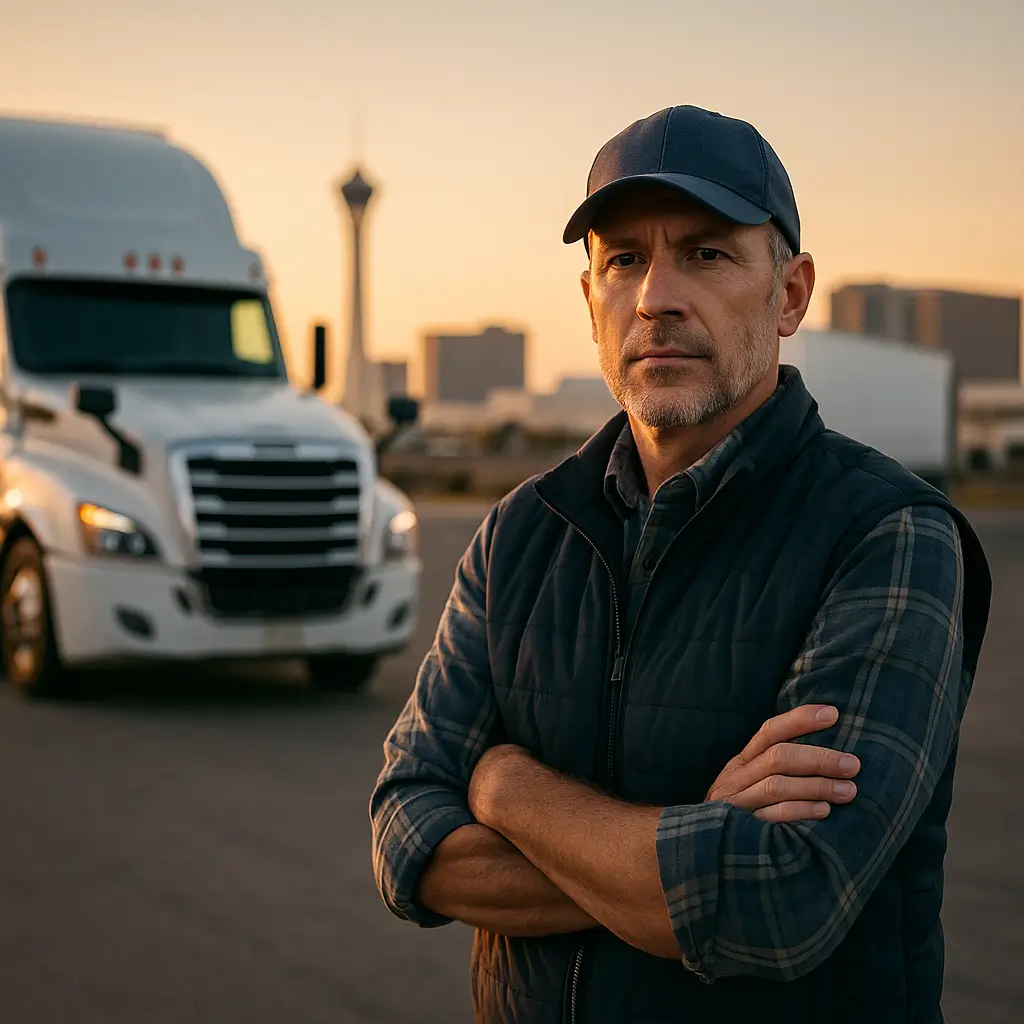
Learn Las Vegas commercial auto insurance requirements, Nevada 25/50/20 minimums, higher-limit triggers, NVLIVE steps, 2026 costs, and quote tips.

Commercial auto insurance Las Vegas typically starts at Nevada’s 25/50/20 liability minimums ($25,000 bodily injury per person / $50,000 per accident / $20,000 property damage), but many Vegas businesses need higher limits for contracts, passengers, heavier vehicles, or interstate work. If your policy doesn’t match your real vehicle use (delivery routes, jobsite runs, employee drivers, app-on rideshare), you can face coverage disputes, lost contracts, or big out-of-pocket losses. Nevada DMV’s insurance overview is the baseline reference: https://dmv.nv.gov/insurance.htm.
Before you price-shop, get the definition straight: commercial auto is built for business use, business-titled vehicles, and business operations that personal policies often exclude. If you want the fundamentals first, see commercial auto insurance basics for business vehicles.
Table of Contents
Reading time: 8 minutes
- Key Takeaways
- Commercial Auto Insurance Las Vegas: Who Needs It (and Who Usually Doesn’t)
- Commercial Auto Insurance Las Vegas Minimums: Nevada 25/50/20 + When Higher Limits Apply
- Commercial Auto Insurance Las Vegas Costs (2026): What Actually Drives Your Price
- What a Las Vegas Commercial Auto Policy Covers (and the Add-Ons That Matter)
- Rideshare, Delivery Apps, and NVLIVE Compliance: A Las Vegas Checklist
- Frequently Asked Questions
- Conclusion: Build a Policy That Matches the Way You Work
Key Takeaways (Read This If You’re Parked at the Yard)
Nevada’s commonly cited liability minimum for registered vehicles is 25/50/20, but many Vegas contracts and higher-severity operations require $1,000,000 limits and sometimes an umbrella.
- 25/50/20 is the legal floor in Nevada: It often won’t satisfy casinos, venues, general contractors, or property managers who ask for higher limits and specific COI wording.
- “Affordable” usually means “correctly classified”: The quickest way to avoid overpaying (or a claim problem) is matching use class, radius, drivers, and limits to what you actually do.
- Hauling, towing, passengers, or interstate work changes the game: You may need a trucking-style setup, not a basic business auto policy.
- Documentation matters in Nevada: Keep ID cards and contract-ready COIs current so NVLIVE verification and gate/security checks don’t turn into downtime.
Commercial Auto Insurance Las Vegas: Who Needs It (and Who Usually Doesn’t)
Commercial auto insurance is designed for vehicles used primarily for business—especially business-owned vehicles or employee-driven vehicles—because many personal auto policies restrict or exclude business activities like deliveries or transporting customers.
What it is (plain English)
Commercial auto is built for business risk: work routes, job sites, employee drivers, tool loads, and higher-frequency driving patterns. It’s also built for the paperwork you’ll get asked for (COIs, additional insureds, higher limits).
Why it’s essential (business reality in Vegas)
Personal auto is priced and written for personal use. When a claim file shows “delivery route,” “jobsite,” “employee driver,” or “app was on,” that’s where disputes start—right when you can’t afford delays.
Who typically needs it in Las Vegas
- Contractors: pickups and vans carrying tools, ladders, and materials—especially with employees driving.
- Delivery and courier routes: frequent stops and Strip congestion increase loss frequency.
- Cleaning, maintenance, security patrol: lots of short trips, lots of parking-lot exposure.
- Food trucks and catering: event schedules and tight setups mean higher property damage risk.
- Passenger transport: limos, shuttles, party buses—usually higher limits and stricter underwriting.
Who might not need it (but should confirm in writing)
Very limited, incidental business use in a personal vehicle can be acceptable under some personal policies, but the only safe answer is your carrier’s written confirmation. “I thought I was covered” is expensive in any city, and Vegas claims can escalate fast.
Commercial Auto Insurance Las Vegas Minimums: Nevada 25/50/20 + When Higher Limits Apply
Nevada’s commonly referenced auto liability minimum is 25/50/20, meaning $25,000 bodily injury per person, $50,000 per accident, and $20,000 property damage, as summarized by the Nevada DMV.
Nevada DMV insurance overview: https://dmv.nv.gov/insurance.htm.
For the full statewide picture beyond Las Vegas, see Nevada commercial auto insurance requirements, limits & rates.
Baseline Nevada liability minimums (25/50/20)
25/50/20 is a split limit structure, so the caps are separated by category (per person, per accident, and property damage). If you’ve never compared split limits to a combined single limit (CSL), read this before you sign a contract or accept a venue requirement: combined single limit vs. split limit truck insurance.
Minimum legal vs minimum to keep contracts: In Las Vegas, “minimum to stay legal” and “minimum to get approved as a vendor” are often two different numbers.
When higher limits apply (simple table)
Higher speed + higher weight + passengers + contract language usually equals higher limits and tighter documentation.
| Vegas Business Scenario | Why Limits Usually Need to Be Higher | What to Ask For (Practical) |
|---|---|---|
| Casino, venue, convention vendor | They manage risk with formal insurance requirements | COI + additional insured; commonly $1M CSL + umbrella requested |
| Passenger transport (limo/shuttle/party bus) | Passenger injury severity can be high | Confirm passenger rating class; higher CSL limits are typical |
| Hotshot or hauling (pickup + trailer) | More weight, more highway exposure, possible cargo claims | Talk hotshot/trucking needs and cargo, not just “business auto” |
| Semi / tractor-trailer | Motor carrier exposure is a different category | Motor carrier liability, filings if required, cargo, physical damage |
| Interstate for-hire operations | Federal financial responsibility rules and filings may apply | Confirm FMCSA applicability; match limits + filings to operations |
FMCSA insurance filing requirements reference: https://www.fmcsa.dot.gov/registration/insurance-filing-requirements.
Practical note: Many local Las Vegas businesses won’t need FMCSA filings, but if you’re hauling for-hire across state lines, you need to confirm it before a roadside inspection or a contract review does it for you.
For a quick rundown of what Nevada operators are paying in 2026, here’s a short breakdown: Nevada Truck Insurance Costs 2026: Owner-Operator Guide.
Commercial Auto Insurance Las Vegas Costs (2026): What Actually Drives Your Price
Commercial auto pricing is primarily driven by underwriting inputs like driver MVRs, prior claims, vehicle type/value, garaging ZIP, radius of operation, annual mileage, and the liability limits/deductibles you choose.
Why it matters (cash flow, not theory)
Premium is a cost-per-mile problem. Overpay and you lose margin every week. Underinsure and one injury claim can wipe out a year of profit, especially if you’re a one-van or one-truck operation.
Vegas-specific cost drivers
- Congestion + stop-and-go routes: more fender-benders and parking-lot hits.
- Higher repair costs: labor rates, parts delays, and ADAS calibration can add up fast.
- Theft/vandalism exposure: depends heavily on garaging and overnight parking patterns.
- Night driving + tourism spikes: more unpredictable traffic behavior.
Rating factors insurers care about
- Drivers: MVRs, years of experience, prior losses (loss runs for fleets).
- Vehicles: work van vs heavy-duty vs passenger unit; value and safety tech.
- Operations: annual mileage, garaging ZIP, radius, and job type (contractor vs delivery vs passenger).
- Policy structure: limits, deductibles, hired/non-owned, umbrella layering.
If you want to understand what moves the needle instead of guessing, use our commercial auto insurance cost estimator.
Pro tip: When you compare quotes, keep limits and deductibles identical across carriers. Otherwise, you’re comparing apples to watermelons.
What a Las Vegas Commercial Auto Policy Covers (and the Add-Ons That Matter)
A commercial auto policy commonly includes liability coverage and can include physical damage (comprehensive/collision) plus options like medical payments and UM/UIM, depending on underwriting and how the policy is written.
If you’re still unsure what limit actually fits your operation, this walks through how to think about it:
Core coverages you’ll see on most quotes
- Liability: bodily injury and property damage you cause to others.
- Physical damage (optional or required by lienholder): comprehensive and collision for your vehicle.
- Medical payments and UM/UIM: availability and structure vary; ask how it applies for your operation.
The add-ons many small businesses miss
Hired and non-owned auto (HNOA) is a common gap when employees drive personal cars for errands or you rent/borrow vehicles. In many cases, your commercial auto policy only covers vehicles scheduled on the policy, not every vehicle that might be used for work.
Use this guide to spot the gap quickly: Hired and non-owned auto insurance explained.

Umbrella vs “forcing it all into auto”
If a contract requires higher limits, an umbrella can be a more cost-efficient way to add protection than pushing everything into the primary auto layer—assuming the underlying limits match the umbrella’s requirements.
Rideshare, Delivery Apps, and NVLIVE Compliance: A Las Vegas Checklist
Nevada uses electronic insurance verification (NVLIVE) and requires active coverage on registered vehicles, so accurate policy information and up-to-date proof of insurance help prevent registration and operational headaches.
Rideshare/TNC: why personal auto often isn’t enough
When the app is on, coverage often changes, and a personal policy may exclude the activity depending on how it’s written. Nevada DOI provides consumer guidance on TNC coverage concepts and why “phases” matter: https://doi.nv.gov/Consumers/TNC_and_Insurance_FAQ/.
Not sure where personal coverage ends and commercial liability begins? This breaks it down: What Exactly Does Auto Liability Insurance Cover?
If you drive Uber/Lyft or do app-based delivery, don’t be vague. Tell your agent:
- Which apps you use
- Passengers vs food/packages
- Typical hours (night shifts can change risk)
- Any off-app commercial work (private rides, catering deliveries, vendor runs)
For Nevada-specific rideshare guidance, see: commercial rideshare insurance: 3 periods explained.
Proof of insurance + “don’t-get-stuck-at-the-gate” documentation
Clients, venues, and GCs usually want contract-ready documents fast, and mismatched names/addresses/vehicles cause delays. Keep this ready:
Keep in the vehicle
- Current insurance ID card(s)
- Registration + driver info
Keep ready for customers/contracts
- Certificate of Insurance (COI)
- Additional insured endorsement(s) if required by contract
- Vehicle schedule and driver list (especially for fleets)
For a step-by-step proof checklist, use: Proof of insurance for commercial vehicles (COI, ID cards).
What to do after an accident (to protect coverage)
- Get photos, driver info, and witness contacts.
- Preserve dashcam footage (save a copy off the device).
- Notify your insurer promptly; late reporting can complicate the claim timeline.
- Don’t argue fault roadside—stick to facts.
Running multiple vehicles?
If you’re adding units or rotating drivers, the structure matters as much as the price. This overview helps you choose the right setup: fleet insurance: costs and 7 coverage types.
For broader compliance and bundling considerations, this Nevada hub is useful: Nevada business insurance overview.
Frequently Asked Questions
Nevada’s commonly referenced liability minimum is 25/50/20, meaning $25,000 bodily injury per person, $50,000 per accident, and $20,000 property damage, as summarized by the Nevada DMV. Many Las Vegas businesses still need higher limits because contracts (casinos, venues, GCs) often require $1,000,000 liability limits and specific COI wording. If you operate as an interstate for-hire motor carrier, federal rules and filings may apply, so confirm requirements using FMCSA guidance. Start with the DMV overview, then set limits based on your actual use and contract language.
Costs vary widely based on vehicle type, driver history, mileage, and limits, but Vegas-area factors like stop-and-go congestion, higher repair costs, and theft exposure in certain garaging ZIPs can push premiums above statewide averages. The only reliable way to get a number that means something is to quote your actual operation rather than compare a generic average. You can also use the commercial auto insurance cost estimator.
Most Vegas venues and general contractors ask for a Certificate of Insurance (COI) showing your liability limits, an additional insured endorsement naming their business, and sometimes a waiver of subrogation. Requirements vary by property, so confirm exact wording before your first day on-site — a mismatched COI is one of the most common reasons vendors get turned away at the gate.
You typically need commercial auto insurance in Las Vegas if a vehicle is owned by the business or used regularly for business operations like deliveries, service calls, jobsite travel, transporting customers, or employee driving. Contractors with tool-loaded pickups and vans, delivery drivers with high stop frequency, and passenger transport operations are common examples. The fastest way to get the correct policy is to disclose the real use-case upfront (drivers, mileage, radius, garaging ZIP, and what you haul/transport). That prevents misclassification, surprise exclusions, and contract rejections.
A personal auto policy can sometimes cover limited, incidental business use, but many common business activities (delivery, transporting people for pay, app-on rideshare phases, or employee use) are restricted or excluded depending on the policy. The only safe answer is what your carrier confirms in writing for your exact use. If you drive Uber/Lyft or do app-based delivery, ask specifically about coverage when the app is on and whether you need a rideshare endorsement or a commercial policy. For Nevada-specific rideshare details, see rideshare insurance in Nevada.
Occasional, truly incidental use may be fine under some personal policies, but “occasional” is defined by your carrier, not by you. If you make deliveries, transport clients, or drive for work more than rarely, get it confirmed in writing — an unconfirmed assumption is exactly what turns a fender-bender into a denied claim.
Not automatically. Most commercial auto policies only cover vehicles specifically scheduled on the policy. If an employee drives a rental, a personal car, or a borrowed vehicle for business, you likely need hired and non-owned auto (HNOA) coverage added — otherwise that trip may fall outside your policy entirely.
Nevada offers a self-insurance option for qualifying fleets, but self-insurance means your business must handle claim-paying ability, administration, and cash-flow risk rather than transferring that risk to an insurer. For many small operators, one severe injury or multi-vehicle loss can create a major cash shock, so a commercial or fleet policy is often the more stable option. If you’re considering self-insurance, review the Nevada DMV fleet/self-insurance information and compare it against your balance sheet, loss history, and contract requirements — or see current Nevada commercial truck insurance rates and minimums for a cost baseline. Nevada DMV fleet page: https://dmv.nv.gov/fleet.htm.
Conclusion: Build a Policy That Matches the Way You Work
Nevada’s 25/50/20 minimum is a starting point, but your real requirement is driven by contracts, passengers, vehicle weight, routes, and whether you cross state lines. In Las Vegas, the right classification and clean documentation matter as much as the premium.
Key Takeaways:
- Use Nevada’s 25/50/20 minimum as the legal floor, not the business target.
- Match your policy to real operations (drivers, mileage, radius, deliveries, passengers, hauling) to avoid gaps and claim disputes.
- Keep proof documents ready (ID cards, COIs, additional insureds) so vendor and venue requirements don’t create downtime.
If you want a quote that’s actually comparable, bring your driver list, garaging ZIP, vehicle details, and any contract insurance requirements—then match limits and deductibles across carriers before you decide.
If you’re trying to match your Las Vegas commercial auto policy to real contract requirements, passenger loads, or delivery routes, LogRock can help you review your operation, coverage needs, and available options. Talk to our team to ask questions, identify possible gaps, and request a quote based on your business.





