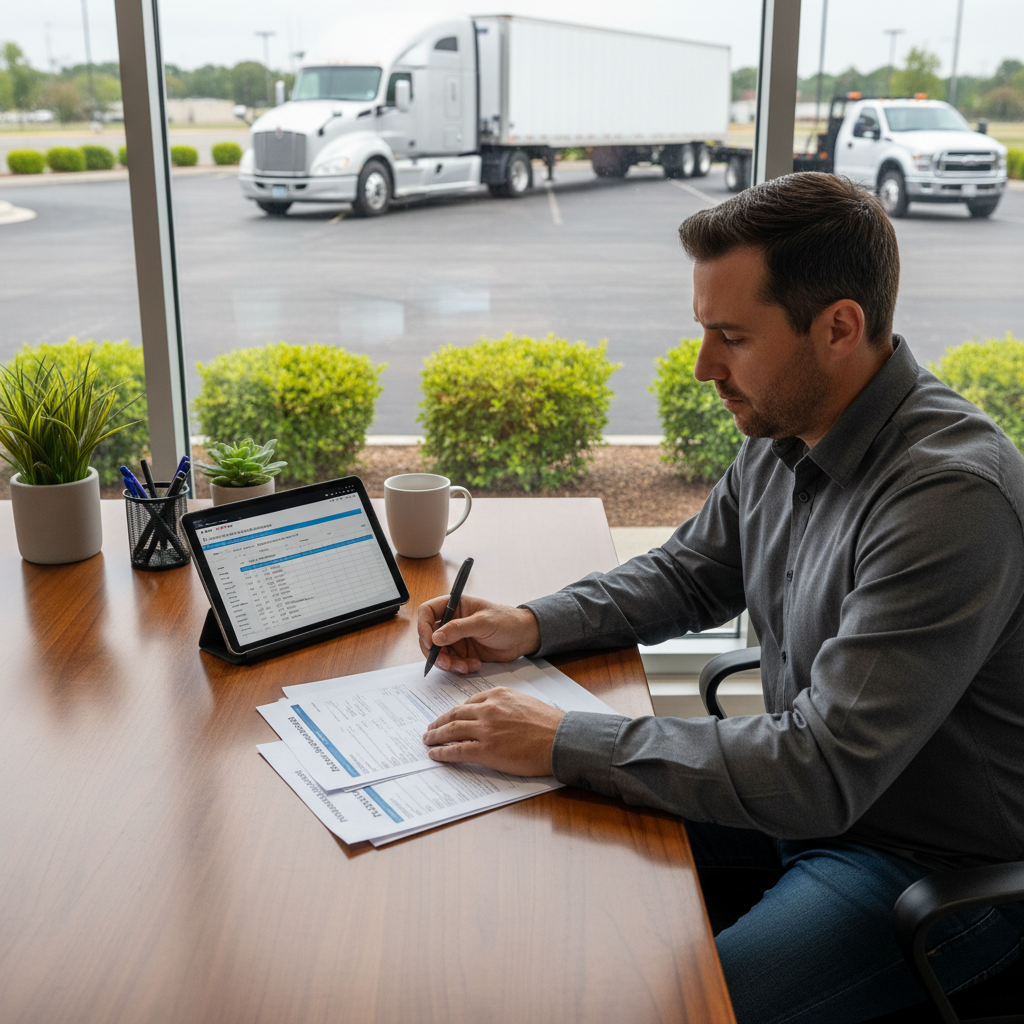

Learn Tennessee commercial auto insurance requirements, 25/50/15 minimum limits, FMCSA and contract rules, 2026 costs, and a coverage checklist.
Commercial auto insurance Tennessee minimum limits are commonly expressed as 25/50/15 ($25,000 bodily injury per person, $50,000 per accident, and $15,000 property damage), but many Tennessee businesses need higher limits (often $1,000,000) because of contracts, job-site requirements, or interstate trucking rules. This guide shows when Tennessee minimums apply, when FMCSA financial responsibility can override them, what coverages to add, and realistic 2026 cost ranges.
If you’re still unsure whether your work truck “counts” as commercial, start with commercial auto insurance coverage and how it differs from personal auto, then come back here to pick the right limits for your operation.
Key takeaways:
- Tennessee’s baseline liability minimum is commonly shown as 25/50/15, but it can be exhausted by one serious injury claim.
- FMCSA rules can require $750,000–$5,000,000 in auto liability for regulated interstate trucking, passenger, or hazmat operations.
- Contracts and worst-case severity (not the legal minimum) usually determine the “right” limit for contractors, delivery, and fleets.
- You can reduce premiums without underinsuring by tightening driver controls, choosing smart deductibles, and documenting operations cleanly.
Table of Contents
Reading time: 8 minutes
- Commercial Auto Insurance Tennessee Minimum Limits (25/50/15 Explained)
- When FMCSA Coverage Applies in Tennessee (and why it changes the numbers)
- Building the right policy: common add-ons beyond liability
- Commercial Auto Insurance Tennessee Cost (2026 ranges) + how to lower premiums
- Frequently Asked Questions
- Conclusion: Get Tennessee-compliant (and contract-ready)

Commercial Auto Insurance Tennessee Minimum Limits (25/50/15 Explained)
Tennessee’s commonly cited minimum liability limits are 25/50/15, meaning $25,000 bodily injury per person, $50,000 bodily injury per accident, and $15,000 property damage per accident.
For an official Tennessee reference on proof of financial responsibility and state minimum liability requirements, see the Tennessee Department of Revenue insurance verification overview.
Those limits can disappear fast in Nashville, Knoxville, or Chattanooga traffic—especially with heavier work trucks, trailers, and job-site driving where claim severity is higher than a normal commute. In practice, many job sites, vendors, and shippers won’t onboard you without higher limits (often $1,000,000 combined single limit), even if your operation is intrastate.
For broader state-specific business coverage context (auto + other common policies), keep this handy: Tennessee trucking insurance guide for owner-operators.
What “liability” means in plain English
Commercial auto liability pays for the injuries and property damage you cause while using a vehicle for business, and it’s built for higher-risk use like job sites, deliveries, multiple drivers, and hauling tools or equipment.
Why minimum limits often aren’t enough for a business
- Contract compliance: Many vendors require a COI showing higher limits before you can start work.
- Claim severity: A single injury claim can exceed 25/50/15 quickly, leaving your business exposed.
- Downtime costs: Even when the claim is handled, missed jobs/loads can crush cash flow.
Not sure how much more than the state minimum you actually need? This video walks through how to think about liability limits:
Who typically needs commercial auto in Tennessee
You likely need commercial auto coverage if any of these are true:
- The vehicle is owned/titled by an LLC or corporation (or you want it insured that way).
- You carry tools/materials, make deliveries, or visit job sites daily.
- You have employees driving for work (including personal cars used for errands).
- You operate a fleet (2+ vehicles) or you have wraps/branding on the vehicle.
When FMCSA Coverage Applies in Tennessee (and Why It Changes the Numbers)
FMCSA financial responsibility rules can require $750,000 to $5,000,000 in auto liability for regulated interstate operations, depending on whether you haul general freight, passengers, or hazardous materials.
Tennessee minimums are only half the story if you cross state lines, run under motor carrier authority, or operate in a way that triggers federal filings. FMCSA’s starting point on filings and insurance requirements is here: https://www.fmcsa.dot.gov/registration/insurance-filing-requirements.
For a practical breakdown of how those rules show up in quotes, dispatch, and compliance, read FMCSA insurance requirements for motor carriers.
What it is (plain English)
FMCSA insurance requirements typically apply when you operate as a regulated motor carrier in interstate commerce, transport passengers for-hire, haul certain hazardous materials, or operate under authority with required filings.
Common Tennessee “accidental triggers”
- You run “mostly intrastate,” but you take one out-of-state load.
- You book loads on a load board and cross state lines.
- You’re leased to a carrier and their contract requires higher limits than Tennessee minimums.
Passenger, hazmat, and higher-limit operations
FMCSA minimum financial responsibility varies by operation, and hazmat/passenger rules can push required limits higher than general freight. Reference: https://www.fmcsa.dot.gov/regulations/hazardous-materials/minimum-levels-financial-responsibility-motor-carriers.
Trucking-specific reminder: Auto liability is not the same thing as cargo coverage, and many brokers require both. That’s where “commercial auto” becomes part of a larger trucking program (commercial truck insurance, semi truck insurance, and many hotshot setups).
Building the Right Policy: Coverages TN Businesses Commonly Add (Beyond Liability)
Most Tennessee businesses add “beyond liability” coverages like physical damage and HNOA, often with deductibles in the $500 to $2,500 range, to keep one accident from turning into a cash-flow crisis.
Once you’ve matched your operation to Tennessee vs. FMCSA rules, the next step is building a policy that won’t fall apart during a claim—especially if you’re financing the vehicle, running multiple drivers, or working under contracts that demand proof.
Common add-ons (and why they matter)
- Physical damage (comprehensive + collision): Often required by lenders; also protects your ability to replace the vehicle quickly.
- Uninsured/underinsured motorist (UM/UIM): Protects you when the at-fault driver has low or no limits.
- Medical payments (when available): Helps with immediate medical bills regardless of fault (availability varies by carrier/state rules).
- Towing/labor + rental reimbursement: Downtime is expensive for contractors and delivery operations.
The common gap: Hired & Non-Owned Auto (HNOA)
Hired and non-owned auto liability is designed to protect a business when an employee uses a personal vehicle for work or when the business rents or borrows a vehicle.
If you have employees running errands, parts runs, estimates, or you rent vehicles seasonally, this is the gap that gets businesses sued even when “the employee had their own insurance.” Use this explainer: hired and non-owned auto coverage (HNOA).
Who should seriously consider HNOA
- Contractors with crews (HVAC, plumbing, electrical)
- Property management and real estate teams
- Nonprofits and churches
- Any business that rents vehicles for peak seasons
Commercial Auto Insurance Tennessee Cost in 2026 (Ranges) + How to Lower Premiums
In 2026, Tennessee commercial auto premiums commonly range from about $1,200–$3,500/year for a single contractor pickup/van to $8,000–$25,000+/year for semi truck insurance or for-hire trucking, depending on limits, drivers, radius, and loss history.
Insurance is a major operating cost—especially as you move from “one work truck” into delivery, fleets, or trucking exposures. For broader industry cost context, ATRI’s trucking operational cost research is a helpful reference: https://truckingresearch.org/.
If you want the underwriting levers that actually move price, review commercial auto insurance cost factors.
2026 cost ranges (useful estimates, not promises)
Rates vary by carrier appetite, garaging ZIP, driver MVRs, operating radius, vehicle type, and what you haul, but these ranges help you budget.
| TN business profile | Typical annual premium range (estimate) | Why it lands there |
|---|---|---|
| Single-vehicle contractor (pickup/van) | $1,200–$3,500 | Moderate miles, tools, job-site driving |
| Delivery/courier (high stop frequency) | $3,000–$8,000+ | Higher exposure, more time in traffic |
| Small fleet (2–10 vehicles) | $2,000–$6,000 per vehicle (varies) | Driver mix + fleet controls matter |
| Hotshot / light-duty hauling | $6,000–$15,000+ | Higher limits + interstate + load exposure |
| Semi truck insurance / for-hire trucking | $8,000–$25,000+ | FMCSA filings/limits, radius, loss trends |
Want a number specific to your operation? Try our commercial auto insurance cost estimator before you compare quotes.
Important: Don’t compare “cheap” vs. “expensive” unless the limits, deductibles, and covered operations match. A policy that fails a contract requirement or excludes your use is expensive the day you need it.
How Tennessee businesses lower premiums (without underinsuring)
- Control drivers like a real business: consistent MVR checks, written hiring standards, documented coaching after incidents. If your loss history has pushed you into the non-standard market, review high-risk commercial auto insurance.
- Pick deductibles with your cash reserve in mind: higher deductibles can cut premium, but you must be able to absorb the hit.
- Clean up your operations data: correct garaging, radius, driver assignments, and vehicle use descriptions reduce underwriting friction.
- Reduce claim severity: dash cams, backing policies, and tight maintenance records help defend claims and protect long-term pricing.
Compliance checklist (what to keep ready)
Most contract delays happen because proof isn’t ready, not because the business “isn’t insured.” Keep this stuff organized:
- Insurance ID cards in each vehicle
- A current COI for job sites/vendors (when required)
- If FMCSA applies: confirm filings and renewal timing on FMCSA’s site
- Renewal reminders 30–45 days before expiration to avoid lapses
Once your COI is ready, here is a practical walkthrough for sending it quickly: How to Send Your Certificate of Insurance 24/7.
Frequently Asked Questions
Tennessee commercial auto questions usually come down to three things: the 25/50/15 baseline, whether FMCSA applies, and what proof (COI/filings) your customers require.
Tennessee’s commonly cited minimum liability limits are 25/50/15, meaning $25,000 bodily injury per person, $50,000 bodily injury per accident, and $15,000 property damage per accident. Those numbers are a legal baseline, not a “business-safe” limit, because one serious injury claim can exceed them quickly. Many contractors and vendors require $1,000,000 liability on a certificate of insurance before you can work on site. If your operation crosses state lines under motor carrier authority, FMCSA rules may also require higher limits and filings.
FMCSA insurance requirements typically apply when you operate as a regulated motor carrier in interstate commerce, and required auto liability can range from $750,000 (common starting point for for-hire property carriers) up to $5,000,000 for certain hazmat operations, depending on what and how you haul. FMCSA may also require insurance filings tied to your authority, not just an insurance card. Start with FMCSA’s filing overview at https://www.fmcsa.dot.gov/registration/insurance-filing-requirements, then confirm your exact authority, commodities, and lanes with your agent or compliance provider.
If a business vehicle isn’t properly insured, you can face citations and lose the ability to operate legally, but the biggest consequences are financial: denied job-site access, contract termination, and out-of-pocket liability after a crash that can exceed $25,000/$50,000 limits in minutes. For regulated trucking, missing required FMCSA filings can also stop dispatch because brokers and shippers verify compliance before loads move. The practical fix is simple: match limits to contracts, avoid coverage lapses at renewal, and keep proof (ID cards, COIs, and filings where required) ready.
A certificate of insurance (COI) is proof of coverage that lists the named insured, policy dates, and liability limits (often $1,000,000) so a job site, vendor, or shipper can confirm you meet their insurance requirements. Many onboarding systems won’t let you start work or get paid until the COI is on file, and they may request additional insured status depending on the contract. If you want a quick, practical breakdown (including what the COI does and doesn’t prove), read how a certificate of insurance (COI) works.
No — commercial auto liability only covers injuries and property damage you cause to others; it does not cover the freight itself. Businesses that haul goods for others typically need a separate motor truck cargo policy alongside their auto liability. This matters for delivery, trucking, hotshot, and for-hire operations because a customer or broker can require cargo coverage even when your commercial auto policy is active.
Generally no. Most personal auto policies exclude or restrict business use, and if a claim happens while you are working, a personal insurer can deny it or limit coverage. Even occasional job-site trips, deliveries, or paid errands may need to be insured under a commercial policy or endorsement. If you are unsure where the line is, compare your situation against commercial auto insurance vs. personal auto insurance before you rely on a personal policy.
25/50/15 splits coverage into separate caps for bodily injury per person, bodily injury per accident, and property damage. A $1,000,000 combined single limit (CSL) is one pool of money available for the whole accident, with no internal split. That is why vendors, contractors, shippers, and job sites often ask for $1M liability on a COI instead of only asking whether you meet Tennessee’s state minimum.
It depends on the lease agreement and whether you are operating under the carrier’s authority or your own. Many leased owner-operators are covered under the carrier’s policy while under dispatch, but may need their own coverage, such as bobtail or non-trucking liability, for personal use or off-dispatch situations. Read the lease carefully and confirm the gap before you move the truck. Tennessee owner-operators can also review Tennessee trucking insurance for owner-operators.
Start the renewal conversation 30–45 days before expiration. A lapse, even a short one, can raise future rates, delay COIs, and create serious problems if FMCSA filings are tied to your authority. Keeping renewal reminders, driver lists, vehicle schedules, and loss information ready makes it easier to shop quotes without rushing into a weak policy.
Conclusion: Get Tennessee-Compliant (and Contract-Ready)
To be road-legal in Tennessee, commercial auto liability is commonly referenced as at least 25/50/15, and interstate trucking may require $750,000+ (and filings) under FMCSA rules depending on the operation.
The safest approach is compliance-first: set limits to match your contracts and worst-case severity, then add the coverages that protect cash flow (physical damage, UM/UIM, and HNOA when employees use personal cars).
Key Takeaways:
- Use 25/50/15 as a baseline, but expect many customers to require $1,000,000 liability.
- If you cross state lines under authority, verify whether FMCSA rules require higher limits and filings.
- Lower premiums by improving driver controls and documentation, not by “cutting coverage” blindly.
Related reading:
- Trucking insurance basics for owner-operators and small fleets
- How to save on commercial auto insurance without cutting the wrong corners
If you want help comparing options, the fastest way is to quote with the same limits, the same deductibles, and the same vehicle use—so you’re making a business decision, not guessing.
If you’re trying to figure out whether Tennessee’s 25/50/15 minimum is enough for your contracts, or whether FMCSA rules apply to your operation, LogRock can help you review your limits, coverage gaps, and compliance filings side by side. Talk to our team to ask questions, compare quotes at matching limits, and get a policy that won’t fail a COI request.