
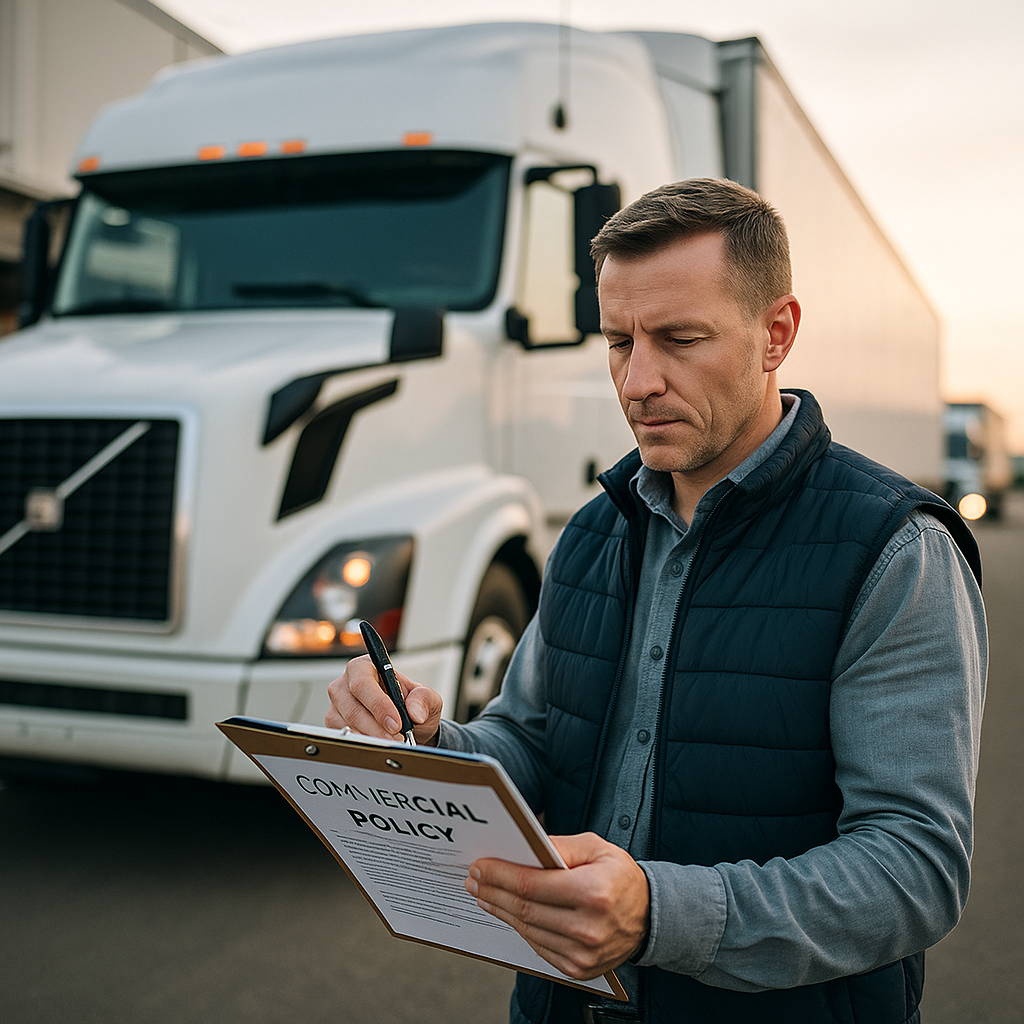

Commercial policy can mean business insurance or trade rules. Learn commercial truck insurance basics and what to verify before signing. Get clarity fast—today.
Commercial policy has two common meanings: (1) a business insurance policy (what trucking contracts usually mean), or (2) a government trade policy (tariffs, quotas, export rules). If you’re an owner-operator, it’s almost always Meaning #1—usually in a broker packet, shipper contract, or lease-on agreement.
Because contracts love vague wording, “maintain a commercial policy with X limits” can get expensive fast if you buy the wrong coverage (or think you’re covered and find out you’re not). If you want a quick foundation first, start with Logrock’s commercial truck insurance basics.
Table of Contents
Reading time: 8 minutes
- Key Takeaways
- What is a commercial policy? (Quick definition + how to spot the context)
- Commercial policy in insurance: what it means for commercial truck insurance and trucking insurance
- What a commercial insurance policy typically covers in trucking (7 common coverages)
- Commercial policy in trade (plus a fast way to tell what your contract means)
- Frequently Asked Questions
- Conclusion: Define the context, then protect the business (not just the truck)

Key Takeaways
These four takeaways summarize how “commercial policy” is used in trucking contracts and how to verify insurance paperwork before you haul.
- “Commercial policy” has two meanings: business insurance vs. government trade policy—context tells you which one.
- In trucking, it usually means commercial truck insurance: specific coverages, limits, endorsements, and sometimes FMCSA filings.
- Don’t guess—verify on your declarations page: limits, deductibles, exclusions, and endorsements should match your contract.
- Cheap premium can be costly: the lowest price isn’t the lowest cost after a claim.
What is a commercial policy? (Quick definition + how to spot the context)
In 2026, the term “commercial policy” is used in two standard ways: a commercial insurance policy for a business, or a government trade policy covering tariffs, quotas, and export/import rules.
The trick is spotting which meaning your document is using, because the same two words show up in very different places: broker onboarding, shipper contracts, and sometimes even non-insurance business paperwork.
What it is (plain English)
A commercial policy is either:
- Insurance meaning: a legal contract between a business and an insurer to cover business risks (liability, vehicles, cargo, property, and more).
- Trade meaning: a government’s approach to regulating trade and commerce (tariffs, quotas, trade agreements, export controls, sanctions).
Why it matters in real trucking life
If you’re running loads and getting “send your COI” emails, you’re dealing with the insurance meaning almost every time. If you’re reading about tariffs or customs, you’re dealing with the trade meaning.
For a deeper overview of how truck policies fit together (liability, cargo, physical damage, endorsements), see the Logrock trucking insurance guide for owner-operators.
Who needs this clarity
- Owner-operators: authority or leased-on, especially when contracts say “commercial policy required.”
- Small fleets (2–20 trucks): standardizing limits and endorsements across drivers and units.
- Anyone onboarding with brokers/shippers: where “commercial policy” is used as shorthand for multiple coverages.
Commercial policy in insurance: what it means for commercial truck insurance and trucking insurance
For trucking contracts, “commercial policy” in insurance typically means a policy written for business use (not personal use) and rated for motor carrier risk, which changes how claims and exclusions apply.
This matters because trucking exposure is different: higher mileage, higher claim severity, contract-required limits, and sometimes regulatory filings that personal lines simply don’t do.
What “commercial” changes (in plain terms)
- Use classification: “for-hire” vs. “not-for-hire” vs. personal use can drive coverage and claim decisions.
- Policy form: commercial auto / motor carrier forms are built for business operations and contractual requirements.
- Contract compliance: brokers and shippers often require specific limits and endorsements, not just “insurance.”
Why it’s essential (and where people get burned)
Claims get evaluated against what you were doing and what your policy actually covers. If your operation is described one way on paper but you operate another way in real life (radius, commodities, garaging, dispatch status), you can end up fighting coverage when you can least afford it.
A practical habit that pays off: read your insurance paperwork like you read a rate confirmation. Use this walkthrough to verify limits, deductibles, covered autos, and forms: how to read an insurance declarations page.
Pro tip: tighten up the “story” underwriters are pricing
Underwriters price uncertainty, and messy details usually show up as higher premiums or stricter terms. Keep your paperwork consistent: garaging address, driver list, operating radius, and commodity/cargo description should match your real operation.
What a commercial insurance policy typically covers in trucking (7 common coverages)
A typical commercial truck insurance setup can include up to seven common coverages—primary auto liability, cargo, physical damage, general liability, bobtail/non-trucking liability, workers’ comp or occupational accident, and hotshot-specific forms—depending on your operation.
Not every carrier needs every item below, but if your contract says “commercial policy required,” this is the checklist you compare against.
1) Auto liability (primary) — the backbone of semi truck insurance
Auto liability covers bodily injury and property damage you cause to others while operating your truck for business.
FMCSA minimums: For many interstate, for-hire motor carriers hauling non-hazardous property, federal rules commonly require $750,000 in public liability (see 49 CFR 387.9), while certain operations (like many passenger carriers and hazardous materials) have higher minimums.
FMCSA reference: https://www.fmcsa.dot.gov/registration/insurance-filing-requirements
2) Motor truck cargo
Motor truck cargo covers damage to the freight you’re hauling, but the “how” varies a lot by form, exclusions, and deductible.
Most brokers treat cargo as non-negotiable because one cargo claim can turn into a fast payment dispute.
3) Physical damage (comprehensive and collision)
Physical damage pays to repair or replace your tractor (and sometimes trailer) after a covered loss like collision, theft, fire, weather, or vandalism.
If you’re financed, your lender usually requires this coverage, and your deductible choice can swing the premium noticeably.
4) General liability (non-auto business liability)
General liability covers third-party injuries or property damage that aren’t caused by operating the truck (for example, certain premises or operations claims).
Some shippers require it even when you’re sure “auto covers everything,” so it’s common to see GL listed in contract insurance requirements.
5) Bobtail / non-trucking liability (when you’re not under dispatch)
Bobtail or non-trucking liability can cover certain liability claims when you’re not under dispatch, but it is not a substitute for primary liability and it is heavily tied to dispatch status.
This is one of the most common lease-on confusion points, so it’s worth getting the terminology right: bobtail vs non-trucking liability.
6) Workers’ comp or occupational accident (depending on your setup)
Workers’ compensation is employee injury coverage required by many states for businesses with employees, while occupational accident is a different product sometimes used in owner-operator arrangements.
One injury can trigger medical bills, lost-time claims, and legal exposure, so this needs to match how you’re structured (employee vs. independent contractor) and what your lease agreement requires.
7) Hotshot insurance (same idea, different operation details)
Hotshot insurance is a commercial setup tailored to pickup-and-trailer operations, where underwriting assumptions (vehicle class, cargo, radius, for-hire use) differ from many Class 8 programs.
If you run hotshot loads, get specific on the form and the operation: hotshot insurance explained.
Quick “contract translation” checklist
- Limits: Do the limits on your declarations page match what the contract asks for?
- Deductibles: Are the deductibles realistic for your cash flow (especially cargo and physical damage)?
- Endorsements: Are “additional insured,” “waiver of subrogation,” or “primary & non-contributory” required?
- Proof: Can your agent issue a COI that matches the contract wording?
Commercial policy in trade (plus a fast way to tell what your contract means)
In economics, commercial policy means a government’s trade rulebook, including tariffs, quotas, subsidies, sanctions, and export controls that affect cross-border commerce.
Meaning in trade (what it is)
- Tariffs/duties: taxes on imported goods
- Quotas: limits on how much can be imported
- Subsidies: government support that changes pricing
- Export controls/sanctions: restrictions on who can ship what, and where
- Trade agreements: rules of origin and preferential terms
Why a trucking business should care (even if you never import anything)
Trade policy can shift freight demand indirectly. When import volumes move, port freight, warehouse replenishment, and lane balance can change—sometimes quickly.
How to tell which “commercial policy” someone means (quick table)
| If you see these words… | They mean insurance | They mean trade |
|---|---|---|
| premium, deductible, limits, insurer, broker, COI | ✅ | ❌ |
| additional insured, waiver of subrogation | ✅ | ❌ |
| tariffs, customs, import/export, quota | ❌ | ✅ |
| trade agreement, sanctions, export controls | ❌ | ✅ |
Pro tip: reduce premium without creating a coverage gap
If your goal is cost control, focus on operational clarity first (accurate radius, clean driver history, consistent filings) before you slash coverages that your contracts still require. A solid starting point: affordable trucking insurance tips.
Frequently Asked Questions
This FAQ answers the four most common owner-operator questions about what “commercial policy” means in trucking insurance and contracts.
A commercial policy is most commonly an insurance policy written for a business to cover business risks like liability, vehicles, cargo, and operations.
The same phrase can also mean a government’s trade policy (tariffs, quotas, export controls), so context matters. If the document mentions premiums, deductibles, limits, COIs, additional insured, or waivers of subrogation, it’s talking about insurance. If it mentions customs, import/export, tariffs, or sanctions, it’s talking about trade.
In trucking, “commercial policy” usually means commercial truck insurance written for business use (for-hire or motor carrier operations), not a personal auto policy.
A trucking commercial setup commonly includes primary auto liability, cargo, and physical damage, with optional coverages like general liability and bobtail/non-trucking depending on whether you’re under your own authority or leased on. If you operate under interstate authority, federal rules often require specific minimum liability limits (commonly $750,000 for many non-hazmat property carriers under 49 CFR 387.9), and brokers may require higher limits or specific endorsements.
Your broker or shipper asks for proof of a commercial policy because they need documented evidence that your coverage, limits, and endorsements match the contract before they tender freight.
In practice, that proof is usually a Certificate of Insurance (COI), sometimes combined with endorsement pages if they require items like additional insured or waiver of subrogation. A COI is a snapshot and can’t override the actual policy language, so it’s smart to confirm the policy matches the certificate and the contract wording. See: certificate of insurance (COI) guide.
A commercial insurance policy covers only the coverages, limits, deductibles, and endorsements that are listed on your declarations page and the attached forms, not what someone “thought” was included.
Many trucking programs include primary auto liability, motor truck cargo, and physical damage, plus optional coverages like general liability and bobtail/non-trucking liability. To verify what you actually have, start with the declarations page for limits/deductibles/policy period and then confirm any required endorsements match the contract language. Here’s a step-by-step guide: how to read an insurance declarations page.
Conclusion: Define the context, then protect the business (not just the truck)
For trucking contracts in 2026, “commercial policy” almost always means business insurance for trucking operations with specific limits and endorsements—not government trade policy.
The practical move is simple: match coverage to your contracts, verify it on the declarations page, and make sure your COI and endorsements say what the broker or shipper is asking for.
Key Takeaways:
- Translate “commercial policy” into specifics: limits, deductibles, coverages, endorsements, certificate holder wording.
- Verify on the declarations page: don’t rely on assumptions or old COIs.
- Price isn’t the same as value: a cheaper premium can cost more after a denied or restricted claim.
If you want to keep learning, these two guides help you avoid common renewal surprises and lease-on mistakes: semi truck insurance cost drivers and bobtail vs non-trucking liability.





