
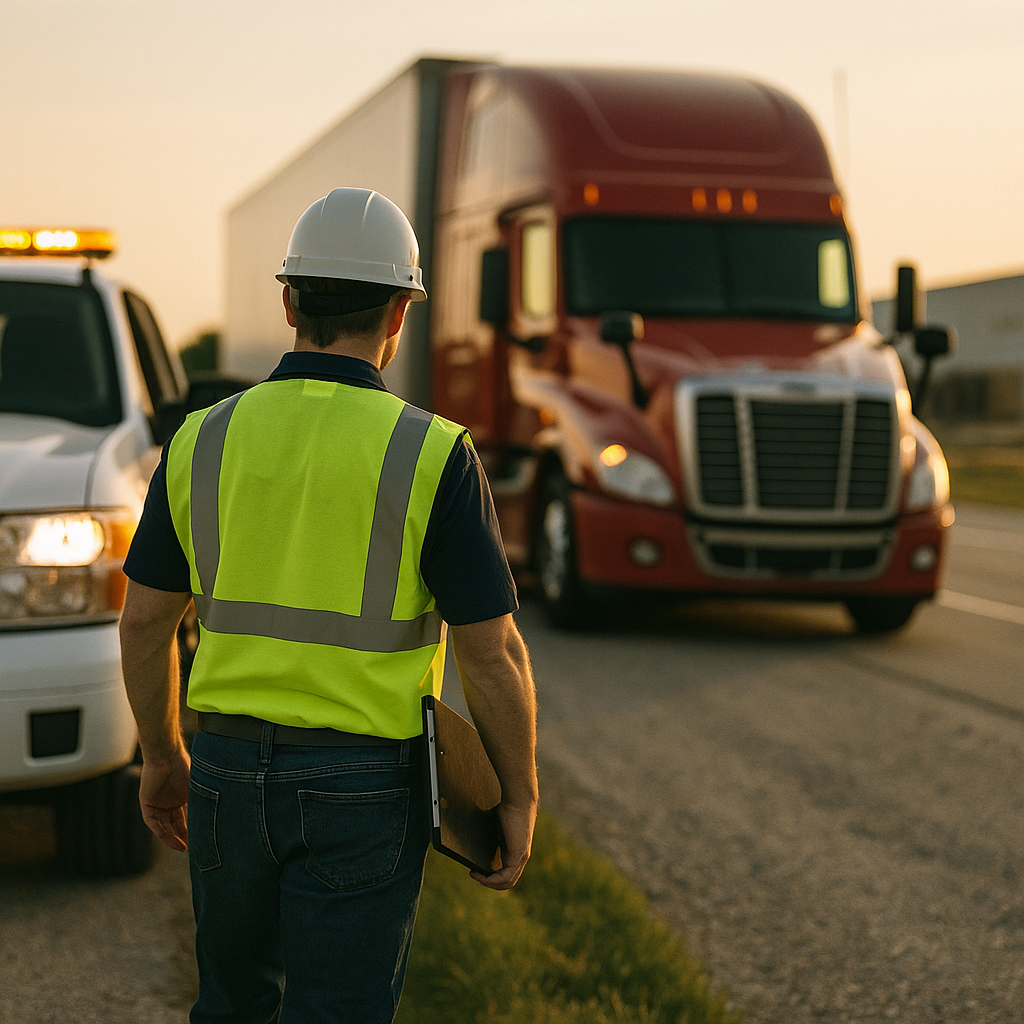

Commercial roadside assistance insurance: what it covers, 2026 costs ($300–$5K+), caps, and add-on vs membership. Compare options today.
Commercial roadside assistance insurance helps pay for disablement services like towing, tire service, jump-starts, and fuel delivery—usually with strict per-event dollar caps and tow-mile limits that decide whether it’s a bargain or a headache. In 2026, the “worst-day” numbers matter: heavy-duty service calls often land around $300–$1,000+, while heavy-duty tows and recoveries can realistically hit $2,500–$5,000+ depending on location, after-hours, and complexity.
If you want a reality check on pricing before you choose any plan, start here: heavy-duty towing and service-call benchmarks. It’s the fastest way to sanity-check whether a “$500 cap” will actually help on your lanes.
Table of Contents
Reading time: 8 minutes
- Is roadside assistance included in commercial auto insurance (or is it separate)?
- What does commercial roadside assistance insurance cover?
- Insurance add-on vs membership vs pay-per-call (and what it costs in 2026)
- Limits, caps, exclusions, and tech: what to verify before you buy
- Frequently Asked Questions
- Conclusion: Buy for your vehicle class—and verify the caps

Is roadside assistance included in commercial auto insurance (or is it separate)?
Commercial roadside assistance is typically offered as an optional endorsement on a commercial auto policy or sold as a separate service membership, and it’s not a federally “required” coverage like liability filings.
What it is (plain English)
Roadside assistance is designed to get a disabled unit moving again after a breakdown or minor incident—think tow, jump, fuel delivery, tire service, or a limited on-shoulder fix.
It usually shows up in one of three ways:
- Insurance add-on (endorsement): added to your commercial auto policy, often with reimbursement rules and set caps.
- Service membership: a subscription program not tied to your policy, run like a dispatch network.
- Pay-per-call: no plan; you pay the wrecker, tire truck, or service provider directly.
For context on how roadside fits into a full trucking policy stack, use this guide as your foundation: commercial truck insurance basics for owner-ops and fleets.
Why it’s essential (business risk)
Roadside assistance isn’t “required by law,” but it can be the difference between a small invoice and an all-day shutdown that wipes out a run’s profit.
Also, don’t confuse roadside with required liability filings. FMCSA filings address public liability requirements; roadside is usually an optional add-on. Reference: FMCSA insurance filing requirements.
Who needs it (exact fit)
- Owner-operators: one surprise $3,500 recovery can smash cash flow.
- Hotshot operators: trailer involvement and rural lanes can turn a “tow” into “recovery.”
- Small fleets (2–10 units): one down unit can snowball missed appointments across the week.
Pro tip
If a program is reimbursement-only, ask two questions before you buy: (1) what documentation is required (invoice, photos, GPS, dispatch ticket), and (2) what the typical reimbursement timeline is. A wrecker usually wants payment at the scene.

What does commercial roadside assistance insurance cover?
Commercial roadside assistance coverage commonly includes towing, tire service, jump-starts, fuel delivery, lockout help, winching/extraction, and limited minor mechanical assistance, but benefits are almost always restricted by dollar caps, mileage caps, and recovery exclusions.
What it is (the “7 essentials”)
Most plans revolve around the same core services, but the limits are where operators get surprised—especially with heavy-duty and “recovery” wording.

| Service | Usually included? | Common limits/exclusions to watch |
|---|---|---|
| Towing | Often | Tow-mile cap, per-event dollar cap, heavy-duty restrictions, “recovery” not included |
| Tire service (flat) | Often | Labor may be covered; tire cost usually excluded; wheel seal/Hub issues excluded |
| Jump-start / battery help | Often | Jump-start covered; battery replacement may be excluded or capped |
| Fuel delivery | Often | Delivery covered; fuel cost may be excluded or paid by driver |
| Lockout | Sometimes | More common on light-duty; can be excluded for heavy trucks |
| Winching / extraction | Sometimes | Time/distance caps; off-road/unsafe-location exclusions; “accident recovery” exclusions |
| Minor mechanical help | Sometimes | Very limited scope; parts and major labor excluded; usually “get you to a shop” only |
Roadside assistance terms and availability vary by insurer and state, and it’s commonly optional. For a general overview of auto coverage structures, see: NAIC auto insurance consumer resources.
Why it’s essential (what it doesn’t replace)
Roadside is a service benefit; it’s not a replacement for core trucking coverages that pay for losses after a crash, theft, hail, or freight damage.
- Physical damage (collision/comp): pays for covered damage to the truck, not a tire truck or tow just because you’re disabled.
- Cargo: pays for covered freight loss/damage, not the service call that happened first.
- Major repairs: roadside rarely pays for full shop labor, expensive parts, or multi-hour diagnostics.
If you want a clean boundary line between “service call” and “insurance claim,” read: physical damage coverage explained (and what it actually pays for).
Who needs it
- Remote-lane operators: rural routes, mountains, oilfield roads, and long gaps between service providers.
- Reefer operators: roadside won’t pay for spoiled cargo, but quicker response can reduce downtime and loss severity.
Pro tip
Ask whether the plan covers tractor + trailer together or only the power unit. Trailer handling is a common “not included” surprise—especially for hotshot and box-truck operations with liftgates or specialty trailers.
Insurance add-on vs membership vs pay-per-call (and what it costs in 2026)
In 2026, heavy-duty roadside events commonly range from $300–$1,000+ for a service call and $2,500–$5,000+ for a heavy tow/recovery, so the best option is the one whose caps match your worst realistic day.
What it is (decision matrix)
There’s no universal winner. The right choice depends on truck class, lanes, event frequency, and whether you can float a big invoice while waiting for reimbursement.

| Option | How you pay | Best for | Where it fails in real life |
|---|---|---|---|
| Insurance add-on | Small monthly add to commercial auto | Light/medium duty, predictable needs, bundling for budget stability | Low caps, reimbursement rules, limited heavy-duty recovery language |
| Membership | Monthly/annual subscription | Owner-ops who want predictable budgeting; fleets standardizing dispatch/vendors | Lane gaps, tow-mile caps, excluded “recovery” scenarios |
| Pay-per-call | You pay when it happens | Local ops with low exposure and strong cash reserves | Big cash-flow hits, especially heavy-duty tow/recovery after-hours |
2026 cost benchmarks (ranges, not promises)
Roadside pricing varies by vehicle class, time of day, and recovery complexity, and the real cost also includes downtime and missed appointments.
ATRI’s operating-cost research consistently highlights repair and maintenance as a major part of total trucking costs, which is why breakdown planning isn’t optional for most carriers. Reference: ATRI Operational Costs of Trucking.
| Vehicle class | Typical roadside service call | Typical tow/recovery risk |
|---|---|---|
| Light-duty commercial (vans/pickups) | ~$100–$400+ | Lower overall, but after-hours can spike |
| Medium-duty (box trucks) | ~$200–$700+ | Higher tow and tire service exposure |
| Heavy-duty (Class 7–8) | ~$300–$1,000+ | ~$2,500–$5,000+ (more with complex recovery) |
| Hotshot (pickup + trailer) | ~$150–$600+ | Can jump if trailer handling or off-route recovery is needed |
If you’re building a budget for the entire insurance program (not just roadside), this breaks down the big premium drivers: what affects the cost of truck insurance.
Who needs which option (quick rules)
- 1-truck owner-op (heavy-duty): membership or a strong insurance add-on only if the per-event cap matches heavy-duty tow reality on your lanes.
- 2–10 trucks: a standardized membership/fleet program can reduce admin and speed dispatch.
- Hotshot: confirm trailer handling, winching/extraction definitions, and rural lane coverage.
Pro tip
Don’t shop roadside by monthly price first—shop by cap vs worst-day cost. If your per-event cap is $500 and a realistic tow is $3,500, you’re self-insuring the difference.
Limits, caps, exclusions, and tech: what to verify before you buy
Most commercial roadside assistance plans limit benefits using a combination of per-event dollar caps, tow-mile caps, annual event caps, labor-time limits, and recovery exclusions, and these restrictions are usually spelled out in the endorsement or membership terms.
What it is (the fine print that decides value)
Two plans can both say “towing included,” but one is useful and the other is basically a coupon. The difference is almost always in:
- Per-event dollar cap: “Up to $X per disablement.”
- Tow-mile cap: “Up to X miles to the nearest qualified facility.”
- Annual event cap: “Up to X events per policy year.”
- Labor-time cap: “Up to 1 hour of roadside labor.”
- Recovery restrictions: winching/extraction definitions, off-road rules, accident recovery exclusions.
Why it’s essential (avoids expensive surprises)
Use this checklist when you’re comparing a roadside endorsement inside a commercial truck insurance package, or when you’re evaluating memberships that sound “unlimited” but aren’t.
10-point roadside checklist (print this):
- 1) Dispatch or reimbursement: Do they send help, or do you pay and submit?
- 2) Tow miles per event: What’s the max, and what counts as “qualified” destination?
- 3) Dollar cap per event: What’s the exact number, and does it differ for heavy-duty?
- 4) Events per year: Is there a hard annual limit?
- 5) Heavy-duty included: Does it explicitly cover Class 7–8 towing and recovery?
- 6) Tractor + trailer: Are both covered together, and under what conditions?
- 7) Winching/extraction: What’s the time/distance cap, and what’s excluded?
- 8) Tire service: Labor only, or any tire cost allowance?
- 9) Battery: Jump-start only, or replacement (and capped at what amount)?
- 10) Coverage area: Do your lanes qualify (rural, mountains, oilfield, border regions)?
Who needs extra scrutiny
- Remote-lane operations: where response times (ETA) can be the biggest “cost.”
- High-penalty freight: where late delivery triggers chargebacks or contract issues.
Tech that actually matters (GPS dispatch + proof)
Strong programs operate like a mini-dispatch workflow: GPS location sharing, status updates, proof-of-service, and escalation if the first vendor can’t handle your axle/weight.
Pro tip (reduce roadside events)
Prevention is still the cheapest roadside plan: tire pressure discipline, battery testing before winter, and consistent pre-trip/PM habits reduce disablements and the renewal-time “frequency” conversation.
For broader ways to reduce operating cost and avoid paying for the same risk twice, start here: how to save on truck insurance without cutting the wrong corners.
Frequently Asked Questions
Commercial roadside assistance insurance typically covers towing, tire service, jump-starts, fuel delivery, lockout assistance, winching/extraction, and limited on-site mechanical help, subject to strict caps and exclusions. Most plans limit benefits with a per-event dollar cap, a tow-mile cap, and sometimes an annual event limit. Heavy-duty operators should confirm the plan explicitly includes Class 7–8 towing and defines what counts as “recovery,” because winching/extraction is commonly limited or excluded. Roadside also usually doesn’t pay for major parts, full shop labor, or cargo loss.
Commercial roadside assistance costs vary by vehicle class and the type of plan (endorsement, membership, or pay-per-call), but 2026 real-world event costs often range from $300–$1,000+ for heavy-duty service calls and $2,500–$5,000+ for heavy-duty tows/recoveries. Light-duty and medium-duty events can still run hundreds, especially after-hours or in rural areas. The most important “cost” to compare isn’t the monthly fee—it’s whether your plan’s per-event cap and tow-mile cap match pricing on your routes.
Roadside assistance is sometimes included, but it’s more commonly offered as an optional endorsement on a commercial auto policy or sold separately as a service membership. The only safe way to confirm is to ask for the endorsement name (or membership terms) and verify the exact limits in writing: maximum tow miles, maximum dollars per event, and events per year. If you’re reviewing your overall policy structure, use: commercial truck insurance basics for owner-ops and fleets.
Using roadside assistance does not automatically increase your premium, but frequent service usage can still affect underwriting at renewal depending on how the carrier records events and evaluates frequency. Many programs treat roadside as a service event rather than a liability loss, but insurers may still consider repeated disablements as an operational risk signal—especially when combined with other losses or poor maintenance trends. To understand what typically gets recorded and how carriers handle reporting, review: truck insurance claims process (what gets recorded and why).
Conclusion: Buy for your vehicle class—and verify the caps
A roadside plan is “worth it” only when its caps match your worst realistic day, which for heavy-duty operators can mean $2,500–$5,000+ tow/recovery exposure in 2026. Pick the option that fits your lanes (endorsement vs membership vs pay-per-call), then confirm dollar caps, tow miles, and recovery language in writing.
Key Takeaways:
- Roadside is usually optional: it’s commonly an endorsement or a separate membership, not a mandated coverage.
- Caps decide everything: compare per-event dollars and tow-mile limits against real heavy-duty pricing.
- Know what it won’t pay: roadside doesn’t replace physical damage, major repairs, or cargo coverage.
If you’re clearing up common misconceptions while you build the rest of your program, these help:





