
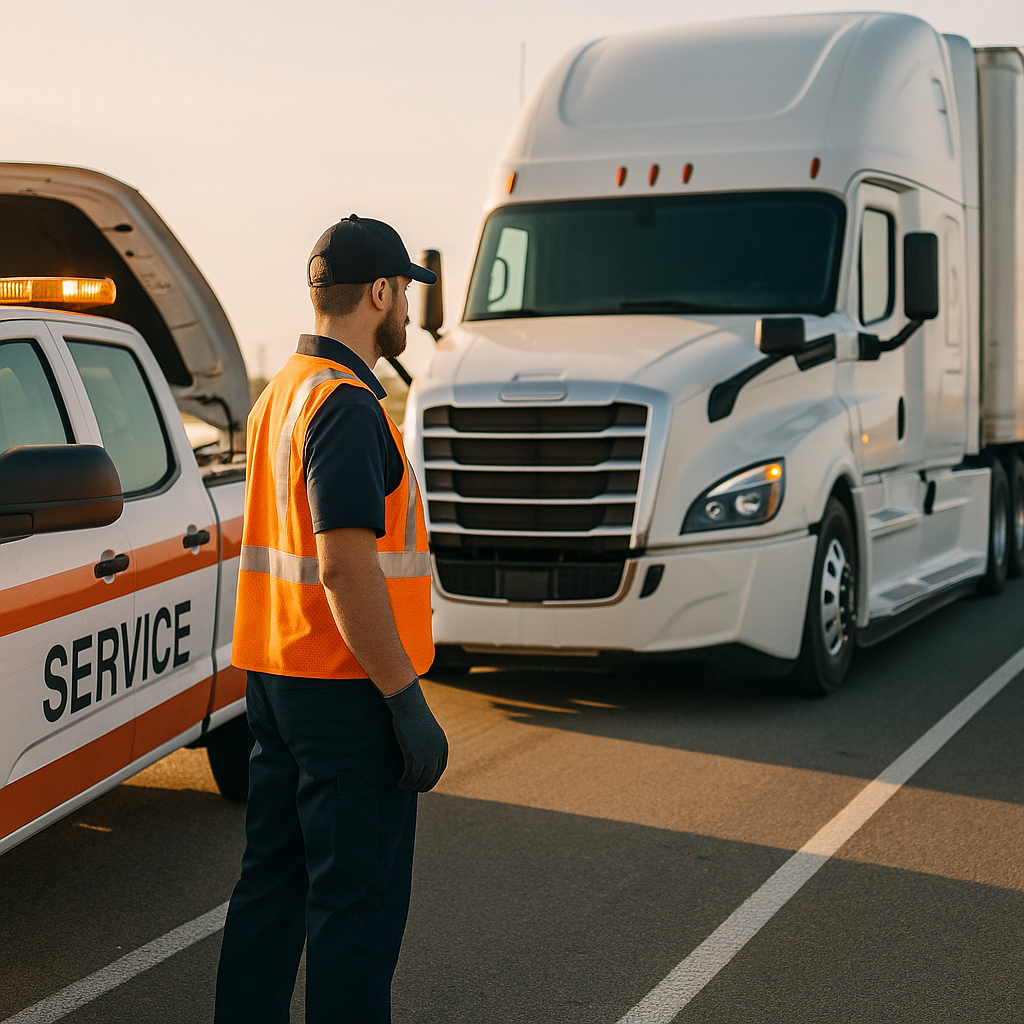

Learn what commercial roadside service includes, 2026 cost ranges, response-time expectations, and membership vs pay-per-use tips. Compare fast.
Commercial roadside service is a 24/7 dispatch network that sends towing, tire, fuel delivery, lockout, winching, and basic mobile diagnostics to commercial vehicles when they break down. The difference between a “good” plan and a bad one usually shows up in the fine print: tow-mile caps, after-hours surcharges, and whether “included” means dispatch-only or includes labor.
And if you’re mixing up roadside service with insurance coverage, start with this plain-English guide: commercial truck insurance basics.
Table of Contents
This guide covers what commercial roadside service includes, how memberships compare to pay-per-use, and realistic 2026 cost ranges for common events.
Reading time: 8 minutes
- Key takeaways
- What is commercial roadside service (and what does it include)?
- Membership vs pay-per-use vs insurance add-on (and what “nationwide coverage” really means)
- How much does commercial roadside service cost in 2026?
- Breakdown playbook: driver script + dispatcher checklist + provider scorecard
- Frequently asked questions
- Conclusion

Key Takeaways for Commercial Roadside Service
Commercial roadside service is a dispatch-and-vendor network that coordinates towing, tires, fuel delivery, lockouts, winching, and basic mobile diagnostics for work vehicles, with limits that vary by provider and vehicle class.
- It’s dispatch + vendor access: You’re paying for a vetted network and coordination, not a blank check for repairs.
- Memberships can win on frequency: If you average multiple roadside events per year, predictable benefits and authorization rules may cost less than repeated emergency calls.
- Pay-per-use can win on rarity: If you rarely call, paying only when needed can be cheaper than annual fees and unused benefits.
- “Nationwide coverage” doesn’t mean equal ETAs: Rural corridors and winter zones can stretch response time and increase rates fast.
- Roadside isn’t insurance: Roadside handles breakdown logistics; insurance is for covered losses (collision, theft, weather, etc.).
What Is Commercial Roadside Service (and What Does It Include)?
Commercial roadside service is 24/7 dispatch to mobile repair, tire, fuel, and towing resources for commercial vehicles, and it’s typically delivered through a provider’s call center, app, and vendor network.
What it is (plain English)
Think of it as a call center + network: you call (or app-request), they locate you, and they send the right help—tire truck, fuel delivery, mobile mechanic, or a heavy wrecker.
Why it’s essential (business reality)
Downtime isn’t just an inconvenience—it’s lost revenue plus fixed costs that keep running while the truck sits. For industry context on how meaningful maintenance-related costs are, see ATRI’s research hub for its annual “Operational Costs of Trucking” work: https://truckingresearch.org/.
Who needs it
- Owner-operators: Tight appointment windows and cash-flow pressure make delays expensive.
- Fleets: Utilization, SLA commitments, and driver satisfaction depend on fast recovery.
- Hotshot operators: Time-sensitive partials don’t forgive “small” breakdown delays.
- Last-mile and service fleets: Starts/stops often mean more tire and battery incidents.
What does commercial roadside service include? (quick answer)
Commercial roadside service typically includes towing/recovery, tire service, jump starts or battery help, fuel delivery, lockouts, winching, and basic mobile diagnostics, plus dispatch support to locate you and route vendors. Coverage limits vary by provider and vehicle class, so confirm tow-mile caps, after-hours fees, and whether “included” means dispatch-only or includes labor.
Quick-reference: what’s usually included vs what triggers extra charges
| Service | Typically included? | Common limits | What triggers extra charges |
|---|---|---|---|
| Towing / recovery | Sometimes | Tow-mile cap or per-event cap | Heavy-duty recovery, rotator, extended mileage, after-hours |
| Tire service (repair/replace) | Often | Limited labor or “service call included” | Tire cost, casing disposal, after-hours, odd sizes |
| Jump start / battery help | Often | Battery testing may be limited | Battery replacement, after-hours, remote areas |
| Fuel delivery | Often | Delivery only | Fuel cost, hazmat restrictions, DEF availability |
| Lockout assistance | Often | Standard doors | Specialty locks, after-hours, remote |
| Winching / extraction | Sometimes | Limited pulls/time | Deep mud/snow, multiple pulls, heavy recovery |
| Mobile diagnostics | Sometimes | Basic scanning / troubleshooting | Long labor time, complex electrical issues |
| Minor repairs (hoses/airlines/lights) | Sometimes | Small parts, short labor | Major component failures, hard-to-source parts |
| Trailer-related help | Sometimes | Lights/airline quick fixes | ABS issues, major structural/mechanical problems |
| Dispatch + location support | Yes | N/A | Rare—usually included |
Pro tip: The cheapest “plan” is the one you don’t need, and preventive maintenance reduces emergency calls, downtime, and after-hours premiums. Start here: preventive maintenance checklist for fewer breakdowns.
Membership vs Pay-Per-Use vs Insurance Add-On (and What “Nationwide Coverage” Really Means)
Commercial roadside assistance is commonly sold through three models—membership plans, pay-per-use dispatch networks, and insurance endorsements—and each model handles billing limits, vehicle eligibility, and vendor density differently.
1) Membership (annual / per-vehicle or fleet)
What it is: You pay a set fee and get defined benefits.
When it fits: Memberships tend to work when your event frequency is predictable (tires, lockouts, jump starts) and you want clearer authorization rules for drivers and dispatch.
- Best for: Regional fleets with steady lanes.
- Also solid for: Owner-operators who’ve already had more than one roadside event in a year.
Pro tip: Ask how they handle invoice itemization and service authorization limits. Surprise add-ons are where “cheap” plans get expensive.
2) Pay-per-use dispatch networks (no membership)
What it is: You pay when you need it—service call + labor + parts + tow.
When it fits: Pay-per-use is often the most cash-flow friendly option for low-frequency breakdowns, and it keeps flexibility if your lanes change month to month.
- Best for: Seasonal operators.
- Also solid for: New authorities still dialing in lanes, customers, and cost-per-mile.
3) Insurance add-on (roadside assistance endorsement)
What it is: An add-on attached to trucking insurance / commercial auto policies.
When it fits: One billing relationship can be convenient, especially for light commercial vehicles.
Where it can fall short: Some endorsements have vehicle-class limits (heavy-duty tractors may not qualify) and some networks aren’t optimized for commercial tire inventory or heavy recovery.
For a practical view of how endorsements and budgets hit real cash flow, see: owner-operator insurance options.
“Nationwide coverage” = dispatch everywhere, not equal ETAs everywhere
Many providers can dispatch nationally, but vendor density and equipment availability still vary by corridor and season.
- Rural interstates
- Oilfield/remote job sites
- Mountain/winter corridors
What to ask before you buy
- Time-to-dispatch and time-to-arrival: Ask if they track it by region.
- After-hours coverage: Nights, weekends, and holidays change pricing and availability.
- Heavy-duty capability: “We tow trucks” isn’t the same as having heavy wreckers/rotators when you need them.
- Cross-border support: US/Canada if you run it.
- Driver comms: App tracking, updates, and an escalation path.
How Much Does Commercial Roadside Service Cost in 2026? (Realistic Ranges)
In 2026, commercial roadside service calls often start around $100–$300+ for a service call and $150–$300+ per hour for mobile labor, with after-hours premiums and heavy-duty recovery equipment pushing totals much higher.
There’s no single “average” because price swings with vehicle class, location, time of day, and event type (jump start vs heavy recovery). But ranges help you budget and compare apples-to-apples.
If you want deeper detail on towing variables like hook fees, mileage, recovery equipment, and storage, keep this bookmarked: truck towing cost guide.
Common pricing models
- Membership: Per vehicle/month or per vehicle/year; sometimes tiered (basic/plus/premium).
- Pay-per-use: Service call + labor rate + parts + tow mileage + surcharges.
Directional cost ranges (budgeting—not quotes)
- Service call / dispatch fee: commonly $100–$300+ (higher for heavy-duty or remote).
- Mobile mechanic labor: often $150–$300+ per hour with minimums (after-hours higher).
- Light/medium towing: hookup + per-mile (caps vary).
- Heavy-duty towing / recovery: can climb fast based on equipment (heavy wrecker vs rotator), scene safety, and time on site.
- Tire service events: you may pay call + labor + tire cost, and tire availability can be the real bottleneck at 2 a.m.
Why pricing varies so much (labor and region)
After-hours labor premiums and metro-area rates are real, and labor-heavy roadside work tends to cost more in higher-wage markets. For baseline wage context by location, see the U.S. Bureau of Labor Statistics OEWS data: https://www.bls.gov/oes/.
What to request so you can actually compare providers
Ask for a one-page rate sheet (or written confirmation) that spells out the billing rules:
- Tow mileage included (if any) and per-event caps
- Labor rate schedule + minimum billable time
- Winch/recovery billing method (per 15 minutes, per hour, flat rate)
- Parts markup policy and invoice itemization
- Billing method: direct bill, reimbursement, or fleet terms
Bottom line: If a provider can’t explain how they bill, you don’t have cost control—you have hope.
Breakdown Playbook: Driver Script + Dispatcher Checklist (and a Provider Scorecard)
49 CFR § 393.95 requires CMVs to carry emergency equipment (including warning devices like reflective triangles), and your breakdown process should include deploying that equipment when stopped on the roadway.
A good roadside plan is 50% vendor and 50% process. When the driver is stressed and traffic is flying by, a simple script gets the right information to dispatch fast.
For documentation habits and safety process alignment, review your internal playbook against a DOT-focused checklist: DOT compliance checklist.
Driver steps (safety first)
- Get as far out of traffic as possible (shoulder, safe turnout). Don’t gamble with a bad spot.
- Hazards on. Assess if you’re leaking fluids, losing air, or have tire debris creating risk.
- Deploy warning devices as required for CMVs. Reference: 49 CFR § 393.95.
- Send exact location: mile marker, direction of travel, nearest exit, and a GPS pin (if safe).
- Provide vehicle details: tractor unit number, trailer number, tire size (steer/drive/trailer), and symptoms (no crank, air loss, vibration, dash lights).
- Take photos (if safe): tire damage, dash codes, surroundings, and the access path.
Dispatcher checklist (to speed up authorization and ETA)
- Vehicle class and configuration (tractor/trailer, axle setup)
- Tire size + position (steer/drive/trailer) and whether you need a casing
- Preferred tow destination (dealer, your shop, nearest capable facility)
- Authorization limit and payment method
- After-hours receiving plan (who can sign, drop location)
- Driver contact info and a “keep me updated every X minutes” expectation
Provider scorecard (simple way to choose)
Score each provider 1–5 on the items that hit your operations the hardest:
- Heavy-duty capability: Can they source the equipment you actually need?
- Corridor coverage: Your lanes, not their marketing map.
- Pricing transparency: Rate sheets, itemized invoices, and written caps.
- Response-time reporting: Time-to-dispatch and time-to-arrival.
- Technology: Tracking, updates, dispatch audit trail.
- Billing flexibility: Fleet terms vs driver-paid reimbursement.
- Escalation path: What happens when the first vendor can’t handle it?
Best practice: Pilot for 30–60 days, then review invoices and ETAs like you review fuel and maintenance—because it hits the same profit line.
Frequently Asked Questions
Commercial roadside service FAQs below cover what’s usually included, who provides it, how it differs from personal roadside, and what it does not pay for (including accident damage).
Most commercial roadside service programs include towing/recovery, tire service, jump starts or battery support, fuel delivery, lockouts, winching, and basic mobile diagnostics, plus dispatch support to locate you and route the right vendor. The limits are what matter in real life: confirm tow-mile caps, after-hours and holiday surcharges, and whether “included” is dispatch-only or includes labor. For tire events, many plans cover the service call but you still pay the tire cost, disposal, and any odd-size sourcing fees. Always ask for written billing rules and itemized invoices.
Commercial roadside assistance is typically provided through three models: insurance add-ons, membership programs, and pay-per-use dispatch networks. Insurance endorsements can be convenient but may have vehicle-class limits and lower caps, especially for heavy-duty units. Memberships can make sense when you have predictable events and want set authorization rules. Pay-per-use works when breakdowns are rare and you want to avoid annual fees. For owner-operators balancing cash flow and coverage choices, this overview helps frame add-ons and budgeting: owner-operator insurance options.
Commercial roadside services are built for heavier vehicles and specialized needs like commercial tire sizes, air systems, and complex towing/recovery, and that usually means different pricing and limits than personal auto roadside. “Included towing” in a personal plan often doesn’t translate to tractor-trailer realities like heavy wreckers, rotators, traffic control, or extended time on scene. Commercial programs also tend to emphasize authorization limits, invoice itemization, and fleet reporting, because controlling downtime and billing is a dispatch-and-operations problem, not just a convenience feature.
Commercial roadside service usually does not cover major repairs or accident-related damage, because it’s designed for breakdown help and immediate logistics (getting you moving or towed). A roadside provider might coordinate a tow to a shop, but the cost of major component work, collision repairs, theft losses, or weather damage is typically handled through insurance, depending on your policy terms and deductibles. If you want the plain-English version of what insurance pays for versus what roadside won’t, start here: physical damage coverage explained.
Conclusion: Build a Roadside Plan That Protects Your Cost-Per-Mile
49 CFR § 393.95 sets emergency equipment expectations for CMVs, and pairing compliance-ready driver steps with a clear roadside provider agreement is one of the simplest ways to reduce breakdown risk and downtime.
Commercial roadside service isn’t about comfort—it’s about controlling downtime, avoiding runaway recovery bills, and keeping your schedule intact. Choose based on your operating reality: membership when incidents are predictable, pay-per-use when events are rare, and insurance add-ons only when the limits match your vehicle class.
Key Takeaways:
- Get billing in writing: Rate sheets, caps, and itemized invoices prevent “surprise” roadside totals.
- Match the model to your frequency: predictable calls often favor membership; rare calls often favor pay-per-use.
- Process matters: A driver script + dispatcher checklist improves ETAs and reduces wasted labor time.
Related reading to control total risk cost (insurance + roadside + downtime):
If you want help comparing roadside options alongside trucking insurance and real operating costs, build a one-page plan (routes, equipment, authorization limits) and shop providers using the scorecard above.





