
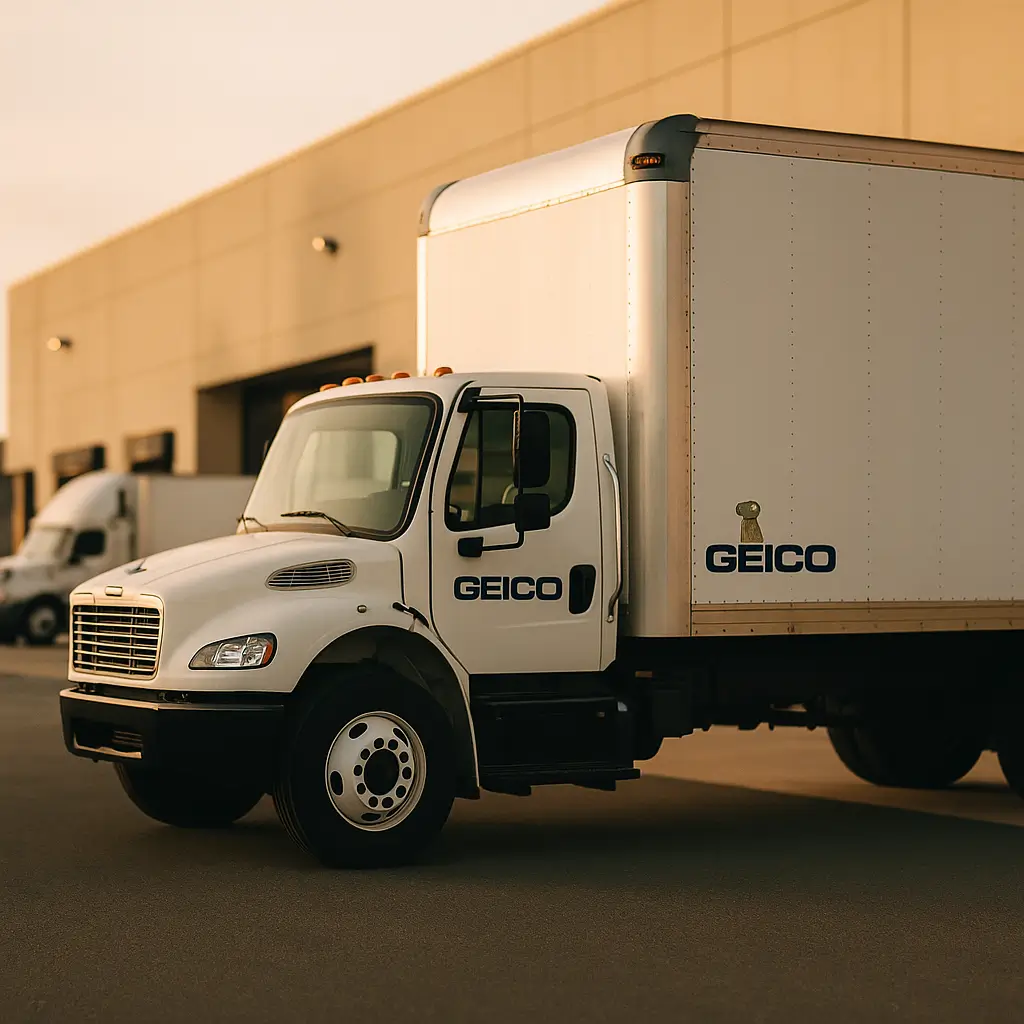

Learn whether GEICO covers moving trucks, common GVWR limits and exclusions, rental coverage gaps, and what protection to consider at pickup.
If you’re asking does GEICO cover moving trucks, the practical answer is: often no for large box trucks, and “maybe” for smaller vans or pickups—depending on the policy’s vehicle-type definition and weight rules (usually based on GVWR). The safest move is to confirm coverage for the exact truck (type + GVWR) and get that answer documented before you drive off the lot.
Before you call, it helps to understand what coverage can (and can’t) follow you into a rental vehicle—especially the split between liability and physical damage—starting with commercial auto insurance basics.
Table of Contents
Reading time: 8 minutes

Key Takeaways
Moving-truck rental claims most often go sideways when the truck is “ineligible” under the personal auto policy definition (vehicle type) or weight rules (typically GVWR).
- Don’t treat a moving truck like a rental car: box trucks are commonly excluded under personal auto language designed for private passenger autos.
- Weight is the hinge point: ask whether eligibility is based on GVWR (rating) or GVW (actual loaded weight).
- If anything is unclear, buy protection at the counter: prioritize liability (SLI) and a damage waiver (LDW/CDW) for the truck.
- Business use changes everything: repeat rentals or paid hauling usually require commercial solutions, not personal auto.
Does GEICO cover moving trucks? Quick answer rules
A GEICO personal auto policy is written around a specific “covered auto” definition, and many moving trucks (especially box trucks) fall outside that definition unless the policy explicitly confirms eligibility by vehicle type and GVWR.
What you’re really asking (plain English)
This isn’t just “rental car coverage.” The real question is whether your policy extends liability (damage/injuries to others) and physical damage (damage to the truck) to a vehicle that may not be a normal private passenger auto.
If you want a clean mental model before you talk to an insurer, use personal vs commercial auto coverage to separate what might follow you into a rental from what often doesn’t.
Before diving into the weight rules and coverage gaps, this breakdown explains what auto liability coverage actually means for a truck driver — and how it differs from other coverage types:
Why this matters (real money risk)
- Truck damage: if you decline the waiver and your policy doesn’t extend, the rental company can bill you for repairs, towing, downtime, and admin fees—which is exactly why physical damage coverage matters (contract terms vary).
- Liability losses: bodily injury and property damage claims can reach six figures quickly, especially in multi-vehicle collisions, pedestrian impacts, or building strikes.
- Coverage disputes: “ineligible vehicle” issues often create delays and denials even when you thought you had “rental coverage.”
The 60-second script to get a real yes/no
Don’t ask, “Am I covered on a moving truck?” Ask this instead:
- “Does my policy extend liability and physical damage to a rented box truck with a GVWR of _____ used for personal moving, and can you note it on my policy file or send confirmation?”
That one question forces the two things that decide most outcomes: vehicle class and weight (GVWR).
GVW vs GVWR: the weight detail that decides coverage
GVWR (Gross Vehicle Weight Rating) is the manufacturer’s maximum loaded weight rating shown on the vehicle’s label, while GVW (Gross Vehicle Weight) is the vehicle’s actual weight at a specific moment (truck + fuel + people + cargo).
Why insurers and rental contracts focus on GVWR
GVWR is fixed and easy to verify, so it’s commonly used for underwriting rules and eligibility decisions. GVW changes every time you load or unload, so it’s less useful as a firm cutoff.
Regulatory context (weight + CDL)
If you want the federal definition framework behind vehicle classifications and CDL thresholds, FMCSA provides guidance here:
- CDL/weight guidance: https://www.fmcsa.dot.gov/registration/commercial-drivers-license/do-i-need-cdl
- Federal definitions (49 CFR 390.5): https://www.fmcsa.dot.gov/regulations/title49/section/390.5
Quick GVWR checklist (before you reserve)
Don’t shop by “truck length” alone. Shop by GVWR, then verify it on the door-jamb label at pickup.
| Rental label (marketing) | What it usually is | What to verify |
|---|---|---|
| Cargo van / 10–12′ | Light-duty van/box | GVWR on sticker + policy eligibility by vehicle type |
| 15–20′ | Medium box truck | GVWR + whether “box trucks” are excluded |
| 26′ | Large box truck | GVWR + expect exclusion unless explicitly confirmed |
For a full breakdown of how GVWR maps to truck class and regulatory requirements, see LogRock’s guide to medium and heavy-duty truck classifications.
Not sure how weight ratings translate into real-world requirements? Here’s a quick breakdown:
If you’re regularly around these vehicles for work, start with box truck insurance considerations so you’re not making expensive assumptions about what a personal policy will do.
What to buy at the rental counter (U-Haul/Penske/Budget): a simple decision tree
Rental counters typically sell (1) a damage waiver for the truck and (2) supplemental liability (SLI), and those two products are the main backstops when personal auto coverage doesn’t extend.
What the counter products usually mean
- Damage Waiver (LDW/CDW): reduces or waives what you owe for damage to the rental truck (terms, exclusions, and dollar caps vary by company).
- Supplemental Liability (SLI): increases liability limits above whatever base layer applies (your policy, the rental company’s minimum, or other coverage).
- Cargo protection: may cover your belongings up to a limit, often with exclusions (theft, water, packing method, etc.).
- Roadside: service plan; it’s not liability insurance and usually doesn’t fix a coverage gap.
For a deeper breakdown of what these counter add-ons cover and when they fall short, see commercial auto rental insurance explained.
If you’re still figuring out the rental side of the equation, this walkthrough is worth a watch before you book:
If you’re still deciding between U-Haul, Penske, and Budget, see LogRock’s comparison of box truck rental companies to understand what each offers before you commit to a reservation.
Decision tree you can use in the parking lot
- GEICO confirms liability + physical damage for this exact truck (GVWR included), in writing: compare your deductible to the waiver price; consider a waiver if you want a clean, low-hassle exit.
- GEICO confirms liability only (no physical damage): strongly consider a damage waiver for the truck and evaluate SLI for higher limits.
- GEICO excludes the vehicle or the answer is unclear: assume you need SLI + a damage waiver, and add cargo protection if your belongings aren’t covered elsewhere.
If you’re using a moving truck for business: personal auto stops, trucking insurance starts
Business use (paid hauling, deliveries, or repeat rentals) commonly triggers exclusions under personal auto policies and often requires commercial auto coverage designed for truck operations and contracts. To understand exactly where personal auto stops and commercial coverage starts, see personal vs commercial auto insurance.
What “business use” can mean in real life
- Deliveries for your company
- Hauling materials to job sites
- Getting paid to help someone move
- Renting box trucks regularly as part of operations
Before comparing rental add-ons versus a real commercial policy, it helps to understand what auto liability actually includes:
Why business use changes the claim and the paperwork
- Policy language: “for-hire,” “livery,” and certain business activities may be excluded or limited.
- Proof of insurance: customers, vendors, landlords, and brokers may require a certificate of insurance with specific limits.
- Severity: commercial losses trend bigger (higher miles, tighter schedules, more third-party involvement).
If you’re comparing rental add-ons versus a real policy, start with what affects commercial auto insurance rates so you’re not surprised by how radius, vehicle class, drivers, and loss history move the price.
And if you’re ready to price it correctly, the clean next step is get commercial auto quotes and ask specifically about hired and non-owned auto if you rent trucks in the business name.
Bottom line + pickup-day checklist (don’t guess—document)
The lowest-risk approach is to document the truck’s GVWR, confirm who provides liability and physical damage coverage, and buy SLI/LDW at the counter when coverage isn’t explicitly confirmed.
Pickup-day checklist
- Get the GVWR: take a clear photo of the door-jamb sticker.
- Confirm authorized drivers: make sure every driver is on the rental agreement.
- Confirm liability + physical damage: write down who covers what (GEICO, rental products, credit card, etc.).
- Decide on SLI + damage waiver: if anything is excluded or unclear, default to protecting the big exposures.
- Do pre-trip photos/video: roofline, corners, mirrors, bumper, and the odometer.
- Keep docs accessible: rental agreement + coverage confirmations in your phone.
If you want to understand how rental coverage works before move day, review commercial auto rental insurance.
One more edge case: non-owner policies
If you don’t own a car and you’re relying on a non-owner policy, verify eligibility by truck type and GVWR before you rent. Non-owner coverage is usually liability-focused and may not cover damage to the rental truck itself.
Why Logrock (when this stops being a one-time rental)
Logrock focuses on practical coverage decisions for owner-operators, small fleets, and businesses that can’t afford to “find out after the accident.” If you’re stepping from a one-time move into regular box truck work, the goal is simple: align the risk with coverage that matches how you actually operate.
Frequently Asked Questions
Often, large moving trucks are excluded under personal auto policies even when “rental car coverage” exists, because the truck may not meet the policy’s covered-auto definition (vehicle type) or weight eligibility rules (commonly tied to GVWR). Some smaller vans or pickups may qualify depending on the specific policy form and state rules. Before you decline counter coverage, confirm (1) whether the rented vehicle is eligible by vehicle type and GVWR, (2) whether liability applies, and (3) whether physical damage (comp/collision) applies to damage to the truck itself. For a full breakdown of how GEICO handles truck rentals, see our guide to GEICO truck rental coverage. For box trucks specifically, see GEICO box truck insurance for delivery drivers.
A “~15,000 lb” limit is commonly mentioned online, but it is not a universal guarantee because eligibility can vary by policy form, state, and vehicle-type restrictions (for example, a “box truck” may be excluded regardless of weight). The only reliable way to decide is to ask whether GEICO uses GVW (actual loaded weight) or GVWR (rated maximum weight) for eligibility, then confirm coverage using the exact truck you’re renting. Take a photo of the door sticker so the GVWR is documented.
If GEICO won’t clearly extend coverage (or you can’t get the answer documented), it’s usually smart to buy the rental company’s supplemental liability (SLI) and a damage waiver (LDW/CDW) for the truck, because those two products address the biggest loss categories: third-party liability and damage to the truck itself. Also consider cargo protection if your belongings aren’t covered under homeowners/renters insurance or other coverage. The goal is straightforward: avoid being personally responsible for an open-ended bill after a preventable parking-lot or low-clearance loss.
Usually, a non-owner policy is designed to provide liability-only coverage while driving vehicles you don’t own, but it commonly has limitations and may not solve moving-truck eligibility issues tied to vehicle type (box truck) or GVWR. Non-owner coverage also typically does not cover damage to the rental truck (physical damage), which is a major exposure with moving trucks. If you’re relying on a non-owner policy, verify eligibility using the truck’s GVWR and then consider a damage waiver at the counter.
For personal use, most 26-foot moving trucks rented by U-Haul, Penske, or Budget fall under the 26,000 lb GVWR threshold that triggers a commercial driver’s license (CDL) requirement, so a standard driver’s license is typically sufficient. However, GVWR varies by truck and the threshold is a hard line: always check the door-jamb sticker. For commercial use (paid hauling, deliveries), CDL rules depend on the vehicle’s GVWR, whether you cross state lines, and what you’re hauling. For a full breakdown of licensing thresholds, endorsements, and exemptions, see LogRock’s guide to CDL requirements.
The rental terms and some rental company counter products may differ between one-way and local rentals, but your personal auto policy does not typically distinguish between the two. Eligibility is usually based on vehicle type and GVWR, not trip structure. What can differ is the rental company’s liability minimums, the state where the accident occurs, and whether counter products are priced per day or per rental period. For longer one-way moves crossing state lines, confirm that your coverage applies in every state you will drive through.
Most consumer credit cards that offer rental car protection explicitly exclude trucks, cargo vans above a certain size, and vehicles rented for moving purposes, so you generally cannot rely on your card for a box truck. The exclusions are spelled out in each card’s cardholder benefit guide — terms vary widely between issuers and card tiers — so verify your specific agreement before declining counter coverage based on credit card protection.
SLI is coverage sold at the rental counter that increases the liability protection above the rental company’s base layer, covering bodily injury and property damage claims from third parties if you cause an accident. For moving trucks, where the base layer is often limited and personal auto coverage may not extend, SLI is one of the most important products to consider. If you are unsure whether your policy provides liability for the specific truck you are renting, SLI is a straightforward way to close that gap. For more context, see commercial car rental insurance.
It depends on the policy. Some homeowners and renters policies extend coverage to personal property in transit, but limits are often lower than expected, and exclusions for moving or transportation can apply. Read your declarations page and call your insurer to ask specifically: “Does my policy cover personal property in a rented moving truck?” If the answer is no or unclear, consider the rental company’s cargo protection add-on.
If you have no applicable coverage — no personal auto extension, no rental counter products, and no credit card protection — you are personally responsible for every cost: damage to the rental truck, damage to other vehicles or property, and bodily injury claims from others. Rental companies can pursue you directly for truck damage under your rental agreement, including towing, downtime, and admin fees. Third-party liability claims can escalate well into six figures. This is the exact scenario rental counter products are designed to prevent.
Rental truck GVWR varies by vehicle, but common reference points are: cargo vans typically run 8,000–10,000 lb GVWR; 15-foot trucks commonly fall in the 10,000–14,500 lb range; and 20- to 26-foot trucks often land between 14,500 and 26,000 lb GVWR. These are ranges, not guarantees — the only reliable number is the door-jamb label on the specific truck you receive at pickup. If you want the GVWR before pickup day, call the rental company and ask for the GVWR of the truck assigned to your reservation, then use that number when calling your insurer to confirm eligibility. For more on how GVWR maps to vehicle class, see LogRock’s guide to medium and heavy-duty truck classifications.
SafeMove bundles a damage waiver for the truck, limited cargo coverage, and medical and life coverage for the driver. SafeMove Plus adds coverage for a tow dolly or auto transport trailer if you’re towing a vehicle during the move. If your personal auto policy doesn’t clearly extend to the moving truck — which is common for larger box trucks — SafeMove covers the main truck-damage exposure and is worth considering. The choice between SafeMove and SafeMove Plus depends primarily on whether you’re towing another vehicle. Neither product substitutes for supplemental liability (SLI) coverage above U-Haul’s base layer; if you want higher third-party liability limits, add SLI separately. Confirm current terms and pricing directly with U-Haul at reservation, as protection plans and pricing can change.
Rental reimbursement coverage — which pays for a substitute rental car while your own vehicle is being repaired after a covered loss — is a separate benefit from whether your policy extends liability and physical damage to a moving truck you are driving. Rental reimbursement covers the cost of renting a car to replace yours; it does not expand your policy’s eligibility to cover a different vehicle you are operating. The question to ask GEICO is whether your policy extends both liability and physical damage to the specific moving truck you plan to rent. Rental reimbursement does not affect that answer.
Coverage in this situation depends on two things: whether you are listed as an authorized driver on the rental agreement, and whether your personal auto policy (or the renter’s) extends to the truck’s vehicle type and GVWR. Most rental companies require all drivers to be listed on the agreement — if you are not listed, the rental company’s coverage does not apply to you, and your personal auto policy faces the same vehicle-type and GVWR eligibility questions it would if you had rented the truck yourself. Before driving: make sure you are added to the rental agreement at the counter, confirm eligibility with your insurer using the truck’s GVWR, and decide together who will purchase counter coverage. Do not assume coverage follows just because someone else made the reservation.
Conclusion: Confirm GVWR, document coverage, and don’t leave the counter exposed
Moving-truck insurance problems usually aren’t “bad luck”—they’re mismatched vehicle class, weight rules, and undocumented assumptions. If GEICO can’t confirm the exact truck (type + GVWR) for both liability and physical damage, treat that as a no and protect yourself at the counter.
Key Takeaways:
- Verify GVWR on the door sticker and use that number when you ask about coverage.
- Separate liability from truck damage; they don’t always follow you the same way.
- When unclear, buy SLI + LDW to avoid becoming the one financing the claim.
If you’re not sure whether your personal auto policy actually covers the moving truck you’re renting — or if you’re stepping into regular box truck operations and need coverage built around how you work — LogRock can help you sort it out. Talk to our team, get your questions answered, and request a quote based on your specific situation.
Talk to LogRock and request a quote




