
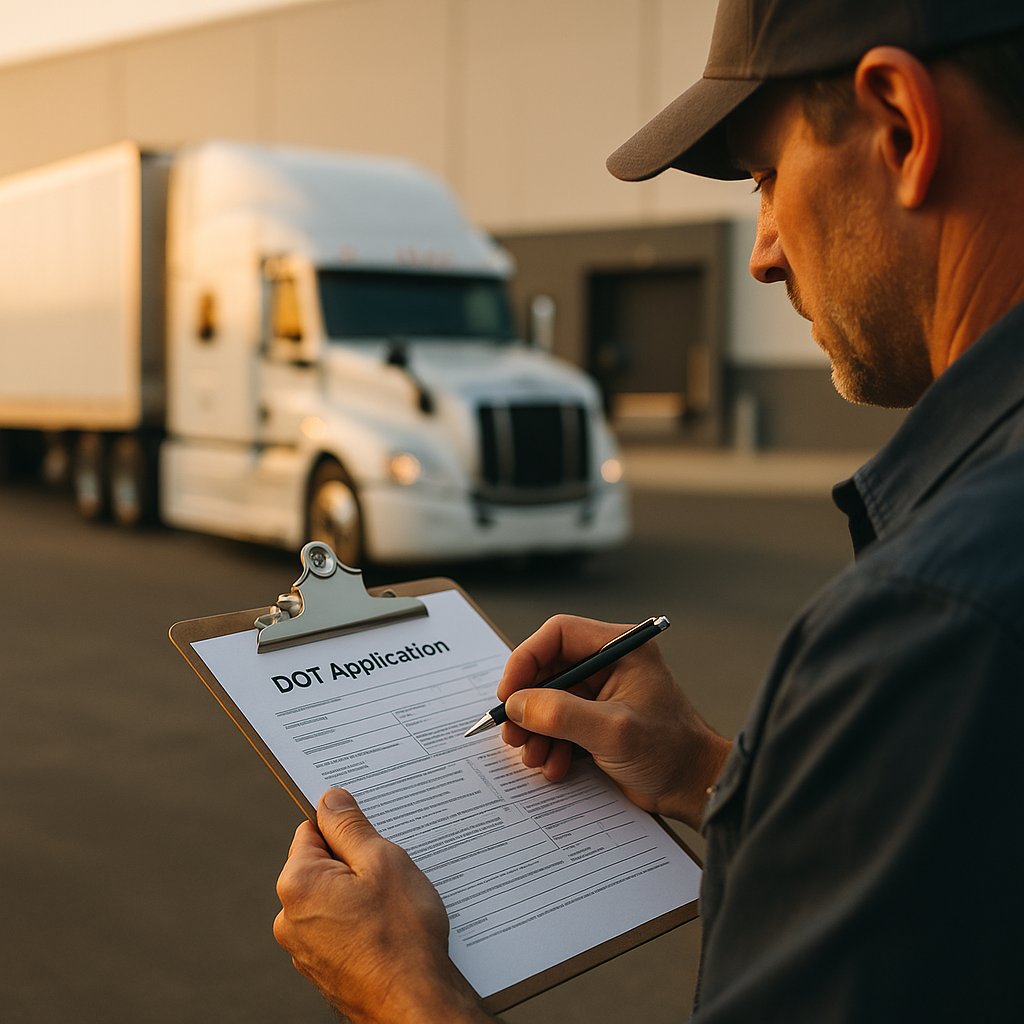
DOT application (USDOT) in 7 steps, 2026 costs ($0 federal), MFA tips, scam warnings, and when trucking insurance/commercial truck insurance kicks in. Start now.

A DOT application (USDOT application) is the process of registering your company with FMCSA to get a USDOT number—your carrier ID tied to safety and compliance. To apply, you create an FMCSA account, start a new USDOT registration, enter your MCS-150 business/operation details, review carefully, and submit, then verify your record shows correctly and set reminders for required updates.
This guide is built for real-world startup pressure—so you can file cleanly, avoid delays, and understand what happens next (especially if you’re also pursuing operating authority). If you’re unsure whether you need USDOT, MC, or both, start with FMCSA authority application.
Featured-snippet answer (How do I apply for a USDOT number?): To apply for a USDOT number, create an account in the official FMCSA registration portal, start a new USDOT registration, complete the MCS-150 business and operation details, review carefully, and submit. Save your confirmation, then verify your company record appears correctly and set reminders for required updates.
Table of Contents
Reading time: 7 minutes
- Key takeaways (quick answers)
- What “DOT application” means (trucking vs other uses)
- Do you need to file a DOT application? Quick eligibility checklist
- How to apply for a USDOT number (DOT application): step-by-step
- DOT application costs in 2026 (and when commercial truck insurance starts costing you money)
- Frequently Asked Questions
- Conclusion: File it once, file it right
Key takeaways (quick answers)
A “DOT application” in trucking usually means getting a USDOT number through FMCSA, and the USDOT filing itself is typically $0 while many real costs show up after registration (authority, permits, and insurance filings).
- DOT application ≠ MC authority: A USDOT number is an identifier; operating authority (often “MC”) is permission for many for-hire interstate operations.
- Filing direct is usually free: Most new-carrier spend happens on registrations, compliance setup, and sometimes commercial truck insurance filings.
- Accuracy prevents delays: Your operation type, cargo, and addresses must match other documents (authority, insurance, permits).
- Scams target new carriers: Use official .gov pages and verify your record in FMCSA systems before paying anyone.
What “DOT application” means (trucking vs other uses)
In U.S. trucking, “DOT application” most commonly means a USDOT number registration with the Federal Motor Carrier Safety Administration (FMCSA), not a driver job application or a DOT physical form.
Most common meaning: USDOT number (trucking DOT registration)
A USDOT number is the identifier linked to your carrier’s safety profile, inspections, and compliance record. For a plain-English breakdown of what it’s used for at scales and roadside inspections, see what a DOT number is used for.
Other meanings you might be seeing
- Driver paperwork: “DOT application” sometimes refers to a driver employment packet or a DOT medical card (DOT physical).
- Graphviz DOT: A diagramming language used by developers (not trucking-related).
USDOT vs MC number (and why it matters to revenue)
If you’re planning to haul for-hire across state lines under your own business, you may need both a USDOT number and operating authority. A practical starting point is FMCSA authority application, since brokers often ask for “DOT and MC,” and insurance/filings can depend on the authority type.
- USDOT number: Carrier identification + safety/compliance record.
- MC/operating authority: Permission for many for-hire interstate operations, with extra filing requirements.
Do you need to file a DOT application? Quick eligibility checklist
FMCSA generally requires a USDOT number for interstate operations using a commercial motor vehicle (CMV), including vehicles with GVWR/GCWR of 10,001+ lbs, certain passenger carrier operations, and certain hazmat movements.
FMCSA’s official “Do I need a USDOT number?” page is here (external): https://www.fmcsa.dot.gov/registration/do-i-need-usdot-number.
You likely need a USDOT number if you:
- Operate interstate (cross state lines) in commercial transportation and meet common federal triggers (weight, passengers, placarded hazmat).
- Plan to run under your own company as a for-hire carrier (typical for many new authorities and owner-operators going independent).
You might not need your own USDOT number if you:
- Are leased on to a motor carrier and operate under the carrier’s USDOT/authority (common in lease-operator setups).
Intrastate-only (one state) is where it gets messy
Intrastate operations can still be regulated under state rules, and some states apply FMCSA-like requirements even if you never cross state lines. If you’re moving fast, don’t guess—misclassification can turn into broker onboarding issues and painful cleanup later.
Pro tip: If you want a “broker-ready” baseline after you register, keep a simple setup checklist handy using DOT compliance checklist for new carriers.
How to apply for a USDOT number (DOT application): step-by-step
The USDOT application is submitted through FMCSA’s registration system using MCS-150 data, and carriers must update their MCS-150 information at least every 2 years (and sooner when key details change).
FMCSA’s registration forms hub (external) is here: https://www.fmcsa.dot.gov/registration/registration-forms.
Before you start: gather info so you don’t time out
- Business details: Legal name, DBA (if any), physical + mailing address, email, phone.
- Tax ID: EIN (or SSN depending on structure).
- Operations: For-hire vs private, interstate vs intrastate, number of CMVs, estimated mileage.
- Cargo categories: Only what you actually haul (don’t “check everything”).
- Driver basics: Who’s driving, CDL where required, and compliance plan.
Step 1: Use the official portal (avoid look-alike sites)
Start from FMCSA pages (URLs ending in .gov) and ignore ads and mailers that claim you “must pay now” for free items. If a site won’t clearly identify FMCSA as the system owner, treat it like a red flag.
Step 2: Start a new USDOT registration (where MCS-150 fits)
Most people calling it “the DOT application form” are really talking about entering MCS-150 information through the portal. If you want a plain-English breakdown of confusing fields and update triggers, use MCS-150 form guide.
Step 3: Complete key fields correctly (common error traps)
- Operation type: For-hire vs private must match how you actually run loads and get paid.
- Cargo classification: List what you haul; overstating or understating can create inspection and onboarding problems.
- Addresses: Keep them consistent with insurance, authority, permits, and business records to avoid mismatches.
Step 4: Review like it’s a contract (because it is)
- Verify legal name/DBA, address, and contact details.
- Confirm interstate/intrastate and operation type selections.
- Save a PDF/screenshot of the confirmation for your records.
Step 5: Get your USDOT number and verify visibility
It’s common to receive a number quickly after submission, but public systems can lag. Save your proof of submission and verify your company record appears correctly.

Step 6: MFA/login tips (2026 reality check)
FMCSA account access is built for security, so plan for multi-factor authentication (MFA) like it’s part of the job. Use an authenticator app when possible, store backup codes securely, and plan ahead if you change phones so you don’t get locked out mid-filing.
Step 7: Stop when it’s time to stop
If you’re stuck, don’t call random “support” numbers from unofficial sites. Use contact paths published on FMCSA pages and keep records of what you submitted.
DOT application costs in 2026 (and when commercial truck insurance starts costing you money)
The FMCSA USDOT registration is typically $0, while common add-on costs include operating authority fees (often $300 per application), compliance registrations like UCR, and insurance filings required to activate for-hire authority.
What’s free vs what you’ll pay for
| Item | Typical cost | What it’s for |
|---|---|---|
| USDOT number (FMCSA filing) | $0 (typical) | Carrier ID tied to safety/compliance record. |
| Operating authority (MC application) | Often $300 | Permission for many for-hire interstate operations (fee varies by authority type). |
| BOC-3 process agent | Varies (often paid to an agent) | Designation of process agents; commonly required when pursuing authority. |
| UCR registration | Varies by fleet size | Annual registration required for many interstate carriers. |
| Third-party filing help | Varies | Convenience service; not required if you file yourself. |
Where trucking insurance affects the timeline
This is the part that slows people down: a USDOT number alone doesn’t automatically make you “for-hire and ready to run” under your own authority. If you’re pursuing authority, you’ll typically need insurance filings (and minimum coverage amounts depend on what you haul and how you operate).
If you want a practical breakdown of what new authorities usually need (and when the filings matter), read truck insurance requirements for new authorities.
Commercial truck insurance, trucking insurance, hotshot insurance, semi truck insurance (what changes?)
The USDOT filing process is similar, but underwriting and minimums can feel very different depending on your equipment and operation. For example, hotshot setups (pickup/medium-duty truck + trailer) can face tighter commodity and radius scrutiny, while heavier semis often carry higher liability exposure and different claims patterns.
- Affordable trucking insurance isn’t just price—it’s matching coverage to your real operation (radius, commodities, for-hire status, driver list).
- Wrong classification can create cancellations, claim disputes, or failed broker onboarding when certificates don’t match filings.
Your “what’s next” checklist (don’t skip this)
After you have your USDOT number, your next steps depend on whether you’re leased on, running your own authority, and operating multi-state.
- Authority path: Plan for BOC-3 filing explained, UCR registration, and insurance filings.
- Multi-state operations: Learn the basics early so renewals don’t surprise you: IFTA and IRP basics.
- Ongoing updates: Update MCS-150 when key details change and keep a calendar for required periodic updates.
Scam-proofing (because “DOT application” scammers love new carriers)
New carriers are frequently targeted by “final notice” mailers and look-alike websites that charge for free or low-cost items. Use these rules to protect your wallet:
- Use .gov pages for federal filings and references.
- Be skeptical of urgency (“pay immediately” / “avoid penalties”) when you haven’t requested a service.
- Verify your record using legitimate FMCSA tools like SAFER (external): https://safer.fmcsa.dot.gov/.
If you already paid a questionable service, save screenshots, receipts, and emails, and consider disputing the charge with your card provider.
Frequently Asked Questions
In trucking, a DOT application usually means applying for a USDOT number through FMCSA, which is the carrier identifier tied to safety and compliance records. People also use the phrase for non-carrier items like a driver job application, DOT physical paperwork, or even Graphviz DOT (software), but those aren’t FMCSA carrier registration. If you’re seeing terms like USDOT, FMCSA, or MCS-150, it’s almost always about carrier registration and the information FMCSA uses to classify your operation.
You apply for a USDOT number by using the official FMCSA registration system, creating/logging into your account, starting a new USDOT registration, and submitting your MCS-150 business and operation details. Review your operation type (for-hire vs private), cargo categories, and addresses carefully before submitting, then save your confirmation. Afterward, verify your company record appears correctly in FMCSA systems and keep your login/MFA access secure so you can update your information when it changes and complete required periodic updates.
You can find official registration forms and references for MCS-150 on FMCSA’s Registration Forms page at fmcsa.dot.gov/registration/registration-forms. Many carriers submit MCS-150 information directly through the online portal rather than mailing a paper form, but the underlying data is the same. If you want a field-by-field walkthrough plus common mistakes (like cargo categories and operation type), use MCS-150 form guide and keep the details consistent with your authority, insurance, and permit documents.
You don’t always need IFTA/IRP immediately after getting a USDOT number, because IFTA and IRP requirements depend on multi-state operations and your vehicle class/weight setup. If you’ll operate across state lines with qualifying equipment, it’s smart to plan early so you’re not scrambling after you start running loads or when plates and renewals come due. For a straightforward overview of what these programs are and why they matter, read IFTA and IRP basics and map your planned lanes before committing to paperwork.
Conclusion: File it once, file it right
A DOT application is a business-critical filing that sets the foundation for compliance, broker onboarding, and “what’s next” registrations. The clean path is simple: confirm whether you need USDOT, MC, or both, file through official FMCSA channels, verify your record, and build the post-filing stack (compliance setup, registrations, and insurance).
Key Takeaways:
- USDOT registration is typically $0 when filed directly with FMCSA, but authority/permits/insurance can add real startup cost.
- Pick the correct operation type and cargo categories to avoid delays and cleanup later.
- Verify your company record in SAFER and ignore “final notice” mailers pushing paid services for free items.
Keep going with the most common “next steps” reads: BOC-3 filing explained and UCR registration.





