
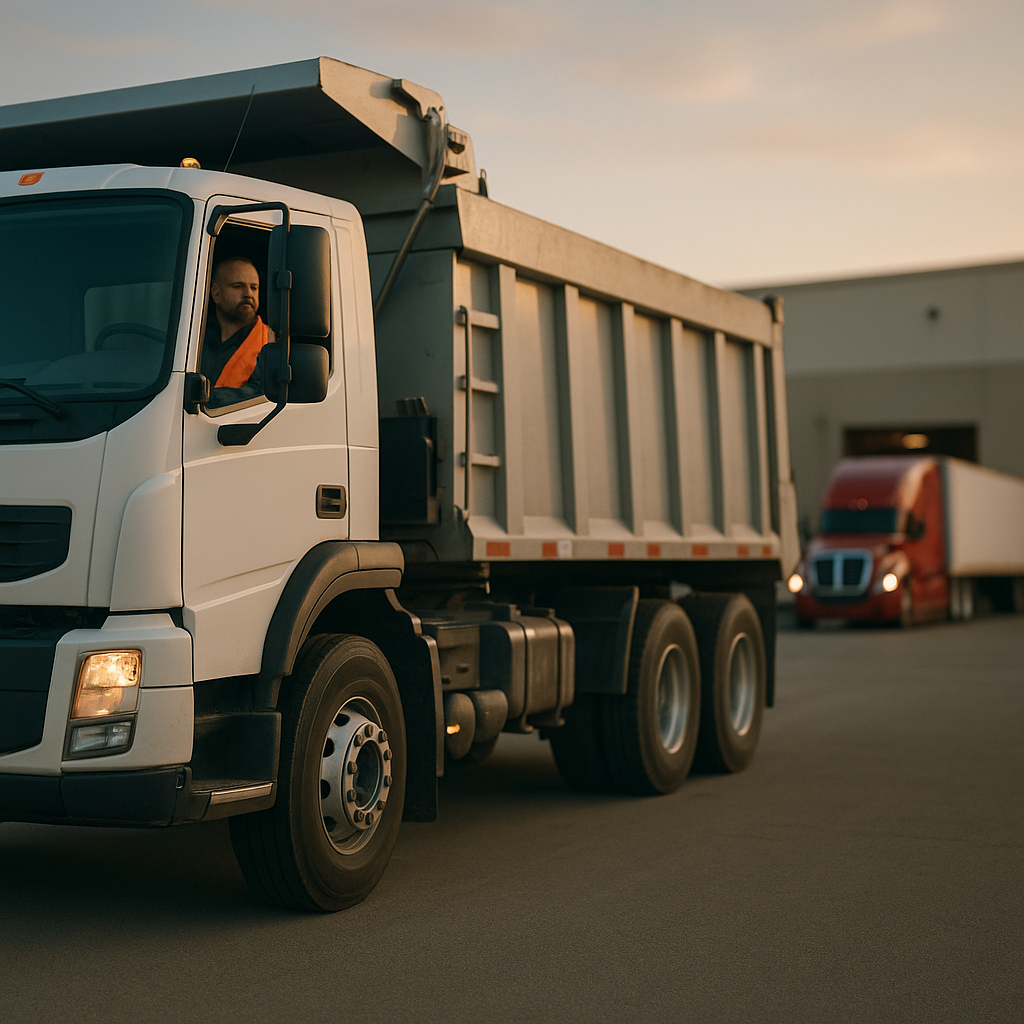
Dump truck insurance cost in 2026 is often $400–$1,200+/mo. Compare rates by state and job type, and lower premiums—get a quote.

Dump truck insurance cost in 2026 is commonly $400–$1,200+ per month per truck for many small local/regional operators, with higher-risk work pushing the number up. That range is the clean budgeting answer, but your final price depends on state, job type, driver history, limits, and whether you add physical damage and contractor coverages.
If you want the bigger picture of how policies are built (liability vs physical damage vs GL), start with commercial truck insurance basics. This guide breaks cost down by state, job type, and coverage choices so you can budget like an owner instead of guessing.
Table of Contents
Reading time: 8 minutes
- Introduction: Why “A Cheap Policy” Can Get Expensive Fast
- Key Takeaways
- Average Dump Truck Insurance Cost (Monthly + Annual): Quick Answer
- Dump Truck Insurance Rates by State (2026): What Changes and Why
- What Coverage Is Required for Dump Trucks (and What’s Optional)
- How to Lower Dump Truck Insurance Costs (Without Cutting the Wrong Corner)
- Frequently Asked Questions
- Conclusion: What You Should Budget (and Your Next Step)
Introduction: Why “A Cheap Policy” Can Get Expensive Fast
A single commercial auto liability claim can reach $100,000+ quickly, and that severity risk is a big reason dump truck insurance rarely stays “cheap” for long.
If you’re running a dump truck, you’re not losing money at 65 mph—you’re losing it at 5 mph on a tight jobsite, backing into a cone line, tipping a bed on uneven ground, or catching a cracked windshield every other week. Those “small” claims stack up, and insurers price dump trucks accordingly.
Before you chase the lowest number, make sure you understand what’s actually driving your dump truck insurance cost—and what levers you can pull without putting your business at risk.
Key Takeaways
For many small dump truck operators in 2026, a realistic budget is about $400–$1,200+ per month per truck, with job type and territory being the biggest swing factors.
- Most dump truck operators budget ~$400–$1,200+/month per truck, but your state, job type (construction vs quarry), and limits can swing it hard.
- Rates vary by state because of litigation climate, traffic density, theft, weather, and local repair costs—not because insurers “like” one state more than another.
- Your biggest savings usually come from clean driver selection + accurate classification + smart deductibles, not from cutting required limits.
- Contracts often drive limits (GCs, municipalities, quarry sites), so “legal minimum” and “what you need to get paid” are not the same thing.
Average Dump Truck Insurance Cost (Monthly + Annual): Quick Answer
In 2026, dump truck insurance commonly runs about $400–$1,200+ per month per truck for many local/regional operations, with higher-risk work pushing costs higher.
Higher-risk work (quarry/mining, heavy off-road exposure, poor loss history, multiple drivers) can push costs beyond that, while clean local risks with tight operations may land lower.
To understand why your number is your number, it helps to know what affects the cost of truck insurance, because dump trucks get rated more on exposure and loss patterns than “how hard you work.”
Monthly → Annual budgeting table (simple reality check)
| Monthly premium | Annual premium (x12) | What this helps you decide |
|---|---|---|
| $400/mo | $4,800/yr | Low-risk local + clean drivers (often still contract-driven) |
| $800/mo | $9,600/yr | Typical local/regional contractors with standard limits |
| $1,200/mo | $14,400/yr | Higher-risk territory, jobsite exposure, new venture, higher limits |
Assumption note: These are budgeting ranges, not promises. Final pricing depends on state, garaging ZIP, radius, drivers, loss history, limits, deductibles, and whether you add physical damage/GL/work comp.
Cost ranges by risk tier (plain-English version)
- Lower risk (often $400–$700/mo): short radius, stable local construction/municipal work, experienced CDL driver(s), continuous prior coverage, clean losses.
- Mid risk (often $700–$1,200/mo): mixed job sites, more road miles, tighter contract requirements, occasional overnight parking, newer venture history.
- Higher risk (often $1,200+/mo): quarry/mining/off-road-heavy, steep grades/rollover exposure, multiple drivers per unit, claims/violations, lapsed coverage.
Dump Truck Insurance Rates by State (2026): What Changes and Why
In 2026, many dump truck operators see budgeting ranges from roughly $350 to $1,400+ per month depending on state-level loss costs, garaging ZIP, and jobsite exposure.
State pricing differences are real—and they’re not just “politics.” Insurers look at:
- claim frequency and severity trends
- litigation environment
- traffic density and worksite congestion
- theft/vandalism and weather losses
- medical and repair costs by territory
Sample budgeting ranges (illustrative)
| State bucket (examples) | Common characteristics | Budgeting range (monthly) |
|---|---|---|
| Lower-cost states (e.g., rural/low density) | fewer high-severity losses, lower repair/medical costs | $350–$750 |
| Mid-cost states (mixed) | average traffic + mixed litigation environment | $500–$1,000 |
| Higher-cost states (dense/complex) | higher severity, higher repair costs, more litigation | $800–$1,400+ |
If you operate in a high-volume market, it’s worth reviewing a state-specific baseline like truck insurance in Texas (even if you’re not in TX, it shows what underwriters typically ask for: radius, garaging, driver schedule, and job type).
How to use this section (and what it does not include)
- Use it to spot outliers: If you’re quoted 2× what similar operators pay, you may be misclassified (wrong radius, wrong usage, wrong job type) or you have a driver/loss issue you need to fix.
- Don’t treat it as a guarantee: Adding physical damage on a newer $150,000+ dump, adding GL for a GC contract, or adding work comp for employees changes the total fast.
What Coverage Is Required for Dump Trucks (and What’s Optional)
FMCSA requires interstate motor carriers transporting non-hazardous property to carry at least $750,000 in public liability in many cases, with higher minimums for certain hazardous materials and passenger operations.
Your dump truck can be “legal” and still not be “hireable.” For most operators, coverage is driven by three forces:
- State rules (intrastate)
- Federal rules (interstate authority)
- Contract requirements (GCs, municipalities, quarries, brokers)
For interstate operations and proof/filings context, the FMCSA explains the framework here: FMCSA insurance filing requirements. For the LogRock breakdown that’s easier to apply to your setup, see FMCSA insurance filing requirements.
Commercial auto liability (the baseline cost driver)
What it is: Pays for bodily injury/property damage you cause with the truck.
Why it’s essential: One bad crash can wipe out years of profit, and many jobsite contracts require higher limits than bare legal minimums.
Who needs it: Everyone running a dump truck on public roads—owner-operators and fleets.
Physical damage (comp + collision)
What it is: Pays to repair/replace your dump truck if it’s stolen, vandalized, or wrecked—subject to deductible.
Why it’s essential: If you’re financed/leased, it’s usually required. If you’re paid off, it’s still a business decision: can you eat a total loss without killing cash flow?
Who needs it: Most financed units; anyone whose truck value would crater the business if lost.

General liability (GL) — common for contractors
What it is: Covers “operations” claims not tied to a vehicle accident (think: jobsite property damage and non-auto exposures).
Why it’s essential: Many GCs and municipalities require GL even if you already have auto liability.
Who needs it: Contractors doing construction/municipal work, especially when contracts demand certificates of insurance (COIs).
Workers’ comp vs occupational accident
What it is: Workers’ comp typically covers employees for work-related injury (state-specific). Occ/Acc can apply in certain owner-operator/1099 setups but is not a 1:1 replacement.
Why it’s essential: One injury claim can become a long-term cost, and some sites require proof before you roll in.
Who needs it: Anyone with employees; owner-operators depending on contracts and state rules.
Pro tip: If a GC requires specific wording (additional insured, waiver of subrogation, primary/non-contributory), price it up front. Fixing it after the fact wastes time and can delay getting dispatched.
How to Lower Dump Truck Insurance Costs (Without Cutting the Wrong Corner)
Most sustainable premium reductions come from controlling loss frequency, keeping continuous coverage, and tightening underwriting details (drivers, radius, and classification) instead of dropping limits your contracts require.
The goal isn’t “cheap.” The goal is affordable trucking insurance that still pays when things go sideways.
For a deeper checklist, use how to save on truck insurance. Here are the highest-impact moves for dump truck operators:
1) Run tight driver controls (because jobsite losses are frequent)
- Use a written backing policy: spotter when available, GOAL (Get Out And Look), and no blind backing into congested zones.
- Don’t let “any driver” hop in the unit if your policy and driver schedule aren’t set up for it.
2) Fix classification issues before they become audit bills
Misclassification is one of the fastest ways to get hit with surprise premium at audit or renewal.
- Wrong radius: local vs intermediate vs long haul
- Wrong use: construction vs hauling vs quarry/off-road
- Wrong garaging ZIP: where the truck is actually kept
- Missing driver updates: new drivers not added correctly
3) Choose deductibles like a business owner, not like a gambler
Higher deductibles can reduce premium, but only if you have cash reserves and a downtime plan.
- Example: Moving physical damage deductibles from $1,000 to $2,500 can lower premium for some risks, but increases out-of-pocket when claims happen.
- Price common losses honestly (glass, tires, minor jobsite hits) and decide what you can absorb.
4) Use safety tech the right way
Dash cams, telematics, and coaching can help your underwriting story—especially if you can show you actively manage speeding, hard braking, and backing events.
5) Keep continuous coverage (don’t lapse)
A lapse—even a short one—can put you into a “new venture / higher risk” bucket, which usually costs more than operators expect.
6) Compare quotes “apples-to-apples”
- Liability limits
- Physical damage deductibles
- Driver schedule
- Radius and job type
- Required filings/COIs wording
If you’re vetting motor-carrier details for authority status (when relevant to your operation), the FMCSA SAFER tool is here: https://safer.fmcsa.dot.gov/
7) Don’t mix up dump truck needs with other segments
- Semi truck insurance is often driven by highway mileage, cargo patterns, and interstate exposures.
- Hotshot insurance pricing can behave differently (pickup + trailer, different loss patterns, different contract requirements).
- Dump trucks often get hit hardest by jobsite frequency (low-speed collisions, backing, rollovers, glass, tires), plus contract-driven limits.
Frequently Asked Questions
Most dump truck operators budget $400–$1,200+ per month per truck in 2026, with the final number driven by state, garaging ZIP, job type (construction vs quarry/off-road), driver MVR/loss history, and coverage limits. Adding physical damage on a higher-value unit, plus contractor requirements like GL and special COI wording, can move the total up fast. The quickest way to pin down your real price is to run a clean submission and compare options side-by-side—start with a dump truck insurance quote.
The biggest premium drivers for dump trucks are job type/exposure (especially quarry/off-road), driver MVR and prior losses, garaging territory, radius, and liability limits and deductibles. Dump trucks tend to generate high claim frequency from jobsite realities—backing, tight turns, uneven ground, and low-speed impacts—so insurers price both frequency and severity. If you want the underwriting logic behind these factors, it’s explained step-by-step in what affects the cost of truck insurance.
At minimum, dump trucks need commercial auto liability to operate legally, but “required” depends on whether you’re intrastate or interstate and what your customers demand in contracts. For interstate operations, FMCSA sets minimum financial responsibility rules, including $750,000 public liability for many non-hazardous property carriers, with higher minimums for certain hazards and passenger operations. If you run under authority or need filings, review FMCSA insurance filing requirements and the plain-English guide at FMCSA insurance filing requirements.
Dump truck insurance can be cheaper than semi truck insurance only when the operation is truly short-radius, controlled, and clean, because highway exposure and interstate patterns often drive semi pricing. But dump trucks can be similar—or higher—when the work brings heavy jobsite exposure, frequent backing claims, rollover risk, or quarry/off-road use. A better comparison is which operation has higher claim frequency and severity for your exact setup, using the same limits, deductibles, drivers, and radius. If you’re comparing providers and what they’re good at (not just price), see best dump truck insurance.
Conclusion: What You Should Budget (and Your Next Step)
For 2026 budgeting, many small operators land around $400–$1,200+ per month per dump truck, then move up or down based on state, job type, drivers, limits, and deductibles.
The operators who control cost long-term aren’t the ones who buy “cheap”—they run clean drivers, classify correctly, and shop renewal with a tight submission.
Key Takeaways:
- Budget first: Use $400–$1,200+/mo per truck as a planning range, then refine it with your exact state, radius, and job type.
- Don’t underinsure contracts: Your GC/municipal/quarry requirements often matter more than “minimum legal” limits.
- Stop preventable premium spikes: Avoid misclassification and coverage lapses, and learn the common traps in common truck insurance mistakes.
If you want to keep researching before you bind, compare trade-offs in best dump truck insurance. When you’re ready to price your exact operation, start a dump truck insurance quote and compare options side-by-side.





