
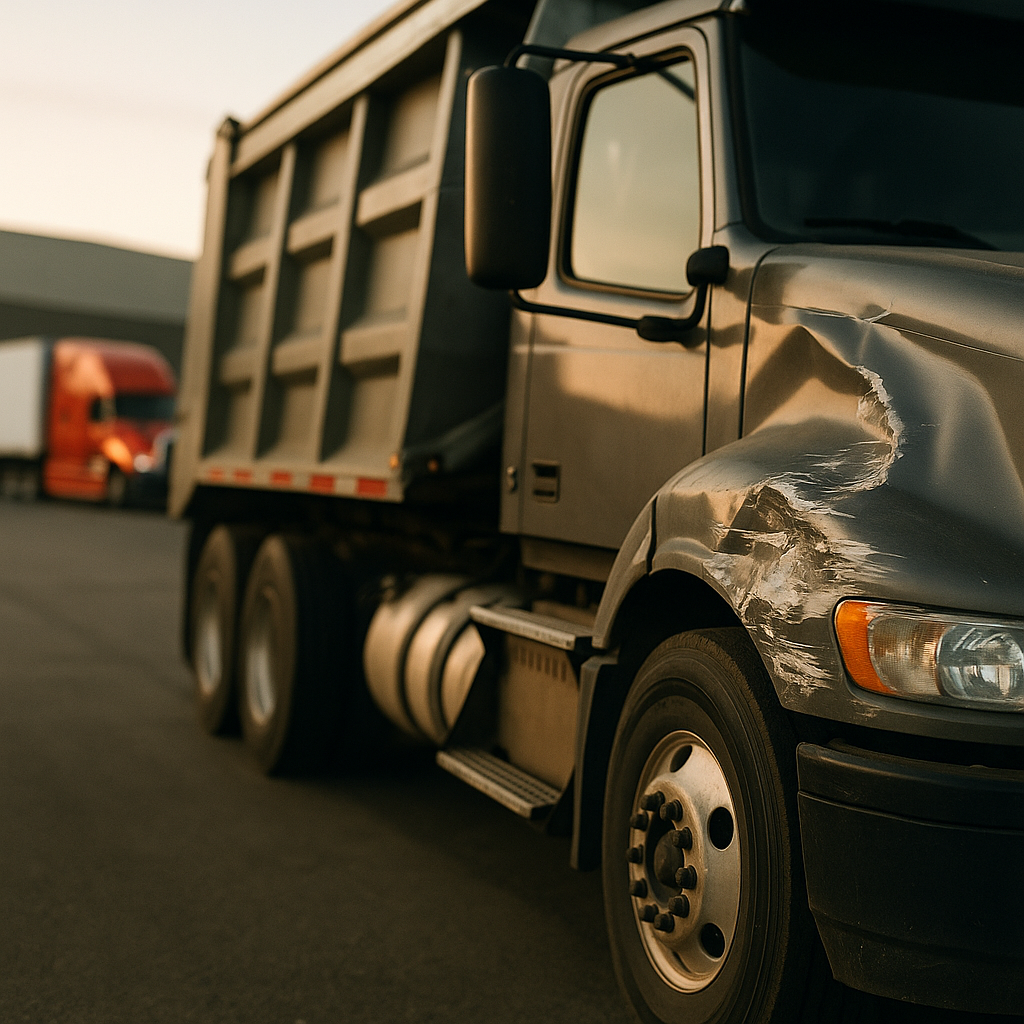
Dump truck physical damage insurance for 2026: collision vs comprehensive, cost drivers, deductibles, add-ons, and buying tips. Get quotes.
Dump truck physical damage insurance is the coverage that helps pay to repair or replace your truck after a covered collision or comprehensive loss—so one rollover, loader bump, or hailstorm doesn’t turn into a $15,000–$60,000 cash-flow crisis plus weeks of downtime.
If you want the full coverage checklist beyond physical damage, start here: Commercial Dump Truck Insurance: 2026 Costs + 7 Coverages.
Featured snippet answer (50–60 words):
Dump truck physical damage insurance pays to repair or replace your truck when it’s damaged by collision (wrecks, rollovers, backing accidents) or comprehensive/other-than-collision (theft, fire, hail, vandalism, falling objects). It typically does not cover wear and tear, mechanical breakdown, or routine maintenance—and custom equipment may need to be scheduled.
Key Takeaways:
- Physical damage protects your dump truck asset (not the other guy’s car, not the load, not the jobsite).
- For dump operations, collision is usually the expensive part; comprehensive is often cheaper but higher-frequency (glass, theft, weather).
- Your deductible should match your cash reserves—if you can’t write that check tomorrow, it’s too high.
- Financed/leased trucks are often contract-required to carry physical damage even when it’s not a legal filing requirement.
Table of Contents
Reading time: 8 minutes
- What Is Dump Truck Physical Damage Insurance (and who actually needs it)?
- What Physical Damage Covers for Dump Trucks (Collision vs. Comprehensive)
- Dump Truck Physical Damage Insurance Cost in 2026 (What really drives the price)
- Deductibles, Add-Ons, and “Is It Required?” (How to protect cash flow)
- Real-World Claim Scenario + Buying Checklist (avoid the denial surprises)
- Frequently Asked Questions
- Conclusion: Buy Physical Damage Like a Business Owner (Not Just a Price Shopper)
What Is Dump Truck Physical Damage Insurance (and who actually needs it)?
Dump truck physical damage insurance is a commercial auto coverage that helps pay to repair or replace your dump truck after a covered loss, using collision and/or comprehensive coverage and applying your deductible and valuation terms (often ACV).
Physical damage is part of commercial auto (what most owners loosely call commercial truck insurance), and it’s separate from liability.
- Liability = pays for other people’s injuries/property damage when you’re at fault.
- Physical damage = pays for your truck (your unit) when it’s damaged.
If you want a quick primer on how physical damage fits inside a full commercial truck insurance setup (including filings and common limits), see this commercial truck insurance basics overview.
Physical damage vs. liability (quick distinction)
- What it is: Protection for your unit—think “repair/replace my dump truck.”
- Why it’s essential: A single loss can wipe out months of profit and crush cash flow.
- Who needs it: Anyone who can’t comfortably self-insure the truck value.
Cash-owned vs. financed/leased dump trucks
- What it is: The “required vs optional” reality.
- Why it’s essential: Lenders and lessors usually require physical damage and will want the lienholder listed.
- Who needs it:
- Financed/leased: Usually required by contract.
- Cash-owned: Still often smart—dump trucks run in higher-risk environments than many over-the-road lanes.
Pro tip: If you’re comparing this to semi truck insurance or hotshot insurance, remember: dump trucks spend more time around equipment, uneven ground, and tight backing—your physical damage risk profile is just different.
The “5 options” you can actually choose (what to ask for on quotes)
Most dump truck physical damage decisions come down to five quote-level choices you can control or verify before binding.
- Option 1: Collision (impact/rollover/backing losses)
- Option 2: Comprehensive (theft, fire, hail, vandalism, falling objects)
- Option 3: Deductibles (collision vs comprehensive can be different)
- Option 4: Custom equipment scheduling (dump bed, PTO/hydraulics, tarps, toolboxes)
- Option 5: Add-ons (downtime/rental reimbursement, towing & labor, GAP on financed units)

What Physical Damage Covers for Dump Trucks (Collision vs. Comprehensive)
Physical damage coverage for dump trucks is typically split into collision coverage for impact/rollover losses and comprehensive (other-than-collision) coverage for theft, fire, hail, vandalism, and falling objects.
The peril concepts align with common insurance definitions (NAIC consumer overview is a helpful baseline for terminology: https://content.naic.org/consumer/auto-insurance).
For a deeper policy-form breakdown (ACV, endorsements, settlements), use this reference: how physical damage coverage works for trucks.
Collision coverage (dump-truck-specific examples)
- What it is: Damage from impact—whether you hit something or something hits you.
- Why it’s essential: Dump trucks see severe losses: rollovers, jobsite backing accidents, tight turns.
- Who needs it: Any operator running active job sites, quarries, paving, demo, or tight urban work.
Common real-world collision claims:
- Rollover on an uneven grade at a job site
- Backing into a loader bucket, pole, or concrete barrier
- Sliding into a berm or gate at a quarry entrance
- Bridge/overpass strike (yes, it still happens)
Comprehensive (other-than-collision) coverage (high-frequency perils)
- What it is: Non-collision losses—weather, theft, fire, vandalism, falling objects.
- Why it’s essential: These are the “truck was parked / truck wasn’t moving” losses that still wreck your month.
- Who needs it: Anyone parking outdoors, running seasonal work, or leaving units at jobsites/yards.
Common dump-truck comprehensive claims:
- Theft/vandalism at a yard
- Hail/wind damage (especially parked units)
- Fire
- Falling objects / flying debris cracking glass
Covered vs. not covered (quick table)
| Scenario | Typically Covered by Physical Damage? | Notes |
|---|---|---|
| Rollover, at-fault wreck, backing accident | Yes (Collision) | Deductible applies |
| Theft, fire, hail, vandalism | Yes (Comprehensive) | Deductible applies |
| Windshield/glass damage | Often (Comprehensive) | Rules vary by carrier/state |
| Worn hydraulic pump, blown turbo from age | No | Wear/tear & mechanical breakdown |
| Rust/corrosion, gradual damage | No | Maintenance issue |
| Aftermarket bed/tarp/PTO/hydraulics | “Maybe” | Often needs custom equipment scheduling |
Pro tip: Claims get messy when the insurer says “that’s mechanical breakdown” and the operator says “no, it happened because of an impact.” Photos, repair notes, and a clean statement matter.
Dump Truck Physical Damage Insurance Cost in 2026 (What really drives the price)
In 2026, dump truck physical damage insurance cost is driven mainly by the truck’s value (often ACV), collision and comprehensive deductibles, garaging ZIP/territory, jobsite exposure, and loss history—so there isn’t a single honest flat rate.
For a deeper underwriting breakdown, use: what affects truck insurance rates.
The biggest pricing variables (in plain English)
What it is: How carriers price physical damage.
Why it’s essential: If you understand the levers, you can usually find more affordable trucking insurance without gutting coverage.
Who needs it: Everyone—especially new ventures, new authorities, and anyone with a financed unit.
Most important inputs:
- Truck value (ACV/stated value/agreed value if available)
- Collision deductible vs comprehensive deductible
- Garaging ZIP/territory (storm, theft, traffic density)
- Jobsite/off-road exposure (quarry, soft ground, equipment interaction)
- Loss history (loss runs) and driver MVRs
- Model year/repairability (parts cost + shop availability)
Collision vs. comprehensive: which costs more?
In dump operations, collision is usually the heavier premium because severity is high (rollovers, heavy impacts, frame/axle damage). Comprehensive can still sting in hail/theft territories, but it’s often the “smaller” half of physical damage pricing.
Quick estimator (directional — copy/paste)
Use this to sanity-check quotes and ask better questions (not to replace underwriting):
DUMP TRUCK PHYSICAL DAMAGE ESTIMATOR (directional)

1) Truck ACV/stated value: $__________
2) Collision deductible: $__________
3) Comprehensive deductible: $__________
4) Garaging ZIP: __________
5) Operations: (circle) Road-only / Mixed / Heavy jobsite-quarry
6) Annual miles: _________
7) Custom equipment value to schedule: $__________
8) Want downtime/rental reimbursement? (yes/no)

Ask agent to show:
- Collision premium: $______/year
- Comprehensive premium: $______/year
- Custom equipment endorsement: included / scheduled / excluded
- Any off-road/jobsite limitations: yes / no (explain)
Pro tip: If an agent can’t clearly separate collision vs comprehensive pricing, you’re not getting a clean comparison.
Deductibles, Add-Ons, and “Is It Required?” (How to protect cash flow)
Deductibles and endorsements (like downtime, towing & labor, and scheduled equipment) control how much you pay out-of-pocket per claim and how quickly you can keep working, which is why they often matter more than a small premium difference.
For more premium-control tactics beyond deductibles, see: how to save on truck insurance.
Deductible planning (the “write the check tomorrow” rule)
What it is: Your out-of-pocket per claim.
Why it’s essential: A low premium with a deductible you can’t fund is fake savings.
Who needs it: Anyone without a dedicated maintenance/claims reserve.
A practical approach many dump operators use:
- Lower comprehensive deductible (glass/theft/weather claims happen)
- Higher collision deductible (fewer claims, but bigger hits)
Pro tip: If you run slim reserves, don’t “self-insure by accident” with a $10,000 deductible while still paying premium.
Add-ons that matter for dump trucks
Consider asking for these endorsements/options (availability varies by carrier):
- Downtime / rental reimbursement / substitute transportation
Helps keep revenue moving when the truck is in the shop (often daily limit + max days). - Custom equipment / permanently attached gear
Dump bed, hydraulics/PTO, tarping system, toolboxes, cameras, strobes—get values listed. - Towing & labor / roadside
Heavy tow bills can be brutal. Confirm limits that match reality. - GAP coverage (financed trucks)
If the ACV settlement is less than the loan payoff after a total loss, GAP can prevent you from writing a painful check.
Is physical damage “required”?
Legally required? Usually, no—most legal/filing requirements focus on liability, not physical damage. FMCSA insurance filing requirements are focused on liability filings for interstate carriers: https://www.fmcsa.dot.gov/registration/insurance-filing-requirements.
Contract-required? Often, yes if:
- You’re financed or leased (lienholder requirements)
- A contract partner insists on certain coverages (varies)
Real-World Claim Scenario + Buying Checklist (avoid the denial surprises)
Claim outcomes on dump trucks often come down to whether the damage is documented as a collision loss versus mechanical breakdown and whether custom equipment was properly listed or scheduled before the loss.
Scenario: jobsite rollover
You’re on a soft shoulder, bed up, the ground gives, and the truck tips.
- Collision typically handles the truck damage (minus deductible).
- If you added downtime/rental reimbursement, it may help you stay afloat while the unit is down.
- If your bed/tarp/hydraulics weren’t properly scheduled as custom equipment, you may find out the hard way what’s limited.
Counter-scenario: hydraulic failure from wear
A pump fails after years of use and takes out other components. That’s commonly treated as mechanical breakdown / wear and tear—not physical damage.
Buying checklist (use this when you shop quotes)
Before you bind:
- Confirm collision vs comprehensive deductibles (separately)
- Confirm the valuation method (ACV vs agreed value, if offered)
- List lienholder correctly (if financed)
- Disclose jobsite/off-road/quarry exposure honestly
- Schedule custom equipment with dollar amounts
- Ask how glass is handled in your state/territory
- Get the “what’s excluded” explanation in writing (email is fine)
Frequently Asked Questions
Physical damage coverage is generally optional by law (liability is the common legal requirement), but lenders and contracts often require physical damage, and the core coverages are collision and comprehensive.
Physical damage insurance generally covers the dump truck itself for collision losses (wrecks, backing accidents, rollovers) and comprehensive/other-than-collision losses (theft, fire, hail, vandalism, falling objects), subject to your deductible and policy terms. It usually excludes wear and tear, rust/corrosion, and mechanical breakdown. If you’ve got high-dollar permanently attached gear—like a dump bed, tarping system, PTO/hydraulics, toolboxes, or cameras—ask whether it’s included automatically or needs to be scheduled as custom equipment with a stated dollar amount.
Physical damage coverage is usually not required as a government filing the way liability is, because FMCSA insurance filing requirements focus on liability filings for interstate carriers (see FMCSA insurance filing requirements). However, if the truck is financed or leased, physical damage is commonly required by your lender/lessor contract, and the lienholder typically must be listed on the policy. Even on a cash-owned unit, many dump operators carry physical damage because jobsite and equipment exposure can create high-severity losses.
Physical damage cost depends mainly on the truck’s value (often ACV), your collision and comprehensive deductibles, garaging ZIP/territory, jobsite/off-road exposure (quarry, soft ground, equipment interaction), and loss history. For many dump operations, collision prices higher than comprehensive because rollover and impact losses can be severe. The best way to pin down your number is to compare multiple quotes and ask for the collision and comprehensive premiums to be shown separately so you’re comparing apples to apples.
If you want a concrete state example to cross-check common coverages and what’s typically required, start with this Texas dump truck insurance guide and then verify your own state’s DOT/DMV requirements. State rules can affect registration, proof-of-insurance expectations, and jobsite contracting requirements, even though physical damage itself is usually a financial decision or a contract requirement rather than a government filing.
Conclusion: Buy Physical Damage Like a Business Owner (Not Just a Price Shopper)
Dump truck physical damage insurance protects the revenue-producing asset that keeps your operation alive by covering repair or replacement after covered collision and comprehensive losses, and the right deductibles and equipment scheduling prevent ugly claim surprises.
In 2026, the operators who win aren’t just chasing the cheapest premium—they’re matching collision vs comprehensive, setting deductibles they can actually fund, and scheduling equipment so a claim doesn’t turn into a denial.
If you want to tighten up the rest of your coverage stack (the stuff physical damage doesn’t handle), here’s related reading:
Key Takeaways:
- Ask quotes to show collision and comprehensive separately so you can compare pricing clearly.
- Pick deductibles you can fund immediately (especially after a big collision loss).
- Schedule custom equipment values in writing so attached gear isn’t underinsured.
When you’re ready to shop, get quotes that show collision and comprehensive separately, confirm equipment values in writing, and make sure your policy matches how you actually work.





