
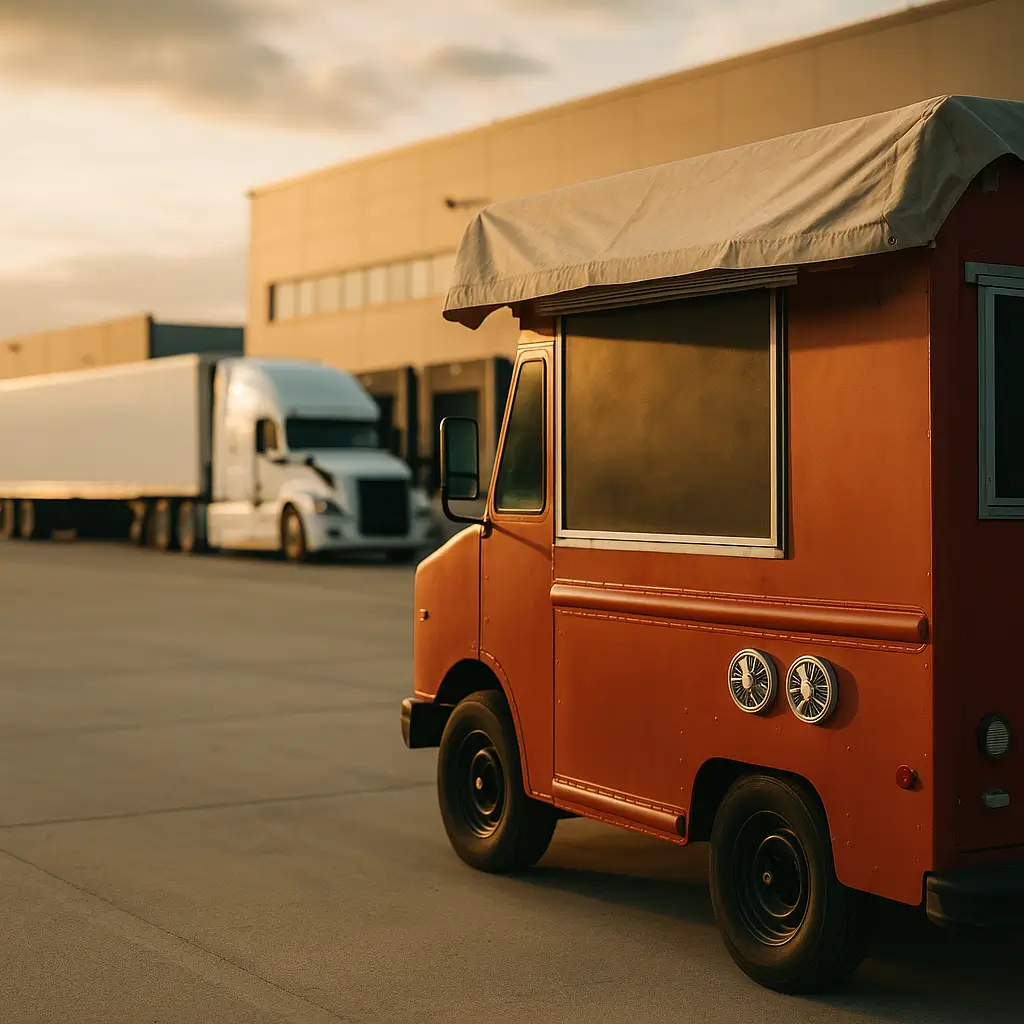

See 7 food truck insurance policies, typical limits, COI needs, festival checklist, and 2026 annual cost ranges.
Food truck insurance requirements in 2026 usually aren’t one “official” checklist—most operators need a stack of policies (commercial auto + general liability + a few add-ons) to satisfy city permits, commissary agreements, and event contracts.
Running a food truck isn’t just cooking and sales—it’s permits, commissary rules, and vendor agreements that can shut you down fast if you can’t show proof of coverage. If you want the big picture of how policies fit together, start with our guide for mobile vendors before you buy random add-ons.
What insurance does a food truck need (most common list)?
- Commercial auto (to drive/operate the truck)
- General liability (often required for permits/events)
- Product liability (foodborne illness/allergen claims)
- Workers’ comp (if you have employees; rules vary by state)
- Property/inland marine (equipment, tools, inventory)
- Optional add-ons: liquor liability, hired/non-owned auto, cyber
This guide separates what’s required by law vs required by contract, shows typical limit requests, includes a COI copy/paste template, and shares realistic 2026 cost ranges.
Table of Contents
Reading time: 9 minutes
- Key Takeaways (Save This Before You Call for Quotes)
- What “Insurance Requirements” Really Means (Law vs Contract vs Survival)
- The 7 Most Common Food Truck Insurance Requirements (With Typical Limits)
- Festival & Event Insurance Requirements (Get Approved Without Chaos)
- Certificate of Insurance (COI) Request Template + Timeline
- How Much Does Food Truck Insurance Cost in 2026?
- Frequently Asked Questions
- Conclusion

Key Takeaways (Save This Before You Call for Quotes)
Most food truck insurance “requirements” are set by contracts and permits—not a single nationwide law—and many events commonly request $1,000,000 per occurrence / $2,000,000 aggregate general liability plus COI endorsements.
- “Requirements” usually means city/event/landlord contract rules, not just state law—read the permit packet and vendor agreement line-by-line.
- Expect many festivals to ask for $1M/$2M general liability plus Additional Insured wording on the COI.
- Your biggest premium drivers are vehicle value + driving record + payroll + late-night/high-traffic ops + cooking/fire exposure.
- If you wait until the week of an event to request endorsements, you’re gambling—build a 7–14 day COI buffer into your process.
What “Insurance Requirements” Really Means for Food Trucks (Law vs Contract vs Survival)
Food truck insurance requirements come from (1) state law, (2) contracts/leases, and (3) your actual risk, and those three buckets often demand different coverages and limits.
Most owners hear “requirements” and assume there’s one universal checklist. In reality, you’re dealing with three buckets:
1) Required by law (varies by state)
- Auto financial responsibility is usually the #1 legal trigger because the truck is a vehicle on public roads.
- Workers’ compensation is commonly required once you have employees, but the exact triggers and exemptions vary by state.
2) Required by contract (the real gatekeepers)
Even if you’re technically “legal,” you can still be blocked from operating by city/county permits, commissary agreements, landlords, festivals, breweries, markets, corporate catering clients, and lenders/lessors.
If you want the clean framework, review insurance requirements: required by law vs required by contract so you don’t waste money chasing the wrong “requirement.”
3) Required by your risk profile (business survival)
A food truck is a rolling kitchen, so your most common loss scenarios include slip-and-falls at the service window, burn injuries, fire/suppression issues, theft of POS/generators/tools, foodborne illness or allergen allegations, and downtime that crushes cash flow.
Authority note: The U.S. Small Business Administration notes that insurance needs often come from laws, contracts, and leases—not just one statute—so you have to match coverage to your situation. Source: U.S. Small Business Administration – Get business insurance
The 7 Most Common Food Truck Insurance Requirements (With Typical Limits)
The most common food truck insurance requirements include commercial auto and general liability, with many contracts frequently requesting $1M/$2M liability limits and COI endorsements like Additional Insured.
| Coverage | Who commonly requires it | What it protects | Typical limit requests (examples) |
|---|---|---|---|
| Commercial auto | State law, lenders, venues | Auto liability + (optional) physical damage | State minimum varies; contracts may require higher |
| General liability | Cities, festivals, landlords | Third-party injury/property damage | $1M per occurrence / $2M aggregate (common request) |
| Product liability | Events, corporate clients | Foodborne illness/allergen allegations | Often bundled with GL; confirm forms/endorsements |
| Workers’ comp | State law; some events | Employee injuries (medical + wage benefits) | State-regulated; contracts may demand proof or exemption |
| Property / inland marine | Lenders/lessors (sometimes) | Equipment, tools, inventory | Based on equipment value (schedule key items) |
| Liquor liability | Breweries, private events | Alcohol-related liability | Varies; contract-driven |
| Hired & non-owned auto (HNOA) | Corporate clients (sometimes) | Business liability from personal/rented auto use | Often $1M (commonly requested), but varies |
1) Commercial Auto Insurance (almost always required)
Commercial auto insurance covers liability while driving the truck and typically offers options for physical damage (comprehensive/collision) that lenders often require on financed units.
State minimum liability limits vary — check the Insurance Information Institute’s state-by-state guide for your state’s floor, then confirm whether your contracts require higher limits.
Personal auto policies commonly exclude commercial use, and they’re not built for a rolling kitchen exposure story. If your operation starts looking more like “commercial truck insurance”—towing a trailer, running multiple units, or doing long-distance catering—your rating and underwriting questions can change even though it’s still commercial auto.
For a deeper breakdown of what’s covered and how limits work, see commercial auto insurance (food truck = commercial vehicle).
For a detailed breakdown of how food truck auto insurance is rated and what physical damage options look like, see our auto-specific guide.
Not sure how commercial auto and general liability work together? This video breaks down the difference:
2) General Liability (often required by cities, venues, landlords)
General liability insurance pays for third-party bodily injury and property damage claims (for example, a customer trip-and-fall at the service window or accidental damage to a venue’s property).
Typical limit request (common pattern, not universal): $1,000,000 per occurrence and $2,000,000 aggregate.
Watch-out: GL often includes products-completed operations, but don’t assume that automatically equals strong foodborne illness/allergen protection—confirm how product liability is handled in your policy forms.
For food-truck-specific limits, exclusions, and how GL pairs with product liability, see our food truck liability insurance guide.
3) Product Liability / Foodborne Illness (sometimes required; always smart)
Product liability insurance responds to allegations that your food caused injury or illness, including foodborne illness and allergen claims, and it’s commonly required by events and corporate catering clients.
The CDC tracks the public health burden of foodborne illness, which is why venues and insurers treat this as a real exposure category. Source: CDC – Burden of Foodborne Illness
- Underwriting-friendly habits: temp logs, allergen callouts, labeled containers, and documented staff training.
- Operational payoff: fewer claims, fewer contract disputes, and fewer “we need a revised COI” headaches.
4) Workers’ Compensation (if you have employees—state rules vary)
Workers’ compensation insurance is regulated at the state level and typically becomes mandatory once you meet your state’s employee trigger, paying medical and wage benefits for work-related injuries.
Authority note: Requirements and exemptions vary by state. Source: U.S. Department of Labor – Workers’ Compensation
Pro tip: Even if your state allows an exemption, some venues still demand proof of workers’ comp or an exemption letter before they let you set up.
5) Property / Inland Marine (equipment, tools, inventory)
Inland marine/property coverage protects the movable equipment that makes you money—grills, fryers, hood components, generators, POS tablets, signage, and smallwares—often based on scheduled values.
Theft and fire don’t care that your equipment is “bolted down,” and some items won’t be covered properly unless they’re listed (scheduled) or endorsed correctly.
6) Liquor Liability (if you serve alcohol)
Liquor liability insurance covers alcohol-related liability when you sell or serve alcohol, and it’s frequently a strict contract requirement for brewery events and private catering.
If alcohol is part of the gig, expect tighter contract wording and less tolerance for “we’ll add it later.”
7) Hired & Non-Owned Auto (often missed)
Hired and non-owned auto (HNOA) covers your business liability if employees use personal or rented vehicles for business errands like supply runs or catering drop-offs.
This is the coverage that saves you when the claimant’s attorney names the business—because “it happened on the clock.”
Festival & Event Insurance Requirements (and How to Get Approved Without Last-Minute Chaos)
Festival and event insurance requirements for food trucks usually center on a COI showing general liability (often $1M/$2M), correct certificate holder details, and endorsements like Additional Insured.
Common event baseline: Many food truck vendor agreements request $1 million per occurrence and $2 million aggregate in general liability. The contract and permit packet control the actual required limits and endorsements.
Festivals and big venues are the gatekeepers: no paperwork, no entry.
Common festival checklist (what they usually ask for)
- General liability (often $1M / $2M)
- Product liability included or clearly shown
- Commercial auto proof (sometimes a separate COI)
- Workers’ comp proof if you have staff onsite
- A COI listing the venue/city as certificate holder
- Additional Insured wording (often required)
- Sometimes: waiver of subrogation, primary & non-contributory (endorsements)
Plain-English on the contract language
- Additional Insured: Adds the venue/city as protected under your policy for certain claims tied to your operations.
- Waiver of Subrogation: Your insurer agrees not to pursue the venue for recovery in certain scenarios.
- Primary & Non-Contributory: Your policy pays first (before theirs) for covered claims.
One-day / short-term coverage (when it works and when it doesn’t)
Some pop-ups accept short-term event policies; others require an annual policy with endorsements. The bigger problem is often timing: endorsements can take days, and events reject sloppy COIs.
To avoid rework, reference this certificate of insurance (COI) guide before you submit anything.
Certificate of Insurance (COI) Request Template + Submission Timeline (Copy/Paste)
A Certificate of Insurance (COI) is the standard proof-of-coverage document vendors submit to cities and events, and a realistic best practice is to request COIs 7–14 days in advance when endorsements are required.
A COI is the document you’ll be asked for over and over, so treat it like an SOP.
COI submission timeline (simple rule that prevents headaches)
- 7–14 days ahead: Best practice if endorsements are needed (Additional Insured, waiver, primary/non-contributory)
- 24–72 hours: Sometimes possible for simple COIs, but don’t count on it during busy seasons
- Build time for corrections (wrong entity name/address is a top rejection cause)
COI request checklist (collect these 6 items)
- 1) Certificate holder’s exact legal name
- 2) Mailing address (not just an email)
- 3) Event dates + setup/teardown window
- 4) Required coverages + limits (GL, auto, workers’ comp)
- 5) Required wording (Additional Insured, waiver, primary/non-contributory)
- 6) Delivery instructions (where to send it + deadline)
Copy/paste email template (send to your agent/carrier)
Subject: COI Request for [Event Name] — [Event Date]
Hello,
Please issue a Certificate of Insurance for my food truck business with the following details:
- Certificate Holder (exact legal name): [NAME]
- Address: [ADDRESS]
- Event / Location: [EVENT + ADDRESS]
- Dates (include setup/teardown if required): [DATES/TIMES]
- Required coverages/limits: [GL limits], [Auto limits], [WC if applicable]
- Endorsements requested (if required): Additional Insured / Waiver of Subrogation / Primary & Non-Contributory
- Special instructions: Please confirm the Additional Insured is added by endorsement (not only shown on the COI).
Thank you,
[Your Name]
[Business Name]
[Phone]
If you’ve never sent a COI before, watch this quick walkthrough before you email your agent:
How Much Does Food Truck Insurance Cost in 2026? (Realistic Ranges + How to Keep It Affordable)
Food truck insurance cost in 2026 is commonly estimated at $2,000 to $8,000 per year for many single-truck operators, but pricing can be higher based on vehicle value, payroll, limits, and cooking/fire exposure.
For a full breakdown by coverage type and operator profile, see our dedicated food truck insurance cost guide.
You’ll see wild numbers online because people compare different businesses (different truck values, payroll, alcohol exposure, and limits). For many single-truck operators, a rough annual range for a basic-to-solid package is often:
- $2,000 to $8,000 per year (broad estimate; your operation can be higher)
Three sample “packages” (how the stack changes cost)
- Lean / local ops: Commercial auto + general liability (basic limits), minimal payroll
- Standard / steady event work: Auto + GL + product liability + equipment coverage + workers’ comp if you have staff
- Event-heavy / higher contract limits: Higher GL limits, more endorsements, liquor liability, more payroll, more COIs
Before choosing your coverage limits, watch this:
What drives price the most (the underwriter’s reality)
- Vehicle value, garaging location, driving record
- Revenue and foot traffic exposure
- Payroll/headcount (workers’ comp)
- Cooking method risk (open flame, hot oil), generator/propane controls
- Late-night operations and high-density events
- Claims history and any lapse in coverage
How to lower premium without getting underinsured
There’s “cheap” and there’s “affordable,” and affordable means you can actually collect when a claim happens.
Fire safety controls and documented maintenance matter for a mobile kitchen. NFPA 96 sets fire-safety requirements for commercial cooking operations, and the NFPA food truck safety guidance covers food-truck-specific risks.
Use how to lower business insurance costs without getting underinsured, then focus on improvements insurers actually care about:
- Fire suppression inspection logs
- Propane handling procedures
- Slip-resistant mats and clear customer flow
- Documented staff training (burns, cleaning chemicals, allergen process)
- Clean loss runs (avoid small nuisance claims when possible)
Frequently Asked Questions
A food truck most commonly needs commercial auto and general liability, and many operators also add product liability, equipment (inland marine/property), and workers’ comp if they have employees. Many festivals and venues commonly require $1,000,000 per occurrence / $2,000,000 aggregate general liability and a COI listing the event as certificate holder with Additional Insured by endorsement. The exact “required” list depends on your state rules, your city permit packet, and your contracts, so separate what’s required by law from what’s required by contract before buying coverage.
Commercial auto insurance is generally required if your food truck is driven for business on public roads because state auto financial responsibility laws apply and personal auto policies commonly exclude commercial use. State minimum liability limits vary, but contracts (corporate catering, large venues) may require higher limits than the state minimum. If your truck is financed or leased, the lender frequently requires physical damage coverage (comprehensive and collision) to protect the vehicle value. For a deeper breakdown of coverages and underwriting expectations, see commercial auto insurance (food truck = commercial vehicle).
Food trucks often need workers’ compensation once they have employees, but the trigger, exemptions, and owner-election rules vary by state because workers’ comp is regulated at the state level. Even when a state exemption is available, many venues still require proof of workers’ comp or a formal exemption letter before they’ll approve your vendor application. The official overview is published by the U.S. Department of Labor here: https://www.dol.gov/general/topic/workcomp. If you staff events, plan ahead—contract requests for workers’ comp documentation can appear with little notice.
Standard commercial auto and general liability policies usually do not cover your equipment, tools, and inventory for theft or fire — that is what inland marine, equipment coverage, or property coverage is for. Items such as generators, POS tablets, hood systems, fryers, and smallwares may need to be scheduled to be protected, especially because they are movable and not permanently attached. Review what is actually scheduled versus what is only assumed to be covered.
Many festivals commonly require $1,000,000 general liability per occurrence and $2,000,000 aggregate, plus a COI that lists the festival, city, or venue as the certificate holder and includes Additional Insured wording. Larger venues may also request endorsements such as waiver of subrogation and primary & non-contributory, and some will ask for separate proof of commercial auto and workers’ comp. Requirements can change event to event, so treat the vendor agreement as the real checklist and build a 7–14 day buffer for endorsements and COI corrections.
A lapse in coverage can put a venue contract, city permit, and insurance pricing at risk. If a policy cancels mid-term, many vendor agreements require notice to the venue and may allow the contract to be canceled. Even a short lapse can narrow options or increase premiums at renewal. Set up reminders well before renewal and address any lapse notice promptly.
Some insurers offer short-term or event-specific policies, but not every venue accepts them. Larger festivals may require an annual policy with endorsements rather than a one-day certificate. Short-term coverage can work for some smaller events, but confirm the venue’s rules first and allow time for a clean COI to be issued.
Product liability insurance isn’t always required by law for every food truck, but it’s frequently required by events, commissaries, and corporate catering clients and is strongly recommended for any business serving food to the public. It helps protect you when someone alleges your food caused illness or an allergen injury, which can trigger medical costs, legal defense, and settlement exposure. The risk category is serious enough that the CDC tracks the burden of foodborne illness here: https://www.cdc.gov/foodborneburden/index.html. Many GL policies include products-completed operations, but you should confirm how foodborne illness is treated in your policy forms.
A COI (Certificate of Insurance) is a proof-of-coverage document issued by your agent or carrier that shows your policy types, limits, and effective dates for a city, venue, or event. To get a COI approved, you typically need the certificate holder’s exact legal name, mailing address, event dates (including setup/teardown), and required limits (often $1M/$2M GL), plus any required endorsements like Additional Insured. If endorsements are required, request the COI 7–14 days ahead so there’s time for endorsement processing and corrections. For a full walkthrough, see the certificate of insurance (COI) guide.
When a venue or city asks to be listed as Additional Insured, they are asking to be added to your policy so certain claims tied to your operations at their event are covered under your liability policy — not just their own. It is not just a label on the COI: it typically requires an endorsement on the actual policy. If the venue asks for Additional Insured by endorsement, confirm with your agent that the endorsement has been issued, not merely noted on the certificate.
You usually can’t rely on personal auto insurance for a food truck because many personal policies exclude commercial use and aren’t designed for a business vehicle that generates revenue. If the truck is insured on the wrong policy type, a claim can be denied and a contract can be voided because you can’t provide acceptable proof of commercial coverage. Food trucks also have unique exposures—equipment value, generator/propane setups, and frequent stop-and-go driving—that belong in a commercial auto underwriting conversation. Ask your agent to confirm (in writing) that the vehicle is rated for business use and that required liability and physical damage coverages match your lender and venue requirements.
It depends on how the trailer is owned and used. If you pull a food trailer with a personally owned pickup, the trailer may not be covered under the commercial auto policy for the truck; a separate trailer endorsement or other coverage may be needed. If the trailer is owned by the business, it typically needs to be listed on the policy. Ask your agent whether the trailer is scheduled and rated correctly for who owns and tows it.
To get a food truck insurance quote quickly, you typically need your VIN, truck value, garaging address, driver info (including MVR details), estimated annual revenue, payroll/headcount, service area, and an equipment list (generator, POS, hood system, suppression system, etc.). Underwriters also often ask about cooking methods (open flame/hot oil), late-night operations, alcohol service, and event frequency because those factors affect loss severity and contract-driven limits like $1M/$2M GL. If you want to reduce back-and-forth, use this commercial insurance quote checklist (what you need to get rated fast) and submit it with your first email. If you want to compare options before you call, see our review of the top food truck insurance companies for 2026.
Conclusion: Build a Simple Process for Food Truck Insurance Requirements
Food truck insurance requirements come from three places—state law, local permits, and contracts—and the fastest way to lose revenue is a COI mistake or a missing endorsement right before an event.
Build a repeatable process, request COIs early, and re-check coverage every time you add staff, expand cities, or start serving alcohol.
Key Takeaways:
- Separate law vs contract: The vendor agreement often sets stricter requirements than state minimums.
- Plan for endorsements: Request COIs 7–14 days early when Additional Insured or waiver language is required.
- Expect common limits: Many events commonly ask for $1M/$2M general liability plus proof of auto (and workers’ comp if staffed).
If you want to tighten up the foundation, review what venues mean by general liability insurance limits and, if you’re hiring help, confirm rules with workers’ compensation insurance overview.
If you’re putting together your food truck insurance stack — or trying to get a COI ready for an upcoming event — LogRock can review your coverage needs, explain your options, and get you a quote based on your operation. Talk to our team before the paperwork becomes the bottleneck.
Talk to LogRock and Request a Quote




