
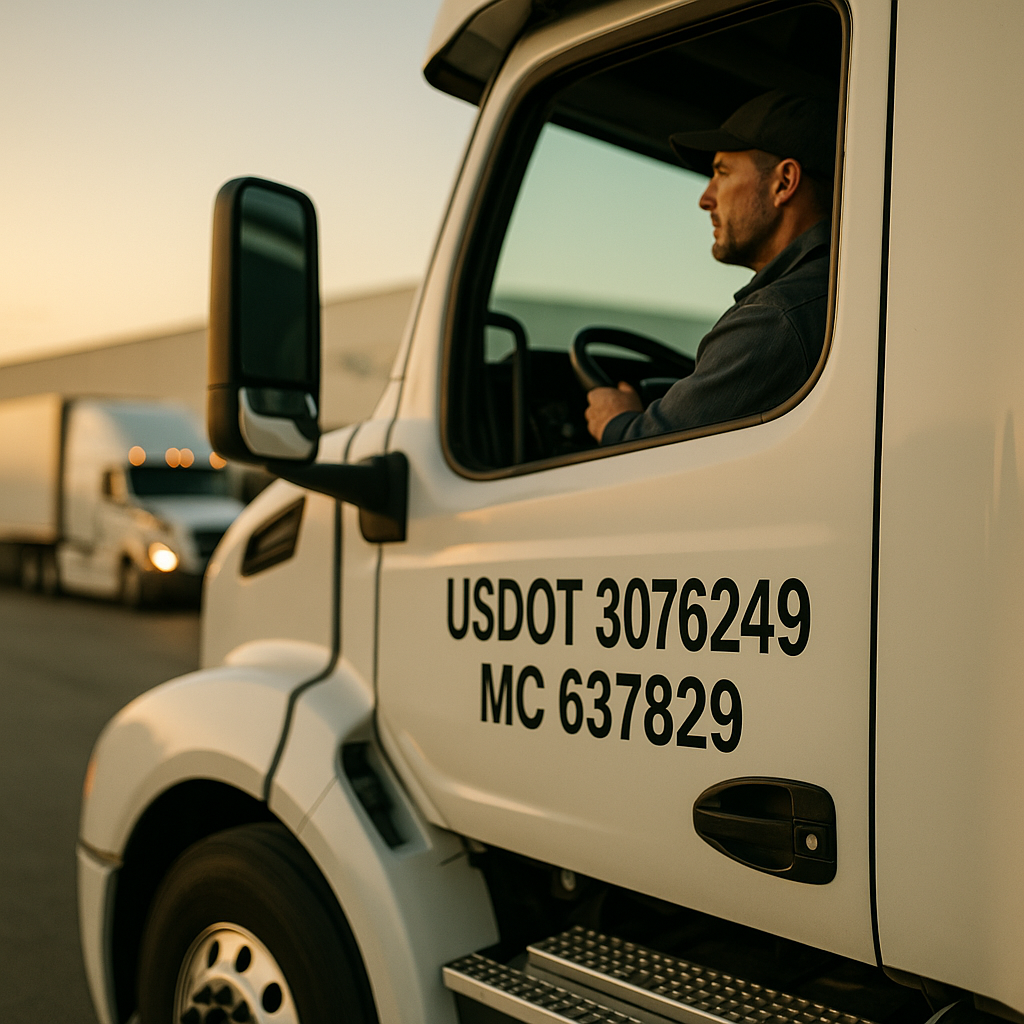
How to get a USDOT and MC number in 7 steps: URS application, $300 authority fee, BOC-3, and insurance filings—updated for 2026. Use the checklist and apply today.

If you’re searching how to get a usdot and mc number, the practical answer is: register in FMCSA’s Unified Registration System (URS) to get your USDOT number, apply for operating authority (what most people still call the “MC number”), then complete the activation filings—mainly BOC-3 and FMCSA insurance filings.
Most new carriers don’t get stuck on the application—they get stuck after they pay, when they can’t book loads because their authority still isn’t active. Before you submit anything, read this pillar breakdown so you understand the full flow end-to-end: FMCSA authority application overview.
Hero image suggestion: Trucking business owner applying for USDOT and MC operating authority online
Alt text: “Trucking business owner applying for USDOT and MC operating authority online”
Table of Contents
Reading time: 7 minutes
Key Takeaways
USDOT numbers identify carriers for FMCSA safety oversight, while operating authority (often called an “MC number”) is the legal permission to haul for-hire interstate loads when required.
- USDOT is an identifier; “MC” is operating authority: Many for-hire interstate carriers need both.
- Paying the fee isn’t the finish line: Your authority isn’t usable until required filings (especially insurance filings) are accepted by FMCSA.
- Most delays are data mismatches: Your legal name and address must match across FMCSA, insurance, and BOC-3.
- Budget like an owner: The $300 federal fee is only one line item; insurance and compliance costs drive the real spend.
Before You Apply: Do You Need a USDOT Number, Operating Authority (MC), or Both?
FMCSA’s “Getting Started” registration guidance explains that carriers typically obtain a USDOT number first, then apply for operating authority if their operation requires it. You can review FMCSA’s overview here: https://www.fmcsa.dot.gov/registration/getting-started.
What it is (plain English)
- USDOT number: Your carrier ID used for safety and compliance tracking.
- Operating authority (“MC number”): Permission to haul certain freight or passengers for-hire in interstate commerce (depending on your operation type).
Why it’s essential (business reality)
Brokers and shippers check your status before they tender freight. If your authority isn’t active, you can’t legally run those loads, and you’ll burn time, cash flow, and credibility.
Who needs it (quick decision tree)
- Leased on to a motor carrier (running under their authority): You typically operate under the carrier’s operating authority, though you may still have state or business requirements.
- For-hire, interstate (booking loads under your own name): Often USDOT + operating authority.
- Private carrier (hauling your own product), interstate: Often USDOT; operating authority may not apply.
- Intrastate only: State rules can apply even if FMCSA authority doesn’t.
If you want a clean “yes/no” compliance filter before you spend money, use this: DOT compliance requirements checklist.
Image suggestion: Flowchart showing whether you need a USDOT number, MC authority, or both
Alt text: “Flowchart showing whether you need a USDOT number, MC authority, or both”
Pro tip: Don’t guess on “for-hire vs private” or “interstate vs intrastate.” Those choices drive downstream paperwork, and the wrong selection can stall insurance filings later.
Step-by-Step: How to Get a USDOT and MC Number (Operating Authority) in FMCSA’s System
FMCSA confirms that USDOT registration is submitted through the Unified Registration System (URS), which is the federal portal used to collect carrier identity and operation details. FMCSA’s USDOT registration FAQ is here: https://www.fmcsa.dot.gov/faq/how-do-i-register-usdot-number.
This is the “do it without getting stuck” version—what to have ready, what to click, and what usually breaks after you submit.
What you need ready (so you don’t get stuck mid-application)
- Legal business info: exact legal name, DBA (if any), EIN/SSN, physical address (not just a P.O. box), phone, email
- Operation details: for-hire/private, interstate/intrastate, cargo types, equipment types (power-only, dry van, flatbed, reefer, hotshot, etc.)
- Driver details: who is driving, CDL details, and prior DOT history (if any)
- Time: 30–90 minutes to enter info; most delays come from activation filings, not typing
Step 1: Go to the official URS path and create your sign-in
- Use the official FMCSA route into URS.
- Use an email/phone you’ll keep long-term (not a temporary dispatch email).
- Avoid autofill if you’ve moved recently—wrong addresses cause filing rejections later.
If you want a guided walkthrough to follow on a second screen, use: FMCSA URS registration guide.
Step 2: Complete identity verification (and keep it consistent)
Identity verification reduces fraud, but it’s also where many new authorities hit “why am I stuck?” issues when details don’t match.
- Business name doesn’t match EIN/SSN records
- Address formatting differences (Suite vs # vs Unit)
- Someone else’s email/phone used for the account
Rule: The exact legal name and address you submit should be the same legal name and address your insurance agent uses later for filings.
Step 3: Submit the USDOT portion correctly (avoid the usual errors)
Where new carriers mess up is usually the operation classification, not the spelling.
- Operation classification: choosing the wrong for-hire vs private option
- Cargo/equipment: selecting types you don’t actually haul (creates rating and underwriting confusion)
- Plan vs reality: mileage/radius estimates that don’t match what you’re actually going to do
When you submit, save confirmation screens and reference numbers, and screenshot your submitted legal name and address so you can cross-check later.
Step 4: Apply for operating authority (what people still call the “MC number”)
FMCSA’s operating authority application includes a $300 federal fee per authority request and requires you to select the authority type that matches your operation. FMCSA’s overview is here: https://www.fmcsa.dot.gov/registration/get-mc-number-authority-operate.
- Authority type: property vs household goods vs passenger (pick what fits your business model)
- Business identity: the name and address must match your later filings
Reality check: Paying the fee doesn’t mean you can haul tomorrow. Your authority must be activated.

Activation, Costs, and Timeline: What Actually Gets You “Active”
FMCSA will not activate operating authority until required filings are received and accepted—most commonly a BOC-3 process agent filing and the insurer-submitted FMCSA insurance filing—after the $300 application fee is paid.
Step 5: File your BOC-3 (process agent)
BOC-3 is an activation requirement for many operating authorities, and in most cases the process agent company files it for you.
- Match exactly: legal name must match FMCSA character-for-character
- Match exactly: address must match FMCSA character-for-character
- Verify: it’s filed under the correct authority
Step 6: Get the right insurance—and make sure filings are submitted (not just bound)
FMCSA states that insurance filings are required to activate operating authority and those filings are submitted by the insurer (not the carrier) through FMCSA’s insurance filing process. Reference: https://www.fmcsa.dot.gov/registration/insurance-filing-requirements.
This is where new authorities get tripped up:
- You buying a policy ≠ FMCSA receiving the filing
- If the filing is rejected (often due to a mismatch), your authority stays inactive
This is also where selecting the right commercial truck insurance setup matters. Whether you need semi truck insurance for a tractor-trailer, hotshot insurance for a one-ton and trailer, or broader trucking insurance for a small fleet, the policy has to be structured so the correct filings can be submitted and accepted. Start here for a plain-English overview of coverages and why they affect activation: commercial truck insurance basics.
Step 7: Don’t forget the “go-live” items (often missed)
Depending on where and how you operate, you may also need items like UCR, IRP/IFTA, and HVUT before you’re truly launch-ready.
- UCR registration
- IRP/IFTA setup (apportioned plates + fuel tax reporting)
- HVUT (Form 2290), permits, and state-level requirements
- Company vehicle markings (legal name/numbering requirements)
Image suggestion: Checklist of filings needed to activate MC authority: BOC-3 and insurance filing
Alt text: “Checklist of filings needed to activate MC authority: BOC-3 and insurance filing”
Activation checklist (print this)
| Item | Who typically handles it | What can delay you | Your “owner move” |
|---|---|---|---|
| USDOT + Operating authority application | You | Wrong business details, wrong authority type | Screenshot/save your submitted legal name & address |
| BOC-3 filing | Process agent company | Name/address mismatch | Confirm they filed under the exact FMCSA legal name |
| Insurance policy | You + agent | Wrong operation type, wrong garaging, wrong equipment | Be honest about radius/cargo; don’t “cheap it down” inaccurately |
| Insurance filing to FMCSA | Insurance company | Filing rejected, missing endorsement, mismatch | Ask your agent: “When will the filing show as accepted?” |
| Other registrations (UCR/IRP/IFTA/etc.) | You | Waiting until last minute | Build a launch checklist and calendar reminders |
Total cost (realistic budget)
The federal operating authority application fee is $300 per authority request, and that cost is separate from BOC-3 service fees and your insurance premium. FMCSA reference: https://www.fmcsa.dot.gov/registration/get-mc-number-authority-operate.
- $300 FMCSA operating authority fee (federal fee)
- BOC-3 service fee (varies by provider)
- Insurance down payment / initial premium (varies by operation, MVR, equipment, radius, and cargo)
- Compliance/registration costs that fit your operation (UCR, plates, permits, etc.)
If you’re shopping for affordable trucking insurance, make sure “cheap” isn’t cheap for the wrong operation type—misrating can trigger re-quotes, rejected filings, or denied claims.
How long it takes (typical timeline)
- Day 0: Submit application in the FMCSA system
- Next days/weeks: Processing + waiting on BOC-3 and insurance filings
- When filings are accepted: Authority becomes active (don’t haul until you verify)
Common mistakes that delay approval (avoid these)
- Using a DBA on one form and a legal name on another
- Applying as “intrastate” while planning to run interstate loads
- Assuming “I paid, so I’m active”
- Not checking status before hauling your first load
Next Steps: Get Approved Without Delays (and Without Bleeding Cash Flow)
The fastest way to go active is to keep one consistent legal name and address across URS, BOC-3, and insurer filings, then verify your authority shows as active before hauling.
Treat activation like a launch checklist, not an afterthought. Get your business info consistent, confirm filings are accepted, and verify you’re active before you book the first load.
Related reading (recommended)
Frequently Asked Questions
You register for a USDOT number by applying through FMCSA’s Unified Registration System (URS) and submitting your business identity and operation details in the USDOT portion of the application. FMCSA confirms URS is the official pathway for USDOT registration at https://www.fmcsa.dot.gov/faq/how-do-i-register-usdot-number. To avoid delays, enter your legal name and physical address exactly as they appear on your EIN/SSN records, then save your confirmation details. Those same legal details must match later filings (BOC-3 and insurance) or your authority activation can stall.
You get operating authority (often called an “MC number”) by applying through FMCSA, selecting the correct authority type for your operation, and paying the $300 federal application fee per authority request. FMCSA’s operating authority overview is at https://www.fmcsa.dot.gov/registration/get-mc-number-authority-operate. After you apply, you still must complete activation steps—most commonly a BOC-3 process agent filing and insurer-submitted insurance filings—before you can legally haul under your own authority.
Getting an MC number can take days to weeks depending on how quickly FMCSA receives and accepts your activation filings, especially BOC-3 and your insurer’s FMCSA insurance filing. The application itself is often not the slow part; the common delay is “coverage is bound” but the filing hasn’t posted or was rejected due to a legal name/address mismatch. The fastest path is to (1) file BOC-3 immediately, (2) bind the correct policy, and (3) confirm with your agent when the filing shows as accepted.
To activate MC operating authority, you typically need a BOC-3 process agent filing and required insurance filings submitted to FMCSA by your insurer, and those are separate from the $300 federal operating authority fee. FMCSA explains the insurance filing requirement here: https://www.fmcsa.dot.gov/registration/insurance-filing-requirements. BOC-3 service fees vary by provider, and insurance costs vary widely based on equipment, radius, cargo, and driving history. For a plain-English breakdown of BOC-3, read: BOC-3 filing explained.
Conclusion: Get Your USDOT + MC, Then Verify You’re Actually Active
Most for-hire interstate carriers must obtain a USDOT number, apply for operating authority, and then wait to haul until FMCSA shows accepted BOC-3 and insurance filings that activate the authority.
The cleanest way to avoid dead weeks is to keep your legal name and address identical across every filing, then confirm status before you take a load.
Key Takeaways:
- Plan for the $300 operating authority fee, plus BOC-3 and insurance costs.
- Activation depends on accepted filings, not on “I bought a policy.”
- Most delays come from name/address mismatches between URS, BOC-3, and insurance filings.
If you want to go active fast, run this like a launch: one set of business details, one checklist, and one final status verification before you roll.





