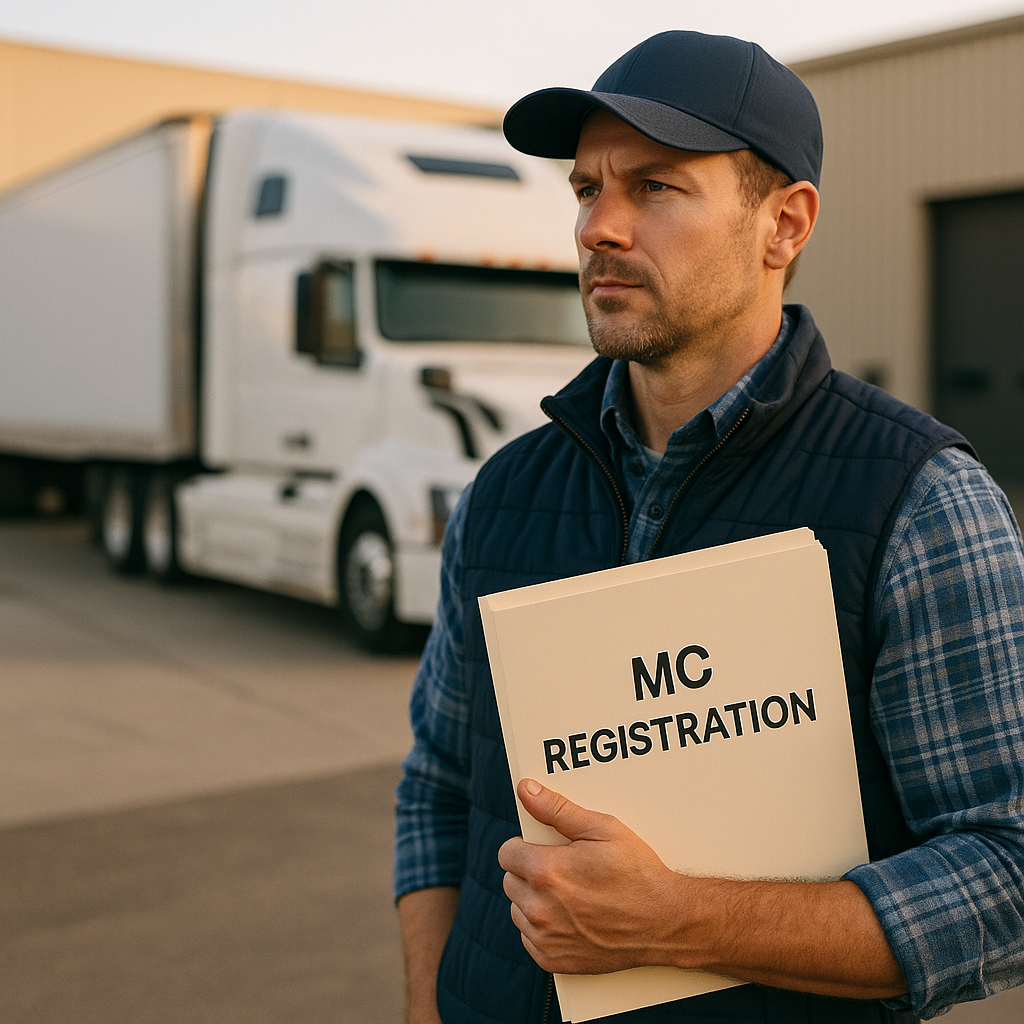
MC registration in 2026 made simple: URS vs Motus timeline, $300 fee, activation steps, and scam-proof checklist. Get compliant fast—start now.

MC registration is still the phrase most drivers use for getting FMCSA operating authority—the legal permission to haul for-hire freight across state lines (or to broker/forward freight). In plain English: you’re not “buying an MC number,” you’re applying for authority, paying the fee, and completing the filings that make your status turn Active.
If you’re trying to go from “I’ve got a truck” to “I can legally book loads,” the fastest way to lose money is confusion—waiting on paperwork, booking under the wrong setup, or paying a fake “registration” site. Start by getting crystal clear on the USDOT vs MC number differences so you don’t pay for something you don’t need.
Table of Contents
Reading time: 8 minutes
What Is MC Registration (and what an “MC Number” really means)?
In 2026, “MC registration” most commonly means applying to the Federal Motor Carrier Safety Administration (FMCSA) for interstate for-hire operating authority, which has a $300 FMCSA fee per operating authority.
You’ll still hear “MC number” in broker packets and onboarding calls because the market’s language hasn’t fully caught up. What matters is that your authority is the right type for your operation and shows as Active in FMCSA systems.
MC registration = operating authority (plain English)
What it is: “MC registration” is shorthand for registering with FMCSA for operating authority—permission to haul regulated freight for-hire across state lines (or to broker/forward loads, depending on what you apply for).
Why it’s essential: Most brokers and shippers won’t onboard you without verifiable authority. If you run under the wrong setup, you can lose loads, get flagged at roadside, or discover your insurance and filings don’t match your actual operation.
- For-hire interstate carriers: You haul freight you don’t own for payment.
- Brokers: You arrange transportation for others for a fee.
- Freight forwarders: You arrange (and may consolidate) freight and often take on more responsibility for the shipment.
If you want a full walkthrough before you touch the application, use this: FMCSA operating authority application walkthrough.
Quick definitions (so you don’t register for the wrong thing)
Carrier: You operate the truck and physically move freight.
Broker: You match freight to carriers; you don’t haul it on your own authority unless you’re also a carrier.
Freight forwarder: You may arrange transportation and also handle freight in ways that trigger additional compliance requirements.
A common costly mistake is paying a “dispatch service” that’s actually brokering loads without the correct authority. When there’s a claim, a chargeback, or non-payment, that mess can land right on the carrier.
Are MC Numbers Still Required in 2026? (URS vs Motus timeline)
As of April 2026, FMCSA still requires carriers, brokers, and freight forwarders to hold the correct operating authority for their business model, even though many brokers and TMS systems still ask for a legacy “MC” identifier.
In other words, you don’t win by arguing about terminology—you win by having the right authority type, keeping it active, and making it easy for brokers to verify you.
The 2026 reality: you need “operating authority,” not nostalgia
MC numbers are historically tied to operating authority identifiers. In 2025–2026, FMCSA has been transitioning registration systems and how identifiers are managed (often discussed as URS and newer modernization efforts sometimes called “Motus” in industry updates). Meanwhile, the market still uses “MC” because broker packets, factoring checklists, and onboarding fields were built around it.
| Period | What you’ll see in the real world | What you should do |
|---|---|---|
| Legacy era | “MC number” used everywhere (packets, signage, onboarding) | Know your identifiers and keep authority active |
| Transition period | URS referenced; “Motus/modernization” discussed in updates | Use official FMCSA portals and watch for required verification steps |
| Mixed-market reality | Many parties still ask for MC | Provide the identifier they request and prove your authority is Active |
If you’re budgeting time before you can run under your own authority, read this first: How long does MC authority take?
Official FMCSA starting points:
Practical note: Industry outlets have widely reported an “MC number retirement” roadmap, but exact dates and formatting can change; treat anything that isn’t on FMCSA pages as subject to updates.
How to Register for MC Authority: Step-by-Step (2026)
To register for MC authority in 2026, you submit an FMCSA online application, pay the $300 fee per operating authority, and then complete post-application filings (especially insurance and a process agent) before your status can change to Active.
Image idea: Laptop + trucking paperwork theme (clean header graphic).
Here’s the 5-step version you can follow without getting trapped in a dozen tabs.
Step 1) Confirm you actually need operating authority
Not every operation needs operating authority. Some businesses need only a USDOT number (often private carriers moving their own goods), while most for-hire interstate hauling triggers authority requirements.
If you’re for-hire, crossing state lines, hauling regulated freight, and booking loads under your own company name, you should confirm authority requirements before you roll.

Step 2) Create your FMCSA account + be ready for identity verification
FMCSA registration is online, and verification practices have gotten stricter due to fraud and identity theft. Small mismatches (legal name, address, entity type) can stall your authority and waste weeks.
If a site looks like “FMCSA registration” but isn’t .gov, slow down. Scammers make money on speed and confusion.
Step 3) Choose the right authority type + pay the fee
The FMCSA fee is $300 per operating authority, so applying for multiple authorities can mean multiple fees. Use FMCSA’s fee and authority overview here: https://www.fmcsa.dot.gov/registration/get-mc-number-authority-operate.
- Carrier authority: for-hire hauling
- Broker authority: arranging transportation
- Freight forwarder authority: arranging/handling freight under that model
Step 4) Complete post-application requirements (this is where most people stall)
Submitting the application isn’t the finish line. Your authority typically won’t go active until required filings are on file—especially insurance and a process agent (BOC-3).
Insurance filings (high-level, but critical): Your insurer files required proof with FMCSA (commonly referenced as BMC-91/BMC-91X, depending on the operation). If you’re shopping for commercial truck insurance, trucking insurance, hotshot insurance, affordable trucking insurance, or semi truck insurance, the key question is simple: Will the policy and filings match what I applied for? Start here: BMC-91/BMC-91X insurance filing requirements.
Step 5) Monitor status and avoid common delays
After you file, prevent “paperwork rot”: missing filings, lapsed insurance, or entity mismatches that flip you to Pending or Inactive.
- Insurance filing not received or rejected for mismatch
- BOC-3 not on file
- Entity name mismatch (LLC vs DBA vs punctuation differences)
- Address inconsistencies across FMCSA, insurance, and tax documents
Official FMCSA FAQ (online steps): https://www.fmcsa.dot.gov/faq/how-do-i-get-operating-authority-mc-number
Transition checklist + scams: protect your authority (and your cash flow)
FMCSA authority can remain Pending or become Inactive if required filings like insurance (BMC-91/BMC-91X) or a process agent (BOC-3) are missing, late, or mismatched to your legal entity information.
Image idea: Simple 3–5 milestone timeline labeled “as of April 2026”.
If you already have an MC number: do this before your next broker packet
This checklist is built for the real world, where some brokers still demand an MC and others verify by USDOT and authority status.
- Verify your status in FMCSA public systems (don’t trust screenshots from third parties).
- Make your legal name + DBA + address match across FMCSA, insurance, W-9, banking, and invoices.
- Update broker packets: provide what they request and show proof of Active authority.
- Re-check insurance renewals; even a short lapse can flip you inactive.
- Lock down who has access to FMCSA credentials and the company email tied to registration.
For a deeper fraud-prevention resource, use: How to avoid trucking authority scams.
Don’t buy, sell, borrow, or “rent” an MC number
Using someone else’s authority (or letting someone use yours) can trigger contract issues, insurance claim disputes, and enforcement risk—especially after a crash, cargo claim, or serious roadside inspection.
Verify authority status yourself (free): FMCSA SAFER carrier lookup: https://safer.fmcsa.dot.gov/
Frequently Asked Questions
FMCSA operating authority questions usually come down to three verifiable items: the $300 per-authority fee, required BOC-3 process agent coverage, and required insurance filings being accepted and matched to your legal entity details.
MC registration is the common term for applying to FMCSA for operating authority, which is the legal permission to haul for-hire freight interstate (or to broker/forward freight) and costs $300 per operating authority. A USDOT number is different: it’s primarily an identifier tied to safety and compliance tracking. Most broker onboarding depends on your authority showing as Active in FMCSA systems, not just having a number on a business card. If you’re unsure which identifier you need, review the USDOT vs MC number differences before you pay for anything.
Most for-hire interstate carriers need operating authority to legally haul regulated freight for payment across state lines, and brokers and freight forwarders need authority to arrange or manage transportation under their business model. Some private carriers hauling only their own goods may not need operating authority even if they have a USDOT number, but they still have safety compliance obligations. The right answer depends on what you haul, who owns the freight, your lanes, and whether you’re paid to transport or arrange transport.
Many brokers still ask for an “MC,” but the requirement you must meet is having the correct operating authority and keeping it Active and verifiable in FMCSA systems. As of April 2026, registration modernization is still evolving, so the safest approach is to follow FMCSA’s official guidance for application and maintenance rather than third-party interpretations. Start with FMCSA’s pages on applying and authority types here: FMCSA registration overview and FMCSA operating authority FAQ.
You register for MC authority by applying through FMCSA’s official online system, paying $300 per operating authority, and then completing the post-application requirements that trigger activation—especially insurance filings and a BOC-3 process agent filing. Most “stuck in pending” situations come from missing filings or name/address mismatches (LLC vs DBA, punctuation, old address). If you suspect the process agent step is your bottleneck, follow this: BOC-3 filing guide. To avoid downtime, line up your insurance so filings can be submitted quickly after you apply.
Conclusion: MC registration is a process, not a number
MC registration in 2026 comes down to applying for the right FMCSA operating authority, paying the $300 per-authority fee, and keeping required filings (insurance + BOC-3) accepted so your status stays Active.
If you want fewer surprises, do two things before you apply: make your business identity match everywhere, and plan insurance early so your filings don’t delay activation.
Key Takeaways:
- MC registration = FMCSA operating authority, not just getting a USDOT number.
- $300 is per authority, so costs can add up if you apply for multiple authority types.
- Activation depends on filings—insurance (BMC-91/BMC-91X) and BOC-3 are common delay points.
Related reading: Texas commercial truck insurance guide and Florida commercial truck insurance guide.