Mobile catering van insurance is usually a bundle of commercial auto, general liability, and equipment coverage. Venues commonly ask for $1,000,000 in general liability and a certificate of insurance (COI). Workers’ comp applies if the operator has employees, while spoilage and umbrella coverage are common add-ons.
Mobile catering van insurance is usually a package of commercial auto + liability + equipment coverage, because your risk happens in three places: on the road, at the venue, and through the food you serve. If you’re using a van for paid events, personal auto insurance typically won’t match the business exposure (and can exclude certain business-use claims). For a baseline, start with commercial auto insurance for business vehicles.
Most mobile catering vans need commercial auto liability (and physical damage), general liability (often required by venues), and equipment/property coverage for cooking and serving gear. If you have employees, workers’ comp is commonly required. Many operators also add spoilage/equipment breakdown, hired & non-owned auto, and umbrella liability for higher-limit event contracts.
Table of Contents
Reading time: 9 minutes
- Key takeaways (60-second summary)
- Who needs mobile catering van insurance (and how it’s different from food truck insurance)
- Required (or commonly required) mobile catering van insurance coverages
- How much does mobile catering van insurance cost in 2026?
- COIs, contracts, and when a catering van starts to look like trucking insurance
- Frequently asked questions
- Conclusion
Key takeaways (60-second summary)
Most venue contracts in the U.S. commonly ask for $1,000,000 general liability and proof of insurance via a COI, which is why mobile catering van insurance is more than “just car insurance.”
- Gaps cause the real losses: Denied or restricted claims often come from misclassified use (serving the public, towing, or cooking exposure that wasn’t disclosed).
- Venues care about limits + COIs: If your COI is wrong (or “additional insured” is missing), bookings can be delayed or canceled.
- 2026 price is driven by exposure: Vehicle value, miles/radius, driver records (MVR), equipment value, and required limits move the premium the most.
- Towing and long routes change the game: If you tow often or run high mileage, some commercial truck insurance rating logic starts to apply.
Who needs mobile catering van insurance (and how it’s different from food truck insurance)
Insurers commonly rate mobile catering based on measurable factors like radius, mileage, frequency of public service, onboard cooking, and total equipment value, and those inputs can change the policy form and price.
If you’re unsure whether you’re closer to a food truck, a catering company with a van, or a trailer setup, compare the risk profiles in food truck insurance vs catering van coverage.
Mobile catering van vs food truck vs trailer
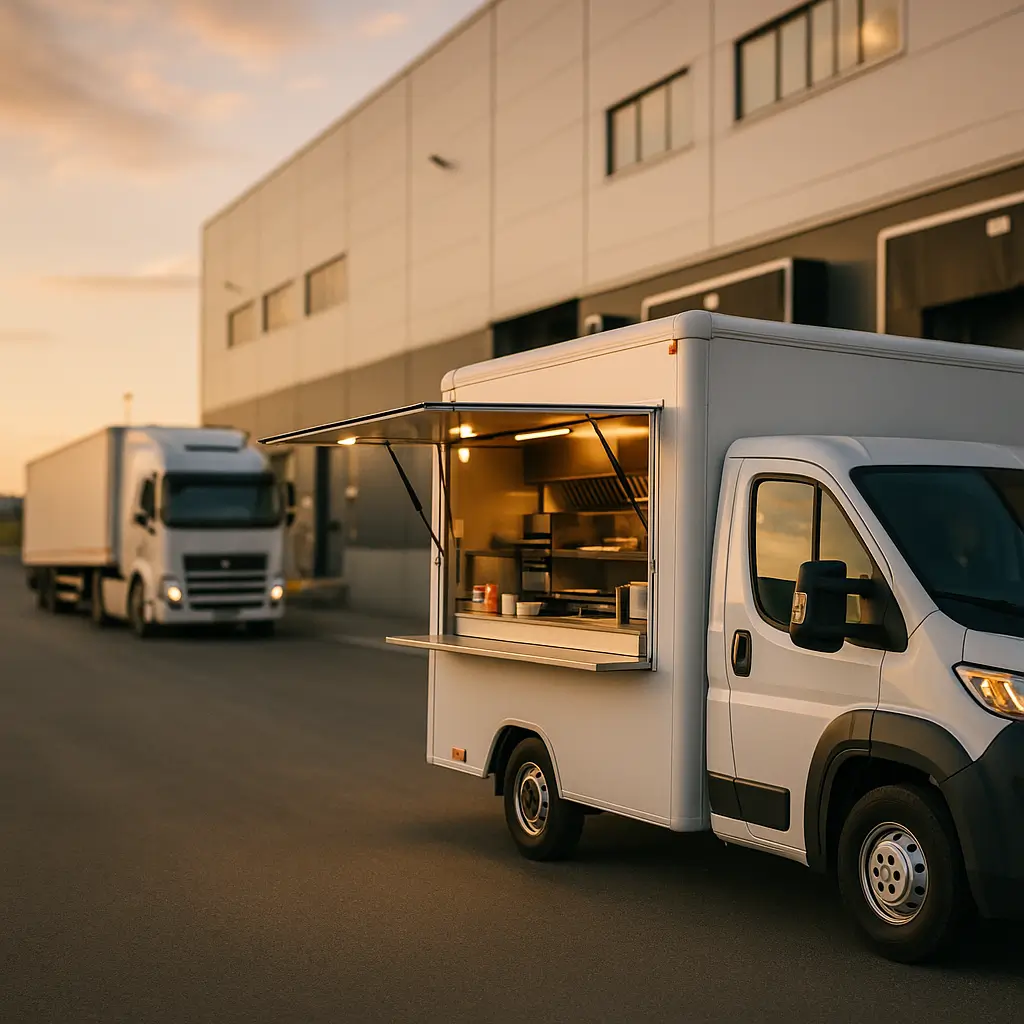
A catering van often handles transport + setup + service (sometimes with onboard cooking), while a food truck is typically a “rolling kitchen” with heavier onsite service exposure; a trailer setup adds towing risk plus “what’s covered where” questions.
- Why classification matters: Misclassifying the operation is a common reason policies get endorsed incorrectly, which can slow claims or create surprise exclusions.
- Who needs it: Anyone serving customers from a van at events, festivals, job sites, campuses, breweries, weddings, or private venues.
- Pro tip: Write down your top 3 revenue streams (for example: weddings, corporate lunches, festivals). Insurers often price those differently.
If your operation is closer to a food van setup, read through food van insurance to compare how policies are rated for that configuration.
Common use cases insurers price differently
Frequency and setting matter: a weekend-only wedding operator is a different exposure than a daily downtown lunch-run van with constant stops and tight parking.
- Higher-frequency stops: More chances for backing incidents, curb strikes, and parking-lot claims.
- High foot traffic: More slip-and-fall and premises-type claims while serving.
- Pro tip: If you’re seasonal, ask about storage/lay-up options (when available) and document secure storage (fenced lot, cameras, alarms).
Required (or commonly required) mobile catering van insurance coverages
“Required” coverage comes from a mix of state auto liability laws, venue contracts, and your business structure, but event work commonly triggers requests for $1M auto liability and $1M/$2M general liability on a COI.
Use the table below to compare quotes apples-to-apples, because “cheap” quotes often skip a coverage you actually need for contracts or real-world losses.
Quick coverage table (use this when comparing quotes)
| Coverage | What it typically covers | Who commonly requires it | Typical limits you’ll see requested* | Common gap to watch |
|---|---|---|---|---|
| Commercial auto liability | Injuries/property damage from at-fault crashes | State law + contracts | Often $1M CSL for event work | Personal auto policy exclusion for business use |
| Physical damage (comp/collision) | Your van if stolen/wrecked | Lender/lease + you | Deductible-driven | Modified kitchen build not scheduled correctly |
| General liability | Slip-and-fall, property damage at venue, some product liability | Venues/event organizers | $1M/$2M is a common ask | “Additional insured” not added by endorsement |
| Property / equipment | Tools, kitchen gear, POS, tents | You | Based on replacement cost | Off-premises gear not covered without right form |
| Workers’ comp | Employee injuries (burns, slips, lifting) | State law (varies) | State-based | Misclassifying employees as contractors |
| Hired & non-owned auto | Employees using personal cars for errands | Contracts | Often $1M | Assuming your auto policy covers non-owned use |
| Umbrella/excess | Extra limits above auto/GL | Larger venues | $2M–$5M | Underlying limits don’t meet umbrella requirements |
*Limits vary by venue, city, and contract; don’t treat these as legal requirements.
1) Commercial auto liability (and physical damage)
Commercial auto covers business-use driving, including liability for injuries/property damage and optional comprehensive/collision for theft and vehicle damage.
- Who needs it: Any operator driving to events, hauling food/equipment, or running regular service routes.
- Common pitfall: Upfits/modifications (custom build-outs) may need to be scheduled or valued correctly to avoid underpayment after a loss.
- Practical check: If the van is financed, your lender typically expects physical damage coverage.
Not sure how commercial auto and general liability actually differ? This breakdown covers the key distinction:
2) General liability (including products-completed ops / food-related claims)
General liability (GL) is the primary coverage for third-party injury and property damage at the venue, and it’s one of the first items venues ask to see on a COI.
For a baseline on what GL does and doesn’t do for mobile operators, use general liability insurance for mobile businesses. For catering-specific GL details and what venues typically require, see liability insurance for catering service.
- Real-world examples: A guest trips near your serving line, a hot drink spill causes a burn claim, or you damage a venue floor during setup.
- Contract gotcha: “Additional insured” usually requires an endorsement; the COI alone may not create coverage. “Additional insured” typically requires an endorsement to the policy — a COI alone does not create coverage, a distinction confirmed by most state insurance departments. If unsure, your state’s insurance commissioner can clarify what your policy must include.
3) Property / equipment coverage (especially if you cook onboard)
Equipment/property coverage replaces or repairs the gear that makes you money—generators, warmers, POS, tents, refrigeration, and smallwares—after covered theft or damage.
- Why it matters: GL doesn’t replace your gear, and a break-in can wipe out your next month of work.
- Pro tip: Keep an inventory with photos and replacement costs; claim documentation is easier when you can prove ownership and value.
4) Workers’ comp (if you have employees)
Workers’ compensation pays for employee medical bills and wage replacement after work-related injuries, and requirements are set by state law and employee classification rules; the U.S. Department of Labor’s OWCP page links to state programs for reference.
If you need a straight explainer before you hire for the season, read workers’ compensation insurance basics.
- Common injuries: Burns, knife cuts, slips, and lifting injuries during setup/teardown.
- Risk to the business: Getting caught uninsured after an injury can trigger penalties and major out-of-pocket costs.
5) Hired & non-owned auto (HNOA)
Hired & non-owned auto liability covers lawsuits where your business is blamed for an accident involving a rented vehicle or an employee’s personal vehicle used for work errands.
- Common scenario: An employee runs an ice or supply errand in their own car and causes a crash; your business can still be pulled into the claim.
- Buying tip: HNOA is often inexpensive relative to the exposure, especially for event operations with frequent last-minute runs.
6) Equipment breakdown + spoilage (optional, but often smart)
Equipment breakdown coverage can pay for sudden mechanical/electrical failure (not wear-and-tear), while spoilage/temperature-change coverage can help when refrigeration failure ruins inventory, depending on policy wording.
- Why it matters: A refrigerator failure the night before a wedding can create both food-cost losses and lost-revenue losses.
- Ask specifically about: Generator failure, power surge, and temperature-change triggers (and any waiting periods).
7) Umbrella / excess liability (for larger venues and higher foot traffic)
Umbrella (excess) liability increases your total limit above your general liability and auto, and event contracts commonly request umbrella limits like $2,000,000 to $5,000,000 for larger venues or higher-risk events.
- Why it matters: Severe injuries can exceed $1M faster than most owners expect, especially with legal defense costs included.
- Common mistake: An umbrella may require specific underlying limits; if your base auto/GL limits don’t match, the umbrella may not respond cleanly.
How much does mobile catering van insurance cost in 2026? (And what actually drives the price)
In 2026, many U.S. operators see broad annual ranges like $600–$1,800 for general liability and $1,800–$5,400+ for commercial auto, with the final price driven by miles/radius, driving records (MVR), vehicle value, and contract limits. For broader commercial auto pricing context, see commercial auto insurance rates.
Insurance pricing has been under pressure across the market; for trend context, you can reference the U.S. Bureau of Labor Statistics CPI series for motor vehicle insurance: https://data.bls.gov/timeseries/CUSR0000SETA02.
Typical 2026 cost ranges (broad estimates)
| Policy | Common monthly range | Common annual range | Notes |
|---|---|---|---|
| General liability | $50–$150 | $600–$1,800 | Limits, venues served, and claims history matter |
| Commercial auto | $150–$450+ | $1,800–$5,400+ | Mileage, radius, MVR, vehicle value, upfits |
| BOP (GL + property) | $100–$300 | $1,200–$3,600 | Often cheaper than buying separately, if it fits |
| Workers’ comp | Varies | Varies | Driven by payroll, roles, state rules, and claims |
| Umbrella | $25–$150 | $300–$1,800 | Depends on limits and underlying policies |
Wondering how much coverage you actually need? This video walks through the limit decision:
The fastest way to keep it affordable (without cutting the wrong corners)
Bundling and accurate underwriting inputs are two of the only reliable ways to control premium without quietly deleting coverage you’ll need at claim time.
- Bundle where it truly fits: Ask whether a business owners policy (BOP) explained matches your operation, because bundling GL + property can reduce total premium when the carrier appetite is right.
- Get your “use of vehicle” right: Disclose towing, onboard cooking, service frequency, and typical radius so the carrier rates the correct class.
- Quote apples-to-apples: Compare the same limits, deductibles, and equipment values across carriers.
COIs, contracts, and when a catering van starts to look like trucking insurance
A Certificate of Insurance (COI) is typically a one-page ACORD-style document that shows your coverage types, limits (like $1M), policy dates, and certificate holder details—so venues can confirm you meet the contract before you unload.
This is where owners get burned: you’re insured, but you’re not contract-compliant—or your operations drifted (more towing, more miles, more equipment) and the policy never got updated.
Certificates of Insurance (COIs): what venues actually want
A correct COI usually needs the right legal name, the right certificate holder, the right limits, and any required endorsements (like additional insured) to match the venue contract language.
For a step-by-step walkthrough, use the certificate of insurance (COI) guide. For single-event coverage needs, catering insurance for a day explains short-term policy options and how to get a same-day COI.
Copy/paste COI checklist for event bookings
- Legal business name matches the contract (LLC vs DBA matters)
- Venue/event organizer listed correctly (certificate holder)
- Required limits shown (GL and auto if required)
- “Additional insured” endorsement included when required (a COI alone may not be enough)
- Event date/location correct
- Policy effective dates cover the event date
- Any required wording included (some contracts ask for waiver of subrogation)
Watch how operators send Certificates of Insurance correctly — including how to verify the right fields are filled:
Commercial truck insurance logic (why it matters even if you don’t run a semi)
Commercial truck insurance and trucking insurance rating logic often gets triggered by exposure patterns like higher miles, tighter time windows, frequent stops, and towing—even if you’re not hauling freight.
- Higher miles + more stops: More crash frequency exposure (similar to local delivery fleets).
- Towing trailers: Different physical damage questions and “who covers what” issues.
- Higher contract limits: Umbrella/excess becomes more common and more scrutinized.
If you tow a trailer: the “hotshot insurance” comparison you should understand
Regular towing can create risk patterns similar to hotshot-style operations—more backing incidents, more tight-lot sideswipes, and more confusion about coverage for the trailer, contents, and gear at the venue.
- Clarify trailer physical damage: Is the trailer scheduled, and at what value?
- Clarify liability: What’s covered while attached vs detached?
- Clarify equipment coverage: Is gear covered in transit and while set up off-premises?
If you tow frequently and your operation pattern starts to look like hotshot work, review hotshot trucking insurance to understand how those exposures are rated differently.
Catering vans vs semi truck insurance (what’s similar—and what’s not)
Most catering vans do not need semi-truck insurance or FMCSA filings, but commercial use still demands commercial forms, accurate vehicle-use classification, and limits that match contracts.
FMCSA note (only in specific cases): Most mobile catering vans are not for-hire interstate motor carriers, but if your operation functions as a for-hire interstate carrier in a way that triggers federal filings, FMCSA insurance filing rules may apply; reference: https://www.fmcsa.dot.gov/registration/insurance-filing-requirements.
Frequently Asked Questions
Usually not for business use. Personal auto policies commonly exclude claims that arise from using a vehicle for commercial purposes — meaning a denial is likely if you have an accident while driving to an event, hauling equipment, or operating a service route. Commercial auto is designed for business use and covers the liability and physical damage exposures personal policies leave out. If you’re unsure whether your current policy covers your catering operation, ask your insurer directly before your next event.
Most food trucks and mobile catering vans need commercial auto (often with $1,000,000 liability for event work), general liability (commonly $1M per occurrence / $2M aggregate on venue contracts), and equipment/property coverage for cooking and serving gear. If you have employees, many states require workers’ compensation based on payroll and classification. Operators commonly add hired & non-owned auto when staff uses personal vehicles for supply runs, plus spoilage/equipment breakdown for refrigeration risk and an umbrella when contracts request $2M–$5M total limits.
Mobile catering van insurance commonly costs from about $2,400 to $10,000+ per year when you combine general liability ($600–$1,800/year), commercial auto ($1,800–$5,400+/year), and equipment/property and contract-driven add-ons. The biggest pricing drivers are mileage and radius, driver records (MVR), vehicle value and upfits, where you park/store the van, total equipment value, and whether venues require higher limits like $2M–$5M. Use broad market trend context (not a quote tool) from the BLS CPI motor vehicle insurance series: https://data.bls.gov/timeseries/CUSR0000SETA02.
It depends on the policy. Some commercial auto policies offer lay-up or storage endorsements for periods when the vehicle is not in use, which can reduce premium during the off-season. General liability, however, is typically written as an annual policy and may not reduce for seasonal gaps. If you’re seasonal, ask your agent specifically about lay-up options, what triggers coverage back on (and whether an event inquiry counts as “in use”), and whether your equipment is still covered while stored. Document where the van is kept, because garaging location affects both physical damage pricing and the lay-up terms.
Yes—many venues and event organizers require proof of insurance on a Certificate of Insurance (COI), and it’s common to see minimum limits like $1,000,000 general liability and sometimes $1,000,000 commercial auto liability for vehicles entering loading areas or serving onsite. Contracts also frequently require additional insured status, which typically must be added by endorsement (a COI alone may not create coverage). Request the COI early, because last-minute corrections—wrong legal name, wrong certificate holder, missing wording, or missing endorsement—are a common reason bookings get delayed or canceled.
“Additional insured” means the venue or event organizer is added to your liability policy by endorsement, giving them direct coverage rights under your GL policy for claims arising from your operations on their property. A COI alone doesn’t do this — the endorsement must be added to the policy itself, and then reflected on the COI. To get it added, contact your agent with the venue’s full legal name and address before the event. Last-minute requests on event day are a common booking problem, so build this into your pre-event checklist. For more on catering-specific liability requirements, see liability insurance for catering service.
It depends on your state and worker classification, but part-time employees can still trigger workers’ comp requirements and audits because premiums are usually tied to payroll and job class codes, not hours worked. Even when a state doesn’t strictly require it at your size, workers’ comp can protect the business from medical bills, lost-wage demands, and injury-related lawsuits after common catering injuries like burns, slips, and lifting strains. If you’re unsure where you fall, use workers’ compensation insurance basics as a starting point, then confirm your state’s rule before the season starts.
Standard commercial auto and general liability policies typically do not cover spoilage. Equipment breakdown and spoilage coverage is usually a separate add-on — or available through a commercial property or BOP endorsement — and it triggers based on specific causes (like a sudden mechanical failure), not wear-and-tear. Temperature-change triggers and waiting periods vary by policy wording, so ask specifically about: what causes are covered, whether there’s a waiting period before coverage kicks in, and whether the loss must be documented with a service report. For operators whose income depends on refrigerated food, this is worth adding before a big event.
Conclusion: Build a package that books venues and protects cash flow
Mobile catering van insurance works best when it’s built around how you actually operate—miles, towing, equipment value, and venue contract limits—then kept current as the business grows. The goal isn’t buying “everything”; it’s avoiding the few gaps that can wipe out a season.
Key Takeaways:
- Match your commercial auto to real use (radius, miles, towing, and upfits) so claims don’t turn into arguments.
- Build venue-ready liability: GL limits, additional insured endorsements, and a COI process you can repeat quickly.
- Insure what makes you money: equipment/property, plus spoilage/equipment breakdown if refrigeration or powered gear is critical.
Related reading (to tighten your package):
- Protecting revenue when the van goes down: business interruption insurance (lost income)
- Meeting higher venue limits without overpaying: umbrella insurance (excess liability limits)
If you want faster approvals and fewer surprises, build your coverage around your contracts first, then your calendar, then your equipment list.