
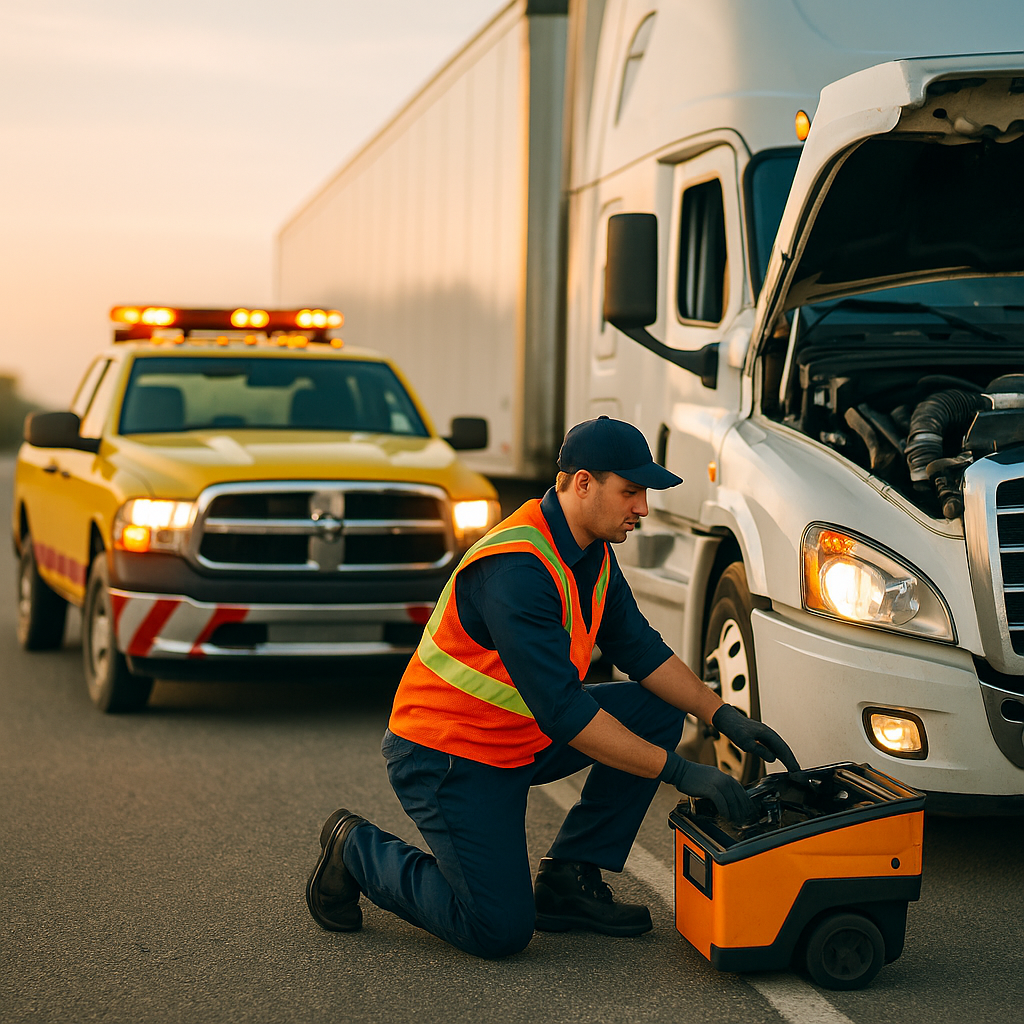

Roadside service for commercial vehicles: 7 common calls, 2026 cost ranges, SLA targets, and a dispatch script. Get help faster.
Roadside service for commercial vehicles is on-location help that gets a truck or trailer safe and legal again—most often tires, jump/battery issues, fuel/DEF delivery, lockouts, air leaks, minor mechanical/electrical fixes, and tow coordination. Heavy towing and recovery (winching/rotator) are usually separate, and that’s where the bill can jump fast.
If you’ve been out here long enough, you know the “service call fee” isn’t the real pain—the real cost is downtime: missed appointments, burned HOS, detention that doesn’t pay, and the OOS headache if you gamble and roll anyway. Roadside planning belongs in the same risk bucket as your safety program and your Commercial truck insurance basics.
Key takeaways:
- Most invoices are dispatch fee + travel + labor + parts (plus after-hours multipliers).
- You can materially improve ETA by giving dispatch mile marker + direction + safe pull-off + tire size + load status.
- Roadside ≠ towing ≠ recovery; authorize the right thing.
- The cheapest breakdown is the one you prevent: a disciplined pre-trip reduces calls and roadside inspection risk.
Table of Contents
Reading time: 7 minutes
- What roadside service for commercial vehicles covers (and what’s usually extra)
- 2026 cost ranges for roadside service for commercial vehicles
- Response time (SLA) for roadside service for commercial vehicles
- Prevention + vendor vetting (reduce calls, reduce risk)
- Frequently Asked Questions
- Conclusion: Get the right roadside help without surprise bills

What roadside service for commercial vehicles covers (and what’s usually extra)
Roadside service for commercial vehicles typically supports Class 3–8 trucks and trailers with mobile repairs (tires, batteries, fuel delivery, lockouts, air-line leaks, and minor electrical), while heavy towing and recovery are usually billed separately.
What it is (plain English)
Commercial roadside assistance is mobile repair plus incident coordination for working equipment—box trucks, hotshots, straight trucks, semis, and trailers. A solid provider can also coordinate the tow, storage yard, and shop handoff when it’s beyond a shoulder fix.
Why it’s essential (business + compliance reality)
Breakdowns hit you twice: cash flow and compliance. One blown steer on a loaded run can flip a profitable day into a negative week, and “just running it to the next exit” is how minor defects turn into OOS violations at an inspection.
If you want the compliance side in plain language, connect this to DOT compliance for truckers.
Reference: FMCSA explains the purpose and process of roadside inspections here: https://www.fmcsa.dot.gov/safety/roadside-inspections
Who needs it (exact audience)
- Owner-operators: any operation living on CPM and tight appointment windows.
- Hotshot operators: a tire or hub issue on a gooseneck can snowball fast, which is why hotshot insurance and roadside planning intersect in the real world.
- Small fleets (2–50 trucks): consolidated billing and a repeatable breakdown process reduce dispatch chaos.
- Dispatchers + safety managers: less time chasing ETAs and fewer “surprise authorization” invoices.
The 7 most common commercial roadside calls
- Tire service: repair/replace steer, drive, or trailer tires.
- Jump-start / battery testing: no-crank triage and battery support.
- Fuel delivery: diesel delivery; DEF availability varies.
- Lockout: cab or side box access.
- Air leaks: lines, fittings, gladhands, minor hose fixes.
- Minor mechanical: belts, clamps, basic derate triage.
- Basic electrical: lights, simple wiring, alternator/battery checks.
What’s usually extra (or billed separately)
- Heavy towing: Class 7–8 hook, loaded tow, specialty equipment.
- Recovery/winching/rotator: ditch, soft shoulder, rollover risk.
- Long-distance travel: rural lanes can drive travel fees.
- After-hours multipliers: nights/weekends/holidays.
- Major parts/shop-level work: beyond small consumables.
Quick way to prevent surprise authorizations: ask dispatch, “Is this being sent as roadside repair, tow, or recovery—and what’s the not-to-exceed without calling me back?”
2026 cost ranges for roadside service for commercial vehicles
In 2026, roadside service for commercial vehicles commonly ranges from $150–$350 for a basic call-out to $1,500–$15,000+ for recovery, depending on travel, labor hours, parts availability, and after-hours multipliers.
How invoices usually break down
- Dispatch/service call fee: getting a truck rolling to you.
- Travel: mileage and/or portal-to-portal time.
- Labor: hourly or flat-rate for simple jobs.
- Parts/materials: tires, batteries, airlines, fittings, wiring supplies.
- Adders: after-hours, traffic risk, scene complexity, additional units.
Typical per-call price ranges (transparent, but realistic)
These are ranges—not promises—because location, time, equipment, and load status move the number fast.
| Service type | Typical 2026 range (per event) | Common add-ons that change the bill |
|---|---|---|
| Service call + basic labor start | $150–$350 | After-hours multiplier, rural travel |
| Tire repair/replace (commercial) | $400–$1,500+ | Steer vs drive vs trailer, availability, mounting, call-out distance |
| Jump-start / battery test | $150–$450 | Multi-battery systems, battery replacement, terminal/cable work |
| Fuel delivery | $150–$400 + fuel | After-hours, minimum gallons, DEF availability |
| Lockout | $100–$300 | Damaged lock, key issues, side box complexity |
| Air leak / airline/fitting | $200–$900 | Hard-to-find leak, parts availability, cold-weather failures |
| Basic electrical (lights/wiring) | $150–$700 | Trailer harness faults, corrosion, diagnostics time |
| Heavy towing (Class 7–8) | $800–$3,500+ | Loaded/unloaded, axle config, storage/yard fees |
| Recovery/winching/rotator | $1,500–$15,000+ | Terrain, rollover risk, multiple units, traffic control |
Tire bills are the most common “why is this so high?” moment—especially on steers. For the deeper cost drivers, use this as your baseline: Semi truck tire replacement cost guide.
Membership vs pay-per-use (when each is cheaper)
- Pay-per-use: usually fine if you run well-maintained equipment and average 0–1 roadside events/year.
- Membership/fleet program: tends to win when you have older equipment, seasonal tire/battery problems, multiple units, or you want consolidated invoicing and rate consistency.
Rule of thumb: if one bad month can create 2–3 calls (tires + jump + tow coordination), a program often pays for itself in rate control and admin time—even when it doesn’t “fully cover” the event.
Pricing control question list: ask for written rules on after-hours labor multiplier, travel billing (miles vs portal-to-portal), not-to-exceed approvals, and whether towing/recovery rates are negotiated or pass-through.
Response time (SLA) for roadside service for commercial vehicles
For commercial roadside events in 2026, a realistic response-time target is often 45–120 minutes near major metro corridors and 2–4+ hours in rural areas, with weather and heavy-wrecker availability driving the longest delays.
What an SLA means in the real world
An SLA is a target, not a guarantee. If you’re on a shoulder in a tight spot or you need specialty equipment (heavy wrecker/rotator), the provider may need to stage the right truck and tools before they roll.
Downtime math (why speed beats “cheap”)
Every hour on the shoulder stacks costs: missed appointment penalties, driver hours burned under HOS, reefer temp risk, and tow/storage charges if you’re forced to move. On the insurance side, a breakdown can escalate into an incident quickly—one reason trucking insurance and semi truck insurance decisions should match how you actually operate.
Dispatch-ready call script (copy/paste)
Use this script to cut the back-and-forth that burns 20–40 minutes.
- Exact location: mile marker, direction of travel, nearest exit, and whether you’re safely off the lane
- Unit details: tractor/trailer, unit #, tire size (steer/drive/trailer), axle config, last 6 of VIN if needed
- Load status: loaded/empty, hazmat (Y/N), oversize (Y/N), reefer temp constraints
- Symptoms: “air won’t build past X,” “steer tire blew,” “derate + fault code,” “no crank,” “smoke/leak”
- Safety status: triangles out, on shoulder, injuries (Y/N), fluids on ground (Y/N)
- Authorization: “Not-to-exceed $___ without calling me” + backup approver if you’re driving
Tech-enabled dispatch (how to get the right help sent first)
Providers that accept photos/video, fault codes, and live location reduce wrong-dispatch errors—the expensive kind. If you’re building that stack, start here: Trucking telematics guide.
Speed lever that actually works: standardize a breakdown report in your driver app/ELD notes so dispatch gets the same info every time.
Prevention + vendor vetting (reduce calls, reduce risk)
A repeatable pre-trip and post-trip routine that checks tires, lights, air lines, fluids, batteries, and belts can prevent many of the most common roadside failures that trigger OOS risk and missed appointments.
Prevention that actually works
You don’t need a fancy program—you need consistent checks that catch the issues that strand trucks:
- Tires: pressure, tread, uneven wear, cuts, valve stems
- Lights: tractor + trailer, including turn signals and markers
- Air: rub points, gladhands, leaks, frozen fittings in winter
- Fluids: coolant, oil, power steering, visible leaks
- Batteries: terminals, corrosion, loose cables
- Belts/hoses: especially on older units
Use a disciplined checklist here: Pre-trip inspection checklist.
Why it matters for compliance and claims
Roadside defects can turn into OOS violations, missed delivery windows, and sometimes an incident that becomes a liability claim—especially when a tire failure turns into a crash or cargo loss. That’s where affordable trucking insurance only helps if it’s built correctly (limits, endorsements, and exclusions that match real roadside scenarios).
EV and alternative power units (don’t assume coverage)
Some providers will service electric commercial vehicles, but many will default to tow-to-qualified-facility. Ask specifically about high-voltage safety protocols, towing requirements (flatbed vs wheel-lift restrictions), and whether they can provide power assist versus transport-only.
Vendor vetting checklist (before you need them)
- 24/7 dispatch: live ETA updates and escalation path
- Billing rules: travel method, after-hours multiplier, parts markup
- Lane coverage: your top 5 lanes and regular customer areas
- Heavy tow + recovery: in-house capability or clearly managed subcontracting
- COI and safety process: documentation and incident handling
Reference: FMCSA SAFER can help verify carrier and safety basics: https://safer.fmcsa.dot.gov/
Billing control tip: require photos and timestamps on tow/recovery invoices; scene complexity is real, but documentation keeps it honest.
Frequently Asked Questions
Commercial roadside assistance typically covers common on-site repairs (tires, batteries, fuel delivery, lockouts, air leaks, and basic electrical), while heavy towing and recovery are frequently billed as separate line items with higher equipment and labor costs.
Commercial roadside assistance usually includes on-site tire service, jump-starts and battery testing, fuel delivery (and sometimes DEF), lockouts, air-leak fixes (lines/fittings), and minor mechanical or electrical repairs for Class 3–8 trucks and trailers. Most providers bill these as a dispatch fee plus travel, labor, and parts. What’s commonly excluded or billed separately is heavy towing and recovery/winching/rotator work, which can change the total from a few hundred dollars to several thousand. Always confirm whether you’re authorizing “roadside repair,” “tow,” or “recovery,” and set a not-to-exceed amount.
Fuel delivery is commonly available, and a typical 2026 invoice is a service fee of about $150–$400 plus the fuel cost (and after-hours adders if it’s nights, weekends, or holidays). Towing varies by program: some plans include limited towing or discounted rates, but heavy towing and recovery are often separate and can run $800–$3,500+ for a heavy tow and $1,500–$15,000+ for recovery depending on the scene. Ask about limits, exclusions, and whether towing/recovery rates are pre-negotiated or pass-through.
Yes, mobile mechanics can handle many truck roadside fixes, including air leaks, basic electrical (lights/wiring), battery issues, clamps/hoses, and simple no-start triage, as long as the repair is safe to perform on scene. If the truck is derated with deeper engine/emissions faults or needs specialized tools and parts, towing to a qualified shop is often faster than repeated roadside attempts. Pricing can still vary widely by market because labor rates, travel billing, parts markup, and after-hours rules differ—see the Truck repair costs guide for the main drivers.
Roadside arrival time depends on location (urban vs rural), time of day, weather, and whether the job needs specialty equipment like a heavy wrecker or rotator, but many fleets plan around 45–120 minutes in busy corridors and 2–4+ hours on rural routes. You can shorten ETA by giving dispatch the mile marker and direction, confirming you’re safely off the lane, sharing tire size and axle configuration, stating loaded/empty and hazmat status, and sending photos or fault codes when available. Clear “not-to-exceed” authorization also prevents delays caused by call-backs.
Conclusion: Get the right roadside help without surprise bills
Roadside service for commercial vehicles works best when you treat it like a system: know what’s included, know what’s extra, and give dispatch the exact info that gets the right truck and parts on the first roll.
And if you’re tightening your risk plan, make sure your coverage matches real-world breakdown scenarios—because a roadside event can escalate into liability fast, and that’s when your commercial truck insurance needs to perform.
Key Takeaways:
- Expect most bills to be dispatch + travel + labor + parts; recovery is where costs can spike into five figures.
- Cut ETA with a standard breakdown report: mile marker, direction, safe pull-off, tire size, load/hazmat, photos/fault codes.
- Prevent the calls you can: tires, lights, air, fluids, and batteries catch most roadside-causing problems.
Related reading: Towing and recovery insurance coverage and Owner-operator operating costs guide.
If you want a quick review of your roadside plan and coverage gaps (tow/recovery exposure, endorsements, and real-world claim scenarios), use the button above to get a quote/checkup.





