
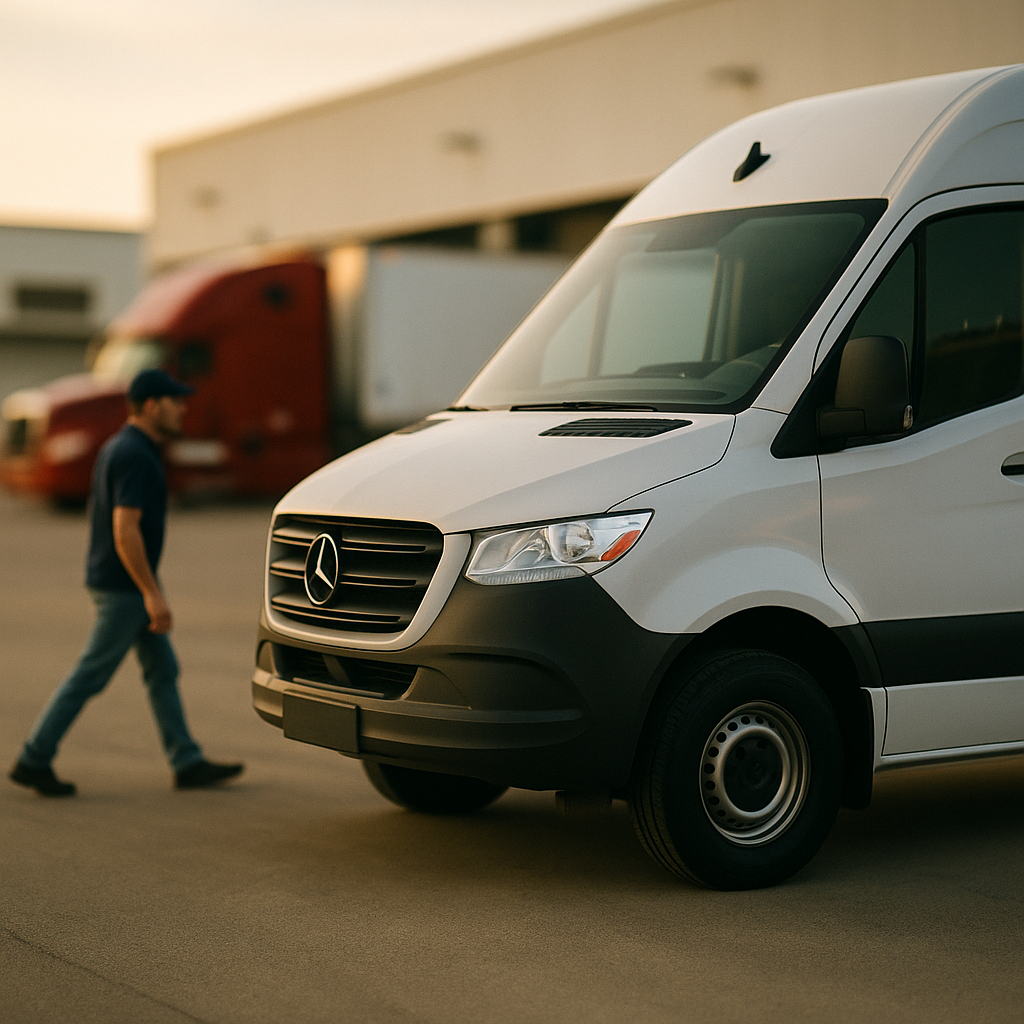

Sprinter van insurance for owner operators: 6 must-have coverages, 2026 cost ranges, and cargo options—so brokers accept your COI. Get quotes.
Sprinter van insurance for owner operators usually comes down to a simple, broker-friendly stack: commercial auto liability, cargo insurance, and physical damage, with general liability, non-trucking liability, and occupational accident added depending on how you run. Your exact requirements hinge on whether you operate under your own authority or you’re leased to a motor carrier.
If you’re running a Sprinter as an owner-operator, you’ve probably already learned this the hard way: get insured the “wrong” way (like personal auto or a mismatched policy setup), and you can get blocked by brokers—or denied on a claim. If you want the big-picture framework first, start here: owner-operator insurance coverage basics.
This guide gives you a practical checklist: what coverages you actually need, what they typically cost in 2026, and how to build a COI that gets accepted so you can book loads and keep cash flow steady.
Table of Contents
Reading time: 9 minutes

Key takeaways
A realistic 2026 planning range for many Sprinter van owner-operators is $4,000–$10,000/year (about $335–$835/month), but your authority status and cargo requirements can push it higher.
- Your “authority status” drives everything: Own authority typically means primary liability in your name; leased-on often shifts primary liability to the carrier while dispatched.
- Cargo insurance is where Sprinter operators get rejected: limits, theft clauses, and “unattended vehicle” wording can matter more than most people expect.
- Affordable trucking insurance comes from clean underwriting: continuity of coverage, tight radius, realistic mileage, and the right deductibles usually move the premium more than guesswork.
Why Sprinter van owner-operators need a different insurance setup than “big truck” operations
For-hire delivery and courier work typically requires commercial insurance because most personal auto policies exclude or limit “for-hire” use and many broker onboarding processes require a COI with specific limits and endorsements.
Sprinters sit in a weird zone: you’re smaller than most commercial trucking classes, but you still have for-hire exposure and cargo risk that personal auto was never designed to cover. A good rule: if you’re hauling for money, getting paid by a broker/shipper, or running delivery/courier routes—assume you need commercial coverage.
To see the basic split between personal auto vs commercial (and why “business use” endorsements often don’t fix for-hire), review: commercial truck insurance vs personal auto differences.
Sprinter van vs personal auto vs commercial auto (plain English)
- Personal auto: often excludes “for-hire” and many delivery uses; claims are where it breaks.
- Commercial auto: built for business use, COIs, contract requirements, and underwriting based on your operations.
What changes your requirements the most
- Own authority vs leased-on: who carries primary liability while you’re working.
- Cargo value + theft target: electronics, medical, parcels, and other high-theft items can change cargo pricing and requirements.
- Operating radius + metros: dense city miles tend to rate higher than rural runs.
- How you get freight: load boards/brokers vs direct shipper contracts.
The 6 core coverages for Sprinter van insurance (owner-operator checklist)
A broker-acceptable Sprinter owner-operator package commonly includes primary auto liability, cargo, and physical damage, with general liability, non-trucking liability, and occupational accident added based on your contract and authority status.
If you haul freight that isn’t yours, cargo wording matters. For a deeper breakdown of what cargo policies commonly exclude, use: cargo insurance fundamentals and exclusions.
Coverage checklist (quick table)
| Coverage | What it protects | Who usually requires it | When it applies |
|---|---|---|---|
| 1) Primary auto liability | Injury/property damage to others | Law + brokers/carriers | When operating for business (often the primary requirement) |
| 2) Cargo (annual) | Customer’s freight in your care (subject to form/exclusions) | Brokers/shippers | When hauling others’ goods (limit must match freight value) |
| 3) Physical damage (comp/collision) | Your Sprinter (theft, wreck, weather) | Lenders/lease companies; many owners | Any time; protects your asset and cash flow |
| 4) General liability (GL) | Non-auto third-party claims (dock/property incidents) | Many warehouses/brokers | Business operations, not auto accidents |
| 5) Non-trucking liability (NTL)/bobtail | Liability off-dispatch (leased-on scenarios) | Many motor carriers | When not under dispatch (depends on contract) |
| 6) Occupational accident | Medical/disability-style benefits for you | Many carriers (leased-on) | If you’re injured and can’t run |
1) Primary auto liability
Primary auto liability is the foundation of commercial auto coverage, paying for bodily injury and property damage you cause to others while operating for business.
Without it, you won’t pass most broker onboarding and you may not be able to operate legally depending on your setup and filings. Many brokers commonly expect higher limits (often quoted as “$1M”), even when a lower statutory minimum may apply to some operations—your goal is “accepted,” not “minimum.”
2) Cargo insurance (annual policy)
Cargo insurance is designed to cover freight you’re responsible for while it’s in your care, custody, or control, subject to the policy’s exclusions and conditions.
Brokers won’t tender you a load if your COI doesn’t meet the contract, and cargo claims can be denied on technicalities (unattended vehicle language, theft conditions, improper securing, temperature issues, or “mysterious disappearance”). Don’t buy cargo on price alone—buy it on wording.
3) Physical damage (comprehensive + collision)
Physical damage combines comprehensive and collision coverage to help repair or replace your van after a covered loss like a crash, theft, vandalism, or hail.
Your Sprinter is your revenue engine; if it’s down, you’re down. The dial you control most is your deductible—higher deductibles can lower premium, but only if you can actually write the check after a loss.
4) General liability (GL)
General liability typically covers non-auto third-party claims tied to your business operations, like property damage at a facility that isn’t caused by an auto accident.
Some shipper/warehouse contracts require it, and it protects you from the “weird dock incident” losses that don’t fit auto liability.
5) Non-trucking liability (NTL) / bobtail (when applicable)
Non-trucking liability (NTL) is commonly used by leased-on owner-operators to address liability exposure when they’re not under dispatch, subject to the carrier contract and policy wording.
It can help close a common gap for off-duty driving like heading home or moving the van for personal reasons, but it doesn’t replace the carrier’s primary liability while you’re dispatched. If you want the clean explanation, review: non-trucking liability vs bobtail coverage.
6) Occupational accident
Occupational accident is a benefits-style policy (structure varies) that can help cover medical costs and provide disability benefits if you’re injured and can’t work.
If you get hurt and can’t run, the bills keep coming—vehicle payment, insurance, rent, and living expenses. Many carriers require it for leased-on contractors, and even when it isn’t required, it’s worth pricing for solo operators.
2026 cost benchmarks: how much Sprinter van insurance costs for owner-operators (and what moves the price)
Many Sprinter van owner-operators can plan around $4,000–$10,000 per year (about $335–$835 per month) for a workable commercial insurance stack, with new ventures and high-theft cargo often pricing above that band.
For a deeper dive into the pricing variables carriers actually rate on, see: trucking insurance cost factors.
Typical annual + monthly ranges (planning numbers)
- $4,000–$10,000 per year
- ~$335–$835 per month
That range can move quickly if you’re a new venture, running high-theft freight, or operating heavily in big metros. “Average cost” numbers in commercial auto are broad because underwriting swings with loss trends and repair inflation; for industry context, see: NAIC.
Cost scenarios (quick table)
| Scenario | Typical setup | Planning range (annual) | Planning range (monthly) |
|---|---|---|---|
| Leased-on local courier | Carrier handles primary liability while dispatched; you carry PD + NTL + occ/acc | $4,000–$6,500 | $335–$540 |
| Own authority, moderate cargo | Primary liability + cargo + PD + (maybe GL) | $6,000–$9,000 | $500–$750 |
| Own authority, higher-value freight / metro | Higher cargo limits + higher theft exposure | $8,000–$12,000+ | $665–$1,000+ |
Underwriting checklist (what actually drives your quote)
- MVR + prior claims: tickets, at-fault accidents, and commercial loss history
- Insurance continuity: lapses can trigger “new venture” pricing
- Garaging ZIP + metro density: city miles and theft rates matter
- Radius and states: 0–100 miles vs multi-state changes exposure
- Cargo type + limit requested: higher limits and theft-target freight raise premiums
- Van value + repair costs: newer Sprinters can cost more to repair (ADAS, sensors, cameras)
Cargo insurance: annual policy vs per-load coverage (Sprinter-specific reality)
Annual cargo is often the smoother option for broker onboarding, while per-load cargo can work for occasional or specialized shipments if your brokers explicitly accept it.
- Annual cargo (best for steady work): consistent COI and fewer last-minute load delays, but you pay year-round.
- Per-load cargo (best for occasional/high-value loads—if accepted): flexible, but some brokers won’t treat it as a substitute for an annual COI.
Many brokers verify authority and insurance status using FMCSA tools; one common reference is FMCSA SAFER. The goal is simple: don’t win the load and then lose it because your COI doesn’t match the contract.
Common mistakes that get Sprinter owner-operators burned
- Running deliveries on personal auto and learning about exclusions after a loss
- Buying “minimum” limits that fail broker onboarding (missed loads)
- Mismatching cargo limits to actual freight you accept
- Ignoring unattended vehicle/theft language (a major issue for cargo vans)
- Letting coverage lapse and getting repriced like a brand-new risk
Frequently Asked Questions
A Sprinter van owner-operator typically needs commercial auto liability, cargo insurance (when hauling freight for others), and physical damage to protect the van. Many also add general liability for facility-related incidents and occupational accident for benefits if they’re injured. If you’re leased to a motor carrier, you may also need non-trucking liability (NTL) for certain off-dispatch use, depending on the contract and policy wording. The “right” stack is whatever matches your authority status, cargo value/type, operating radius, and what your brokers or carrier require on the COI.
For many Sprinter van owner-operators, a realistic planning range is $335–$835 per month (about $4,000–$10,000 per year), but new ventures and higher-theft freight can push pricing above that. Carriers typically rate on your MVR/claims history, insurance continuity, garaging ZIP, operating radius, states traveled, cargo type and cargo limit, and the van’s value/repair cost. If you want a cleaner comparison, shop quotes using the same limits, deductibles, radius, and cargo description—otherwise you’re comparing different policies, not different prices.
If you haul other people’s freight and work with brokers, cargo insurance is usually required to get loads tendered and to keep your COI from being rejected. The most important practical rule is that your cargo limit should match the freight value you accept; if you book $75,000 loads with a $25,000 cargo limit, you’re setting yourself up for a contract failure (and possibly an uncovered gap). Also read theft and “unattended vehicle” wording carefully, because those exclusions are common friction points for cargo-van operations. For deeper detail, see cargo insurance fundamentals and exclusions.
You most commonly need non-trucking liability (NTL) if you’re leased to a motor carrier and want liability coverage for certain off-dispatch driving, like personal use or repositioning not under the carrier’s direction. NTL is not a substitute for the carrier’s primary auto liability while you’re dispatched, and it won’t fix a mismatch between your lease agreement and your insurance wording. Because definitions of “dispatch” and covered use can vary by contract and policy form, it’s smart to confirm requirements in writing and review a plain-English breakdown like non-trucking liability vs bobtail coverage.
Conclusion: build a Sprinter insurance package brokers will accept
A Sprinter owner-operator insurance plan isn’t about “checking a box”—it’s about keeping your freight access and protecting your cash flow after a loss. Start by choosing the right lane (own authority vs leased-on), then build a coverage stack that matches your real operation and broker contracts.
Key Takeaways:
- Decide authority first: your insurance and filing needs change dramatically between own authority and leased-on.
- Don’t cheap out on cargo wording: unattended vehicle/theft conditions and limit mismatches are common rejection points.
- Shop apples-to-apples: same radius, same limits, same deductibles, same cargo description—then compare.
If you’re trying to keep costs down without gutting protection, use: how to lower commercial truck insurance premiums. If you’re comparing van work to other light-freight paths, see: hotshot insurance guide.





