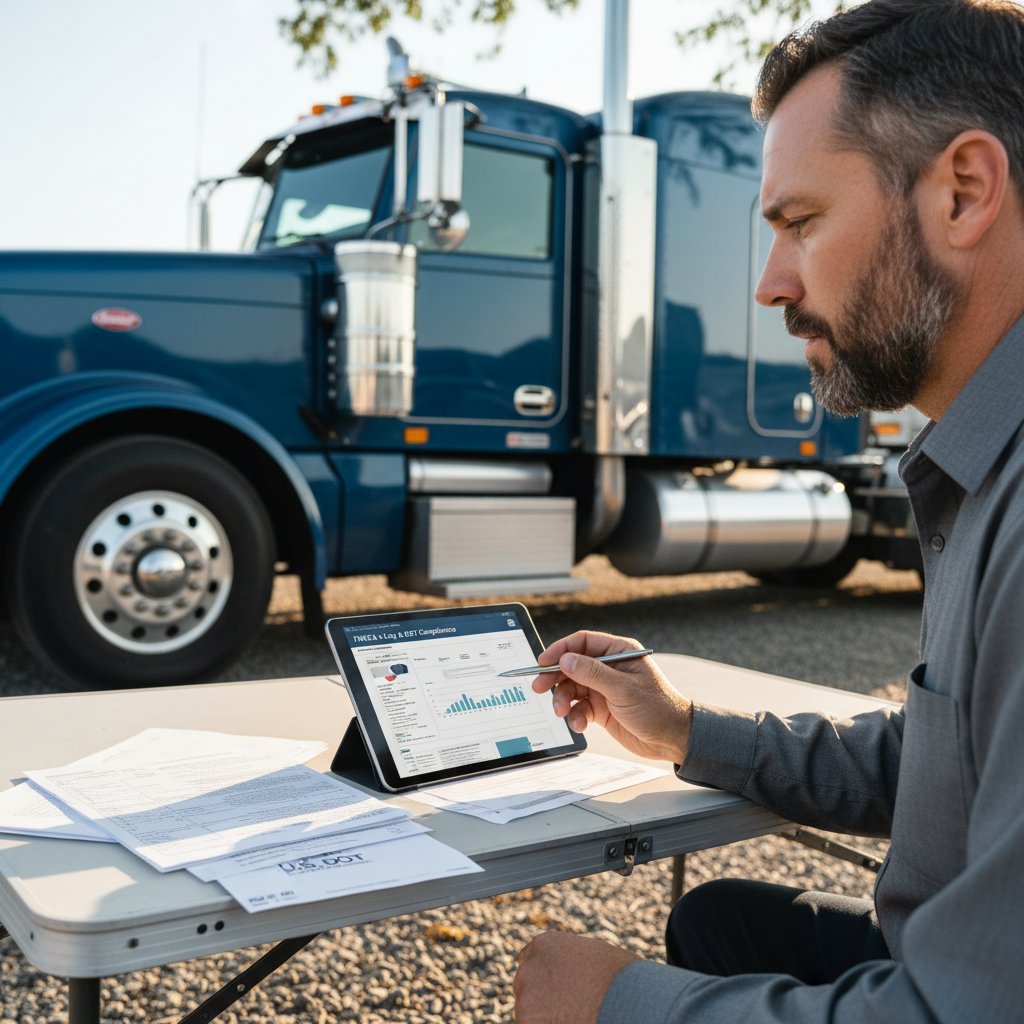
Learn CDL requirements fast: age, CLP, ELDT training, medical card, tests, documents, and endorsements. Don’t guess—get a plan and quote today.
CDL requirements in 2026 aren’t complicated, but they are strict: you generally need to be 18+ for intrastate or 21+ for interstate, pass a DOT medical exam, get a Commercial Learner’s Permit (CLP), complete Entry-Level Driver Training (ELDT) if you’re a first-time applicant, and pass the knowledge + CDL skills (road) tests. Fees, documents, and scheduling rules vary by state.
If your plan is to become an owner-operator, don’t wait until you’ve bought a truck to learn your monthly costs—start with commercial truck insurance basics so you can price the business before you commit.
Table of Contents
Reading time: 9 minutes
- The Basic CDL Requirements (Federal Baseline)
- Step-by-Step CDL Process: CLP to Road Test
- CDL Application Documents: A Real-World Checklist
- CDL Classes, Endorsements, and Restrictions (What Changes What You Can Haul)
- Medical Card, Clearinghouse, and Compliance Updates
- CDL Requirements by State: What Usually Changes
- After You Get Your CDL: Don’t Let Insurance and Compliance Wreck Your Cash Flow
- Your Questions Answered: “People Also Ask” FAQs
- The Logrock Difference: Insurance Built for Business Owners
- Conclusion: Get Your CDL Plan (Then Protect the Business)
The Basic CDL Requirements (Federal Baseline)
Federal CDL requirements are set under FMCSA rules in 49 CFR Parts 383 and 384, but your state DMV/DOT controls your exact paperwork, fees, and scheduling.
That’s why the core steps look the same nationwide, yet you’ll still see delays from things like identity documents, medical card submission rules, and test availability.
1) Age requirements (18 intrastate vs. 21 interstate)
Most states allow a CDL at 18 for intrastate-only driving, while federal law requires 21+ to drive interstate or haul federally regulated hazardous materials across state lines.
- Business risk: Under 21 can mean fewer lanes, fewer brokers, and less revenue opportunity.
- Pro tip: If your long-term plan is OTR or multi-state freight, build your timeline around 21+ interstate eligibility.
2) A valid license + proof you’re eligible in your state
You must already have a valid non-commercial driver’s license and meet state identity, residency, and legal presence requirements before a CLP can be issued.
This is where people lose time: mismatched names, missing residency proofs, or bringing copies when originals are required.
3) DOT medical certificate (medical card) + self-certification
A DOT medical certificate is issued after a physical exam by a certified medical examiner and is required for most non-exempt CDL driving under 49 CFR 391.41.
- Reality check: A passed CDL test doesn’t matter if your medical status isn’t valid in your state’s system.
- Pro tip: Bring glasses/contacts, a medication list, and any relevant medical paperwork so the clinic can certify you without delays.
4) Get a Commercial Learner’s Permit (CLP)
A CLP is the permit stage that you earn by passing written knowledge tests so you can practice driving with a qualified CDL holder.
In most states, you’ll test on general knowledge plus any endorsements you want to pursue (like air brakes or tanker) before you ever touch the road test.
5) Hold your CLP long enough (often 14 days)
Federal rules require a minimum 14-day holding period between CLP issuance and the CDL skills test (49 CFR 383.25), and states can add more scheduling conditions.
Book your skills test early, then work backward so the holding period and training requirements are met on test day.
6) Entry-Level Driver Training (ELDT) for first-time CDL holders
ELDT is a federal training requirement in 49 CFR Part 380, Subpart F, and training must be completed through a provider listed on the FMCSA Training Provider Registry (TPR).
If ELDT completion isn’t recorded for you in the system, you can be blocked from scheduling or taking the skills test for covered applications and upgrades.
7) Pass knowledge tests and the CDL skills test
The CDL skills test typically includes pre-trip inspection, basic control skills, and an on-road test, and failures usually trigger retest fees plus scheduling delays.
If you’re trying to get on the road fast, treat test prep like money: every missed appointment can cost you weeks of income.
Step-by-Step CDL Process: CLP to Road Test
A realistic CDL timeline is usually 2–6+ weeks because ELDT program length and skills test availability are the biggest variables in most states.
Some DMVs are backed up for weeks, while others have third-party testers that can speed things up.
Typical CDL timeline (realistic planning view)
| 1 | Gather documents + get DOT medical exam | 1–7 days |
| 2 | Apply + pass knowledge tests to get CLP | 1 day |
| 3 | Complete ELDT (if required) | 1–4+ weeks (varies by program) |
| 4 | Hold CLP minimum period (often 14 days) | 14 days minimum |
| 5 | Schedule + pass skills test | 1 day (plus scheduling lead time) |
Budget expectations (because cash flow matters)
CDL costs vary by state and school, but most drivers pay for DMV fees, a DOT medical exam, training, and at least some lost earning time during testing.
- DMV application/testing fees: commonly tens to a few hundred dollars total (state-dependent)
- DOT medical exam: typically out-of-pocket unless a carrier sponsors it
- Training costs: the biggest variable—pricing and program length are all over the place
- Lost earning time: the hidden cost if you’re not working while training/testing
Pro tip: Before you pay for training, confirm (1) the provider is in the FMCSA TPR for ELDT, and (2) your state’s skills test scheduling isn’t months out.
CDL Application Documents: A Real-World Checklist
Most DMVs require identity, residency, SSN/legal presence documentation, and a medical card (or medical status submission) before they’ll issue a CLP or CDL.
States vary on the exact list, but the categories below are the “usual suspects.” When in doubt, bring originals.
Common CDL documentation requirements
- Proof of identity: state-approved ID
- Proof of date of birth: often built into your identity document, but not always
- Social Security Number proof: or state-approved alternative
- Proof of legal presence: citizen or non-citizen documentation as required by your state
- Proof of residency: often 1–2 documents (utilities, lease, etc.)
- Current driver’s license: valid and in good standing
- DOT medical certificate: or electronic confirmation depending on your state workflow
- 10-year driver history: some jurisdictions request or verify this
- Name change documents: if your documents don’t match
Pro tip: If your name format doesn’t match across documents (middle initial, hyphen, suffix), fix it before you burn a DMV trip.
CDL Classes, Endorsements, and Restrictions (What Changes What You Can Haul)
CDL class, endorsements, and restrictions determine what you can legally operate, what freight you can accept, and what jobs you’ll qualify for.
Two drivers can both “have a CDL” and still have totally different earning options based on what’s printed on the license.
CDL classes (high-level)
| Class A | Combination vehicles (tractor-trailer setups) | OTR, regional, heavy hauling |
| Class B | Single vehicle (straight trucks) | Dump, local delivery, vocational |
| Class C | Smaller commercial vehicles requiring hazmat or passenger | Passenger vans, hazmat in smaller units |
Common endorsements (and why they matter)
1) HazMat (H) / Tanker (N) / Combo (X)
HazMat and tanker endorsements expand the freight you can haul, and HazMat typically requires a TSA background check plus fingerprinting in addition to testing.
- Why it matters: HazMat can pay better, but compliance and scrutiny are higher.
- Pro tip: Don’t apply last-minute—background processing timelines can delay your start date.
2) Doubles/Triples (T)
The doubles/triples endorsement is required to pull more than one trailer where that configuration is allowed and used.
Some carriers and regions require it as a baseline qualification, even for otherwise “standard” freight.
3) Passenger (P) and School Bus (S)
Passenger and school bus endorsements are required for transporting passengers, and states typically apply stricter testing and screening because liability exposure is higher.
If you’re considering passenger work, plan for additional requirements beyond a basic CDL test.
Restrictions (the quiet deal-breakers)
CDL restrictions can limit legal operation of common equipment such as manual transmissions or air-brake vehicles, depending on what you tested in.
- Manual restriction: can block jobs that still run manuals
- Air brake restriction: can eliminate a lot of commercial vehicles
- Equipment-based limits: the test vehicle can define what you’re allowed to drive afterward
Business reality: If you’re investing in a career, test in the right equipment so you don’t “graduate” into fewer options.
Medical Card, Clearinghouse, and Compliance Updates
Ongoing CDL compliance commonly includes keeping your DOT medical certificate current and staying eligible under the FMCSA Drug & Alcohol Clearinghouse rules in 49 CFR Part 382.
Passing the CDL test is the start of compliance, not the end of it—especially if you plan to run under your own authority later.
DOT medical certificate: keep it current
If your medical certificate expires or isn’t properly recorded, many states can downgrade or invalidate your commercial driving privilege until it’s corrected.
- Don’t assume paper is enough: some states use electronic submission and won’t update from a card photo.
- Build a calendar: track expiration dates and give yourself buffer time for appointments.
Drug & Alcohol Clearinghouse (why it matters even early)
The Clearinghouse is a federal database used by employers and enforcement to identify CDL drivers with prohibited drug-and-alcohol program violations, and it can directly affect employability.
If you plan to become an owner-operator, start acting like a business now: keep records clean, keep your process tight, and don’t “wing it” on compliance.
CDL Requirements by State: What Usually Changes
While the federal baseline is consistent, states commonly differ on fees, appointment rules, document proofs, medical submission methods, and testing availability.
The steps are similar—the friction points change.
What varies by state (the stuff that slows you down)
| Fees | Application, testing, issuance fees differ | Check your DMV fee page before you show up |
| Appointment process | Walk-in vs. appointment; long lead times | Book early; ask about alternate locations if allowed |
| Document rules | Extra proof of residency, driver history requests | Over-prepare: bring more documentation than the minimum |
| Medical submission | Paper vs. electronic workflows | Confirm your state’s method before test day |
| Testing availability | Third-party testers vs. DMV-only | Ask about third-party options to reduce delays |
Pro tip: If you’re relocating soon, confirm how domicile/residency impacts timing so you don’t get stuck in a “wrong state, wrong paperwork” loop.
After You Get Your CDL: Don’t Let Insurance and Compliance Wreck Your Cash Flow
A CDL lets you drive, but operating profitably as an owner-operator depends on controlling fixed costs like insurance, permits, and compliance systems.
If you’re planning to run under your own authority, your early budget typically includes:
- Truck payment (or maintenance if paid off)
- Fuel + deadhead
- Plates/permits (IRP) and fuel tax reporting (IFTA)
- ELD/HOS habits and compliance admin
- Commercial truck insurance (often one of the top monthly bills)
Where trucking insurance gets expensive fast (and why)
For-hire interstate carriers hauling property are subject to FMCSA financial responsibility minimums, commonly $750,000 in liability under 49 CFR 387.9, while many brokers and shippers require $1,000,000.
- New authority + limited history can price higher
- Freight type (hazmat, autos, high-value) affects rates and underwriting
- Operating radius, garaging ZIP, and claims history matter
- Limits and contract requirements are often dictated by broker/shippers
If you’re running lighter equipment, don’t assume your needs are “simple.” Hotshot coverage is its own category—especially for cargo, physical damage, and radius. When you’re ready, read the hotshot insurance guide.
Price your insurance before you commit to the truck. Getting a CDL is step one; protecting your cash flow is step two. A real quote should be based on your radius, trailer, freight, and experience—not guesses.
The Logrock Difference: Insurance Built for Business Owners
Logrock builds trucking insurance around how owner-operators actually operate—radius, trailer type, freight, experience, and whether you’re leased-on or running authority.
- You care about: cost per mile, downtime, and cash flow
- You need speed: fast certificates (COIs) when a broker needs it now
- You want clarity: coverage explained in plain English, not buzzwords
Whether you’re pricing semi truck insurance for your first year or trying to keep trucking insurance from eating your margin, we’ll tell you what matters, what doesn’t, and what it typically costs for your setup.
Frequently Asked Questions
You can typically get a CDL at 18 for intrastate driving, but you must be 21 to drive interstate under federal CDL rules (49 CFR Part 383). That 21+ line is a big deal because it affects OTR lanes, multi-state loads, and many broker/shippers’ requirements. If you’re under 21, you may still build experience and income locally, but plan around the limitation so you’re not counting on interstate freight you can’t legally haul yet. When you’re mapping your timeline, treat “interstate eligibility” like a revenue unlock, not a small detail.
Most states require proof of identity, proof of residency (often 1–2 documents), SSN verification (or an approved alternative), legal presence documentation if applicable, your current driver’s license, and a DOT medical certificate or medical status submission. Some DMVs also verify a 10-year driver history or ask for extra residency proofs. The fastest way to lose a week is a mismatch (name format, missing document, wrong version), so bring originals and make sure your documents all match before you show up.
You generally must hold your Commercial Learner’s Permit (CLP) for at least 14 days before taking the CDL skills test, because federal rules set a minimum waiting period (49 CFR 383.25). States can add friction on top of that with appointment rules, limited testing slots, or additional school requirements. If you’re trying to move fast, schedule your skills test as soon as you get your CLP (or as soon as your state allows scheduling), then work backward to ensure your ELDT completion and the 14-day window are satisfied on test day.
The main CDL classes are Class A, Class B, and Class C, and the class determines the type/size of commercial vehicle you can legally operate. Class A usually covers combination vehicles (tractor-trailer setups), Class B covers straight trucks, and Class C covers smaller commercial vehicles that still require a CDL because of passenger or hazmat requirements. Your endorsements and restrictions matter just as much as the class—testing in the wrong equipment can add limitations that block certain jobs. If you want the most flexibility for freight and future owner-operator options, Class A typically opens the most doors.
Affordable trucking insurance for a new owner-operator often still lands in the four-figure per-month range, because pricing depends on authority status, experience, radius, garaging ZIP, freight type, and required limits (many brokers expect $1,000,000 liability even though some FMCSA minimums are lower). The cheapest policy can become the most expensive decision if it leaves gaps that cause claims disputes or contract rejections. If you’re comparing add-ons, learn the difference between Non-Trucking Liability vs. Bobtail insurance so you’re not paying for coverage that doesn’t match how you actually operate.
Conclusion: Get Your CDL Plan (Then Protect the Business)
CDL requirements are easiest when you treat them like a checklist: eligibility → medical → CLP → ELDT → skills test → endorsements/restrictions—then you shift to insurance and compliance.
If you run this like a business instead of a gamble, you’ll save time, avoid retest delays, and make smarter decisions before you take on truck payments.
Key Takeaways:
- Know your lane: 18 intrastate vs. 21 interstate can change your earning potential.
- Don’t underestimate ELDT + scheduling: they’re usually the biggest timeline variables.
- Quote insurance early: commercial truck insurance is a top monthly expense—price it before you buy equipment.
Related reading: Commercial Truck Insurance Basics, Hotshot Insurance Guide, and Non-Trucking Liability vs. Bobtail.