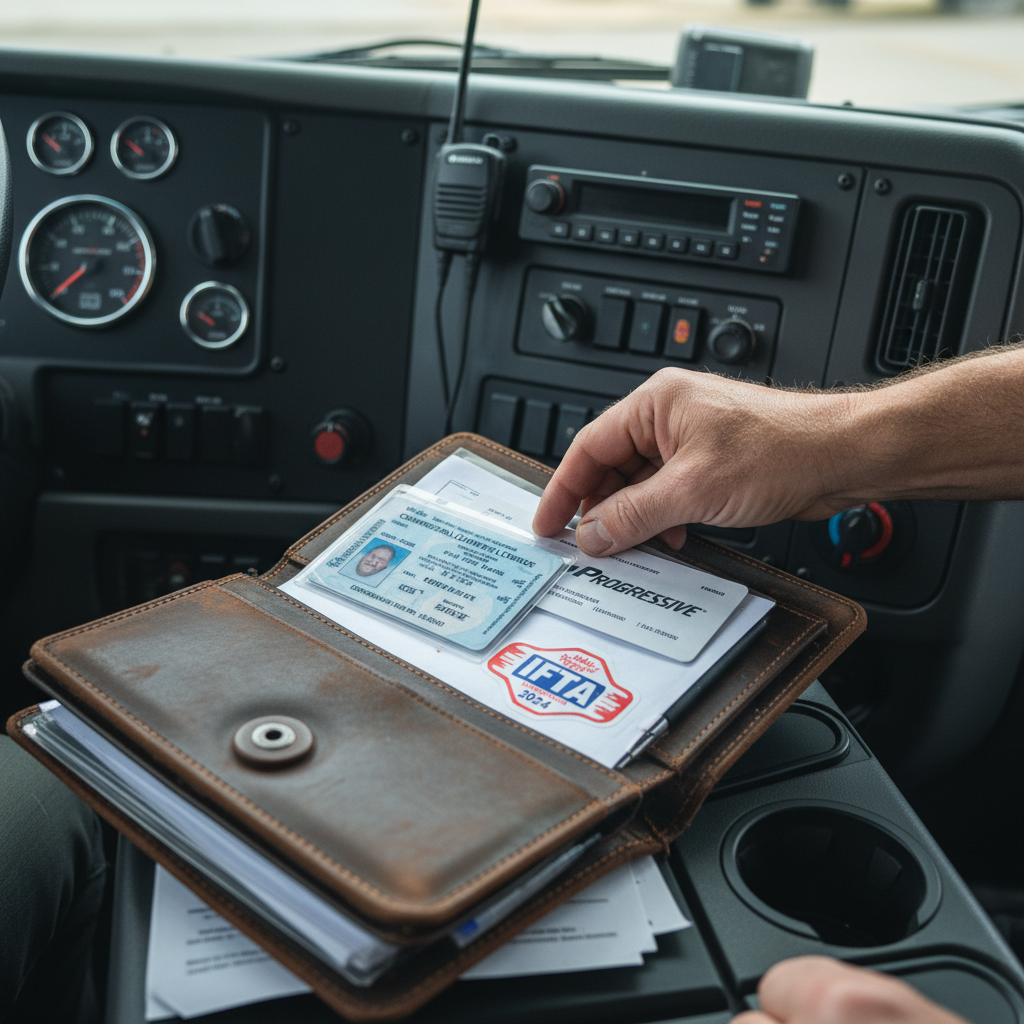
As an owner-operator, you know that a DOT inspection at a weigh station-a "chicken coop"-is an audit of your business. An officer with a clipboard isn't just looking at your tires; they're testing your professionalism.
You can have the cleanest rig on the road, but if your paperwork is a mess, you're not just facing a fine. You're facing an Out-of-Service (OOS) violation. An OOS violation is a business-killer. It means lost time, a missed delivery window, an angry broker, and a direct hit to your CSA score, which will drive up your insurance premiums.
Time is money. Wasting two hours on the side of the road digging for an expired document is burning profit. This is a no-fluff business guide to the 12 essential documents you must have in your cab. Being organized isn't just about compliance; it's about protecting your time and your bottom line.
Your 12-Point In-Cab Document Plan
- Non-Negotiable Credentials: Your CDL and Medical Card are your license to earn. An issue with either is an immediate Out-of-Service (OOS) violation.
- Your Interstate "Passport": Your IRP Cab Card (registration) and IFTA License (fuel tax) are legally required to cross state lines. Don't leave the yard without them.
- Proof of Business: Your Proof of Insurance and Bill of Lading (BOL) prove you are a legitimate, insured business on a legitimate run.
- Compliance & Safety: Your ELD backup instructions are a federal requirement, and your maintenance log is your best legal defense in an accident.
The "Driver" Binder: Your Personal Legal Credentials
These documents prove you are legally qualified to operate a commercial vehicle.
1. Driver's License (CDL)
- What It Is (In Plain English): Your Commercial Driver's License, with the correct endorsements (Hazmat, Tanker, etc.) for the load you're hauling.
- Why It's Essential (The Business Risk): This is obvious, but it's the first thing an officer asks for. If you've forgotten it, or worse, are driving on a suspended CDL, your run is over. It's an immediate OOS, a massive fine, and will likely invalidate your commercial truck insurance if you're in an accident.
2. Medical Examiner's Certificate (Med Card)
- What It Is (In Plain English): The certificate from a DOT-approved medical examiner proving you are physically qualified to drive.
- Why It's Essential (The Business Risk): The FMCSA requires this to be in your possession. Driving with an expired Med Card is the same as driving without a CDL in the eyes of the law. It's a major OOS violation and a huge red flag for your professionalism.
- Pro Tip (Veteran Advice): Your Med Card expires every 1-2 years. Set a digital calendar reminder on your phone for 60 days before it expires so you have time to book an appointment without scrambling.
The "Truck & Trailer" Binder: Your Asset Credentials
These documents prove your equipment is legally registered and insured.
3. IRP Cab Card (Apportioned Registration)
- What It Is (In Plain English): This is not your standard DMV registration. The International Registration Plan (IRP) is an agreement among the US states and Canadian provinces. This card proves you have paid your registration fees "apportioned" across all the jurisdictions you run in.
- Why It's Essential (The Business Risk): If you're running interstate and only have a base plate from your home state, you'll be fined heavily in the next state you enter. The IRP card is your truck's passport. No card, no interstate travel.
4. Trailer Registration
- What It Is (In Plain English): The separate registration for your trailer.
- Why It's Essential (The Business Risk): This is an easy one to miss. The DOT officer will check your tractor's IRP and your trailer's registration. If it's expired or missing, it's another ticket and potential delay.
5. Proof of Insurance
- What It Is (In Plain English): Your Certificate of Insurance (COI) or an official insurance card showing your policy number, effective dates, and liability limits.
- Why It's Essential (The Business Risk): This is your business's financial armor. You must be able to prove you have the federally mandated minimum liability coverage ($750k, though most brokers require $1M). If you're in an accident, it's the first document you'll exchange. If you're inspected and can't prove you're insured, it's an immediate OOS.
- Pro Tip (Veteran Advice): Keep a paper copy in your binder and a digital copy (like the one Logrock provides) saved as a PDF on your phone.
6. IFTA License & Decals
- What It Is (In Plain English): The International Fuel Tax Agreement (IFTA) license is a paper certificate you keep in the cab. The IFTA decals are the stickers you must have on both sides of your truck.
- Why It'Hence, It's Essential (The Business Risk): This system allows you to pay fuel taxes to all the states you run in via a single quarterly filing. An expired decal is a visual invitation for a DOT officer to pull you over. No paper license in the cab is an easy fine.
The "Load" Binder: Job-Specific Paperwork
These documents are for the specific job you are currently running.
7. Bill of Lading (BOL)
- What It Is (In Plain English): The legal contract between you, the shipper, and the receiver. It details what you're hauling, how much of it there is, and where it's going.
- Why It's Essential (The Business Risk): This is your proof of freight. An officer will check it to ensure you're on a legitimate run and that your load matches the description (especially for hazmat or permitted loads). It's also your key legal document if there's a dispute about payment or freight damage.
8. Permit Copies (Oversize, Hazmat, etc.)
- What It Is (In Plain English): Any special, temporary permits for your current load. This includes oversize/overweight permits, hazmat credentials, or special state-specific permits (e.g., California CARB).
- Why It's Essential (The Business Risk): Running an oversize load without the permit in hand is a catastrophic, business-ending fine and an immediate OOS. These permits are route-specific and time-sensitive.
The "Compliance" Binder: Safety & Support Files
These documents prove you run a safe, professional, and prepared operation.
9. ELD Backup Instructions & Blank Logs
- What It Is (In Plain English): This is a federal requirement. You must carry the ELD manufacturer's user manual, instructions on how to handle a malfunction, and a small supply of paper logbooks.
- Why It's Essential (The Business Risk): During an inspection, if your ELD is on the fritz, the first thing the officer will ask for is this packet. Not having it is a violation. It proves you have a backup plan for tracking your HOS, as required by law.
10. Truck Maintenance Log
- What It Is (In Plain English): A simple binder with records of your recent repairs (brakes, tires, oil changes) and your daily pre- and post-trip inspection reports (DVIRs).
- Why It's Essential (The Business Risk): During a Level 1 Inspection, this log shows the officer you're proactive about safety. In the event of an accident, this maintenance log is a critical legal defense to prove your equipment was in good working order.
11. Lease Agreement (If Leased-On)
- What It Is (In Plain English): If you're leased on to another carrier, you must have a copy of your lease agreement.
- Why It's Essential (The Business Risk): This document proves whose authority you're running under and who is responsible for the insurance and compliance.
12. Emergency Contact Sheet
- What It Is (In Plain English): A laminated piece of paper with key phone numbers: your family, your dispatcher (if applicable), your insurance provider (like Logrock), and your roadside assistance service.
- Why It's Essential (The Business Risk): This is a common-sense business move. If you're in an accident, your phone might be lost, dead, or locked. This sheet gives first responders and law enforcement a way to contact your family and your insurance, fast.
Your Questions Answered: "People Also Ask" FAQs
A: For some, yes, but it's a huge risk. Documents like your IRP Cab Card and IFTA license are often required to be original paper copies. Plus, if your phone dies, you're non-compliant. The "3-Ring Binder" is still the fastest, most reliable, and most professional way to pass an inspection.
A: Expired Med Cards, expired trailer registrations, and failure to have the ELD backup instructions are all common, easily avoidable violations that officers look for.
A: It's simple: IRP (International Registration Plan) is for registration fees (your plates). IFTA (International Fuel Tax Agreement) is for fuel tax. Both are required for interstate commerce, and both must have paper copies in the cab.
A: Get a 2" or 3" three-ring binder. Use plastic sheet protectors and tab dividers for each of the 12 documents. When an officer asks for your "book," handing them a clean, organized binder shows you're a professional, not someone to waste time on.
Logrock Isn't Just Insurance-It's Your Compliance Partner
We know you're a business owner, not a filing clerk. You need to focus on booking loads and turning miles into money, not digging for paperwork. We build our business around making compliance easy.
With Logrock, getting your Proof of Insurance or an updated Certificate of Insurance (COI) for a new broker isn't a 3-day hassle. It's instant. We provide the 24/7 digital access you need to prove you're covered, so you're always ready for an inspection or a new load.
Get Organized, Stay Profitable
Being organized is the cheapest way to protect your time, your money, and your CSA score. An organized cab binder is the mark of a true professional. It turns a stressful 30-minute inspection into a 5-minute "have a safe day, driver."
Keep your binder in the cab, keep your documents together, and keep moving with confidence.