
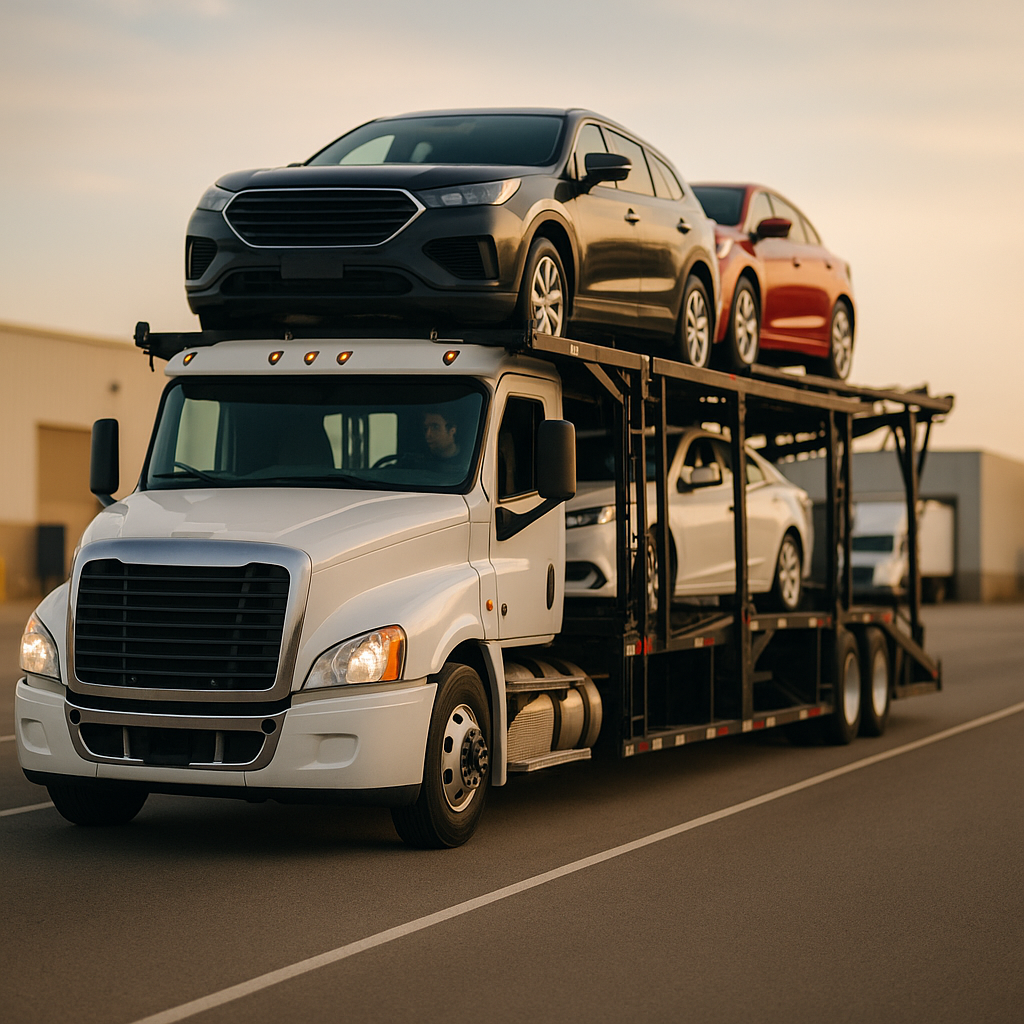

See the typical 2026 3 car hauler insurance cost per month, what coverages you actually need, why rates vary, and how to lower premiums—get a quote.
3 car hauler insurance cost in 2026 usually lands around $800–$1,800 per month per truck for established for-hire operators with clean records, and $1,500–$3,000+ per month if you’re a new authority, running tougher lanes, hauling higher-value vehicles, or buying higher limits. Those ranges assume a broker-ready package (not “liability only”).
If you want the broader baseline on coverages and filings, start with this pillar guide on car hauler insurance cost per month, coverages, and FMCSA requirements. This article stays focused on the 3-car setup: realistic price ranges, what moves the premium, the coverage checklist brokers expect, and cost-cutting moves that don’t create claim gaps.
Key Takeaways: Essential 3-Car Hauler Insurance Cost Facts
- Budget range (per truck): Often $800–$1,800/month (established) or $1,500–$3,000+/month (new authority / higher-risk profile).
- Biggest price levers: authority age, garaging ZIP/state, operating radius (local vs OTR), cargo limit, and vehicle values.
- “Cheap” is usually missing coverage: Many low quotes exclude cargo, physical damage, or trailer scheduling.
- Affordable = controlled risk: accurate radius, right cargo limit for max load value, workable deductibles, safety tech, and apples-to-apples shopping.
Table of Contents
Reading time: 8 minutes
- Typical 3 Car Hauler Insurance Cost Per Month (2026)
- What Changes 3-Car Hauler Insurance Cost the Most
- How Much Do 3-Car Hauler Rates Vary by State?
- Required Coverage for a 3-Car Hauler (FMCSA + Broker Reality)
- Coverage Checklist: What You’re Buying (and What It Adds to the Bill)
- Real Example: Sample 3-Car Hauler Premium Breakdown
- How to Lower 3 Car Hauler Insurance Cost (Without Getting Burned)
- Quote Comparison Checklist (Copy/Paste Template)
- Frequently Asked Questions
- Conclusion & Next Step

Typical 3 Car Hauler Insurance Cost Per Month (2026)
In 2026, most for-hire 3-car hauler operators buying a broker-ready policy see roughly $800–$1,800 per month per truck (established) or $1,500–$3,000+ per month (new authority or higher-risk profile). Those numbers move quickly when you change cargo limits, radius, garaging ZIP, driver history, and the type/value of vehicles you carry.
Use the ranges below as a budgeting tool, then confirm your exact limits and filings before you bind.
2026 monthly price ranges (by scenario)
Important: These are per-truck, per-month ranges. Down payments and installment fees can change your cash-flow hit even if the annual premium is similar.
| Scenario (3-car hauler) | Monthly cost (typical range) | What’s driving the number |
|---|---|---|
| Established authority, clean MVR, regional radius, open trailer, moderate cargo limit | $800–$1,800 | Lower claim frequency profile + stable underwriting |
| New authority (first 12 months), clean MVR, regional | $1,500–$3,000+ | New venture surcharge + limited loss history |
| OTR lanes, higher congestion/theft exposure, higher limits | $1,800–$3,500+ | Lane risk + higher severity potential |
| High-value vehicles / higher cargo limit (or enclosed ops) | $2,000–$4,000+ | Cargo limit + claim severity (one loss is big) |
| Tickets/accidents, prior lapses, or major claims | Varies—often “high or declined” | Underwriting appetite shrinks fast |
What that monthly price usually includes (and what it doesn’t)
A realistic car-hauling insurance stack usually includes auto liability, motor truck cargo, and physical damage (comprehensive/collision) on the truck.
What it might not include unless you ask (and confirm on the proposal):
- Trailer coverage: Trailer physical damage often requires a scheduled value.
- General liability: Commonly required for certain shipper contracts or yards.
- Non-trucking liability / bobtail: Depends on how you operate (leased on vs under your own authority) and when you’re “under dispatch.”
- Hired/non-owned auto: If your business ever uses non-owned vehicles.
If a quote looks unbelievably low, it’s usually because something you assumed was included is missing (cargo, physical damage, trailer value, or required COI wording).
What Changes 3-Car Hauler Insurance Cost the Most
Truck insurance pricing is primarily based on loss frequency per mile and loss severity per claim, which is why radius, garaging ZIP, cargo value, and driver history can swing your monthly payment by thousands. A 3-car hauler can be a clean risk or a high-severity exposure depending on the profile you present to underwriters.
Your operation details (the biggest levers)
- Open vs. enclosed: Enclosed often means higher-value vehicles and higher cargo limits, which raises worst-case payouts.
- Operating radius: Local/regional usually prices better than true OTR because exposure (miles) is lower.
- Garaging ZIP: Congestion, theft rates, hail exposure, and medical/legal costs are baked into rating.
- Who you haul for: Some brokers/contract shippers require higher cargo limits and specific COI language.
Cash-flow tip: Don’t claim “100 miles” and then run 900—misstated radius can create underwriting problems and claim headaches.
Driver + business profile (what underwriters look at)
- Authority age: New authority pricing is real—especially in auto transport.
- MVR/PSP/CAB signals: Violations and crashes can raise rates fast.
- Lapse history: Even short lapses can push you into non-standard pricing.
- Verifiable experience: Documented CDL/industry time can help underwriting confidence.
Equipment + limit choices (your “dials”)
- Truck value + physical damage deductible: Lower deductibles typically increase the monthly premium.
- Trailer value: If it isn’t scheduled correctly, you can be exposed in a loss.
- Liability and cargo limits: Higher limits can win loads, but they also raise premiums.
How Much Do 3-Car Hauler Rates Vary by State?
Insurance rates for 3-car haulers can vary significantly by state because states differ on litigation trends, repair and medical costs, theft frequency, and weather losses, even when the trucks and drivers look similar. In practice, your garaging ZIP often matters as much as the state itself.
Here’s a practical “relative index” view (not a promise of pricing):
| State example | Relative cost index | Why it tends to price that way |
|---|---|---|
| Iowa / Nebraska (example) | Low–Medium | Often lower congestion and lower claim frequency |
| Texas (major metros) | Medium–High | High miles, dense lanes, theft exposure in some areas |
| Florida | High | Litigation environment + hurricane exposure + dense traffic |
| California | High | Repair costs + traffic density + claims severity trends |
| Illinois (Chicago area) | High | Congestion + theft + higher severity potential on certain lanes |
Reality check: Two operators “in the same state” can be priced very differently if one garages in a high-theft metro ZIP and the other doesn’t.
Required Coverage for a 3-Car Hauler (FMCSA + Broker Reality)
FMCSA requires for-hire interstate property carriers to carry at least $750,000 in public auto liability coverage under 49 CFR Part 387, but many brokers and shippers commonly require $1,000,000 liability and cargo limits that match your maximum load value. This gap—legal minimum vs. load requirements—is where operators lose loads or get stuck with uncovered exposure.
FMCSA minimums (the legal baseline)
For for-hire interstate trucking, you generally need primary auto liability meeting federal financial responsibility rules, and your insurer may need to file proof of coverage depending on how your authority is set up.
- Legal baseline: Being “compliant” keeps you legal.
- Business baseline: Being “broker-ready” keeps you moving freight.
Broker/shipper requirements (the money-making baseline)
Car hauling often triggers tighter requirements because cargo values are higher and claims can be severe even at low speeds (ramps, straps, loading).
- $1M auto liability: Very common in broker packets and shipper contracts.
- Cargo that reflects max load value: Not your average day—your worst-case day.
- Specific COI wording: Additional insured, waiver of subrogation, and other endorsements may be required.
If your cargo limit is too low, you’ll either lose the load—or accept it and gamble your business.
Coverage Checklist: What You’re Buying (and What It Adds to the Bill)
A broker-ready 3-car hauler insurance package usually combines auto liability, motor truck cargo, and physical damage, with optional coverages like general liability and bobtail/non-trucking depending on how you dispatch and contract. The table below shows how each coverage impacts cost and when it’s commonly needed.
| Coverage | Typical limit/deductible choice | Premium impact | When you need it |
|---|---|---|---|
| Auto liability | Often $750k–$1M+ | Highest | Always (legal + broker requirement) |
| Motor truck cargo | Often $100k–$250k+ (varies by vehicles hauled) | Medium–High | Any for-hire hauling where you’re responsible for vehicles |
| Physical damage (comp/collision) | Deductibles often $1,000–$5,000 | Medium | If you can’t eat a total-loss or major repair bill |
| Trailer physical damage (scheduled) | Based on trailer value | Low–Medium | If trailer value matters to your balance sheet |
| General liability | Often $1M | Low–Medium | Many shipper yards / contracts require it |
| Non-trucking liability / bobtail (situational) | Varies | Low | If you need coverage while not under dispatch (setup-dependent) |
| Uninsured/underinsured motorist | State-dependent | Low–Medium | If you want added protection in higher UM/UIM states |
| Rental/downtime endorsements (if available) | Varies | Low–Medium | If a week down means bills don’t get paid |
Quick checks before you bind (these save people)
- Cargo limit vs. max load value: Insure your worst-case load, not your “average Tuesday.”
- Filings: Confirm filings are included and correct for your authority (don’t assume).
- Trailer scheduling: Confirm the trailer is scheduled at the right value.
Ask for this when you request quotes: “Please show liability, cargo, and physical damage as separate line items so I can compare apples-to-apples.”
Real Example: Sample 3-Car Hauler Premium Breakdown
A typical established regional 3-car hauler policy often allocates roughly 55%–75% of premium to auto liability, 15%–30% to cargo, and 10%–20% to physical damage, with additional variance from fees and payment plans. This example is illustrative to help you understand what you’re paying for—not a guaranteed quote.
Sample operator profile (illustrative)
- Authority: Established (not brand new)
- Driver: Clean MVR, no major losses
- Use: Regional radius (not true OTR)
- Trailer: Open 3-car
- Cargo: Limit selected to match typical max load value (not minimum)
- Truck: Financed (physical damage required)
Example monthly split (how it often shakes out)
| Line item | Estimated share of total | Why it sits there |
|---|---|---|
| Auto liability | 55%–75% | Frequency/severity exposure is biggest |
| Cargo | 15%–30% | Car hauling has higher severity potential |
| Physical damage | 10%–20% | Truck value + deductible selection |
| Fees/installments | Varies | Payment plan can add meaningful monthly cost |
What changes the number fast: If you bump cargo from a bare minimum to a realistic limit for higher-end vehicles, your cargo line can jump—but that’s often what it takes to book better freight and avoid catastrophic out-of-pocket risk.
How to Lower 3 Car Hauler Insurance Cost (Without Getting Burned)
Lowering 3 car hauler insurance cost usually comes from controlling measurable underwriting inputs—radius accuracy, deductible strategy, safety controls, and no coverage lapses—rather than stripping essential coverages like cargo or physical damage. The goal is a premium that’s competitive while still producing a broker-ready COI and claim protection.
Shop the market the right way (apples-to-apples)
When you compare quotes, keep the same:
- Auto liability limit
- Cargo limit
- Physical damage deductibles
- Stated radius and garaging ZIP
- Truck and trailer values
If one quote is cheaper because it quietly reduced cargo or removed physical damage, you’re not comparing insurance—you’re comparing risk transfer.
Use deductibles like a business owner
Higher deductibles can lower the monthly payment, but only if you can actually pay them during a bad week.
- Practical test: Could you cover the deductible and still make the truck payment, fuel, and basic bills?
- Common range: Physical damage deductibles are often $1,000–$5,000, depending on appetite and equipment value.
Reduce claim frequency (this is where rates get better)
Underwriters reward control because frequency is the easiest lever to measure year over year.
- Dash cam
- Telematics or speed governance (if it fits your operation)
- Documented maintenance
- Clean inspection culture (don’t feed CSA problems)
- Secure parking/yard strategy (theft/vandalism claims matter)
Avoid lapses (they’re expensive)
A lapse can push you into non-standard markets, and the higher price often sticks for the next policy term.
Tighten the operation where you can
- Tighten radius if your freight pattern allows it
- Avoid high-loss lanes when you have options
- Be accurate about garaging location
Quote Comparison Checklist (Copy/Paste Template)
A quote comparison checklist prevents “cheap” policies that are missing cargo, physical damage, trailer value, or required endorsements, which is one of the most common causes of rejected loads and surprise claim gaps. Copy/paste the template below into Notes, Google Sheets, or a CSV so you can compare carriers on the same inputs.
3-Car Hauler Quote Comparison Fields
- Carrier:
- Total monthly:
- Down payment:
- Installment fees:
- Auto liability limit:
- Cargo limit:
- Physical damage deductible (comp/collision):
- Truck value (stated):
- Trailer value (scheduled? Y/N):
- Radius (local/regional/OTR):
- Garaging ZIP:
- Filings included (if applicable):
- Endorsements (additional insured, waiver, etc.):
- Exclusions/notes:
- COI turnaround time:
If you want to run this like a business, calculate insurance cost per mile (monthly premium ÷ realistic monthly miles). That number should inform your rate and lane decisions.
Frequently Asked Questions
For 2026 planning and quoting, the FAQ answers below use common broker expectations (like $1M liability) and federal baselines (like $750,000 FMCSA minimum public liability for for-hire property carriers) so you can sanity-check quotes quickly.
Car hauler insurance commonly costs $800–$1,800 per month per truck for established for-hire operators and $1,500–$3,000+ per month for new authorities or higher-risk profiles in 2026. The biggest swing factors are garaging ZIP/state, operating radius (local vs OTR), cargo limit, vehicle values, and driver/claims history. If you’re comparing quotes, confirm you’re looking at the same stack (liability + cargo + physical damage), because “liability only” can look cheap but won’t meet many broker packets. For the broader baseline beyond 3-car specifics, see Logrock’s car hauler insurance cost and coverage guide.
The factors that most affect car hauler insurance premiums are authority age (new venture vs established), garaging ZIP/state, operating radius, cargo limit and vehicle values, and MVR/claims history. After those, equipment values and deductibles can materially change your physical damage premium, and certain lanes (high theft, high congestion) can raise your liability and cargo pricing. If you want a clean comparison, keep limits and deductibles identical across quotes and make sure the stated radius matches how you actually run.
Enclosed transport is usually more expensive to insure because it often involves higher-value vehicles and requires higher cargo limits, which increases worst-case claim severity. Even if an enclosed trailer reduces some weather and road-debris losses, insurers price around the maximum potential payout when a vehicle is damaged, stolen, or totaled while in your care. If you’re moving from open to enclosed, expect cargo limits (and sometimes COI requirements) to increase, and review deductibles and exclusions so the policy matches the loads you’re actually booking.
FMCSA generally requires for-hire interstate property carriers to carry at least $750,000 in public auto liability coverage under 49 CFR Part 387, and your insurer may need to provide proof of coverage (filings) depending on your authority and operation. That federal minimum is a compliance baseline, not a broker-ready baseline, because many brokers/contract shippers commonly require $1,000,000 liability and cargo limits tied to the maximum value you haul. Always confirm the exact COI requirements on the rate confirmation before you accept the load.
You lower 3 car hauler insurance cost by keeping quotes apples-to-apples (same limits/deductibles), choosing deductibles you can actually pay (often $1,000–$5,000 for physical damage), and reducing claims with controllable steps like dash cams, telematics, secure parking, and disciplined maintenance. Avoid coverage lapses, because a lapse can push you into non-standard markets and raise premiums for a full policy term. If your operation allows it, tightening radius and avoiding higher-loss lanes can also help without cutting the coverages brokers require.
A 3-car hauler setup is typically more expensive to insure than a 1-car setup because it increases exposure and potential cargo value per trip, which raises claim severity. However, the comparison that matters is cost relative to revenue and miles: a stable, well-run 3-car operation with clean history can have a better “cost per car moved” than a smaller but higher-risk operation. To compare fairly, keep the same liability limit (often $1M for brokers) and cargo limit based on maximum load value.
Car haulers often carry cargo limits starting around $100,000, but many operations need $150,000–$250,000+ depending on the maximum value of vehicles they may have on the trailer at one time. The correct way to pick a limit is to insure the worst-case load value, not your average, because the claim payout is based on what was damaged in that specific incident. If you occasionally haul higher-end vehicles, set your cargo limit to match that reality—or you’ll end up either losing loads or self-insuring the gap.
Conclusion & Next Step: Price It Right, Insure It Right
In 2026, a realistic 3 car hauler insurance cost is usually $800–$1,800/month per truck for established operators and $1,500–$3,000+/month for new authorities or higher-risk setups. The biggest levers are state/ZIP, radius, authority age, cargo limit, and loss history.
Key Takeaways:
- Buy coverage to match broker requirements and your maximum load value, not just legal minimums.
- Compare quotes apples-to-apples (same limits/deductibles), or you’ll “save money” by deleting coverage.
- Control premiums long-term by controlling losses (safety tech, clean record, no lapses, accurate radius).
If you want the broader overview of how coverages stack for auto transport, revisit the pillar guide: car hauler insurance cost per month, coverage, and FMCSA requirements.





