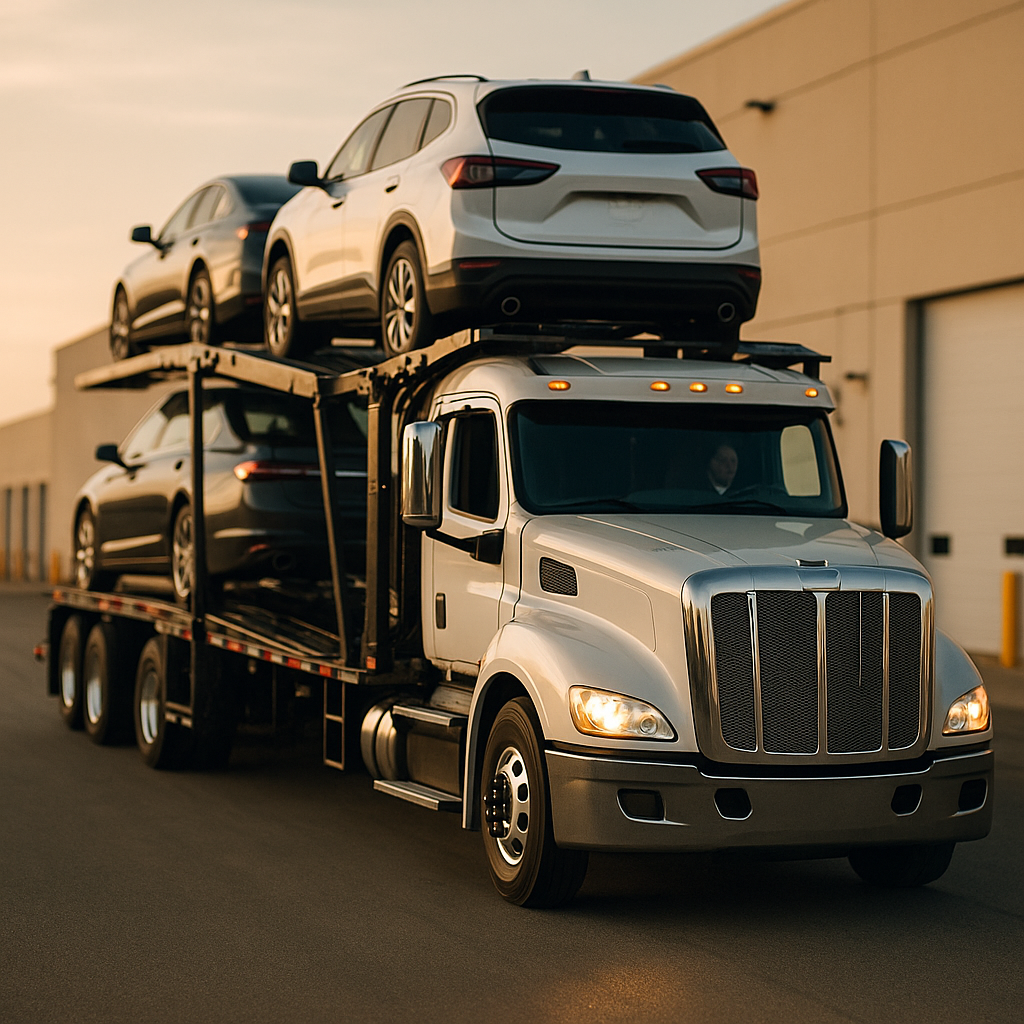
Auto hauler insurance in 2026 typically costs $700–$1,500+ per month per truck. Learn the coverage types that matter for car hauling, what FMCSA filings (BMC‑91/BMC‑91X, MCS‑90) actually do, and how to lower premiums without creating gaps—then get a matched quote.
Auto hauler insurance in 2026 commonly lands around $700–$1,500+ per month per truck for many for-hire owner-operators, with higher pricing for new authority, enclosed/high-value loads, long radius, weak MVR/PSP, or higher cargo limits. Auto hauling is rated differently than general freight because one claim can involve multiple vehicles, higher severity, and contract-driven coverage requirements.
This guide covers realistic cost ranges, required vs. “you’ll lose the account without it” coverages, and the FMCSA filings that can stall your authority if they’re wrong—even when you’ve paid your premium.
Key Takeaways: Essential Auto Hauler Insurance
- Budget reality: Plan on $700–$1,500+ per month per truck for many auto haulers (often more for new ventures, enclosed, and higher cargo limits).
- Your biggest exposure isn’t your tractor—it’s the cars: Vehicle-in-transit/cargo is where claims get ugly fast due to value concentration.
- FMCSA filings aren’t the same as “having insurance”: A COI doesn’t help if your BMC‑91/BMC‑91X filing isn’t submitted correctly.
- Fastest way to lower premium: Improve what underwriters rate—driver profile, loss runs, radius, cargo limits, securement controls, and telematics.
Table of Contents
Reading time: 10 minutes
- What Is Auto Hauler Insurance (and Who Needs It)?
- Auto Hauler Insurance Cost Per Month in 2026 (Realistic Ranges)
- What Drives Auto Hauler Insurance Pricing (Underwriting Factors)
- Coverage Types for Auto Haulers (Required vs Commonly Needed)
- Coverage Limits: How Much Do You Really Need?
- FMCSA Requirements & Filings (BMC‑91, MCS‑90, and More)
- How to Lower Auto Hauler Insurance Premiums (Loss-Control Playbook)
- Sample 2026 Pricing Scenarios (By Hauler Type + Region)
- Auto Hauler Insurance FAQ
- Why Logrock (What You Should Demand From Any Agent)
- Conclusion & Get a Matched Quote
What Is Auto Hauler Insurance (and Who Needs It)?
Auto hauler insurance is a commercial truck insurance package built for transporting vehicles where a single incident can damage multiple units and trigger high-severity cargo claims.
If you’re hauling cars, you’re not “just another general freight policy.” Underwriters typically view car hauling as higher severity because loads are handled constantly, damage disputes are common, and contracts often demand specific limits and forms.
Definition: why vehicle hauling is rated differently
Plain-English definition: Auto hauler insurance combines liability coverage, coverage for your truck and trailer, and vehicle-in-transit (cargo) coverage for the cars you’re transporting.
- High value concentration: Several vehicles on one load can create six-figure exposure fast.
- More “touch points”: Frequent loading/unloading and tight lots increase minor-damage frequency.
- Claims disputes: Pre-existing damage arguments often require photos and documented condition reports.
Own authority vs leased-on: who buys what
Carriers operating under their own MC authority are typically responsible for the full insurance stack and the FMCSA liability filing, while leased-on owner-operators often rely on the motor carrier for primary liability but still need gap coverages.
Verify in writing who carries primary auto liability, who carries vehicle-in-transit/cargo, and how deductibles are handled (including who pays them).
Auto Hauler Insurance Cost Per Month in 2026 (Realistic Ranges)
Auto hauler insurance cost per month in 2026 is commonly $700–$1,500+ per truck for many for-hire owner-operators, and it’s often $1,500–$3,000+ per truck for new authority with higher cargo limits and longer radius.
When you see ultra-low quotes online, they’re often missing key pieces (like proper filings, adequate cargo limits, or a comparable deductible/coverage form).
Typical monthly range per truck (2026)
- $700–$1,500+ per month per truck: common range for many for-hire auto haulers.
- $1,500–$3,000+ per month per truck: not unusual for new authority, higher limits, long radius, or weaker driver history.
- Enclosed/high-value operations: often higher due to theft/weather assumptions and higher load values.
Pricing by hauler type (sanity-check your quote)
| Hauler Type | Typical Risk Profile | Common 2026 Monthly Range (per truck) | Why it moves |
|---|---|---|---|
| Hotshot (1–2 vehicles) | Lower concentration, often new venture | $700–$1,800+ | New authority, MVR/PSP, radius, prior coverage |
| Open multi-car (3–7+ vehicles) | Higher severity from stacked value | $900–$2,500+ | Cargo limit, claims history, lanes/weather |
| Enclosed carrier | Highest value per unit + theft/hail concerns | $1,200–$3,500+ | High limits, security controls, contract requirements |
Mini “cost calculator” inputs to have ready
Accurate quotes come faster when you provide the same underwriting inputs every market will ask for.
- Garaging ZIP + operating states + typical lanes
- Radius: local, regional, or OTR
- Authority age: new venture vs established
- Driver info: years CDL, MVR/PSP, prior claims, prior coverage
- Equipment list: tractor and trailer values
- Operation: open vs enclosed, max vehicles per load
- Load values: max value per vehicle and max total load value
- Limits & deductibles: liability/cargo limits and deductible targets
What Drives Auto Hauler Insurance Pricing (Underwriting Factors)
Auto hauler insurance pricing is primarily driven by authority age, driver history (MVR/PSP), operating radius, loss runs, cargo limit severity, and how often you load/unload in tight environments like auctions and dealerships.
If you want lower premiums, focus on what underwriters rate—not what sounds good in a sales pitch.
Driver & authority profile
Underwriters price both your claim likelihood and your stability as a business, and new authority is commonly surcharged because there’s limited operating history.
- New venture surcharge: lack of history often pushes you into higher-priced markets.
- MVR/PSP patterns: repeated speeding, following too close, or lane violations can spike premium.
- Continuous coverage: lapses can hurt eligibility and pricing.
- Loss runs: frequency and severity both matter.
Operational factors that create claims
- Radius and lanes: longer runs usually mean higher exposure.
- Delivery environment: tight dealership lots and residential streets increase backing and turn claims.
- Loading/unloading frequency: more touches equals more damage opportunities.
- Parking: unsecured lots raise theft/vandalism risk.
Equipment & cargo value concentration
Open vs enclosed and your maximum load value are often bigger pricing levers than operators expect.
- Trailer type/value: specialty trailers can be expensive to repair.
- Max cars per load: stacking increases severity.
- Deductibles: higher deductibles can lower premium, but only if cash flow can absorb the hit.
Coverage Types for Auto Haulers (Required vs Commonly Needed)
Coverage types for auto haulers usually include primary auto liability (often required for authority), vehicle-in-transit/cargo for the cars you haul, and physical damage for your tractor and trailer, with several contract-driven add-ons.
This is where operators most often overspend or buy a policy that looks fine until a claim happens.
Primary Auto Liability (the must-have)
Primary auto liability pays for bodily injury and property damage you cause to others in an at-fault crash, and it’s the coverage tied to your FMCSA financial responsibility filing.
- Practical reality: Many brokers and shippers commonly require $1,000,000 CSL on the COI.
- Business note: The cheapest option isn’t helpful if it can’t meet account requirements.
Vehicle-in-transit / Motor Truck Cargo (where claims get expensive)
Vehicle-in-transit (cargo) coverage is designed to cover the vehicles you’re hauling, and it’s often the make-or-break line for auto haulers because load values can stack into six figures quickly.
Example exposure: 5 cars at $45,000 each is $225,000 before disputes, storage, or downtime issues even show up.
Common exclusions and conditions to read twice
- Unattended/unsecured parking: theft and vandalism conditions vary by insurer.
- Improper securement: strap/chain procedures can be a claims battleground.
- Wear/tear and mechanical failure: often excluded, leading to arguments about “existing damage.”
- Loading/unloading claims: frequently disputed and sometimes limited by form wording.
- Weather (hail) and theft: may have special conditions, especially for open carriers.
Physical Damage (tractor + trailer)
Physical damage (comprehensive and collision) covers your truck and trailer, and it’s commonly required by lenders when equipment is financed.
Even if the unit is paid off, it’s your income machine—one loss without coverage can stop your business.
General Liability (often contract-required)
General liability covers non-auto claims (like premises/operations exposures), and many auctions, terminals, and brokers require it in their contract package.
Garagekeepers (only if you store vehicles)
Garagekeepers coverage can apply to customer vehicles while they’re in your care, custody, and control at a location (yard/lot), and it matters if you keep vehicles overnight or stage them.
Optional: Bobtail / Non-trucking liability (mostly leased-on)
Bobtail/non-trucking liability can help prevent coverage gaps when you’re operating the tractor off-dispatch, but the exact trigger depends on policy wording and the lease agreement.
Coverage Limits: How Much Do You Really Need?
Coverage limits for auto haulers should be set by (1) broker/shipper contract requirements and (2) your worst-case load value, not by the cheapest premium you can find.
Limits that don’t match your real exposure are just uninsured risk with a monthly payment attached.
Match limits to contracts and worst-case scenarios
- Liability: For many for-hire operations working with brokers, $1,000,000 CSL is the practical floor for getting loads.
- Cargo / vehicle-in-transit: Set it to your maximum total load value, not your average.
Quick rules of thumb (practical, not perfect)
- If your max load value is $220,000, a $100,000 cargo limit isn’t “saving money”—it’s rolling uninsured exposure.
- If you never haul over $120,000, buying $500,000 cargo may be wasted premium unless your contracts demand it.
- If you’re trying to grow, align limits to the accounts you want next—not just what you haul today.
FMCSA Requirements & Filings (BMC‑91, MCS‑90, and More)
FMCSA financial responsibility for many for-hire interstate property carriers is commonly tied to a federal public liability minimum of $750,000, and the proof is submitted through insurer filings such as BMC‑91/BMC‑91X rather than a COI or ID card.
Filings issues are a real cash-flow killer: you can pay for coverage and still be unable to run if the filing isn’t accepted.
BMC‑91 / BMC‑91X (proof-of-liability filing)
BMC‑91/BMC‑91X is a filing your insurer submits to the FMCSA to show you meet the required liability financial responsibility for your authority.
- Why it matters: Incorrect or missing filings can delay activation or cause authority status issues.
- Common mistake: Confusing a COI with the FMCSA filing—different document, different purpose.
MCS‑90 endorsement (what it is—and what it is not)
The MCS‑90 endorsement is a federal endorsement attached to certain liability policies to protect the public, and it does not replace cargo or vehicle-in-transit coverage.
If you assume MCS‑90 “covers the cars,” you can end up paying a cargo loss out of pocket.
Leased-on vs own authority (common confusion)
- Leased-on: The motor carrier often carries primary liability and handles filings, but you should verify the lease terms and the carrier’s coverage.
- Own authority: You’re responsible for liability plus filings, and you still need cargo and the rest of the coverage stack.
Not legal advice—confirm details with your agent and, if needed, a compliance professional.
Sample 2026 Pricing Scenarios (By Hauler Type + Region)
Sample auto hauler pricing scenarios are useful for understanding what drives premium, but they are not guarantees because final pricing depends on MVR/PSP, loss runs, garaging, lanes, limits, deductibles, and market availability.
Use these examples to sanity-check whether your quote “makes sense” for your setup.
Scenario A: New authority hotshot, regional radius
- Setup: new venture, 1-ton + 2-car trailer, regional lanes, modest cargo limit.
- Why price can be high: new authority plus limited prior commercial insurance history.
- Typical result: can land near the top of the hotshot range despite fewer cars.
Scenario B: Established open multi-car operator, strong loss runs
- Setup: 3–7 car open carrier, 2–3 years authority, clean loss history, disciplined securement.
- Why price can be controlled: proven history, stable lanes, and documented controls.
- Typical result: mid-range pricing with better market options.
Scenario C: Enclosed carrier hauling high-value vehicles
- Setup: enclosed trailer, higher cargo limit, higher vehicle values, stricter contracts.
- Why price increases: severity, theft/weather exposure, and higher limit requirements.
- Typical result: higher premium, but also higher revenue potential if controls match the risk.
Frequently Asked Questions
Auto hauler insurance typically covers three core areas: auto liability for injuries/property damage you cause, vehicle-in-transit (cargo) for the cars you’re hauling, and physical damage (comp/collision) for your tractor and trailer. Many operations also add general liability because terminals, auctions, and brokers often require it in contracts. If you store or stage vehicles in a yard/lot, you may also need garagekeepers because that exposure is separate from “in transit.” Coverage details and exclusions vary by form, so confirm loading/unloading, theft, and hail conditions in writing.
In 2026, many for-hire owner-operators see $700–$1,500+ per month per truck for auto hauler insurance, and $1,500–$3,000+ per month is common for new authority with higher cargo limits and longer radius. Pricing usually moves most with authority age (new venture surcharge), MVR/PSP and loss runs, operating radius/lane mix, cargo limit severity (max load value), and deductible choices. Open vs enclosed also matters because enclosed loads often involve higher per-unit values and theft/weather assumptions. The only fair comparison is apples-to-apples limits, deductibles, and filings.
For many own-authority interstate for-hire property carriers, FMCSA financial responsibility for public liability is commonly tied to a $750,000 federal minimum, and brokers frequently require $1,000,000 CSL to book loads. Your insurer must also submit the appropriate proof-of-liability filing (commonly BMC‑91/BMC‑91X) for your authority to stay active. Vehicle-in-transit/cargo is not usually an FMCSA “authority filing” requirement, but it’s practically essential for auto hauling and often required by shipper/broker contracts due to high cargo values. Always confirm contract requirements before setting limits.
Most own-authority for-hire interstate carriers need their insurer to file proof of required liability coverage with FMCSA, commonly through BMC‑91 or BMC‑91X, depending on how the filing is submitted. Many liability policies also include the MCS‑90 endorsement, which is designed to protect the public and is not cargo insurance for the vehicles you haul. If you’re leased-on to a motor carrier, the carrier often handles primary liability and filings, but you should verify this in the lease and confirm what coverages you still need personally (like physical damage or non-trucking/bobtail). Filing errors can delay authority even when premium is paid.
You can lower auto hauler insurance premiums by reducing claim frequency/severity and proving it to underwriters with documented controls over 6–12 months. Start with a written securement SOP, retension checks, and time-stamped pickup/drop photos to reduce “existing damage” disputes and loading/unloading claims. Add forward-facing dashcams, GPS tracking/geofencing, and a simple coaching process so your operation looks managed, not ad hoc. Then improve submission quality at renewal: provide current loss runs, a clean unit/driver list, and consistent radius/lane details. Raise deductibles only to a level you can pay without stressing cash flow, and right-size cargo limits to true max load value.
Why Logrock (What You Should Demand From Any Agent)
A competent auto hauler insurance agent should be able to explain your cargo form, key exclusions, and FMCSA filing timeline in plain English, because misunderstandings here can create six-figure gaps.
Auto hauling is specialized, and generalist quoting can leave you exposed without you realizing it.
Demand this in writing
- Matched quotes: same limits, deductibles, and forms so you can compare apples-to-apples.
- Clear cargo explanation: vehicle-in-transit form, exclusions, and how claims are handled.
- Filing support: realistic FMCSA filing timelines so authority doesn’t stall.
- Premium plan: a 6–12 month roadmap (controls + renewal strategy), not “pay it and pray.”
If an agent can’t explain it quickly and clearly, you’ll pay for that later—either in premium or in a denied claim.
Conclusion: Get the Right Auto Hauler Insurance, Then Earn Better Rates
Auto hauler insurance is a cash-flow decision and a survival decision. Buy coverage that protects your authority, your equipment, and the vehicles you’re hauling—then use documented controls to push rates down over time.
Key Takeaways:
- Expect $700–$1,500+ per month per truck in 2026 for many auto haulers; new authority/enclosed/high limits can run higher.
- Don’t confuse an insurance card with FMCSA filings; a missing or incorrect BMC‑91/BMC‑91X can keep you from running.
- Your best premium levers are loss control, documentation, telematics, and clean renewal submissions.