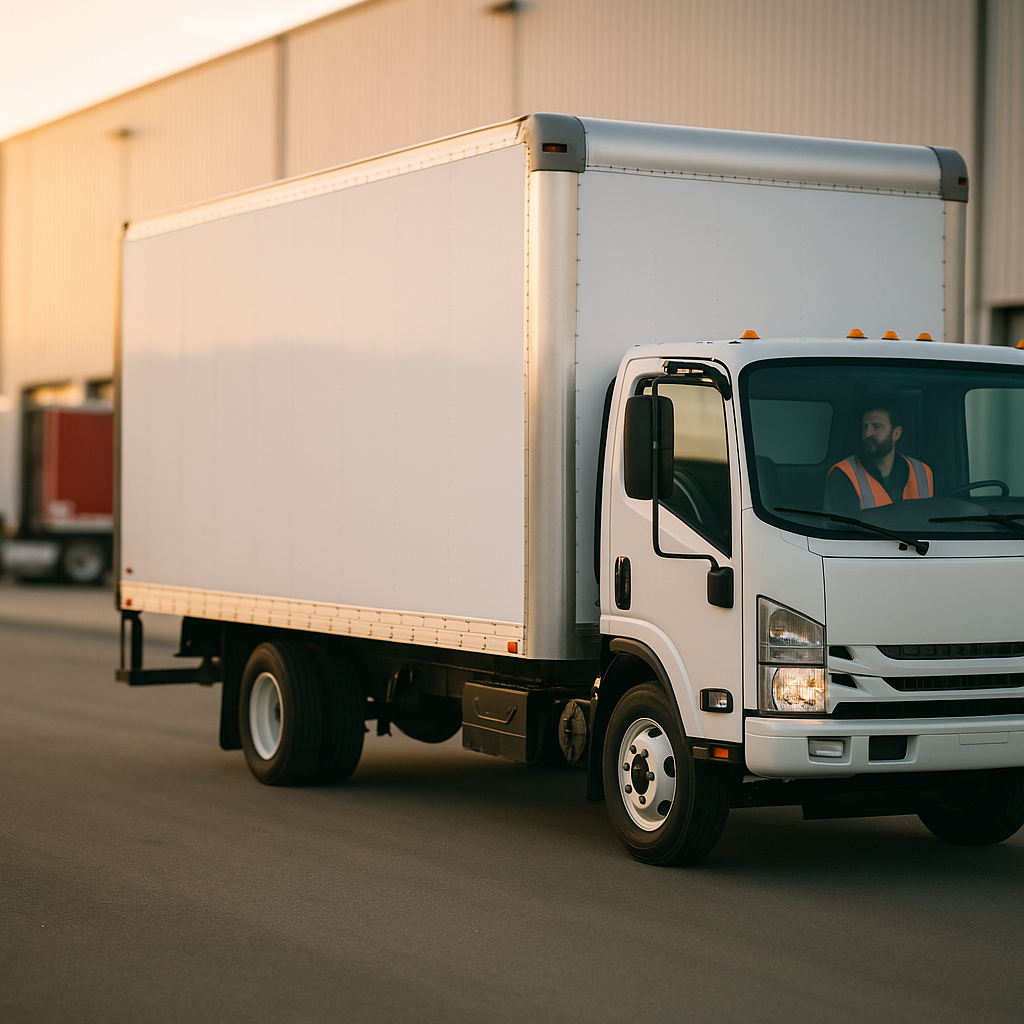
Compare the best box truck insurance in 2026. See real cost ranges, required coverages, and a buying checklist to get the right policy fast—get a quote.
Best box truck insurance in 2026 isn’t “one top company”—it’s the right coverage setup for your operation (moving vs. last-mile vs. contractor), your radius, your cargo, and what brokers/shippers require on a COI.
Featured snippet answer: Box truck insurance typically includes commercial auto liability (injuries/property damage you cause) plus physical damage (comprehensive/collision) for your truck. Many box truck businesses also add cargo coverage, general liability, and hired/non-owned auto depending on who drives and what you haul. Required limits depend on your state, interstate/for-hire status, and contract requirements.
Your box truck can be profitable all week—until one claim, one rejected COI, or one “you’re not covered for that” call wipes out cash flow. This guide shows how to compare quotes apples-to-apples, what 2026 pricing typically looks like, and a checklist to avoid getting upsold, underinsured, or delayed at dispatch.
Key Takeaways: Essential Best Box Truck Insurance (2026)
- “Best” means best fit: your truck size, radius, cargo, and contract requirements matter more than brand names.
- Most box truck policies are built from 5 parts: liability, physical damage, cargo (often), general liability (often), and endorsements.
- Cheap can be expensive: if your COI fails requirements or exclusions trigger a denial.
- You can lower premiums: by reducing risk on paper (telematics, dash cams, driver controls, accurate radius, deductibles + a reserve).
Table of Contents
Reading time: 11 minutes
- Which Companies Offer the Best Box Truck Insurance in 2026?
- Box Truck Insurance Cost (2026): Typical Monthly and Annual Ranges
- What Does Box Truck Insurance Cover? (Required + Optional Coverages)
- Box Truck Insurance Requirements (Federal, State, and Contract)
- What Factors Affect Box Truck Insurance Premiums?
- How to Lower Box Truck Insurance Costs (Advanced 2026 Strategies)
- Real-World 2026 Pricing Scenarios (What Operators Might Pay)
- Buying Checklist: How to Get the Best Policy (Not Just the Cheapest)
- Why Work With a Box-Truck-Specialist Agency (Not a Generalist)
- Frequently Asked Questions
- Conclusion & Get a Quote
Which Companies Offer the Best Box Truck Insurance in 2026?
The best box truck insurance company in 2026 is the one that will write your exact operation, issue COIs quickly (including additional insureds), and offer pricing that matches your risk profile.
Most “best insurance company” lists are really popularity contests. In the real world, the “best” insurer is the one that can insure your lane—moving vs. courier vs. contractor—without exclusions that break your contract or kill a claim.
How we define “best” (criteria you can verify)
A fair comparison method is to judge every quote on underwriting appetite, claims strength, coverage flexibility, COI support, and apples-to-apples price.
- Underwriting appetite: some carriers love local courier, some avoid moving, and some won’t touch high-theft cargo.
- Claims reputation + financial strength: you need the carrier to pay promptly, not stall.
- Coverage flexibility: cargo options, GL packaging, HNOA, downtime/rental, towing/labor.
- Operations support: fast COIs, additional insured, waiver of subrogation, after-hours help.
- Price competitiveness: new venture vs. established, urban vs. rural, multi-driver vs. single driver.
“Best by scenario” quick picks (what to shop for)
Shopping by scenario works better than chasing a brand name because box truck underwriting changes by cargo, stops, radius, and where the truck sleeps at night.
| Scenario | What “best” usually means | What to ask for |
|---|---|---|
| Local courier / last-mile | Strong commercial auto pricing for short radius + frequent stops | Accurate radius/mileage rating, backing-loss controls, fast COIs |
| Moving / furniture / appliance delivery | Better packaging of auto + cargo + general liability | Cargo limits matching load values + GL for carry-in exposure |
| Contractor/service box truck (tools/equipment) | Physical damage + liability with optional tools/equipment coverage | Tools/inland marine if needed, garaging/security credits |
| Multi-driver / small fleet (2–10 trucks) | Fleet safety controls + driver management | Driver list controls, MVR standards, telematics discounts |
| High-value cargo / high theft areas | Underwriter willing to write + strict controls | Security requirements, parking/storage plan, higher deductibles |
Provider comparison table (what to compare line-by-line)
Comparing box truck insurance rates correctly means matching limits, deductibles, valuation, and exclusions—not just the monthly payment.
| Line item | Why it matters | What to match across quotes |
|---|---|---|
| Liability limit | Brokers/shippers often require $1M | Same limit + same structure (CSL if offered) |
| Physical damage | One comp claim can crush cash flow | Same deductibles + valuation method (ACV vs. stated) |
| Cargo | Required to get work in many lanes | Same limit, same deductible, same exclusions |
| General liability | Many losses aren’t “auto” | Same limit + same covered operations |
| Endorsements | This is where claims get denied | HNOA, reefer/spoilage, rental/downtime, towing/labor |
Box Truck Insurance Cost (2026): Typical Monthly and Annual Ranges
Box truck insurance in 2026 commonly ranges from $250 to $1,600+ per month per truck (about $3,000 to $20,000+ per year), depending on drivers, garaging ZIP, radius, truck value, and required limits.
Pricing is wide because your risk is wide. A 16′ local contractor truck isn’t the same risk as a 26′ metro mover making 12 stops per day with tight backing and customer-property exposure.
Typical 2026 cost ranges (what most buyers see)
- $250 to $1,600+ per month for many box truck operations
- $3,000 to $20,000+ per year depending on limits, truck value, drivers, and state
Reality check: If you’re a new venture in a high-claim metro with $1M liability, physical damage, and cargo, you’ll usually land toward the higher end.
Cost ranges by operation type (planning numbers)
| Operation type | Typical monthly range | Why it lands there |
|---|---|---|
| Local service/contractor (tools, light hauling) | $250–$800 | Lower miles/radius and simpler cargo needs |
| Courier/last-mile delivery | $400–$1,100 | Stop frequency + urban exposure drives liability |
| Moving/furniture/appliances | $700–$1,600+ | Carry-in risks + cargo + GL frequently required |
| Refrigerated / temp-sensitive (if applicable) | $900–$2,000+ | Higher cargo scrutiny + endorsements |
| Multi-driver / small fleet | Varies | Driver quality often controls pricing more than the truck |
Costs by box truck size/class (GVWR & box length)
| Common setup | What changes in underwriting | Typical impact |
|---|---|---|
| 12–16′ (often Class 3–4) | Lower weight, often lower stated value | Usually cheaper if radius is tight |
| 20–26′ (often Class 5–7) | Higher truck value + bigger claim severity | Usually higher, especially in metro lanes |
Why your quote jumps 20–40%+ (common triggers)
- New venture: limited history and no prior commercial coverage.
- Driver MVR issues: speeding, following too close, at-fault losses.
- Higher limits: many contracts require $1,000,000 liability and specific cargo minimums.
- Garaging ZIP: theft, vandalism, and claim frequency are priced heavily.
- Lapse in coverage: even short lapses can spike premiums.
What Does Box Truck Insurance Cover? (Required + Optional Coverages)
Box truck insurance coverage is typically built from five components—liability, physical damage, cargo, general liability, and endorsements—so the “right policy” depends on how you operate and what your contracts demand.
Think of coverage as a stack. Liability is the foundation. Everything else protects your truck, your cargo, and your ability to keep rolling without a cash-flow crater.
1) Commercial auto liability (the foundation)
Commercial auto liability pays for injuries and property damage you cause with the box truck and usually includes legal defense costs.
- Why it’s essential: a serious accident can exceed state minimums quickly, and contracts often require more.
- Who needs it: everyone operating a box truck commercially.
- Common contract target: $1,000,000 because many brokers/shippers require it.
2) Physical damage (comprehensive + collision) for the truck
Physical damage covers repair or replacement of your box truck after collision, theft, vandalism, fire, hail, and similar losses, subject to deductibles and valuation terms.
- Why it’s essential: financed/leased trucks typically require it, and one total loss can end a small operation.
- Who needs it: anyone who can’t replace the truck out of pocket tomorrow.
Practical rule: pick deductibles you can pay without skipping maintenance or payroll, then keep a reserve to match.
3) Motor truck cargo (when you need it—and what it won’t cover)
Motor truck cargo insurance covers customer cargo you’re responsible for if it’s damaged or lost during transport, based on your policy’s terms, limits, and exclusions.
- Why it’s essential: many brokers/shippers won’t load you without cargo coverage.
- Who needs it: if you haul other people’s goods for money, especially under contract.
Common denial triggers to ask about up front:
- Unattended vehicle/theft conditions: parking rules and lock requirements matter.
- Improper packing/loading: a frequent issue in moving and furniture work.
- Excluded commodities: electronics, alcohol, and other high-theft items may be limited or excluded.
- Temperature/spoilage: typically requires an endorsement if you have reefer exposure.
4) General liability (GL) for non-driving risks
General liability (GL) covers third-party bodily injury and property damage claims that aren’t caused by operating the vehicle, such as many loading/unloading or “inside the building” incidents.
Example: you’re carrying a refrigerator and gouge hardwood floors or crack a doorway—GL is often where that claim lands.
5) Hired & non-owned auto (HNOA) + common endorsements
Hired and non-owned auto (HNOA) provides liability protection when your business uses vehicles it doesn’t own, such as employee personal vehicles for errands or rented/borrowed vehicles.
- Who needs it: operations with helpers using personal cars for business tasks or any regular rental/borrowed vehicle exposure.
Other endorsements to discuss: towing & labor, rental reimbursement/downtime, trailer interchange (if applicable), and reefer breakdown/spoilage (if applicable).
Box Truck Insurance Requirements (Federal, State, and Contract)
Box truck insurance requirements come from three sources—state law, federal FMCSA rules for certain interstate/for-hire operations, and broker/shipper contracts—and the contract layer is often the one that determines whether you can get dispatched.
1) What’s required by law (state minimums)
State minimum commercial auto liability limits vary by state and are often too low to satisfy real-world severity or broker/shipper contracts.
- What it is: your state’s minimum required auto liability.
- Why it’s risky: “legal minimum” and “enough to keep your business alive” are different numbers.
2) What’s required federally (when FMCSA rules apply)
FMCSA financial responsibility rules generally require $750,000 in public liability for for-hire interstate carriers hauling non-hazardous property in vehicles over 10,001 lbs GVWR (see 49 CFR 387.9), with higher minimums (often $1,000,000 or $5,000,000) for certain hazardous materials.
FMCSA compliance also ties into whether you operate interstate, whether you’re for-hire, and whether you need filings connected to operating authority.
Practical guidance: if you cross state lines for hire, confirm your USDOT/authority/filing needs with a specialist—guessing can cost you loads and create compliance headaches.
3) What’s required to get work (brokers/shippers)
Broker and shipper COI requirements commonly demand $1,000,000 auto liability plus specific COI wording, and missing wording can get a load rejected even if you “have insurance.”
Common COI requests:
- $1M auto liability (often non-negotiable)
- Cargo minimums (varies by lane/commodity)
- Additional insured
- Waiver of subrogation
- Primary & noncontributory wording
If COI turnaround is slow, you lose dispatch time. Time is money.
What Factors Affect Box Truck Insurance Premiums?
Box truck insurance premiums are primarily driven by driver MVR/claims, garaging location, radius/mileage, stop frequency, truck value, and the limits/deductibles you choose.
Underwriters price box truck insurance the same way you price freight: risk, exposure, and loss history.
1) Driver profile
Driver profile includes MVR, years of experience, prior losses, age, CDL vs. non-CDL (varies by state/carrier), and the number of drivers on the policy.
2) Business profile
Business profile includes years in business, prior commercial coverage, lapses/cancellations, and how mature your safety process is on paper.
New ventures often pay more because there’s no track record.
3) Truck profile
Truck profile includes model year, stated/actual cash value, safety tech, theft attractiveness, and where the truck is parked/garaged.
4) Operation profile
Operation profile includes radius, annual mileage, stop frequency, urban vs. rural exposure, cargo type, and loading/unloading details.
A tight urban route with lots of backing is not automatically “cheap” just because it’s local.
How to Lower Box Truck Insurance Costs (Advanced 2026 Strategies)
Lowering box truck insurance costs in 2026 usually comes from reducing priced risk—using documented safety controls, accurate radius/mileage, secure parking, and deductible choices backed by real cash reserves.
It’s not about begging for a discount or switching carriers every six months. It’s about showing underwriters you’re a safer bet.
Rate-reduction moves that actually work
Underwriters give the best pricing to operators who can prove they have fewer losses, faster claims resolution, and fewer theft/backing incidents.
- Dash cams + written coaching policy: “we have cameras” matters less than how you use footage.
- Telematics/usage-based programs: where available, this can validate low miles and safer driving.
- Back-up/spotter policy: reduces backing losses in tight docks and residential moves.
- Driver standards in writing: MVR thresholds, onboarding checklist, probation periods.
- Secure parking plan: fenced/controlled lot, lighting, GPS tracking, immobilizers.
- Raise deductibles strategically: only if you keep a repair reserve fund.
Shopping strategy: how to compare quotes correctly
Comparing quotes correctly means matching the terms that drive claim outcomes, not just matching the monthly payment.
- Match liability: same limit and same structure.
- Match physical damage: same deductibles and valuation method.
- Match cargo: same limit, deductible, and major exclusions.
- Match GL: same limit and covered operations.
- Match fees: installment fees can quietly inflate “cheap” quotes.
Timing tip: start quoting 30–45 days before renewal/effective date so you’re not forced into last-minute pricing.
Real-World 2026 Pricing Scenarios (What Operators Might Pay)
Real-world box truck insurance scenarios in 2026 typically fall within the $250–$1,600+ per month per truck range, but final pricing depends heavily on state, drivers, truck value, claims history, and required coverages.
These examples are for budgeting—not promises.
Example 1: 26′ moving/delivery in a major metro (higher exposure)
Setup: $1M liability, physical damage on a higher-value truck, cargo + GL, frequent stops/backing.
Why it costs more: higher claim frequency environments + carry-in exposures + cargo handling.
Typical result: often toward the upper end of the monthly ranges.
Example 2: 16′ local contractor/service routes (lower mileage)
Setup: $1M liability, physical damage, minimal/no cargo, tight radius, low annual miles.
Why it can cost less: less exposure—if garaging and drivers are clean.
Typical result: can land toward the lower-to-middle range.
Example 3: refrigerated or high-value deliveries (special scrutiny)
Setup: higher cargo limits, possible reefer/spoilage endorsement, stricter security requirements.
Why it costs more: higher severity risk + tighter exclusions + higher limit needs.
Typical result: higher premiums and stricter underwriting conditions.
Buying Checklist: How to Get the Best Box Truck Insurance Policy (Not Just the Cheapest)
A box truck insurance buying checklist reduces quoting delays and pricing mistakes by making sure your VIN, garaging ZIP, radius, drivers, cargo values, and contract wording are accurate before underwriting starts.
If you want speed and accuracy, five minutes of prep saves hours of back-and-forth and prevents bad assumptions that jack up price.
Before you quote (5 minutes of prep)
Bring this information:
- Truck info: VIN, year/make/model, garage ZIP, estimated annual miles
- Value & financing: ACV expectation and lender/lease requirements
- Drivers: DOB, license numbers, years of experience, violations/accidents
- Operation: radius, states, stop count, delivery type, loading/unloading details
- Cargo: max value on the truck at one time + commodity list
- Contracts/COI wording: required limits + AI/WOS/PNC (if required)
When reviewing quotes (dealbreakers)
- Liability limits: match your contracts (not just state minimums).
- Physical damage deductibles: you can actually pay them.
- Cargo exclusions: don’t silently kill your lane.
- GL included: if you enter customer property or handle goods.
- COI process: turnaround time affects dispatch and revenue.
After binding (avoid expensive surprises)
- Confirm COI requests: where to send them and expected turnaround.
- Driver changes: add/remove drivers properly (don’t “forget” helpers).
- Renewal timing: start early so you aren’t forced into last-minute pricing.
Why Work With a Box-Truck-Specialist Agency (Not a Generalist)
Box truck insurance often requires coordinating commercial auto, cargo, and general liability so your COI wording matches contracts and common claim scenarios don’t fall into coverage gaps.
Box truck insurance sits in a weird lane between “commercial auto” and “true trucking,” and generalist agents can miss the operational details that decide whether a claim is covered.
What a specialist helps you do
- Avoid gaps: between auto vs. GL vs. cargo.
- Get COIs right: additional insured, waiver of subrogation, primary & noncontributory.
- Present risk cleanly: so underwriters can price you fairly, especially as a new venture.
- Match your real operation: radius, stops, garaging, drivers, and what you actually haul.
Frequently Asked Questions
These FAQs answer the most common box truck insurance questions, including 2026 cost ranges of $250–$1,600+ per month per truck and how coverages like $1M liability, physical damage, cargo, and general liability fit together.
Box truck insurance usually covers commercial auto liability plus physical damage (comprehensive and collision) for the truck, and many operations add motor truck cargo and general liability based on contract requirements and how you handle property.
For many for-hire jobs, brokers and shippers commonly require $1,000,000 auto liability on the COI, and moving/white-glove delivery often needs GL for “inside the building” damage. If you use rented vehicles or employees’ personal cars for business errands, hired & non-owned auto (HNOA) helps close that liability gap.
Box truck insurance in 2026 often costs $250 to $1,600+ per month per truck (roughly $3,000 to $20,000+ per year), depending on drivers, garaging ZIP, radius, stop frequency, truck value, and required limits.
New ventures, high-claim metro areas, and operations that need $1M liability plus physical damage, cargo, and GL tend to price toward the higher end. The most reliable way to estimate is to compare multiple quotes with the same limits, deductibles, and endorsements, so you’re not accidentally comparing different coverage.
The best box truck insurance company is typically the one that has an underwriting appetite for your exact operation (courier, moving, contractor, high-theft cargo) and can issue COIs quickly with the wording your contracts require.
Instead of chasing one carrier name, ask for 3–5 options and compare apples-to-apples: liability structure (often $1M), physical damage valuation (ACV vs. stated), cargo exclusions, whether GL is included/needed, and how fast endorsements like additional insured or waiver of subrogation can be issued. That’s what decides dispatch speed and claim outcomes.
The biggest box truck insurance premium drivers are driver MVR/claims, garaging location, radius and annual mileage, stop frequency, truck value, and your limits/deductibles.
Lapses in coverage and prior cancellations can also raise rates quickly because they signal instability to underwriters. Operational details matter too: moving and white-glove work often adds GL exposure, and certain commodities can tighten cargo terms. If you want a clean quote, be precise on radius, parking/security, and driver history—those inputs often change the premium more than anything else.
You can lower box truck insurance costs without underinsuring by reducing priced risk with documented controls like dash cams + coaching, telematics, written driver standards, secure parking, and accurate radius/mileage reporting.
Pick higher deductibles only if you keep a repair reserve that can actually pay them, because “high deductible + no cash” turns small claims into business-ending problems. Shopping early also matters: starting quotes 30–45 days before renewal helps avoid rushed placements and limited carrier options. The goal is cheaper premiums with the same real protection, not cheaper premiums with exclusions that break your lane.
Conclusion & Get a Quote
The best box truck insurance in 2026 is typically a $1,000,000 liability policy paired with physical damage and, when contracts require it, cargo and general liability that match your actual operation and COI wording needs.
Buy for fit, not just price. Separate “legal minimum” from “minimum to get work,” and compare quotes with identical limits, deductibles, endorsements, and exclusions.
Key Takeaways:
- Buy for fit: operation, radius, cargo, stops, and garaging drive coverage and price.
- Plan for contracts: many lanes require $1M liability and specific COI wording.
- Compare apples-to-apples: match limits, deductibles, valuation, endorsements, and exclusions.
If you want help building a clean quote request so you get real numbers fast, start by comparing multiple box-truck-friendly markets with the same coverage structure.