
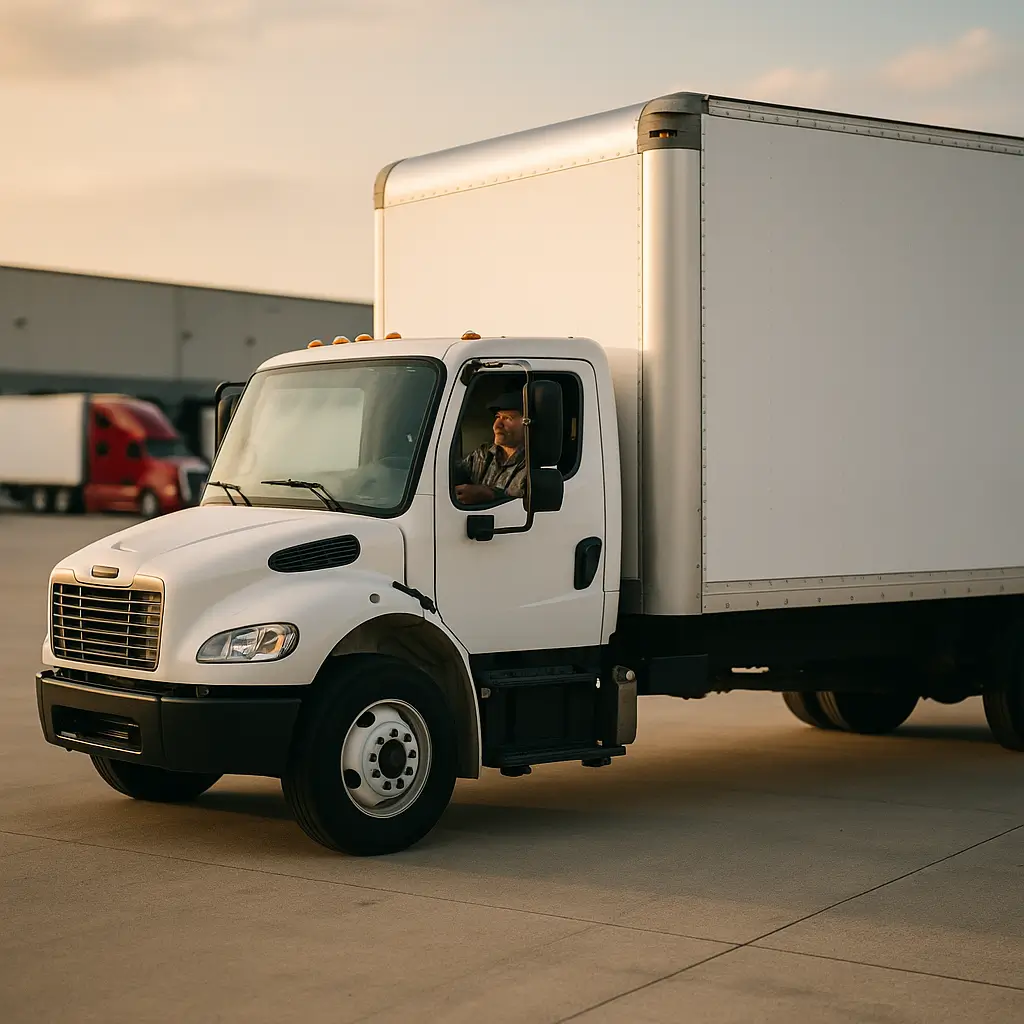
Compare box truck insurance companies, 2026 costs, required coverages, FMCSA vs. intrastate rules, and savings tips.

Best box truck insurance in 2026 usually costs about $450–$1,800+ per month per truck for most owner-operators and small fleets, depending on radius, garaging ZIP, driver history, cargo type/value, truck value, and new venture/new authority status.
If your box truck is how you pay your bills, insurance isn’t paperwork—it’s what keeps one fender-bender from turning into a cash-flow problem that ends the business.
Table of Contents
Reading time: 11 minutes
- What “Best Box Truck Insurance” Really Means
- Coverage Checklist: Required vs Optional
- 2026 Cost Benchmarks + Simple “State” Matrix
- What Affects Rates (Underwriter’s Checklist)
- FMCSA vs Intrastate Requirements (What’s Actually Required)
- Best Box Truck Insurance Companies (2026): Best-For Categories
- How to Get Cheap Box Truck Insurance (Without Getting Burned)
- New Venture / New Authority: First 90-Day Playbook
- Common Mistakes That Cost More Later
- Frequently Asked Questions
- Why Logrock’s Approach Is Different
- Conclusion & Get a Quote
What “Best Box Truck Insurance” Really Means (and How to Choose the Right Fit)
In commercial trucking, the “best box truck insurance” is the policy that meets common contract limits (often $1,000,000 auto liability), protects your truck and income, and stays valid when a claim happens.
A lot of articles try to name a “#1” insurer, but trucking insurance doesn’t work that way—your routes, cargo, and contract requirements determine what “best” means.
Best for who? Match the insurer to your operation
Box truck risks aren’t all the same, and insurers price them differently:
- Local last‑mile / final‑mile: Frequent stops, backing, tight lots, and higher claim frequency (even small claims).
- Moving / household goods: More loading/unloading exposure and often higher general liability needs.
- Courier / expedited: Time pressure, night deliveries, and higher theft exposure.
- Interstate for-hire: More miles, more states, more compliance, and stricter COI review.
A simple scorecard to compare quotes
When you compare commercial truck insurance quotes, use the same scorecard every time so you’re not comparing different products.
| Scorecard Item | What to check (practical) |
|---|---|
| Total cost | Down payment + monthly + fees (not just “monthly”). |
| Liability strength | Limit (often $1M) + exclusions that can kill contracts. |
| Cargo | Limit + deductible + theft/unattended vehicle language. |
| Physical damage | Agreed value vs ACV, deductible, rental/downtime options. |
| Claims/uptime | Repair network and how towing/storage delays get handled. |
| New venture appetite | Will they write you if you’re new—and at what terms? |
Box Truck Insurance Coverage You Need (Required vs. Optional)
Commercial auto liability is the legal baseline in most places, but many box truck operators need a “working” package that includes liability + cargo + physical damage to stay contract-ready and solvent after a loss.
Minimum legal coverage and the coverage you need to stay in business are not always the same thing.
Coverage checklist (quick table)
| Coverage | What it protects | Who needs it | Typical “real world” note |
|---|---|---|---|
| Auto liability | Injuries/property damage you cause | Everyone | Many contracts want $1M CSL |
| Cargo | Customer’s goods in your care | If hauling others’ goods | Limits vary by commodity/value |
| Physical damage (comp/collision) | Your truck | Financed/leased (and smart even if paid off) | Deductible choice matters |
| General liability (GL) | Non-auto claims (premises/operations) | Common contract requirement | Often needed for moving/installation |
| Workers’ comp / occ/acc | Driver injuries | Employees/1099 setups | State rules vary |
| Hired & non-owned | Liability for rented/borrowed vehicles | If you rent/borrow | Commonly overlooked |
| Rental / downtime | Cash flow while truck is down | Owner-operators | Critical if one truck = one income |
1) Primary liability (often $750K–$1M+ depending on operation)
Primary liability pays for bodily injury and property damage to others if you cause a crash, and many shipper/broker packets require $1,000,000 even when a lower minimum might apply.
- Pro tip: Quote the same liability limit with every carrier (usually $1M) or you’re not comparing pricing fairly.
Before choosing your liability limit, it helps to understand exactly what auto liability pays for—and what it won’t:
2) Cargo insurance (if you’re hauling other people’s stuff)
Cargo insurance covers the freight you’re responsible for while it’s in your care, custody, and control—cargo insurance limits for box trucks typically run $100K–$500K depending on what you haul.
- Pro tip: Read the “unattended vehicle” and “secure location” wording; it can decide whether a theft claim gets paid.
3) Physical damage (comprehensive + collision)
Physical damage repairs or replaces your truck if it’s stolen, vandalized, hit by weather, or wrecked, and lenders/lessors commonly require it for financed equipment.
- Pro tip: Pick a deductible you can pay during a slow week; the deductible is real money at the worst time.
4) General liability (GL)
General liability covers many non-auto third-party claims (for example, certain property damage during delivery not caused by the vehicle), and it’s frequently required for moving, white-glove, and in-home delivery work.
If you’re unsure where auto liability ends and general liability begins for your box truck operation, this breakdown covers the key differences:
5) Optional coverages that often matter for box trucks
- Hired & non-owned auto: If you rent a vehicle or drivers use personal vehicles for work tasks.
- Rental reimbursement / downtime: Keeps revenue moving while the truck’s in the shop.
- Towing/roadside: Storage and towing bills can climb fast after a loss.
- Equipment/inland marine: Liftgate, pallet jack, straps, tools, and other gear.
Tip: When you request a quote, have your routes, cargo, truck value, and contract requirements ready so the COI comes back compliant the first time.
How Much Does Box Truck Insurance Cost in 2026? (Benchmarks + Simple “State Cost Matrix”)
In 2026, a typical “working” box truck insurance package often lands around $650–$1,800+ per month per truck, while liability-only can run $300–$900 per month depending on risk factors.
Pricing is state- and ZIP-sensitive, but you still need planning numbers for cash flow.
2026 cost benchmarks (use ranges, not fairy tales)
- Liability-only: $300–$900/month
- Liability + cargo: $450–$1,300/month
- “Working” full package: $650–$1,800+/month
What makes you land on the high end fast
- New venture/new authority
- Metro delivery exposure (dense traffic, frequent backing)
- High theft areas or high-value cargo
- Poor MVR or prior losses
- Higher truck value + low deductibles
Simple “state cost matrix” (how to think about it)
Instead of pretending there’s one accurate price per state, budget using a matrix of cost drivers.
| Pricing Driver | Lower-cost tendency | Higher-cost tendency |
|---|---|---|
| Garaging | Rural/suburban ZIP | Dense metro ZIP |
| Litigation | Lower lawsuit frequency | High litigation / severe verdict venues |
| Theft | Lower theft exposure | Cargo/theft hotspots |
| Operations | Local predictable routes | High-mileage, irregular routes |
Bottom line: Your ZIP + radius + operation typically matter more than the name on the policy.
What Affects Box Truck Insurance Rates (The Underwriter’s Checklist)
Commercial auto underwriters typically rate box truck insurance using at least 6 core inputs: garaging ZIP, operating radius, driver MVR/experience, loss history, vehicle value/type, and cargo/operation classification.
Your job is to give clean, consistent details so the underwriter doesn’t price you like a worst-case scenario.
Vehicle factors
- Specs: GVWR/class, box length, liftgate
- Model year and value
- Safety tech: dashcam, GPS tracking, telematics, ABS, stability control
- Parking: secured yard vs street parking
Dashcams are one of the fastest ways to signal lower risk to underwriters—here’s what to know before you buy one:
Driver + business factors
- MVR: speeding, reckless, DUI, at-fault losses
- Commercial experience: years driving commercially (even non-CDL experience can matter)
- Insurance history: continuous coverage helps
- Driver count: number of drivers and who they are
- New venture/new authority: limited history = higher uncertainty
Operations + cargo factors
- Radius: 0–50 miles vs 500+ miles
- Exposure: night deliveries, high-traffic routes, lots of backing
- Cargo: type/value and loading/unloading exposure
- Contract requirements: additional insured, waivers, endorsements
If contracts also require GL, see general liability for trucking businesses for what to expect on limits and cost.
If you prefer to hear the breakdown, this video walks through everything underwriters look at when pricing your policy:
Practical move: Create a one-page “quote packet” (VIN, garaging ZIP, radius, cargo description, driver list, loss history, and contract limits). It speeds up quoting and cuts down on mistakes.
FMCSA vs. Intrastate Requirements for Box Trucks (What’s Actually Required)
For-hire interstate carriers hauling non-hazardous property generally face an FMCSA federal liability minimum of $750,000, per FMCSA financial responsibility rules, while certain hazardous materials can require $1,000,000 or $5,000,000 depending on the commodity.
This is where box truck operators get burned, because “a box truck” can be purely intrastate—or it can be interstate for-hire with federal compliance and filings.
Interstate (FMCSA) basics
If you operate as a for-hire interstate carrier (and your vehicle/operation falls into regulated categories), you may need federal financial responsibility compliance and active coverage to keep running loads. Review box truck liability insurance requirements if you’re unsure whether your operation falls under federal minimums or state-only rules.
Proof of insurance filings (what your insurer files vs what you carry)
- Filings: When filings apply, insurers typically file proof electronically through the FMCSA L&I portal; filing type depends on authority and cargo.
- Day-to-day docs: You’ll still need insurance ID cards and COIs for customers—different documents, different purpose.
Intrastate: why requirements can differ
Intrastate-only operations can follow state-specific rules and minimums, but contracts can still demand $1,000,000 liability and cargo coverage regardless of state minimums.
Rule of thumb: Buy insurance based on (1) legal requirements, (2) contract requirements, and (3) balance-sheet risk—in that order.
Best Box Truck Insurance Companies (2026): Who They’re Best For
In 2026, most box truck operators and small fleets get the best results by comparing 3+ quotes across different carrier “types,” because underwriting appetite changes by state, operation, and driver history.
There isn’t one universal winner; availability and pricing depend on where you run and what you haul.
Build a “best-for” comparison table
| Category | Often “best for” | What to watch |
|---|---|---|
| Large commercial carriers | Broad appetite, scalable coverages | Can be strict on MVR and new ventures |
| Digital broker platforms/marketplaces | Fast quoting, multiple options | Confirm endorsements/COI language match contracts |
| Regional/specialty trucking markets | Niche operations, certain cargo | Limited states and tighter guidelines |
| Small-business insurers (GL-heavy) | Operators needing stronger GL | May not be best on auto/cargo pricing |
How to compare quotes apples-to-apples
Lock the variables below, or you’ll get quotes that look cheaper because something important is missing.

- Same liability limit (often $1M)
- Same cargo limit and deductible
- Same physical damage deductible
- Same radius and annual mileage
- Same driver list and experience
- Same cargo description (misclassification becomes a claim problem)
How to Get Cheap Box Truck Insurance (Without Getting Underinsured)
The cleanest way to lower box truck premiums is to shop multiple quotes with identical limits and deductibles, then reduce risk (radius, drivers, safety tech) instead of stripping coverage.
Cheap is good; underinsured is not.
1) Shop the market the right way
- Get multiple quotes (or use a broker with multiple markets).
- Provide consistent info so you don’t get garbage pricing.
2) Right-size deductibles (based on cash reserves)
Higher deductibles can lower premium, but they only work if you can pay the deductible without skipping repairs or avoiding legitimate claims.
3) Use safety tech underwriters respect
- Dashcams with driver coaching
- Telematics (hard braking, speed, following distance)
- GPS tracking/theft recovery
Keep documentation; underwriters like proof.
4) Tighten your radius and be honest
If you quote 0–50 miles but actually run 200-mile days, you’re setting up a coverage fight when a loss happens.
5) Avoid lapses
Lapses often reduce carrier options and increase pricing. Treat renewal dates like compliance deadlines—because they are.
New Authority / New Venture: First 90-Day Playbook
Many trucking insurers treat new venture trucking insurance differently—typically 0–2 years in business and/or no prior commercial auto coverage, which usually means fewer markets and stricter terms early on. If you already have new authority and are shopping your first policy, the same logic applies.
You can’t manufacture a track record overnight, but you can reduce uncertainty fast.
1) Bring receipts
- Prior insurance declarations pages (if you have them)
- Loss history (clean or not—disclose it accurately)
- Driver experience summaries
2) Run tight operations early
- Start local/regional before expanding radius
- Avoid high-theft/high-value cargo until you’ve built history
- Keep driver count low and qualified
Watch this if you’re in your first 90 days with new authority—it covers what auto liability actually means for new carriers:
3) Act like a carrier with a safety program
- Written safety policy (simple is fine)
- Preventive maintenance logs
- Dashcam policy and coaching notes
Underwriting is risk + trust. Your paperwork builds trust.
Common Box Truck Insurance Mistakes (That Cost More Later)
The most expensive box truck insurance mistake is buying a policy that fails a contract requirement (often $1,000,000 liability plus cargo/GL), because you’ll end up re-shopping mid-term and losing work.
- Buying minimum limits that fail a contract → rewrite mid-term, pay fees, risk downtime.
- Wrong classification (wrong radius/cargo/use) → claim disputes and denied COIs.
- Underinsuring truck value → payout doesn’t replace the truck.
- Skipping downtime exposure → “covered” but broke while the truck’s in the shop.
- Letting coverage lapse → fewer options, higher rates.
Frequently Asked Questions
In 2026, many box truck owner-operators pay about $450–$1,800+ per month per truck, with liability-only often closer to $300–$900 per month depending on risk. Pricing is driven by garaging ZIP, operating radius, driver MVR and experience, prior losses, cargo type/value, truck value, and whether you’re a new venture/new authority. A “working” package (liability + cargo + physical damage) usually costs more than liability-only, but it’s what most contract-driven operations need to avoid rejected COIs and cash-flow problems after a loss.
You need commercial auto liability at a minimum, and many contracts require $1,000,000 even if a lower legal minimum could apply. If you haul other people’s goods, you typically need cargo insurance with a limit and deductible that match what you’re actually carrying. If the truck is financed/leased—or you can’t replace it out of pocket—you also need physical damage (comprehensive and collision). Many delivery and moving contracts also require general liability (GL) and specific endorsements, so the contract language should drive the final checklist.
Not necessarily. Most box trucks under 26,001 lbs GVWR don’t require a CDL to operate under federal rules, and insurers can write commercial auto coverage for non-CDL drivers. However, if the truck is over the non-CDL weight threshold, or if you’re operating under certain state rules, CDL requirements may apply. Either way, insurers will ask about driver license class and commercial driving experience during quoting—non-CDL doesn’t mean non-commercial, and the underwriting process is the same.
Motor truck cargo insurance can cover theft, but the specific policy language matters—a lot. Most cargo policies include language about “unattended vehicles” or require the cargo to be in a “secure location” for a theft claim to be paid. If your truck is left unlocked, parked on a public street overnight, or if the location doesn’t qualify as “secure” under the policy definition, the claim may be denied. Before binding coverage, ask your agent to walk you through the theft exclusions and what qualifies as a covered location. Review box truck cargo insurance limits for more detail.
Agreed value means the insurer pays a pre-set amount for your truck if it’s a total loss—no depreciation applied. Actual cash value (ACV) means the payout reflects what the truck was worth at the time of the loss, factoring in age and depreciation. For newer or high-value box trucks, agreed value is usually worth the slightly higher premium because you know exactly what you’ll get. ACV policies can leave a gap between the payout and what it actually costs to replace the truck, especially if equipment prices have increased.
It depends on how the damage happens. Physical damage to your truck (for example, backing into a dock) is typically covered under commercial auto. But damage to a customer’s property during loading or unloading that isn’t caused by the vehicle itself often falls outside auto liability and into general liability (GL) territory. Some cargo policies also include loading/unloading coverage, but exclusions vary. Moving companies and last-mile operators with regular in-home delivery exposure often need both cargo and GL to be fully covered for loading/unloading incidents.
General liability covers third-party claims that fall outside your commercial auto policy — things like property damage during a delivery that wasn’t caused by the vehicle itself, slip-and-fall incidents, or certain in-home delivery mishaps. For many box truck operators, it’s optional by law but not optional in practice: moving companies, white-glove delivery services, and operators doing in-home or installation work are frequently required to carry GL by their contracts or the facilities they access. If your work is purely curb-drop delivery with no in-home exposure, you may not need it right away — but your shipper or broker contract is the place to check, not the legal minimum. See general liability for trucking businesses for limits and cost ranges.
You get cheap box truck insurance by comparing multiple quotes with identical limits, deductibles, radius, and cargo description so you’re not accidentally buying a weaker policy. After that, the biggest premium levers are raising deductibles to a level you can afford, tightening radius if your operation allows it, keeping a clean MVR and loss history, and adding safety tools like dashcams, telematics, and GPS tracking (with documentation). Avoid coverage lapses; even a short lapse can reduce carrier options and increase pricing at renewal.
Garaging ZIP is one of the first things underwriters look at — it tells them where the truck is based overnight, which signals exposure to theft, accident frequency in that traffic environment, and local litigation patterns. A truck garaged in a dense metro ZIP (especially in a high-litigation state) can cost significantly more to insure than an identical truck based in a rural or suburban ZIP, even with the same driver history and cargo. This matters most for the physical damage rate and the liability base rate. If you do have the option to keep the truck in a lower-risk location overnight (a secured yard vs. street parking in a dense area), that can genuinely reduce your rate — and it’s worth documenting with your insurer.
A lapse—even a short one—can have real consequences. If you have active motor carrier authority, a coverage lapse can trigger a notice to FMCSA and potentially suspend your ability to operate under that authority until coverage is reinstated. Even without authority, a lapse reduces your carrier options at renewal and often raises your rate because insurers treat a gap as higher risk. Treat renewal deadlines the way you treat registration deadlines: missing them has downstream costs.
An additional insured is a party added to your insurance policy who gets some protection under it — typically the shipper, broker, or facility owner that hired you. When a broker or shipper requires you to list them as an additional insured on your COI, they’re protecting themselves from claims that arise from your operations. For box truck operators, this is a standard contract requirement and not a red flag — but it does mean your insurer has to issue a COI with that language included. The important thing is to confirm your policy actually allows additional insured endorsements before you sign a contract, and to make sure the COI your insurer issues matches the exact entity name the contract specifies. A mismatch (even a minor one) can get a COI rejected.
Every driver on your policy is run through an MVR check, and their record directly affects your rate. A driver with a clean history often has minimal impact; a driver with recent violations or at-fault losses can increase your premium or trigger a carrier exclusion — meaning that driver won’t be covered under that policy. Owner-operators with only one driver (themselves) have the most control here. If you’re adding employees or subcontractors, expect the underwriter to ask for a full driver list and MVRs before quoting. The safest approach is to vet drivers before adding them and remove drivers who no longer operate your truck — listed-but-inactive drivers still carry rating weight with some carriers.
FMCSA insurance requirements can apply when you operate as a for-hire interstate carrier in regulated categories, and federal liability minimums are commonly $750,000 for non-hazardous property and can be $1,000,000 or $5,000,000 for certain hazardous materials depending on what you haul. Separately, many brokers and shippers still require a $1,000,000 COI regardless of federal minimums. If your operation requires filings and your coverage lapses, you can lose the ability to run under that authority until coverage is reinstated. For full details, see the FMCSA financial responsibility requirements.
Yes, but your options narrow and your rate will reflect the risk. Carriers treat MVR violations and prior at-fault losses as signals of future claim likelihood—the more recent and severe the history, the fewer markets will quote you, and those that do will price it higher. The best move is to be accurate and upfront during quoting. Hiding violations or losses can result in a denied claim or a cancelled policy, which is far worse than a higher premium. Some specialty markets write higher-risk drivers; a broker who works multiple markets is usually the right path here.
The best box truck insurance company depends on your state, routes, cargo, driver history, and whether you’re a new venture, because underwriting appetite varies by carrier and territory. The most reliable way to pick is a scorecard approach: compare total cost (down payment + fees), liability limit (often $1M), cargo terms, physical damage valuation, and claim handling—using identical inputs across quotes. If one quote is dramatically cheaper, it’s often due to a different radius, missing endorsements, a lower cargo limit, or exclusions that can get a COI rejected.
Why Logrock’s Approach Is Different: Insurance as a Cash-Flow Tool
Most box truck operators need coverage that passes COI review quickly—often with $1,000,000 auto liability plus the cargo/GL terms their contract requires—so they can keep the truck moving and the revenue steady.
That’s the lens we use: keep you compliant, keep you covered, and reduce downtime risk (because downtime is what hurts most small operations).
Related Reading
- Commercial auto liability limits: Box Truck Liability Insurance: 2026 Minimums ($750K–$1M)
- Cargo insurance basics: Box Truck Cargo Limits (2026): $100K–$500K
- How to lower trucking insurance premiums: Lower Trucking Insurance Premiums: 11 Ways to Save (2026)
Conclusion & Get a Quote
The best box truck insurance in 2026 is the coverage that meets legal rules and common contract demands (often $1,000,000 liability), protects your truck and cash flow, and doesn’t surprise you with exclusions when something goes wrong.
If you want a real comparison, the key is keeping quote inputs consistent and building the policy around your actual routes and cargo.
Key Takeaways:
- Pick coverage based on legal + contract + balance-sheet risk (not just minimum limits).
- Compare quotes apples-to-apples: same limits, deductibles, radius, and cargo class.
- New venture? Tight operations + clean documentation usually improves options faster.
If you’ve worked through this guide and you’re ready to compare real options—or you’re trying to figure out whether your current policy actually holds up against your contract requirements—LogRock can help. Our team works with box truck operators every day: new ventures, renewals, COI reviews, and coverage gaps. Talk to us, ask your questions, and get a quote built around your specific routes, cargo, and driver history.





