
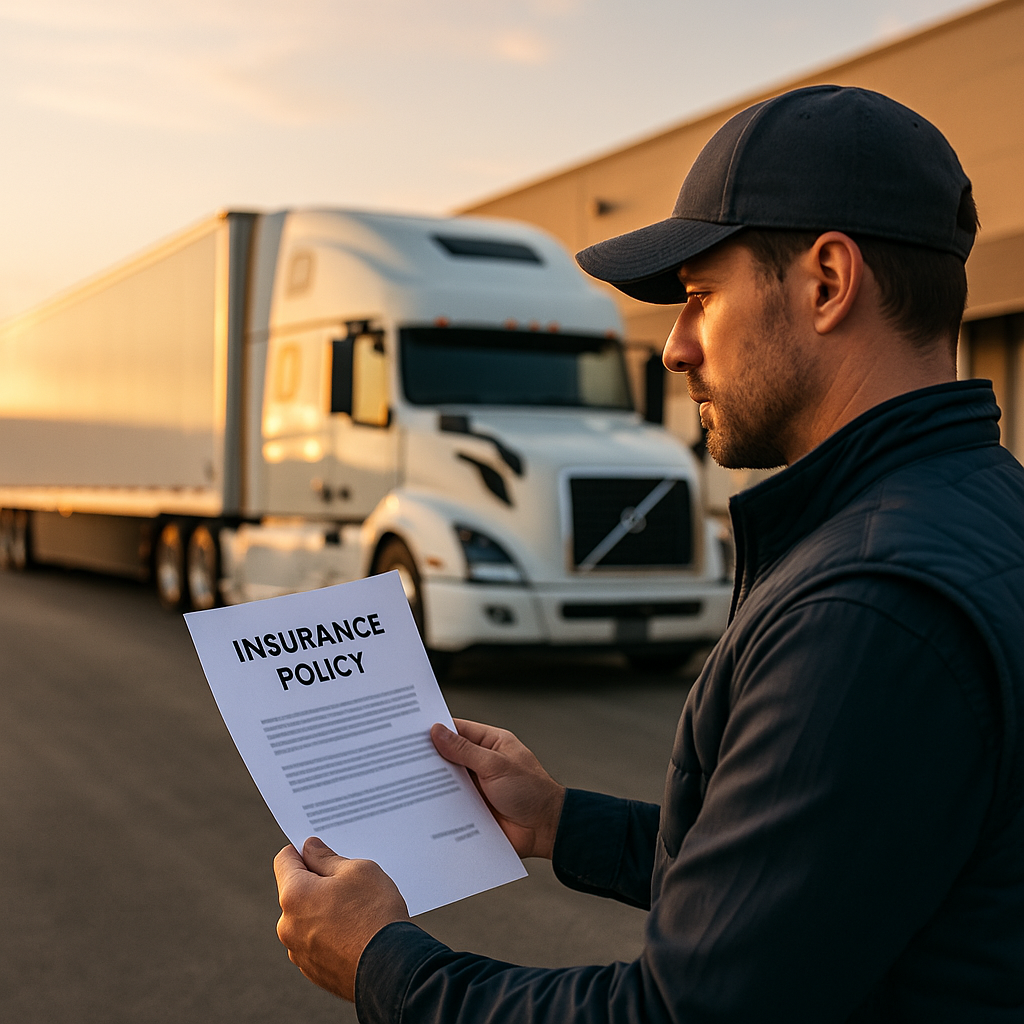
BIPD insurance in trucking covers bodily injury & property damage liability. See FMCSA minimum limits, filings, costs, and common mistakes—then get a quote.

BIPD insurance (trucking) usually means bodily injury + property damage liability—the coverage that pays for injuries and property damage you cause to others, plus legal defense, up to your policy limit. If you’re running under your own authority, it’s the core coverage tied to FMCSA financial responsibility rules and broker onboarding.
Your truck can run perfect all week and still get your business wrecked by one liability claim—because legal defense, medical bills, and property damage stack fast. Most owner-operators don’t get burned by the crash itself; they get burned by wrong limits, wrong filings, or the wrong “BIPD” definition on a Certificate of Insurance (COI), which can delay authority activation or get you rejected by brokers.
Table of Contents
Reading time: 10 minutes
- Key takeaways
- What does “BIPD” mean?
- What BIPD insurance covers
- Is BIPD required for trucking?
- FMCSA minimum BIPD limits (2026)
- Proof of BIPD insurance: filings & MCS-90
- How much BIPD costs
- Common exclusions & denied-claim scenarios
- BIPD vs. other trucking coverages
- Frequently Asked Questions
- Why Logrock
- Conclusion
Key takeaways: essential BIPD insurance (trucking)
BIPD in trucking typically refers to primary auto liability (public liability) that covers third-party bodily injury and third-party property damage.
- BIPD meaning (trucking): Bodily Injury + Property Damage liability (coverage for damage you cause to others).
- FMCSA minimums (property carriers): Commonly $750,000 / $1,000,000 / $5,000,000 depending on commodity/hazmat class (commonly cited under 49 CFR Part 387).
- Proof isn’t just a COI: Your insurer typically files your liability proof electronically; you must verify your legal name, DOT/MC, and operation details match.
- Cheapest can be most expensive: Wrong limits or wrong filings can lead to authority delays, broker rejections, or coverage disputes.
What does “BIPD” mean? (Why the acronym gets confusing)
In trucking compliance and broker onboarding, “BIPD” almost always means Bodily Injury + Property Damage liability (primary auto liability/public liability), not business interruption coverage.
You’ll see “BIPD” used two different ways online, so the safest move is to match what your broker/shipper is actually requesting on the COI.
1) BIPD in trucking = Bodily Injury + Property Damage (liability)
What it is: Third-party liability from an at-fault accident—injuries to other people and damage to their property.
Where you’ll see it: Many COIs won’t say “BIPD.” They’ll say Auto Liability, Primary Liability, or Public Liability.
Why it matters: A serious crash isn’t just a “bad day”—it can become a business-ending cash event if your limit, operation class, or filings are wrong.
2) BIPD in other industries = Business Interruption + (Extra) Expense
What it is: A property/business policy concept that replaces income when a business is shut down (fire, storm, etc.).
How to confirm fast: Look at the line item on the quote/COI—if it says Auto Liability / Primary Liability / Public Liability, you’re in the right lane for trucking.
What BIPD insurance covers (real trucking examples)
BIPD liability covers injuries and property damage you cause to other people, and it typically includes legal defense costs, but it does not pay for your truck repairs or your cargo.
Think of BIPD as “damage I cause outside my cab,” not “damage to my equipment or freight.”
1) Bodily injury: injury or death of others
What it covers: Medical costs and related damages when someone else gets hurt and you’re at fault.
- Ambulance/ER care, surgeries, rehab
- Lost wages / loss of earning capacity
- Pain and suffering (varies by state and claim)
- Legal defense (often a major cost driver)
2) Property damage: damage to other people’s property
What it covers: Repairs or replacement for what you hit.
- Passenger vehicles
- Guardrails, signs, bridges, buildings, docks
- Sometimes cleanup tied to property damage (policy-specific)
What it doesn’t cover: Damage to your tractor/trailer—this is typically handled by physical damage coverage.
3) Settlements and judgments (up to your limit)
How limits work: If you’re found liable, your insurer pays covered damages up to the policy limit (for example, $750,000 or $1,000,000).
In real-world broker freight, a $1,000,000 limit is often required even when $750,000 is legally sufficient for certain operations.
Is BIPD required for trucking? (Interstate vs. intrastate)
FMCSA requires minimum levels of public liability insurance for most for-hire interstate motor carriers, while intrastate-only carriers follow their state’s rules and contract requirements.
Interstate carriers (most common authority situation)
If you cross state lines (or haul interstate freight), you’re typically subject to FMCSA financial responsibility rules.
- Compliance impact: If coverage/proof isn’t on file correctly, your authority may not go active.
- Revenue impact: If your limits don’t meet broker requirements, you may not get loaded even if you’re legal.
Intrastate-only carriers
If you truly stay in one state, that state sets the minimums and filing process (which may or may not mirror FMCSA).
Reality check: Even intrastate, broker/shipper contracts can require higher limits than the legal minimum.
FMCSA minimum BIPD liability limits (2026) — table by freight type
FMCSA public liability minimums for many property carriers are commonly $750,000 (non-hazardous general freight), $1,000,000 (oil and certain hazardous materials), and $5,000,000 (high-hazard hazardous materials), commonly cited under 49 CFR Part 387 (including §387.9).
Even when $750K is legal for your operation, many brokers and shippers require $1,000,000 to tender loads.
FMCSA BIPD minimums (property carriers) — simplified table
| Freight type / operation (common examples) | Common minimum public liability limit | What this means in real life |
|---|---|---|
| General freight, non-hazmat | $750,000 | Legal minimum for many operations, but may not satisfy broker contracts |
| Oil in bulk / certain hazmat classes | $1,000,000 | More expensive to insure; underwriting is typically tighter |
| High-hazard hazmat | $5,000,000 | Specialized markets; expect stricter safety/driver requirements |
Operational truth: If you want access to more broker freight with fewer COI rejections, pricing out $1M primary liability is often the practical move.
Proof of BIPD insurance: filings, MCS-90, and mistakes that delay authority
FMCSA compliance usually depends on an electronic insurance filing from your insurer (not just a COI), and mismatches in legal name, DOT/MC, limits, or operation class can delay authority activation by days or weeks.
This is where new authorities lose momentum—and cash flow—because “I have a policy” isn’t the same as “FMCSA shows me compliant.”
1) What the MCS-90 endorsement is (and what it isn’t)
MCS-90 is a federal endorsement tied to financial responsibility, and it is not a replacement for carrying the correct underlying liability coverage, limits, and properly rated operation.
- Not cargo insurance: It doesn’t cover freight.
- Not physical damage: It doesn’t fix your truck.
- Not a “run anything” pass: It doesn’t make a misclassified operation okay.
2) How proof usually works (what you should verify)
Typical process: you bind a liability policy with the correct limit, then your insurer or filing service submits proof electronically, and FMCSA updates your authority status once all requirements are satisfied.
Brokers often check your authority and insurance status, so don’t assume a PDF COI in your inbox means you’re good.

3) Filing-safe checklist for new authorities (do this before booking loads)
- Legal name match: Your policy must match your authority paperwork (LLC vs Inc vs DBA matters).
- DOT/MC numbers: Verify every digit.
- Operation matches reality: Radius, states, commodity (general freight vs hazmat), units.
- Limits match your freight plan: If your target brokers require $1M, don’t bind $750K and “hope.”
- Verify filing posted: Check your authority status after binding.
- Don’t confuse filings: BOC-3 is a separate process agent filing, not BIPD liability insurance.
How much does BIPD insurance cost? (realistic ranges + pricing factors)
For a single power unit, for-hire operation, and a $1,000,000 limit, BIPD (primary liability) often prices around $10,000–$25,000/year for many new authorities and $6,000–$15,000/year for many established carriers with clean loss history, but hazmat, towing, metro exposure, and losses can push pricing above $25,000/year.
No honest agent can quote you from a blog post, but you can spot what’s “normal,” what needs explanation, and what may be a risk flag.
Typical BIPD (primary liability) premium ranges (ballpark)
- New authority, general freight, $1M limit: often $10,000–$25,000/year
- Established carrier (clean losses), general freight, $1M limit: often $6,000–$15,000/year
- Higher-risk operations (hazmat, tow, certain metros, poor loss history): can be $25,000+/year
What affects the price the most (what underwriters rate)
- New venture/new authority surcharge
- Driver MVR + verifiable experience
- Loss history (frequency and severity)
- Operating radius (local vs regional vs long-haul)
- Garaging state and lanes (litigation environment, crash frequency)
- Commodity (general freight vs hazmat vs auto hauler, etc.)
- Equipment (tractor vs hotshot; trailer type)
- Safety controls (dash cams, telematics, driver coaching)
Ways to lower BIPD premiums without underinsuring
- Shop renewal 60–90 days early (last-minute binds often cost more).
- Keep operations consistent and report changes before you haul a different commodity or radius.
- Use dash cams and document coaching (underwriters like proof, not promises).
- Choose deductibles you can actually fund after a loss.
What usually backfires: Cutting limits below what your target brokers require, because it reduces load access—not just premium.
Common exclusions, grey areas, and denied claims (truck-specific scenarios)
Many trucking liability claim disputes trace back to unlisted drivers, misrepresented operations (radius/commodity), off-dispatch coverage misunderstandings, or late reporting that weakens legal defense.
Every policy is different, but these scenarios consistently create fights, gaps, or non-renewals.
Unauthorized driver / unlisted driver
What happens: Someone runs your truck who isn’t scheduled/approved.
Why it goes bad: Coverage may be limited or disputed depending on driver listing rules and endorsements.
How to prevent it: Tight driver control and fast policy updates.
Misrepresented operation (radius/commodity change)
What happens: You were rated for local general freight; you start running multi-state or hauling higher-hazard commodities.
Why it goes bad: Underwriting can deny, restrict, re-rate after audit, or non-renew.
How to prevent it: Tell your agent before you take the load, not after the claim.
“Off dispatch” confusion (bobtail / non-trucking liability)
What happens: You’re driving without a load and assume it’s “all the same” coverage.
Why it goes bad: Depending on your setup (leased-on vs authority) and policy wording, there can be gaps when you’re not under dispatch or using the truck personally.
How to prevent it: Get clarity on when primary liability applies and whether you need non-trucking liability.
Late reporting / weak documentation
What happens: You delay reporting and ELD/dash cam data gets overwritten.
Why it goes bad: Defense gets weaker, settlements get bigger, and premiums follow.
How to prevent it: Same-day reporting, preserve ELD/dash cam, photos, witness info.
BIPD vs. other trucking coverages (comparison matrix)
BIPD (primary auto liability) is the core third-party liability coverage, while cargo, physical damage, general liability, and umbrella cover different risks and are often required by brokers, shippers, or lenders.
If a broker onboarding packet asks for “BIPD,” they usually mean auto liability—not general liability and not cargo.
| Coverage | What it covers | Who it protects | Who usually requires it | Typical limits (examples) |
|---|---|---|---|---|
| BIPD / Primary Auto Liability | Injury + property damage you cause to others | Your business | FMCSA + brokers/shippers | $750K / $1M / $5M |
| Motor Truck Cargo | Freight you’re hauling (damage/theft, per terms) | Shipper + you | Brokers/shippers | $100K common, varies |
| Physical Damage | Your tractor (and sometimes trailer) for collision/comp | You + lender | Lenders often | Actual cash value / stated value |
| General Liability | Non-auto liabilities (slip/fall, some ops exposures) | Your business | Shippers/warehouses sometimes | $1M common |
| Non-Trucking Liability | Liability when using truck for non-business (policy-specific) | You | Some lease agreements | Often matches auto liability limits |
| Trailer Interchange | Damage to a non-owned trailer in your care | You + trailer owner | Trailer pools/partners | $20K–$50K+ typical |
| Umbrella / Excess | Extra liability above primary | Your business | Some shippers/brokers | +$1M, +$2M, +$5M |
Frequently Asked Questions
BIPD insurance covers third-party bodily injury and third-party property damage when your truck is at fault, and it typically includes legal defense costs within the policy terms and limit. In plain terms, it pays for the other person’s injuries and the other party’s damaged property (cars, guardrails, buildings), up to your limit (for example, $750,000 or $1,000,000). BIPD generally does not pay to repair your tractor/trailer (physical damage coverage does) and does not pay for damaged freight (motor truck cargo does). Always confirm the exact coverage line item on your COI: “Auto Liability,” “Primary Liability,” or “Public Liability.”
For most for-hire interstate motor carriers, FMCSA requires minimum public liability (BIPD) coverage to operate under authority, and many brokers require $1,000,000 even when a lower legal minimum applies. If you run interstate (or haul interstate freight), your authority and load access depend on correct limits and correct proof/filings. If you’re truly intrastate-only, your state sets the minimums and filing rules, but your contracts can still force higher limits. The practical takeaway is simple: meet the law and meet your broker’s onboarding requirements, or you may be compliant but not bookable.
Common FMCSA minimum public liability limits for many property carriers are $750,000 for non-hazardous general freight, $1,000,000 for oil and certain hazardous materials, and $5,000,000 for high-hazard hazardous materials, commonly cited under 49 CFR Part 387 (including §387.9). These numbers vary by commodity and hazmat class, so “what you haul” matters as much as “where you haul.” Even when $750,000 is legal, many brokers and shippers require $1,000,000 as a contract standard, so the legal minimum may not be enough to access the freight you want.
In trucking, “BIPD” is usually shorthand for primary auto liability (public liability), meaning third-party bodily injury and property damage coverage. You’ll commonly see it labeled on paperwork as “Auto Liability,” “Primary Liability,” or “Public Liability” rather than “BIPD.” The key is the function: it’s the liability coverage that protects you when you cause injuries or property damage to others. Don’t confuse it with general liability (non-auto risks) or cargo insurance (freight), because brokers may ask for all three and each one does a different job.
No—MCS-90 is an endorsement tied to federal financial responsibility and it does not replace carrying the correct underlying liability policy, limits, and properly rated operation. In practice, carriers get into trouble when they assume MCS-90 is “coverage for anything.” It is not cargo insurance, it is not physical damage coverage, and it doesn’t make a misclassified operation okay. If your radius/commodity/driver setup doesn’t match how you actually run, you can still face claim disputes, re-rating, or non-renewal even if an endorsement exists.
Brokers require $1,000,000 because “legal minimum” and “contract requirement” are different standards, and many broker/shippers set $1M as a baseline risk rule for onboarding. If you don’t meet their required limit, you can be blocked from their freight even if you’re compliant with FMCSA for your operation. That’s why the “cheaper” $750K option can cost more in the real world: fewer loads, more onboarding rejections, and more time spent chasing exceptions. If your freight plan depends on mainstream brokers, quoting $1M is usually the fastest path to being bookable.
Why Logrock: practical insurance help for working owner-operators
A compliance-ready BIPD setup requires the right limit, the right operation classification (radius/commodity), and filing accuracy that matches your DOT/MC and legal name.
You’re not buying insurance to feel good—you’re buying it to stay compliant, stay bookable, and protect cash flow when something goes sideways.
- We structure commercial truck insurance around how you actually run (radius, lanes, commodity).
- We quote multiple markets so you’re not stuck with the first number you’re handed.
- We help you avoid common mistakes that trigger filing delays, broker rejections, and claim problems.
Conclusion: get the right BIPD limit (and proof) before you roll
BIPD insurance in trucking is the core liability coverage that protects your business after an at-fault crash and helps keep your authority and broker relationships intact. The smartest move isn’t chasing the lowest premium—it’s matching your limits, filings, and operation details so you can book loads, pass compliance checks, and survive a serious claim.
Key Takeaways:
- BIPD = bodily injury + property damage liability (third-party).
- FMCSA minimums are commonly $750K / $1M / $5M depending on freight type (commonly cited under 49 CFR Part 387).
- Best protection is correct coverage + correct proof + correct operation details—not a cheap COI.
If you want fewer compliance surprises and fewer “your COI doesn’t meet requirements” emails, set up your BIPD limit and filings correctly before you start booking loads.





