
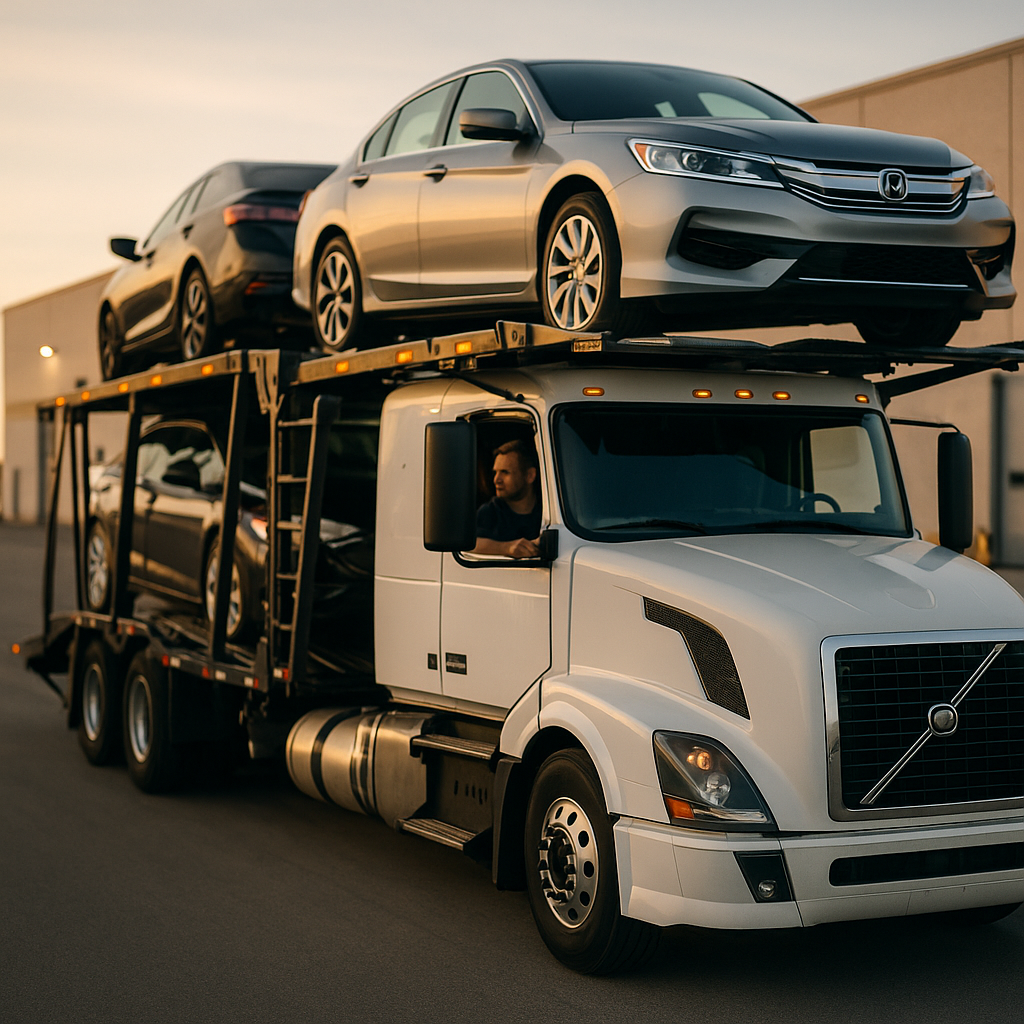
Learn car hauler insurance requirements for 2026: FMCSA liability limits, filings (BMC-91/91X, MCS-90), cargo and coverage checklist—stay compliant and book loads. Get a quote.
Car hauler insurance requirements in 2026 come down to two things: (1) the legal minimums to keep your authority active, and (2) the contract minimums to get your COI accepted by brokers, load boards, auctions, and shippers. For most for-hire auto haulers, that means FMCSA-filed public liability (often carried at $1,000,000 for easier booking) plus cargo/auto-in-transit sized to the total value on your trailer.
If you’re new authority, the most common failure isn’t “no insurance.” It’s the wrong insurance: incorrect class, missing filings, or cargo that isn’t actually written for hauling vehicles. This guide lays out the limits, filings, and a simple checklist you can use before you try to book your next load.
Table of Contents
Reading time: 9 minutes
- At-a-Glance: Car Hauler Insurance Requirements Checklist
- FMCSA Minimum Insurance Requirements (and What FMCSA Doesn’t Require)
- Coverage Types Car Haulers Typically Need (Mandatory vs Contract-Required)
- Requirements by Operation Type: Hotshot vs Open Carrier vs Enclosed
- State & Intrastate Nuance: How to Verify Your State’s Requirements
- How Much Does Car Hauler Insurance Cost Per Month in 2026?
- How to Lower Your Premium Without Cutting Required Coverage
- Load Boards, Brokers, and Platform Requirements
- Why a Car-Hauling-Specific Setup Matters for Owner-Operators
- Frequently Asked Questions
- Conclusion: Confirm Your Limits, File Correctly, and Book Loads
At-a-Glance: Car Hauler Insurance Requirements Checklist
A broker-ready car hauler insurance program in 2026 typically includes FMCSA-filed public liability (legal minimum often referenced as $750,000 for non-hazardous property carriers) plus cargo/auto-in-transit commonly written at $100,000–$250,000+ depending on the vehicles you move.
Use this as a quick “can I legally run” and “will my COI get accepted” checklist—especially if you’re new authority or switching from leased-on to your own MC.
| Item | Who Requires It | Typical Limit/Standard | When It Applies |
|---|---|---|---|
| Commercial Auto Liability (Primary) | FMCSA/state + brokers | Often $750k–$1M (many require $1M) | Always (for-hire) |
| Cargo / Auto-in-Transit | Shippers/brokers/load boards | Commonly $100k–$250k+ (higher for enclosed/high-value) | Hauling customer vehicles |
| Physical Damage (Comp/Collision) | Lender/lease + you | Based on truck/trailer value | If financed/leased, or you can’t self-insure |
| General Liability | Many facilities/shipper contracts | Often $1M per occurrence | Yards, lots, loading/unloading risk |
| Filings (BMC-91/91X) | FMCSA | Proof of liability on file | Own authority (interstate) |
| MCS-90 Endorsement | FMCSA compliance | Attached to liability policy | Own authority (interstate) |
| BOC-3 | FMCSA authority requirement (not insurance) | Process agent designation | Own authority (interstate) |
| Optional: Trailer Interchange | Trailer owners/agreements | Varies | If pulling someone else’s trailer under interchange |
| Optional: Occupational Accident / WC | You/state/contract | Varies | Owner-operators, especially leased-on |
Reality check: meeting the legal minimum doesn’t guarantee you can book loads—most of the friction happens at the COI stage with contract minimums.
Key takeaways you can use today
- Legal floor vs bookable floor: FMCSA/state minimums keep you legal; brokers and platforms often push you to $1M liability plus cargo.
- Filings matter: having a policy isn’t the same as having FMCSA filings active on your authority.
- Auto-in-transit is specialized: generic “motor truck cargo” can be the wrong form for vehicle hauling.

FMCSA Minimum Insurance Requirements for Car Haulers (and What FMCSA Doesn’t Require)
For-hire interstate car haulers must maintain public liability financial responsibility under 49 CFR Part 387 and keep the insurer’s BMC-91/91X filing active so the FMCSA shows the carrier as authorized to operate.
Here’s what that means in plain English, plus the stuff FMCSA doesn’t require that will still get you turned down by brokers.
1) FMCSA minimum liability limits (federal)
What it is: Liability pays for injuries and property damage you cause to others (cars, buildings, guardrails, etc.).
Why it matters: One serious injury claim can run into six or seven figures, and brokers treat liability as the fastest “yes/no” on your COI.
- Legal minimum (commonly referenced): $750,000 for non-hazardous property carriers (verify your specific operation and authority type).
- Practical standard: Many brokers and platforms expect $1,000,000 auto liability for easier onboarding.
2) Required filings and proof to activate/maintain authority
What it is: FMCSA doesn’t just want you to have a policy; it wants proof filed by your insurer.
- BMC-91/91X: The filing your insurance company submits to prove your liability coverage is in place.
- MCS-90: A federal endorsement tied to public liability financial responsibility; it is not cargo insurance and it is not physical damage.
- BOC-3: Not insurance—this is a process agent designation so legal papers can be served.
What goes wrong in real life: Wrong effective dates, wrong named insured, a lapse, or an insurer that’s slow to file can show you as inactive, and brokers will reject you even if you “have a policy.”
3) What FMCSA does not require (but customers do)
FMCSA focuses on public liability, not your customer contracts. In the real world, most auto-hauling work still demands:
- Cargo/auto-in-transit (to protect the vehicles you’re hauling)
- Physical damage (because lenders and leases usually require it)
- General liability (because facilities don’t want uncovered premises/operations risk)
Coverage Types Car Haulers Typically Need (Mandatory vs Contract-Required)
Most for-hire car haulers in 2026 carry $1,000,000 auto liability and $100,000–$250,000+ auto-in-transit cargo because those are common contract minimums even when the legal minimum is lower.
The right mix depends on how you haul (hotshot vs stinger vs enclosed), the total vehicle value per trip, and who you haul for (brokers, auctions, dealerships, private customers).
1) Primary liability (commercial auto liability)
What it is: Covers bodily injury and property damage you cause while operating.
Why it’s essential: It’s the backbone of compliance, and the first number a broker looks for on a COI.
Claim reality: A single lane-change accident with injuries can quickly become a high-dollar attorney-driven claim, even if you did “everything right.”
2) Cargo / Auto-in-transit (vehicles you’re hauling)
What it is: Covers damage to the cars on your trailer, subject to limits, per-vehicle caps, deductibles, and exclusions.
Why it’s essential: Auto hauling stacks value; a normal-looking load can be $80,000–$200,000+ in total vehicle value depending on what’s on the deck.
- Common claim triggers: securement failures, loading/unloading damage, theft/vandalism while parked, and weather losses.
- Common mistake: buying generic cargo and assuming it’s written correctly for vehicle hauling (it may not be).
3) Physical damage (comp + collision) for your truck (and often your trailer)
What it is: Pays to repair/replace your equipment after collision, theft, fire, hail, animal strike, and more.
Why it’s essential: If your truck is financed, it’s usually required; if you’re a one-truck operation, a total loss can end your business.
What to ask about: ACV vs stated value, trailer coverage, deductibles, and how claims are settled.
4) General liability (often contract-required)
What it is: Covers non-auto liability exposures like premises/operations and certain loading/unloading incidents not tied to auto liability.
Why it’s essential: Many yards, auctions, and shippers want to see $1M per occurrence before you step on their property.
Get coverage matched to your operation type (hotshot/open/enclosed), cargo value, and radius—so your COI gets accepted without back-and-forth.
Requirements by Operation Type: Hotshot vs Open Carrier vs Enclosed Auto Transport
Insurance underwriting changes by operation type because the same trip can represent $80,000 in vehicle value for a hotshot or $250,000+ for enclosed/high-end moves, which shifts claim severity and required cargo limits.
If your policy description doesn’t match what you actually do, you’ll feel it when a broker rejects the COI—or worse, when a claim hits an exclusion.
1) Hotshot car hauler (pickup + trailer)
What it is: Same liability concepts, different equipment and risk profile.
Where hotshots get burned: mismatched use/class, wrong radius, or cargo limits that don’t reflect the real total value (two “regular” cars can still be $80k–$120k combined).
- Tip: If you’re for-hire, you need commercial coverage that explicitly reflects auto hauling, not “general hauling.”
2) Open multi-car carrier (stinger / 7–10 car)
What it is: Higher frequency operations with higher aggregate cargo values per trip.
Why it’s different: Multi-unit losses are more likely (hail, multi-vehicle contact damage, chain reactions during loading), and a single incident can impact several vehicles.
3) Enclosed auto transport
What it is: Higher-value vehicles and tighter customer expectations (luxury, exotics, classics).
Why it’s different: Cargo limits, per-vehicle limits, and exclusions get tested hard; your customer is paying for white-glove, and your insurance has to match that risk.
State & Intrastate Nuance: How to Verify Your State’s Car Hauler Insurance Requirements
Intrastate car hauler insurance minimums are set by each state DOT/PUC, while interstate operations follow FMCSA financial responsibility rules under 49 CFR Part 387, so you need to verify the correct authority type before you bind coverage.
Publishing a 50-state list without checking current rules is how people get fined, put out of service, or sold the wrong policy. Here’s the safe way to do it.
1) Determine: intrastate-only or interstate?
- Interstate: you cross state lines (FMCSA rules apply).
- Intrastate: you operate in one state only (state rules apply), but contracts can still require $1M liability.
2) Check your state’s commercial insurance minimums
Search your state DOT/PUC requirements for for-hire carriers and confirm whether minimums change based on GVWR, vehicle class, or commodity.
3) Compare against broker requirements and choose the higher standard
This is the money point: you can be legal and still unbookable if your COI doesn’t meet contract minimums (commonly $1M liability plus cargo minimums).
How Much Does Car Hauler Insurance Cost Per Month in 2026?
Car hauler insurance cost per month in 2026 is mainly driven by liability limit (often $1,000,000), cargo limit ($100,000–$250,000+), operating radius, garaging, driver history, and whether you’re a new venture.
Any article that gives you a single “average monthly price” is guessing—car hauling is priced on risk signals and loss severity, not just the truck.
Practical cost drivers (what underwriters care about)
- New authority / new venture status
- Radius (local vs regional vs OTR)
- Driver MVR/PSP and years of CDL experience
- Loss history (frequency matters as much as severity)
- Cargo limit (and whether it’s truly auto-in-transit)
- Equipment values (truck + trailer) and valuation method
- Parking/garaging (theft/vandalism exposure)
- Deductibles and claim handling history
Sample “quote scenarios” (not exact pricing)
- Hotshot car hauler: can price lower than multi-car carriers, but rates climb fast with high cargo limits or poor loss history.
- Open multi-car carrier: typically higher due to frequency and aggregate value on the deck.
- Enclosed: often higher due to vehicle values, higher cargo limits, and stricter underwriting.
Tip: “Affordable” usually comes from stronger risk controls (clean MVRs, secure parking, securement SOPs, no lapses), not from chopping limits that brokers require.
Load Boards, Brokers, and Platform Requirements (What They Commonly Ask For)
Many brokers and load boards require a COI showing $1,000,000 auto liability and at least $100,000 cargo/auto-in-transit before they’ll tender an auto-transport load.
Even when FMCSA is satisfied, brokers and platforms are the ones feeding you freight—so their minimums become your “real-world minimums.”
Common asks
- $1M commercial auto liability
- Cargo/auto-in-transit minimums (often $100k+, higher for enclosed/high-value)
- General liability in certain facilities/shipper contracts
- COI formatting: correct legal name, effective dates, limits, and certificate holder/additional insured wording when required
COI pro tip (saves time)
Send your agent a single email with: the broker’s name/address exactly as shown, a screenshot of the requirement, and a same-day deadline. COI rejections are usually fixable, but they cost you loads while you wait.
Why a Car-Hauling-Specific Setup Works for Owner-Operators
Owner-operators get fewer COI rejections when the policy is correctly classified for auto hauling, the named insured exactly matches the carrier legal name, and the FMCSA filing (BMC-91/91X) stays continuous with no lapses.
You don’t need “more insurance.” You need correct insurance that matches your real operation: hotshot vs stinger, open vs enclosed, your radius, your parking reality, and the typical value on your trailer.
The unsexy questions up front are the ones that prevent ugly surprises later: per-vehicle limits, excluded causes of loss, how theft is treated when parked, and whether your “cargo” is actually written as auto-in-transit.
Frequently Asked Questions
To haul cars with your own authority, you must carry public auto liability that meets FMCSA (interstate) or your state’s minimums (intrastate) and keep the insurer’s filing active (typically BMC-91/91X) so your authority remains authorized. Most brokers also require a COI showing $1,000,000 auto liability plus cargo/auto-in-transit (often $100,000–$250,000+) before they tender loads. The MCS-90 endorsement is tied to public liability financial responsibility; it does not replace cargo coverage. If your filings lapse, brokers commonly reject you even if you “have a policy.”
FMCSA minimum public liability for for-hire interstate motor carriers of non-hazardous property is commonly referenced as $750,000 under the federal financial responsibility rules in 49 CFR Part 387, but many auto haulers carry $1,000,000 because it’s a common broker and platform requirement. Your actual “must-have” limit is the higher of (1) what your authority requires and (2) what your contracts require. The key compliance piece isn’t just the limit—it’s keeping the insurer’s filing (BMC-91/91X) active so FMCSA shows your authority as authorized.
Most car haulers need (1) primary auto liability for compliance and booking (often carried at $1,000,000), (2) cargo/auto-in-transit to cover the vehicles on the trailer (commonly $100,000–$250,000+), and (3) physical damage for the truck and often the trailer, especially if financed. Many facilities also require general liability (often $1M per occurrence) for premises/operations exposures. Optional coverages like trailer interchange or occupational accident depend on how you run and what your contracts demand.
Car hauler insurance cost per month varies based on your liability limit (often $1,000,000), your cargo/auto-in-transit limit (often $100,000–$250,000+), operating radius, garaging/parking, driver MVR/PSP, equipment value, and loss history. New ventures typically pay more until they build continuous coverage and a clean loss record. The quickest way to get an unreliable price is to quote a “generic trucking” class that doesn’t match auto-hauling exposure—those quotes often fall apart at binding or claim time.
FMCSA financial responsibility rules for for-hire interstate carriers focus on public liability, not cargo, so cargo/auto-in-transit is usually not an FMCSA “authority activation” requirement the way liability filings are. In real-world auto transport, though, cargo/auto-in-transit is often functionally required because brokers, auctions, and platforms commonly demand $100,000+ (and higher for enclosed/high-value) before they tender loads. If you haul without adequate auto-in-transit, a single loading damage claim can come straight out of your pocket.
MCS-90 is a federal endorsement tied to public liability financial responsibility, and it does not pay for damage to the vehicles you’re hauling the way cargo/auto-in-transit does. Cargo/auto-in-transit is the coverage designed to respond when a customer vehicle is damaged due to a covered cause of loss, subject to the policy’s exclusions, deductibles, and per-vehicle limits. A common mistake is assuming “MCS-90 means I’m covered for cargo” and then finding out the hard way after a securement or loading/unloading claim.
If you’re hauling cars for-hire as a hotshot, you still need commercial auto liability that meets FMCSA/state rules and broker expectations (often $1,000,000), plus cargo/auto-in-transit sized to the total value you carry (two vehicles can easily be $80,000–$120,000 combined). The difference is underwriting: the pickup and trailer must be scheduled correctly, the operation must be classified as auto hauling (not personal use or “general hauling”), and your radius/garaging must be accurate. Mismatched descriptions are a top reason COIs get rejected and claims get complicated.
Conclusion: Confirm Your Limits, File Correctly, and Book Loads
In 2026, car hauler insurance requirements usually mean FMCSA-compliant liability with active filings (BMC-91/91X and an MCS-90 endorsement) plus broker-ready limits like $1,000,000 liability and $100,000–$250,000+ auto-in-transit cargo.
When you match coverage to your real operation (hotshot/open/enclosed) and keep filings continuous, you spend less time fixing COIs and more time hauling.
Key Takeaways:
- Don’t confuse “policy in hand” with “filings on file”: authority can go inactive if BMC-91/91X lapses.
- Carry cargo written for autos: auto-in-transit should match the value you actually move, not a generic guess.
- Buy for booking, not just legality: many brokers want $1M liability and clear COI wording.
If you want a quote that’s built to get accepted (and stay in force), price it around your real radius, parking, equipment, and vehicle values—not a generic “trucking” setup.





