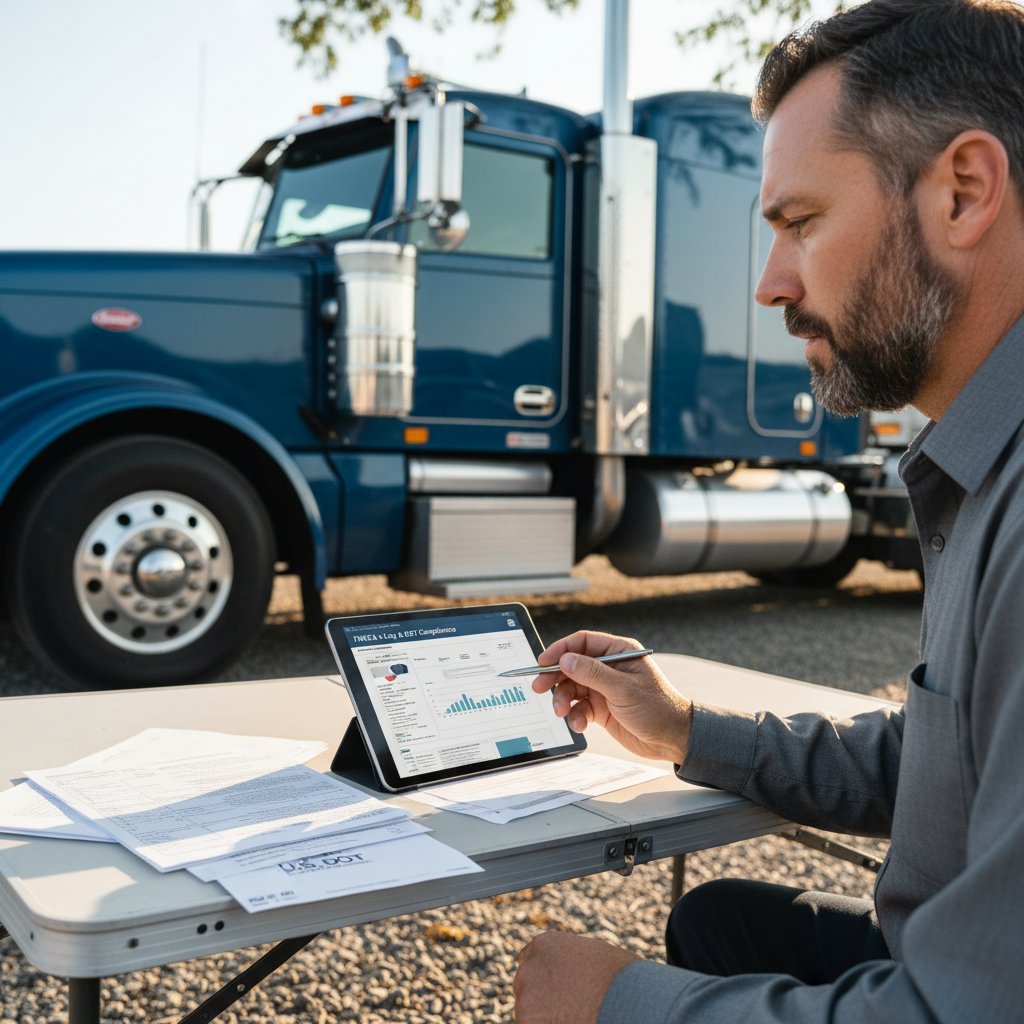
Use a CDL practice test to pass faster with a simple 2026 study plan, state-specific tips, and endorsement breakdowns. Then protect your business—get a quote.
If you’re trying to pass your permit fast, a CDL practice test is the highest-ROI study tool you can use—because it shows exactly what you don’t know before the DMV charges you in time, retest fees, and missed workdays.
What is a CDL practice test and how does it work? A CDL practice test is a timed set of multiple-choice questions that mirrors your state’s CDL permit exams (General Knowledge plus add-ons like Air Brakes, Combination Vehicles, and endorsements). Use it to find weak topics, then study the matching pages in your state CDL manual until you’re scoring 85–90% consistently. Once you pass, plan ahead for the business side too—insurance and compliance can slow down your first load (see the Owner-Operator Trucking Insurance Checklist).
Key Takeaways: Essential CDL Practice Test Strategy
- Practice tests only work if they match your state’s CDL manual. Use them to diagnose weak sections, not to “memorize answers.”
- Most people should start with General Knowledge + Air Brakes + Combination (Class A path). That combo covers the bulk of permit momentum.
- Track your score like a business metric. Don’t go to the DMV until you’re hitting 85–90% consistently on mixed sets.
- Passing the permit is step one—plan ahead for the business side. If you’re going owner-op, commercial truck insurance and filings can bottleneck your start date.
Table of Contents
Reading time: 9 minutes
- How to Use a CDL Practice Test (Without Wasting Time)
- Which CDL Tests You Need: Class A/B/C + Endorsements
- Are CDL Practice Tests State-Specific? Yes—Here’s What to Do
- How Many Questions Are on a CDL Practice Test? (Common Counts + Passing Scores)
- A 7-Day CDL Permit Study Plan (Built for Working Adults)
- Common Mistakes That Cause Retests
- Frequently Asked Questions
- The Logrock Difference: Protect the Business After You Pass
- Conclusion & CTA: Pass the Test, Then Insure the Rig the Right Way
How to Use a CDL Practice Test (Without Wasting Time)
State CDL knowledge tests follow FMCSA minimum standards in 49 CFR Part 383, and many states set the passing score at about 80% per written exam.
A CDL practice test is only valuable if you treat it like a pre-trip inspection: you’re not doing it to feel good—you’re doing it to catch problems before they cost you. If you’re on the owner-op track, the same mindset that keeps your cost-per-mile under control will help you pass faster.
Use this loop (simple and repeatable)
- Take a baseline test (cold): Don’t study first. You need a real starting score.
- Sort misses by topic (not by question): Example: stopping distance, air brake lag, hazard perception.
- Read only the manual pages tied to your misses: Skip the “cover-to-cover” trap.
- Retest on that topic until you’re at 90%: Then move on.
- Do mixed sets: General Knowledge + Air Brakes + Combination builds endurance and reduces test-day panic.
Test-day reality: If your practice tests don’t explain why the right answer is right, you’ll get burned by slightly re-worded DMV questions.
Which CDL Tests You Need: Class A/B/C + Endorsements
A CDL is required when you operate a commercial motor vehicle with 26,001+ lb GVWR/GCWR, or a vehicle designed to carry 16+ passengers, or a placarded hazmat vehicle under 49 CFR §383.3.
Before you grind on practice questions, decide what you’re actually testing for. A lot of people waste time studying endorsements they don’t need yet—and “extra studying” isn’t free when you’re trying to start earning.
1) Pick your CDL class (A, B, or C)
- Class A: Combination vehicles (tractor-trailer). Common path for van, reefer, flatbed, and most long-haul.
- Class B: Straight trucks (dump, box, some local work).
- Class C: Smaller commercial vehicles (often passenger/hazmat-related; varies by state).
Business risk: Studying the wrong class slows your revenue plan. If your end goal is pulling a 53′ van/reefer or running power-only, you’re usually in Class A territory.
2) The “core” knowledge tests most Class A drivers need
For many Class A applicants, these three tests create the fastest “permit momentum”:
- General Knowledge (start here)
- Air Brakes (if the vehicle has air brakes)
- Combination Vehicles (tractor + trailer behavior)
3) Endorsements: what’s included in CDL practice tests?
Endorsement practice tests are focused question sets that match a specific knowledge exam, and they matter because endorsements can unlock better-paying freight (or disqualify you from loads if you don’t have them).
- Tanker (N): liquid/bulk tanks
- Doubles/Triples (T): if your state and job require it
- Hazmat (H) / X (Tank + Hazmat): more compliance, more scrutiny
- Passenger (P) / School Bus (S): transit or school work
Veteran advice: Don’t chase Hazmat just because someone online said it pays more. Hazmat is a business decision—higher compliance load, higher consequences, and your trucking insurance underwriting will scrutinize it.
Are CDL Practice Tests State-Specific? Yes—Here’s What to Do
Your state’s DMV administers the CDL permit exam using its own CDL manual and question bank, even though the baseline CDL standards come from 49 CFR Part 383.
Yes, CDL practice tests should be state-specific, because your state writes and administers the permit exam. The federal framework is similar nationwide, but wording, emphasis, and extra requirements can vary.
The clean approach (no guesswork)
- Download your state’s CDL manual (latest version) and use it as your source of truth.
- Use practice tests that label your state and the test type (General Knowledge vs Air Brakes vs Combination, etc.).
- If a practice test conflicts with the manual, trust the manual.
Why it matters: Non-aligned practice tests create false confidence. Your state examiner doesn’t grade on vibes.
Time-saver: Build a “miss list” by chapter. If you miss three questions tied to one chapter, you don’t need more random quizzes—you need 20 minutes in that chapter and then a targeted retest.
How Many Questions Are on a CDL Practice Test? (Common Counts + Passing Scores)
CDL practice test apps can use any number of questions, but real state knowledge exams often run about 20–50 questions per subject and many states use an ~80% passing score.
A practice test might be 10, 25, 50, or 100 questions. What you care about is whether you’re ready for your state’s real permit exams and whether you can clear the passing score under pressure.
Typical question counts (verify your state)
| Test Type | Common Question Count | Typical Passing Target |
|---|---|---|
| General Knowledge | 50 | Often ~80% (state varies) |
| Air Brakes | 25 | Often ~80% (state varies) |
| Combination Vehicles | 20 | Often ~80% (state varies) |
| Tanker (N) | 20 | Often ~80% (state varies) |
| Doubles/Triples (T) | 20 | Often ~80% (state varies) |
| Hazmat (H) | 30 | Often ~80% (state varies) |
Business-minded rule: Don’t show up aiming to “barely pass.” Aim for 85–90% on practice, because DMV questions aren’t always phrased like your app.
A 7-Day CDL Permit Study Plan (Built for Working Adults)
A 7-day CDL permit study plan totaling about 6–8 hours of focused work (roughly 45–90 minutes per day) is enough for many working adults to reach 85–90% on mixed practice sets.
If you’re balancing a job, family, or you’re already working around someone else’s schedule, you need a plan that respects reality—not a “read the whole book” fantasy.
Day 1: Baseline + setup (60–90 minutes)
- Take a 50-question General Knowledge practice test cold.
- Identify your bottom 3 topics.
- Download your state CDL manual PDF and bookmark those sections.
Day 2: General Knowledge fix day (45–60 minutes)
- Read only the chapters tied to misses (not the whole manual).
- Do two 25-question General Knowledge topic quizzes.
- Write down “why” for any miss (one sentence each).
Day 3: Air Brakes (45–60 minutes)
- Read the air brakes chapter.
- Do two 25-question Air Brakes practice tests.
- Focus on brake lag, stopping distance, leaks, dual systems, and spring brakes.
Day 4: Combination Vehicles (45–60 minutes)
- Read the combination vehicles chapter.
- Do two 20-question Combination practice tests.
- Focus on off-tracking, jackknife risk, coupling/uncoupling basics, and skid control.
Day 5: Mixed set + weak spots (60 minutes)
- Do a mixed set: General + Air + Combination.
- Re-read only the sections tied to missed questions.
- Retest on those sections.
Day 6: Full simulation day (60–90 minutes)
- Do a full set in one sitting: 50 General Knowledge + 25 Air Brakes + 20 Combination.
- Goal: 85–90% on each test.
Day 7: Light review + test booking (30–45 minutes)
- Review your miss list.
- Do one short mixed set (20–30 questions).
- Book the test when your score is stable.
If you’re adding endorsements: Add 2–3 extra days per endorsement. Hazmat often needs more time because it’s detail-heavy and less forgiving.
Common Mistakes That Cause Retests
FMCSA’s Entry-Level Driver Training (ELDT) rule in 49 CFR Part 380, Subpart F has required training from a registered provider before the CDL skills test since February 7, 2022.
Retests usually aren’t about intelligence—they’re about sloppy process. These are the repeat offenders, the same way cheap tires and deferred maintenance show up in breakdown reports.
1) Memorizing answers instead of learning the rule
What it looks like: You recognize the right option on your app, but the DMV re-words it and you miss it.
Fix: Use practice tests that explain reasoning—or write a one-line explanation for each miss (“why that’s the rule”).
2) Ignoring Air Brakes because you “get it”
Reality: Air brakes questions are easy to underestimate, and they punish sloppy understanding.
Fix: Learn the inspection logic (what you check, what fails you) and the stopping dynamics (lag time, stopping distance, spring brakes).
3) Not using a state-specific source
Reality: Generic quizzes drift from your state manual.
Fix: If your state manual says it, that’s the answer key.
4) Underestimating the “business admin” side after passing
Passing the permit isn’t the finish line. If you’re going owner-op, delays often come from scheduling training/skills testing time, medical card timing, ELDT requirements, and lining up commercial truck insurance and filings so you can actually run.
If you don’t plan it, you can end up with a license and no clean path to legally and profitably move freight.
The Logrock Difference: Protect the Business After You Pass
Most brokers and shippers commonly require $1,000,000 auto liability and around $100,000 cargo for standard freight, while FMCSA financial responsibility minimums for many interstate for-hire carriers start at $750,000 (with higher requirements for certain passenger and hazmat operations).
If your goal is independence—your own truck, your own lanes, your own authority—passing the permit is step one. Step two is making sure one claim doesn’t wipe out six months of progress.
How Logrock supports owner-operators and small carriers
- We help structure trucking insurance around how you actually operate (radius, states, cargo, trailer ownership, lease-on vs. running your own authority).
- We focus on affordable trucking insurance strategies that don’t leave landmines in the policy (a “cheap” option that denies claims isn’t cheap).
- Whether you need semi truck insurance for a tractor-trailer setup or hotshot insurance for a one-truck operation, we look at the full risk picture so you can stay compliant and profitable.
Frequently Asked Questions
Most state CDL permit exams use multiple-choice knowledge tests based on the state CDL manual, and the federal minimum standards are set by FMCSA in 49 CFR Part 383.
Yes, free CDL practice tests exist, but the only “free” that matters is one that matches your state’s CDL manual and explains the correct answer (not just right/wrong). Many states use an ~80% passing score on knowledge tests, so a low-quality quiz can create false confidence and cost you a retest. Use free tests to diagnose weak topics, then verify disputed answers against your manual and re-test that chapter until you’re scoring 85–90%. If you can’t explain the rule behind your answer, you’re not ready yet.
Most CDL practice platforms include General Knowledge plus common endorsement tests such as Air Brakes, Combination Vehicles, Tanker (N), Doubles/Triples (T), Hazmat (H) or X, and Passenger/School Bus. The endorsement you need depends on the equipment and freight you plan to haul, so don’t burn hours studying an endorsement that won’t change your first paycheck. If you’re building toward owner-operator work, think of endorsements as a business lever—more access can also mean more compliance and underwriting questions.
Some CDL practice tests are state-specific and some are generic, so you should choose one that lets you select your state and aligns with your current state CDL manual. The baseline CDL standards come from FMCSA (49 CFR Part 383), but states control the exact question bank, wording, and emphasis. If a practice test conflicts with your manual, the manual wins—because that’s what your DMV builds from. The fastest method is to track misses by chapter, re-read only those pages, and then re-test that topic until you’re stable at 85–90%.
CDL practice tests can be any length (10, 25, 50, or 100 questions), but state permit exams commonly use about 50 questions for General Knowledge, 25 for Air Brakes, and 20 for Combination Vehicles, with many states targeting an ~80% passing score. Treat these counts as typical, not guaranteed—your DMV can differ by state and test type. Your goal isn’t to “finish a quiz”; it’s to consistently clear the passing threshold with margin, which is why 85–90% on mixed sets is a smarter go/no-go number.
No, CDL practice tests can’t guarantee a pass because states can change question pools, re-word questions, and test-day pressure affects performance. What you can do is stack the odds: don’t test until you’re scoring 85–90% consistently on mixed sets, and you can explain the rules behind the answers (especially Air Brakes and Combination). Also plan the post-permit timeline—ELDT applies to many new drivers before the skills test, and business items like insurance and filings can delay your start even after you pass the written exams.
Conclusion: Pass the Test, Then Insure the Rig the Right Way
A consistent 85–90% score on state-aligned CDL practice tests gives you a practical buffer above the ~80% passing threshold many DMVs use for CDL knowledge exams.
A CDL practice test is a tool—use it like a business owner: diagnose weak spots, study the right manual sections, and don’t book the DMV until your scores are stable.
Key Takeaways:
- Use state-specific practice tests and verify anything questionable against your CDL manual.
- For most Class A paths, build momentum with General Knowledge + Air Brakes + Combination first.
- Plan the business steps after passing—insurance and compliance often create the real delay.
If you’re heading toward your own truck, protect the upside you’re working for. When you’re ready, get your commercial truck insurance quote and set up coverage the right way the first time.
Related Reading: Owner-Operator Trucking Insurance Checklist, Non-Trucking Liability vs Bobtail Insurance, and Hotshot Insurance Basics.