
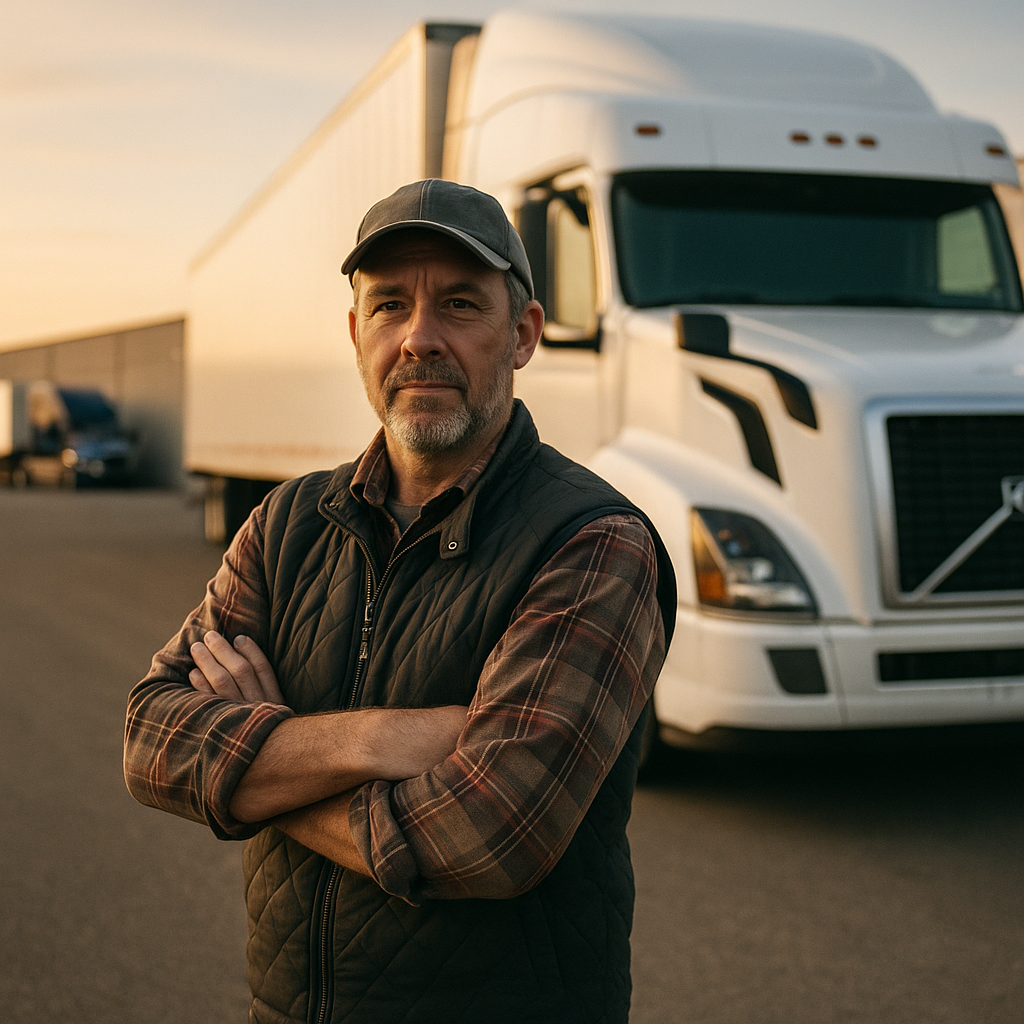
See the cheapest commercial truck insurance in Alabama with 2026 cost ranges, AL vs FMCSA minimum requirements, and proven ways to cut premiums. Get a quote.
If you’re searching for the cheapest commercial truck insurance in Alabama, you’re usually chasing one thing: cash flow. Insurance is a fixed bill that hits whether the truck runs or sits, and a bad renewal can wipe out your margin fast.
Featured snippet (quick answer): The cheapest commercial truck insurance in Alabama is the lowest total annual cost policy that still matches your real operation (cargo, radius, filings, deductibles) and meets common working limits like $1,000,000 auto liability; for many for-hire Alabama operators in 2026, directional pricing often lands around $825–$1,310/month, but new authority, long-haul, reefer/flatbed, and claims can push it much higher.
Table of Contents
Reading time: 9 minutes
- Who’s Actually the Cheapest in Alabama?
- How Much Does Commercial Truck Insurance Cost in Alabama? (2026 Ranges)
- What Drives the Price in Alabama (10 Factors)
- Minimum Insurance Requirements in Alabama (State vs FMCSA)
- Cheapest by Operator Type (Owner-Op, New Authority, Hotshot, Flatbed)
- How to Reduce Premiums in Alabama (Practical Moves)
- Real-World Alabama Price Examples (By City + Truck Type)
- Your Questions Answered: “People Also Ask” FAQs
- Why Logrock (Practical, Not Pushy)
- Conclusion & Get Quotes That Actually Compare
Who’s Actually the Cheapest in Alabama?
The cheapest commercial truck insurance in Alabama is the quote that stays cheapest after you compare 5–7 carriers using the same limits, deductibles, radius tier, cargo class, and required filings.
Most “cheapest in Alabama” articles name one company and call it a day, but commercial trucking markets don’t price that way. Carriers price based on appetite, meaning what they want (and don’t want) right now: cargo, lanes, experience, equipment, and loss runs.
A quick “quote-first shortlist” (2026)
Use this as a starting point—not a promise of the lowest price. Your goal is simple: get multiple quotes built identically so you can spot the real cheapest option (not a coverage trick).
| Company / Market Type | Often competitive for | Watch-outs that can kill “cheap” | What to request on the quote |
|---|---|---|---|
| Large national trucking market | General freight, mixed lanes | Fees; stricter cargo endorsements | Quote with filings, broker-ready limits, and a clean covered-auto schedule |
| Regional / specialty trucking carrier | Specific cargo niches | May decline new venture or long-haul | Ask “What cargo classes do you prefer in Alabama?” |
| Program business (telematics-friendly) | Owner-ops/fleets willing to run cameras/telematics | Data requirements; program rules | Get camera/telematics credit details in writing |
| Independent agency market access | Hard-to-place risks, older trucks | Can be slower to bind | Ask for 2 deductible options + monthly pay plan terms |
| Non-standard / high-risk market | New venture, imperfect MVR | High down payment; tight coverage | Confirm exclusions, unattended theft limits, and radius restrictions |
| Captive / commercial auto-focused carrier | Light/medium-duty, local | May not fit for-hire interstate | Confirm the policy form is for trucking/for-hire use |
How to compare “cheapest” the right way
- Same auto liability limit: for example, $1,000,000.
- Same cargo limit: if you need it (example: $100,000).
- Same physical damage deductibles: comp/collision matched.
- Same radius and cargo class: don’t let a quote “win” by downgrading your operation.
- Fees included: confirm filing fees and installment fees are included in the total annual cost.
CTA: Get “Apples-to-Apples” Alabama Quotes
If you only do one thing, do this: request 3–5 quotes with the same limits and deductibles so you can see the real cheapest option.
How Much Does Commercial Truck Insurance Cost in Alabama? (2026 Ranges)
In Alabama, commercial truck insurance often ranges from about $825 to $1,310/month (roughly $9,900 to $15,700/year) for many for-hire operators based on common industry estimates, with new authority and higher-risk operations regularly pricing above that band.
These are practical benchmarks to help you sanity-check quotes—not guaranteed pricing. Your real numbers swing with authority age, radius, cargo class, truck value, and loss runs.
Alabama cost ranges: liability-only vs full coverage (benchmarks)
| Package type | Typical low-end range | Why it changes fast |
|---|---|---|
| Liability-only (for-hire) | ~$700–$1,200/month | Authority age, MVR, radius, and cargo class can move pricing quickly. |
| Full coverage (liability + physical damage + typical cargo) | ~$1,100–$2,500+/month | Truck value, comp/collision deductible, theft exposure, cargo limit, and specialty equipment. |
Reality check: If you’re financing the truck, the lender usually requires physical damage, so “cheap liability-only” may not be an option.
Quick benchmark scenarios (plain English)
- Local Alabama runs + established authority + clean loss runs: typically better pricing bands.
- New authority + interstate lanes + higher-value freight: typically higher premiums and higher down payments.
What Drives the Price in Alabama (10 Factors)
Underwriters typically rate trucking insurance using 10+ inputs (authority age, cargo class, radius tier, MVR, loss runs, and more), and a single change can move the premium by thousands per year.
If you want the cheapest trucking insurance, stop guessing and start controlling the variables carriers price hardest.
1) Authority age (new venture vs established)
What it is: How long your MC has been active.
Why it matters: New ventures are priced higher because the insurer has less proof you can run safely and consistently.
2) Cargo type (what you actually haul)
What it is: General freight, reefer, flatbed steel, vehicles, hazmat, and more.
Business risk: The wrong cargo class can create coverage gaps, and higher theft/damage exposure usually means higher premium.
3) Radius and lanes (where you run)
What it is: Local, regional, or long-haul/interstate; plus which states and corridors.
Alabama note: Running I-65 / I-20 / I-10 corridors and heavy metro delivery is different exposure than rural lanes.
4) Annual mileage
What it is: Estimated miles in a policy year.
Why it matters: More miles equals more time exposed to accident frequency.
5) Garaging ZIP (theft/vandalism exposure)
What it is: Where the truck is kept overnight.
Business risk: Theft/vandalism physical damage claims can spike renewals; secure parking can help if it’s consistent and documented.
6) Driver record (MVR/violations) + experience
What it is: Violations, at-fault accidents, CDL time, and experience with your equipment.
Why it matters: This is one of the biggest separators between “cheap” and “unquotable.”
7) Truck value and physical damage structure
What it is: Value basis (often ACV) and comp/collision deductibles.
Pro tip: Price two deductibles (example: $1,000 vs $2,500) and compare total annual cost.
8) Cargo limit and deductible
What it is: Cargo limit (example: $100,000 vs $250,000) and the cargo deductible.
Business risk: Underinsuring cargo is a broker relationship killer and a cash-flow problem after a loss.
9) Claims history (loss runs)
What it is: Prior claims, usually reviewed over 3–5 years.
Why it matters: Claims are the fastest way to lose “cheap” pricing for multiple renewal cycles.
10) Payment plan structure and fees
What it is: Down payment, installment charges, filing fees, and service fees.
Business risk: A “cheap monthly” can be a more expensive annual total once fees are added.
Copy/paste checklist: bring these inputs for real quotes
- Vehicle: VIN, year, make/model, and stated value.
- Operations: top 5 states + radius tier.
- Cargo: cargo type(s) + max cargo value.
- Drivers: CDL years + equipment experience.
- History: loss runs (3–5 years) or a no-loss letter.
- Requirements: lease/finance requirements (physical damage + deductibles).
Minimum Insurance Requirements in Alabama (State vs FMCSA)
FMCSA financial responsibility rules for interstate for-hire carriers (49 CFR Part 387) commonly require at least $750,000 public liability for non-hazmat general freight, while many brokers still require $1,000,000 regardless of the legal minimum.
This is where people get burned: they buy “minimum,” then can’t book freight, can’t satisfy a broker COI check, or bind the wrong filing.
1) If you run interstate: FMCSA minimum limits (and when they increase)
Plain English: If you cross state lines for for-hire trucking, federal rules apply and your filings and limits must match your operation.
- General freight (non-hazmat): often $750,000 minimum required federally.
- Hazmat categories: can require $1,000,000+ depending on commodity class.
Business reality: “Legal minimum” and “workable minimum” are not the same thing if your contracts require $1M.
2) If you run intrastate only in Alabama: what changes?
Plain English: Intrastate Alabama rules can differ, but if you ever run interstate—even occasionally—you can create a compliance and claims mess if the policy is written the wrong way.
Practical move: Verify your operation classification with Alabama regulators and your agent before you bind.
3) Coverage types you’ll see on Alabama commercial truck insurance quotes
| Coverage | What it does | Who usually requires it |
|---|---|---|
| Auto liability (primary) | Pays for injuries/property damage you cause. | FMCSA/state + brokers/shippers. |
| Motor truck cargo | Pays for covered damage/loss to freight. | Brokers/shippers. |
| Physical damage (comp/collision) | Repairs/total loss on your truck. | Lenders/leasing + you. |
| Bobtail / non-trucking liability | Liability when off-dispatch (policy-specific). | Common for leased-on owner-ops. |
| General liability | Non-auto claims (example: facility slip/fall). | Many brokers/facilities. |
| Occupational accident | Medical/disability-style coverage for owner-ops. | Some carriers/leases require it. |
CTA: Lower Your Alabama Truck Insurance the Legit Way
We’ll quote multiple markets and help you compare the numbers apples-to-apples (same limits, same deductibles, same radius).
Real-World Alabama Price Examples (By City + Truck Type)
Alabama trucking insurance benchmarks for 2026 often span about $700 to $3,200+ per month depending on city, equipment, radius, and common limits like $1,000,000 liability and $50,000–$100,000 cargo.
These are illustrative examples to help you sanity-check quotes. Your actual premium depends on MVR, loss runs, authority age, lanes, truck value, and cargo.
| City | Equipment | Radius | Freight | Limits (example) | Benchmark range |
|---|---|---|---|---|---|
| Birmingham | Tractor + dry van | Interstate | General freight | $1M liability / $100k cargo | ~$1,200–$2,400/mo |
| Huntsville | Box truck | Regional | Parcel/general | $1M liability / $50k cargo | ~$700–$1,500/mo |
| Montgomery | Hotshot (pickup + trailer) | Regional | Gen freight / equipment | $1M liability / $100k cargo | ~$900–$2,100/mo |
| Mobile | Reefer | Interstate | Temp-controlled | $1M liability / $100k cargo | ~$1,600–$3,000+/mo |
| Tuscaloosa | Flatbed | Interstate | Steel/lumber | $1M liability / $100k cargo | ~$1,500–$3,200/mo |
| Dothan | Tractor | Regional | General freight | $1M liability / $100k cargo | ~$1,100–$2,300/mo |
How to use this table: If your quote is way outside the band, ask why (classification, radius, loss runs, deductibles, truck value, garaging ZIP).
Frequently Asked Questions
The FAQs below answer six common Alabama trucking insurance questions using 2026 cost ranges and compliance baselines like the FMCSA $750,000 minimum (general freight) and common broker requirements of $1,000,000.
Commercial truck insurance in Alabama commonly benchmarks around $825–$1,310 per month (about $9,900–$15,700 per year) for many for-hire operators, but new authority, long-haul lanes, reefer/flatbed, and recent claims can push pricing well above that. The only way to know your real number is to compare 3–5 quotes built identically (same $1M liability if required, same cargo limit, same deductibles, same radius). If one quote is far lower, verify it didn’t “win” by changing cargo class, radius tier, or reducing coverage.
The cheapest commercial truck insurance company in Alabama depends on your authority age, cargo class, radius, garaging ZIP, truck value, MVR, and 3–5 years of loss runs. Because trucking carriers price by underwriting appetite, the “cheapest” market for a Birmingham dry van can be a poor fit for a Mobile reefer or a flatbed running multi-state lanes. A reliable approach is quoting a mix of national trucking markets, regional/specialty markets, and agency-access markets, then comparing apples-to-apples with identical limits, deductibles, and any required filings included.
You can reduce Alabama commercial truck insurance premiums fastest by fixing the variables underwriters price: correct cargo classification, correct radius tier, and a deductible test like $1,000 vs $2,500 for physical damage (only if you can absorb the out-of-pocket cost). Next, re-quote 3–5 markets with identical limits and deductibles so you can measure real savings. If available, add dashcams/telematics only when the carrier provides a written premium credit. Finally, protect renewal pricing by avoiding violations and managing claims carefully, since one at-fault loss can affect premiums for multiple years.
Minimum requirements depend on whether you operate intrastate (Alabama-only) or interstate (FMCSA rules). For interstate for-hire trucking, FMCSA financial responsibility rules commonly require at least $750,000 auto liability for non-hazmat general freight, with higher limits (often $1,000,000+) for certain hazmat categories. In day-to-day operations, many brokers and shippers require $1,000,000 auto liability even when legal minimums are lower. Before binding, verify your required limits based on your authority type, lanes, cargo, and your contracts.
One carrier can be cheaper because it’s pricing a different risk assumption: appetite for your cargo and lanes, different fee structures, and different policy restrictions (endorsements and exclusions). Two quotes can also look different if one is built with lower limits, a different radius tier, or a different physical damage deductible. “Cheaper” sometimes means tighter coverage, so you should verify the covered autos schedule, any unattended theft limits, cargo conditions, and whether required filings are included. The safest comparison is identical limits/deductibles with an annual cost breakdown (premium + fees).
No—commercial auto and commercial truck insurance aren’t always the same in Alabama, especially for for-hire freight. Commercial auto can cover many business vehicles, but trucking insurance is typically written on trucking-specific forms and often needs trucking-specific details like radius tiers, cargo classes, and filings tied to an MC authority. If you haul freight for-hire, you usually need liability written for trucking use, and you may also need cargo, physical damage, bobtail/non-trucking liability (leased-on), general liability, or occupational accident depending on your contracts. A cheap generic auto policy can be a costly mismatch at claim time.
Why Logrock (Practical, Not Pushy)
A clean trucking insurance comparison usually means checking 20+ rating variables and collecting 3–5 apples-to-apples quotes with identical limits, deductibles, radius, cargo class, and required filings.
Owner-operators don’t need another sales pitch. You need coverage that matches how you run so you don’t get crushed by a denial, a broker rejection, or a renewal spike you didn’t see coming.
- Quotes that match your operation: cargo, radius, truck value, and authority status.
- A clean comparison: same limits/deductibles so the “cheapest” is real.
- Coverage that holds up: no hidden gotchas that collapse during a claim.
Conclusion: Get Quotes That Actually Compare
To find the cheapest commercial truck insurance in Alabama in 2026, compare at least 3–5 quotes at the same limits (often $1M auto liability and $100k cargo when required) and verify filings and fees before you bind.
The cheapest policy isn’t a single company—it’s the best-fit coverage for your cargo, lanes, and authority status that stays affordable at renewal.
Key Takeaways:
- Quote 3–5 markets with identical limits/deductibles to find the real cheapest option.
- Don’t confuse legal minimums with broker minimums: many loads require $1,000,000 liability even when legal minimums are lower.
- Biggest price levers: classification, radius, deductibles, and loss history.
If you want a real number that won’t blow up later, get quotes built to match your actual operation.



