
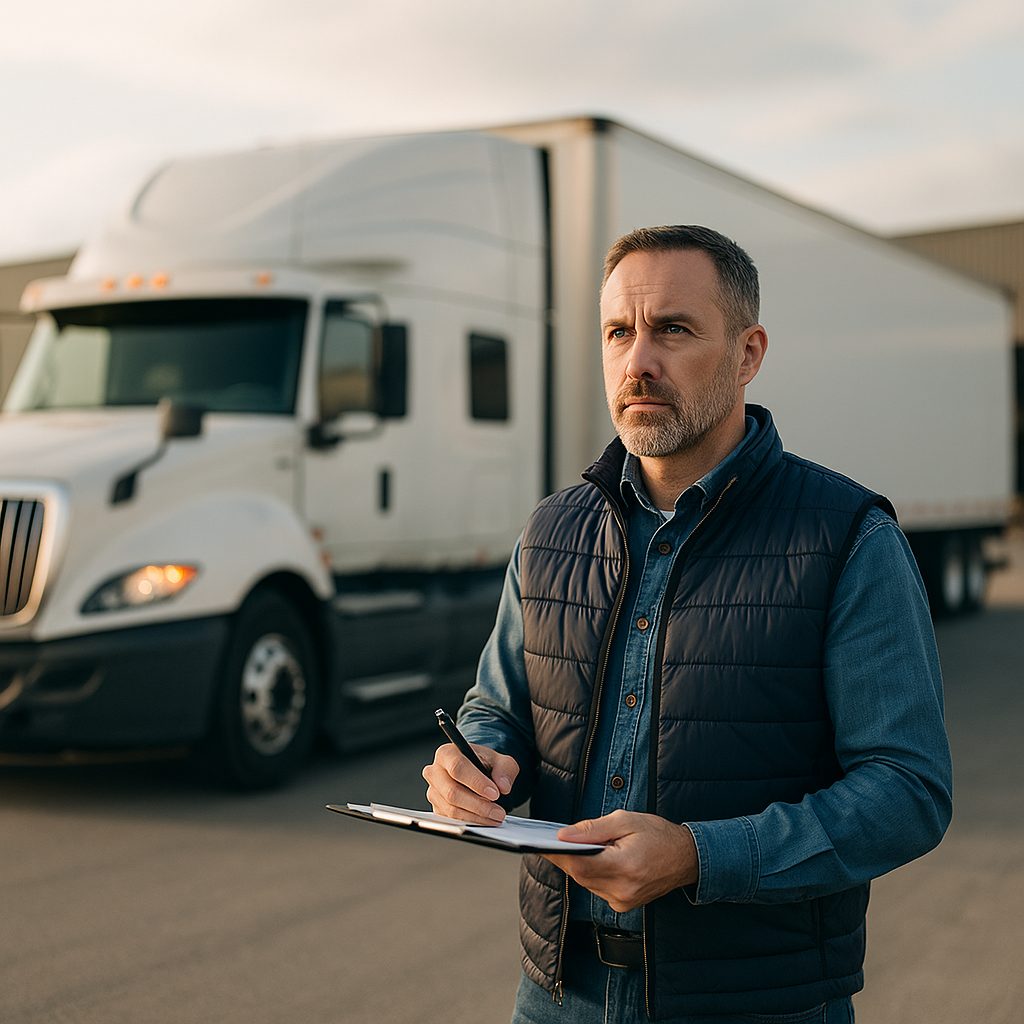
Commercial auto rental insurance (2026) explained: hired & non-owned auto, liability vs rental damage, CDW/LDW, coverage gaps, and state rules—plus a business rental checklist to avoid surprise bills.

Commercial auto rental insurance is the set of coverages that protects a business when it rents or leases vehicles for work, typically combining hired auto liability (and sometimes hired auto physical damage) with rental-counter options like RLI and CDW/LDW. The key is knowing you’re dealing with two different buckets: liability for injuries/property damage to others versus damage/theft of the rental vehicle.
If you rent a car, pickup, cargo van, or day-cab because your unit is down or you’ve got a one-off run, the rental counter’s “Do you want the coverage?” question can turn into a five-figure surprise when loss of use and admin fees show up on the invoice.
Table of Contents
Reading time: 11 minutes
- What Counts as a “Commercial” Rental (and Why It Matters)
- What Does Commercial Auto Rental Insurance Cover?
- Do You Need Separate Insurance for Rental Vehicles Used for Business?
- Hired and Non-Owned Auto Insurance (HNOA) Explained (with Examples)
- Rental Company Coverage: RLI vs CDW/LDW (Waiver) vs “My Policy”
- Are Rentals Covered Under Commercial Auto Policies? (What to Check)
- Commercial Vehicle Rental Insurance Requirements by State (High-Level)
- Real-World Claim Scenarios (Where Businesses Get Surprised)
- How to Choose the Right Coverage (and Control Costs)
- Frequently Asked Questions
- Why Logrock (and a Good Agent) Saves You Money
- Conclusion: Avoid Gaps Before You Rent
What Counts as a “Commercial” Rental (and Why It Matters)
A rental is “commercial” when it’s used for business operations, and that classification can change which policy endorsements apply and which exclusions kick in. If the trip is tied to making money, serving customers, hauling tools, or moving freight, treat it as business use.
Business use vs personal use (the line that matters)
Common “commercial” rental scenarios include:
- Renting a sedan for a sales trip, site visit, or client meeting
- Renting a pickup or cargo van to move tools, ladders, parts, and materials
- Renting a truck temporarily because your unit is in the shop
- Sending an employee to pick up parts or run job-related errands in a rental
Why it matters: personal auto and personal credit-card rental coverage can be limited—or exclude—business activities and certain vehicle types (like cargo vans, large pickups, or “commercial class” rentals).
Owned vs hired vs non-owned (policy language that drives claims)
Many commercial auto programs follow ISO-style definitions where:
- Owned autos: titled to the business
- Hired autos: rented, leased, or borrowed by the business
- Non-owned autos: employee-owned vehicles used for business errands or deliveries
That’s why the fix usually isn’t “a separate rental insurance product.” It’s making sure your policy is set up for hired and non-owned exposures—and that your rental agreement matches your driver rules.
What Does Commercial Auto Rental Insurance Cover?
Commercial auto rental insurance usually splits into two coverage buckets—(1) liability to others and (2) physical damage to the rental vehicle—and the second bucket is the one businesses most often miss. If you only solve liability, you can still get billed for repairs, theft, and “loss of use.”
Coverage Map: Liability vs Damage to the Rental Vehicle
| Coverage need | Usually covered by commercial policy? | Usually covered by rental company option? | Notes / typical gaps |
|---|---|---|---|
| Bodily injury / property damage you cause | Sometimes (hired auto liability / HNOA) | Sometimes (RLI / supplemental liability) | Verify limits and who qualifies as an insured driver |
| Damage to the rental vehicle (collision) | Only if you added hired auto physical damage | Yes (CDW/LDW typically) | Watch deductibles, excluded uses, vehicle-class limits |
| Theft / vandalism / weather damage to rental | Only if hired physical damage includes comprehensive | Yes (LDW typically) | “Loss of use” and admin fees can still be billed |
| Medical payments / PIP | Depends on state and policy | Rarely meaningful | No-fault states can change how injuries get handled |
| Towing / roadside | Sometimes endorsement | Often sold at counter | Convenience purchase, not liability protection |
Liability (injury & property damage) while driving a rental for business
Liability coverage pays for injury and property-damage claims your business causes while using a rental for work. It’s the coverage that responds to lawsuits, attorney fees, settlements, and judgments (up to your limit).
Don’t confuse general liability with auto liability. GL is “slip-and-fall.” Auto liability is “rear-end a minivan in a rental.”
Damage to the rental vehicle (physical damage) — only if you added it
Damage to the rental vehicle is typically covered only by hired auto physical damage on your policy or by CDW/LDW at the counter. Without one of those in place, the rental company can bill your business directly.
Typical charges can include repairs, theft loss, administrative fees, and loss of use (the rental company’s claimed lost rental income while the unit is unavailable).
When the rental company asks for proof
Rental counters often require proof of coverage that matches the rental contract’s named renter and authorized driver rules. A common mismatch is a rental in the company name with a driver who isn’t recognized as an authorized operator under your policy terms.
Do You Need Separate Insurance for Rental Vehicles Used for Business?
Many businesses need separate rental-vehicle coverage through endorsements (hired auto liability and hired auto physical damage) or rental-counter products (RLI and CDW/LDW) because standard general liability policies do not provide auto liability. The right setup depends on how often you rent and how much out-of-pocket risk you can tolerate.
If your business already has commercial auto
You may be covered for liability if your policy includes hired autos. But businesses still miss the second bucket: damage to the rental.
- Confirm hired auto liability: Are hired autos covered, and at what limit?
- Confirm hired auto physical damage: Is collision + comprehensive included for rentals?
- Confirm vehicle types: Passenger car vs pickup vs cargo van vs box truck
If you don’t have commercial auto (only a BOP/GL)
A BOP/GL typically won’t cover at-fault auto crashes. In that case, you’re usually choosing between adding HNOA (liability only) and buying rental-counter products.
If rentals are frequent, building the right commercial auto structure is usually cleaner than paying convenience-priced counter coverage every trip.
Hired and Non-Owned Auto Insurance (HNOA) Explained (with Examples)
Hired and non-owned auto (HNOA) coverage is generally liability-only coverage for vehicles your business does not own, commonly aligned with ISO Symbol 8 (hired autos) and Symbol 9 (non-owned autos) on many commercial auto forms. It’s one of the most misunderstood parts of “commercial auto rental insurance.”
What HNOA covers (and what it doesn’t)
- Hired autos: rentals and short-term leases used for business
- Non-owned autos: employee personal cars used for business errands
What it usually does not cover: physical damage to the rental vehicle. That’s a separate decision (hired auto physical damage or CDW/LDW).
Example scenarios: hired vs non-owned
- Hired auto: an employee rents a car for a customer visit and causes a crash; the business needs liability protection.
- Non-owned auto: an employee uses their personal car for a delivery and causes an accident; the business can still get pulled into the claim.
- Rental theft/damage: a rented cargo van is stolen overnight; liability isn’t the issue—physical damage is.
Rental reimbursement vs rental-car coverage (common confusion)
Rental reimbursement usually pays for a substitute vehicle when an owned, scheduled auto is down due to a covered claim, while hired auto coverage addresses liability or damage tied to vehicles your business rents. You can need both, but they solve different problems.
Rental Company Coverage: RLI vs CDW/LDW (Waiver) vs “My Policy”
Rental companies typically sell RLI for liability and CDW/LDW for rental-vehicle damage, and those products follow the rental contract’s exclusions even if you paid for them. Knowing what each item does helps you avoid paying twice—or paying out of pocket.
RLI vs CDW/LDW vs your commercial policy (quick comparison)
| Item | What it protects | Who provides it | Common exclusions / gotchas | When to buy it |
|---|---|---|---|---|
| RLI (Rental Liability Insurance) | Liability to others | Rental company | Limits may be lower than your contracts require | If you can’t confirm hired auto liability quickly |
| CDW (Collision Damage Waiver) | Collision damage to rental | Rental company | Unauthorized driver, prohibited use, late reporting | If you don’t have hired auto physical damage |
| LDW (Loss Damage Waiver) | Damage + theft/loss | Rental company | Same as above; contract compliance matters | Good “default” when you’re unsure and the rental is expensive |
| Commercial auto hired coverage | Usually liability | Your insurer | Depends on symbols/endorsements and driver rules | Best long-term solution if you rent often |
| Hired auto physical damage | Damage to rental | Your insurer | May have vehicle type/value/duration limits | Best if you rent frequently and want consistent terms |
What is Rental Liability Insurance (RLI)?
Rental Liability Insurance (RLI) is liability coverage sold by the rental company to cover injuries and property damage you cause to others. If your business policy doesn’t extend to hired autos—or you can’t confirm it in the moment—RLI can be a reasonable “stop the bleeding” purchase.
What is CDW/LDW (waiver) and why it’s not the same as insurance
CDW/LDW is usually a contractual damage waiver, not a traditional liability policy, and it can be voided by contract violations like unauthorized drivers or prohibited use. If you rely on it, follow the contract: driver rules, permitted territory, and reporting timelines.
Quick decision rule at the counter
- If you cannot confirm hired auto liability and hired auto physical damage, consider RLI + LDW.
- If you can confirm both (and limits are adequate), you can often decline counter products—but only if the rental class and drivers fit your policy.
Are Rentals Covered Under Commercial Auto Policies? (What to Check)
Rentals are covered under a commercial auto policy only if the policy extends coverage to hired autos (often ISO Symbol 8) and the driver, vehicle class, territory, and use all fit the policy’s terms. “I have commercial auto” isn’t the same as “my rentals are covered.”
What to check (copy/paste checklist)
- Hired auto liability: Is it included, and what limit applies?
- Non-owned auto liability: Are employee-owned vehicles covered for business use?
- Hired auto physical damage: Do you have collision + comprehensive for rentals?
- Insured / authorized drivers: Owners, employees, permissive users—who counts?
- Territory: U.S. only, U.S./Canada, or other restrictions?
- Vehicle type restrictions: passenger car vs cargo van vs pickup vs box truck
- Rental duration cap: short-term rental vs long-term lease rules
- Maximum value limit: any cap on the value of hired autos
If you’re renting a unit to keep revenue moving, treat it like a revenue-critical asset: know the deductible, exclusions, and whether “loss of use” is addressed.
Commercial Vehicle Rental Insurance Requirements by State (High-Level)
Every U.S. state requires auto liability insurance to legally operate on public roads, but rental contracts and business agreements often require higher limits than state minimums. If you cross state lines for work, your real requirement is usually “what the contract requires,” not “what the state minimum is.”

What’s generally required (and what isn’t)
- State minimum liability laws: vary by state and can change.
- Rental company rules: may require proof of coverage or the purchase of their products.
- Customer/job contract requirements: often demand higher limits and may require an umbrella/excess policy.
Interstate trucking note (federal requirement)
FMCSA financial responsibility rules can require at least $750,000 in liability coverage for many interstate for-hire motor carriers transporting property, with higher minimums for certain operations and hazardous materials. If you’re renting a unit to keep freight moving, confirm your operation’s specific FMCSA filing and limit requirements with your agent.
Major-state considerations (framework)
| State | No-fault / PIP considerations | Business-use pitfalls | What to confirm before renting |
|---|---|---|---|
| California | Injury handling differs vs pure tort states | Higher litigation severity in some venues | Higher limits + umbrella discussion |
| Texas | Not a no-fault state | Big gap between minimums and contract-required limits | HNOA + hired physical damage clarity |
| Florida | PIP/no-fault considerations can affect injury claims | Tourist areas can increase claim frequency | Authorized drivers + limits |
| New York | No-fault rules can change injury flow | Dense traffic can increase severity | Strong liability limits + reporting compliance |
| Illinois | Not a no-fault state | Urban severity exposure | Vehicle-class eligibility |
Important: This is not legal advice. Limits change. If you operate across multiple states, confirm compliance and contract requirements with your agent.
Real-World Claim Scenarios (Where Businesses Get Surprised)
Most rental-vehicle surprises come from a coverage mismatch—liability is covered but rental damage is not, or the driver/use violates the rental contract or policy terms. The crash is bad enough; the gap is what wrecks cash flow.
Accident while an employee is on a work trip
Scenario: An employee rents under the company account and causes an accident.
Where it breaks: The business gets pulled in, and without hired auto liability (or with an unauthorized driver), you’re relying on rental-company coverage and hoping the limit is enough.
Fix: Clear rental policy, approved driver list, and verified hired auto liability.
Damage to the rental vehicle with no hired auto physical damage
Scenario: A minor fender-bender in a rental cargo van with no injuries.
Where it breaks: You get billed for repairs plus loss of use and admin fees.
Fix: Choose hired auto physical damage or LDW on purpose—don’t leave it to chance.
International rentals (outside U.S./Canada)
Scenario: You rent overseas for business travel.
Where it breaks: Many U.S. commercial auto policies limit territory, and local insurance rules can be mandatory.
Fix: Confirm territory before you travel and buy compliant local coverage where required.
How to Choose the Right Coverage (and Control Costs)
The lowest-cost rental strategy is choosing the right coverage buckets ahead of time—liability limits that match your contracts and a clear plan for rental-vehicle damage (hired physical damage or LDW). This isn’t about buying “more,” it’s about buying what actually responds.
Decision guide (simple and practical)
- Rent rarely (1–2 times/year): Counter options (RLI + LDW) can be acceptable if you can’t justify policy changes.
- Rent monthly or have multiple employees traveling: Set up HNOA properly and consider hired auto physical damage for consistency.
- Rent trucks/vans for operations: Treat it like operational exposure—confirm vehicle classes, driver rules, and higher limits.
Business rental checklist (use this before you pick up keys)
- 1) Confirm liability: hired auto liability limit (or plan to buy RLI).
- 2) Confirm rental damage plan: hired auto physical damage or LDW/CDW.
- 3) Match names: renter name on contract should match insured/named insured where required.
- 4) Lock down drivers: authorized drivers only—no exceptions.
- 5) Confirm vehicle class: passenger vs cargo van vs pickup vs box truck eligibility.
- 6) Verify territory: states/countries where it will be driven.
- 7) Document condition: photos/video at pickup and return; keep the contract.
- 8) Know what to do in a crash: reporting steps, photos, police report rules.
Cost control that actually moves the needle
- Enforce authorized drivers only (no “just this once”).
- Keep rental paperwork like an asset file (contract, receipts, photos).
- Train drivers on incident steps: report immediately and document everything.
Frequently Asked Questions
Commercial auto rental insurance covers (1) liability claims to others and (2) damage or theft of the rental vehicle, but those buckets usually come from different sources. Liability for a business rental is commonly handled through hired auto liability (often tied to ISO Symbol 8 for hired autos) or the rental company’s RLI. Damage to the rental vehicle is commonly handled through hired auto physical damage on your policy or CDW/LDW at the counter. Coverage still depends on contract compliance, including authorized drivers, permitted use, territory, and vehicle class restrictions.
Yes, many businesses need separate coverage for business rentals because general liability (GL/BOP) does not provide auto liability for at-fault crashes. In practice, you either add the right endorsements to your insurance program (hired auto liability and, if you want rental-damage protection, hired auto physical damage) or you buy the rental company’s products (RLI for liability and CDW/LDW for rental damage/theft). If you rent frequently, policy-based coverage is usually more consistent than paying for counter coverage on every trip.
Hired and non-owned auto insurance (HNOA) is typically liability coverage for autos your business doesn’t own, including rented/leased vehicles (hired autos) and employee personal cars used for business (non-owned autos). On many commercial auto setups, hired autos align with ISO Symbol 8 and non-owned autos align with Symbol 9, but your specific form and endorsements control. HNOA usually does not pay for damage to the rental vehicle itself, so you still need hired auto physical damage or CDW/LDW if you want protection for the rental car, van, or truck.
Sometimes, but only when your commercial auto policy extends coverage to hired autos and the rental meets the policy’s driver, use, and vehicle-type requirements. Many policies indicate hired auto liability through an autos-covered symbol (commonly ISO Symbol 8), but that still doesn’t guarantee the rental vehicle’s physical damage is covered. Damage to the rental vehicle usually requires hired auto physical damage (collision and comprehensive) or CDW/LDW at the counter. Also verify authorized-driver rules, territory (U.S./Canada vs international), and any vehicle class exclusions.
State auto liability minimums apply to rental vehicles the same way they apply to other vehicles operating on public roads, but business contracts often require higher limits than the state minimum. Rental agreements may also require proof of coverage or require you to buy their liability product (RLI) if you can’t show qualifying insurance. For interstate trucking, FMCSA financial responsibility rules can require at least $750,000 in liability coverage for many for-hire property carriers, with higher minimums for certain operations. Always confirm the requirements for where the vehicle will be driven and the contracts you’re working under.
No, CDW/LDW is usually a contractual waiver from the rental company that reduces or removes what you owe them for damage or theft, and it can be voided if you violate the rental contract. CDW typically focuses on collision damage, while LDW often includes theft/loss as well, but the contract wording controls. CDW/LDW does not replace liability insurance, so you still need hired auto liability on your commercial policy or rental-counter RLI to protect your business from injury and property-damage claims to others. Always follow reporting timelines and authorized-driver rules.
Sometimes, but you shouldn’t assume it will, because business credit-card rental benefits often have strict limits and exclusions. Many cards limit coverage to rentals of roughly 15–31 consecutive days, exclude certain vehicle types (like cargo vans, box trucks, or specialty vehicles), and may exclude certain countries or business uses. Credit-card coverage also typically addresses damage to the rental vehicle—not liability to others—so it doesn’t solve the “lawsuit” bucket. Before relying on a card, confirm the benefit guide details for vehicle class, business use, territory, and the exact claim process.
Why Logrock (and a Good Agent) Saves You Money
Businesses most often waste money on rentals by either overbuying convenience-priced counter products or underinsuring because they assume personal auto or general liability will respond. The cheapest plan isn’t the lowest premium—it’s the one that actually pays when the claim hits.
A solid advisor looks at your operation (drivers, vehicle classes, radius/territory, rental frequency) and lines up the right buckets: hired auto liability, non-owned exposure, and a clear plan for rental-vehicle damage. That’s how you protect margins and avoid paying twice.
Conclusion: Avoid Gaps Before You Rent
Commercial auto rental insurance comes down to two questions: (1) who covers liability if you hurt someone in the rental, and (2) who pays for damage or theft of the rental vehicle itself.
Answer those two on purpose before you’re tired at the counter, and you’ll avoid the most expensive “cheap decision” in business travel and temporary vehicle use.
Key Takeaways:
- HNOA is usually liability-focused: hired/non-owned doesn’t automatically cover rental damage.
- Rental damage needs its own solution: hired auto physical damage or CDW/LDW.
- Contract details decide claims: authorized drivers, permitted use, territory, and vehicle class matter.
Related Reading (add internal links once your site search/RAG access is available): Commercial auto insurance basics; Hired and non-owned auto (HNOA) explained; Trucking insurance required coverages and cost drivers.





