
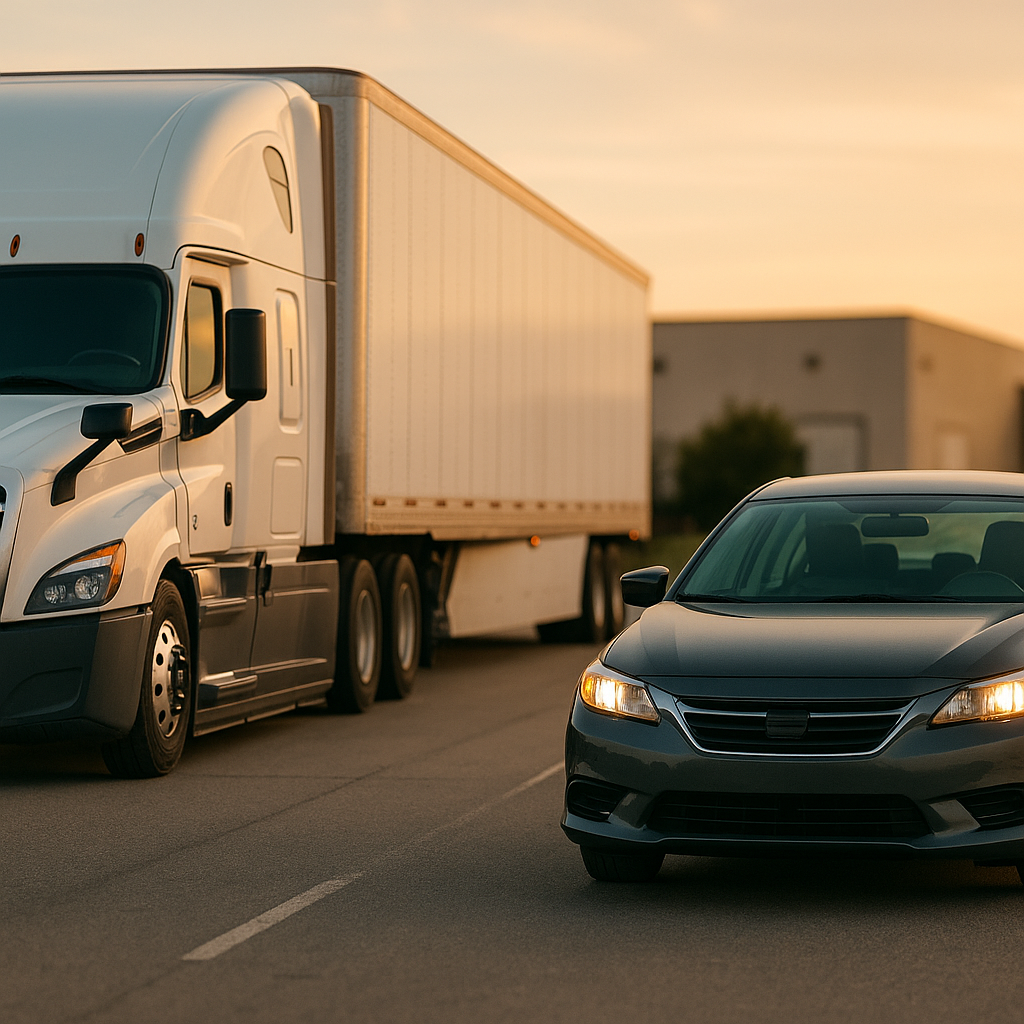
Compare commercial auto vs personal auto insurance in 2026—coverage, drivers, exclusions, costs, mixed-use options, and a decision checklist. Get the right policy fast.
Commercial auto vs personal auto comes down to one thing: whether the vehicle creates business liability exposure (business driving, higher limits, business ownership, or multiple drivers) or is truly limited to household use. If your day-to-day driving includes jobsites, deliveries, hauling tools, employee driving, or contract-required limits, a personal policy can leave you exposed when a claim hits.
The painful part is you usually don’t learn you’re on the wrong policy when you pay the premium—you learn it after an accident, when the adjuster starts asking what the vehicle was doing, who was driving, and whether that trip was personal or business.
Table of Contents
Reading time: 9 minutes
- Quick Answer (Featured Snippet)
- Commercial Auto vs Personal Auto: What’s the Real Difference?
- What Each Policy Typically Covers (and What It Often Doesn’t)
- When You Need Commercial Auto Insurance (Real-World Scenarios)
- Commercial Auto vs Personal Auto Costs (2026 Context)
- Mixed-Use Vehicles: One Vehicle for Work and Life
- State-by-State Considerations (What Changes and What Doesn’t)
- Claims Consequences: What Happens If You Have the Wrong Policy?
- Legal and Tax Angle (High-Level): Ownership, Deductions, Recordkeeping
- Decision Tool: Commercial Auto or Personal Auto? (Flow + Checklist)
- Frequently Asked Questions
- Why Logrock’s Approach Is Different (Owner-Operator Mindset)
- Conclusion: Get Correctly Covered
Quick Answer (Featured Snippet)
Commercial auto insurance is written for business use and business liability exposure (work driving, higher limits, business-owned vehicles, and employee/authorized drivers), while personal auto insurance is written for household driving and often limits or excludes many business uses unless specifically allowed by the carrier. The right policy depends on use, drivers, ownership/title, and contract requirements.
Commercial Auto vs Personal Auto (Side-by-Side)
| Category | Personal Auto Insurance | Commercial Auto Insurance |
|---|---|---|
| Primary purpose | Personal/household driving | Business driving + business liability exposure |
| Typical drivers | Named insured + household members | Named drivers and/or “authorized drivers” (employees/contractors, depending on the policy) |
| Business use | Often limited; varies by carrier/endorsement | Designed for business use |
| Liability limits | Often lower (but selectable) | Often higher (but selectable) |
| Vehicle ownership/title | Usually personally owned | Often business-owned/leased; can also cover personally owned vehicles used for business (depends on underwriting) |
| Common vehicles | Passenger cars, SUVs, light pickups | Service vans, work pickups, delivery vehicles, fleet vehicles (and in trucking: commercial truck programs) |
| Best for | Commuting + errands | Jobsites, deliveries, hauling tools/equipment, employee driving, contract-required limits |
Key Takeaways (Decision-First)
- The real difference is risk exposure, not the vehicle: business use + business drivers + higher limits = commercial territory.
- Misclassifying usage is a claims problem: you can pay premiums for months and still face delays/denials if the trip purpose conflicts with policy terms.
- “Occasional work use” isn’t a loophole: permitted business use is carrier-specific, so confirm it in writing.
- For-hire trucking and hotshot operations usually require commercial truck insurance: personal auto policies commonly restrict “for-hire,” “delivery,” or “livery” use.
Commercial Auto vs Personal Auto: What’s the Real Difference (In Plain English)?
Commercial auto vs personal auto insurance is primarily separated by business liability exposure—including work-related driving, multiple drivers, business ownership, and higher contract-driven limits like $1,000,000 liability that many commercial agreements require.
Personal auto is priced and written around a simple idea: one household, predictable driving, limited drivers, and mostly personal errands plus commuting.
Commercial auto is priced and written around business reality: more miles, more job sites, more time pressure, more third-party exposure, and more situations where the business entity gets pulled into a claim.
Use these four questions to classify correctly
- Use: What is the vehicle doing day-to-day—commuting, jobsites, deliveries, hauling tools?
- Drivers: Who drives—only you, household members, employees, partners, subcontractors?
- Ownership: Is it personally titled or business titled/leased?
- Contracts: Do you need specific limits, additional insured wording, or certificates of insurance (COIs) to get paid?
What Each Policy Typically Covers (and What It Often Doesn’t)
Personal auto policies typically cover liability, collision, comprehensive, and state-required medical benefits, while commercial auto policies add business-friendly structures for drivers, operations, and contract requirements—yet both can deny claims if the loss falls outside defined “permitted use.”
1) Personal Auto Insurance: Built for Non-Business Driving
What it is: Coverage for a personal vehicle used for household life—commuting, errands, and family driving.
What it usually includes:
- Liability: Bodily injury/property damage you cause to others
- Collision: Damage to your vehicle from a crash
- Comprehensive: Theft, hail, vandalism, animal hits, glass
- MedPay or PIP: Varies by state
- UM/UIM: Uninsured/underinsured motorists; varies by state
Where it can break: Many personal policies restrict or exclude certain business uses (especially deliveries, “for-hire” work, or employee driving) unless the carrier specifically allows it by endorsement or eligibility rule.
Clean way to confirm: Ask your agent/carrier, “Is jobsite travel covered? Are deliveries covered? Is carrying tools/equipment covered? Is a business name on the title an issue?” Then get the answer in writing.
2) Commercial Auto Insurance: Built for Business Risk and Business Drivers
What it is: Auto coverage written for business operations where driving is part of revenue production and the business can be sued.
What it often adds:
- Higher liability limits: Often selected to match contracts (commonly $1,000,000 liability in many commercial agreements)
- Broader driver handling: Depending on how the policy is written (named vs authorized drivers) and underwriting rules
- Business options: Coverage considerations for hired/non-owned auto exposure, rentals/loaners, and work equipment/custom parts (varies by carrier)
Why it matters: Commercial auto is designed to respond when the vehicle is being used to serve the business—even if the driver isn’t the owner.
3) Where People Get Tripped Up: “Occasional” Business Use
“I only do it sometimes” isn’t a coverage strategy because claim investigations focus on the facts of the trip and the policy’s definitions of business use.
- Frequency: How often the vehicle is used for work tasks
- Mileage and territory: How far, where, and how often you drive
- Trip purpose: What you were doing the day of the accident
- Driver status: Whether the driver was listed/allowed
Practical fix: Track mileage (an app is fine), keep driver access controlled, and don’t let unlisted drivers “borrow it for a quick run” if the policy doesn’t allow it.
When You Need Commercial Auto Insurance (Real-World Scenarios)
You typically need commercial auto insurance when the vehicle is used for work tasks beyond commuting, is driven by employees/other drivers, is business-titled, or must meet contract limits like $1,000,000 liability for clients, brokers, landlords, or platforms.
1) The Vehicle Performs Work (Not Just Commuting)
If you drive to multiple jobsites, visit clients, haul tools/materials, run service calls, or do deliveries, you’re creating business exposure that underwriting expects to be rated as commercial.
Pro tip: If you regularly haul equipment—even in a pickup—disclose it. Underwriting cares about weight, cargo/theft risk, and where the vehicle goes.
2) Employees or Multiple Drivers Use the Vehicle
More drivers means more exposure and a higher chance the “wrong” driver is behind the wheel when a loss happens.
Pro tip: Run driver screening like carriers do: motor vehicle reports (MVRs), experience, and violation history. It’s cheaper than shopping after a bad renewal.
3) You Use Rentals, Employee Cars, or Non-Owned Vehicles for Work
Even if the business doesn’t own the vehicle, the business entity can still be named in a lawsuit if the errand was for the business.
4) You’re Scaling (More Vehicles, More Miles, More Exposure)
As you add vehicles, territory, and drivers, commercial structure is usually cleaner: consistent limits, consistent driver rules, and fewer gray areas at claim time.
Commercial Auto vs Personal Auto: Is Commercial More Expensive? (2026 Cost Context)
Commercial auto insurance is usually more expensive than personal auto because commercial rating reflects higher liability limits, more miles, more drivers, and higher third-party exposure tied to business operations.
That said, the most expensive policy is the one that doesn’t respond when you need it.
Real-world cost expectations (ranges, not promises)
In the market, it’s common to see single-vehicle commercial auto pricing come in higher than personal auto for the same vehicle because the policy is being priced for business use and business defense. For light-duty contractor vehicles, many insureds land somewhere in the low-thousands per year, while for-hire trucking operations can be materially higher based on authority, radius, vehicle class, and loss history.
Bottom line: Any “personal vs commercial” price comparison is meaningless unless the coverages are matched exactly.
Cost drivers (what moves the number)
| Pricing variable | Why it matters | What you can control |
|---|---|---|
| Vehicle type/weight/class | A service van vs a sedan is a different loss profile | Choose the right unit; maintain it; secure it |
| Industry/use | Delivery/hauling/service calls have different claim patterns | Be accurate; choose carriers that write your class |
| Radius/territory | More miles and dense urban driving tend to increase frequency | Tighten radius when possible; improve garaging security |
| Drivers (MVRs/experience) | Driver history is a major predictor of losses | Hire carefully; train; enforce seatbelt/phone rules |
| Limits & deductibles | Higher limits cost more; lower deductibles cost more | Select limits based on contracts/assets; choose workable deductibles |
| Loss history | Claims follow the business and can drive renewals | Dash cams, driver coaching, documentation, accountability |
| Garaging ZIP | Theft and crash frequency varies by location | Secure parking; anti-theft; lighting; fenced lot when possible |
Apples-to-apples rule (how to compare quotes)
- Match liability limits (and whether it’s split limits vs CSL where applicable)
- Match deductibles for comprehensive/collision
- Match driver lists and driver experience
- Match actual usage (commute-only vs jobsites vs delivery vs for-hire)
Mixed-Use Vehicles: If You Use the Same Vehicle for Work and Life
Mixed-use vehicle insurance becomes a claims risk when the policy’s “permitted use” doesn’t match the vehicle’s real-world trips, especially on days where the same route includes both personal errands and work tasks.
Option A: Personal policy endorsed/rated for limited business use (when allowed)
Some personal carriers allow limited business use for certain professions and light usage, but the rules are carrier-specific and must be disclosed upfront.
Non-negotiable: Get permitted use confirmed in writing (email, endorsement, or policy language). Verbal assurances don’t pay claims.
Option B: Commercial policy that allows incidental personal use
Many commercial auto policies still allow incidental personal errands because carriers understand real life, but the primary exposure is still business and should be rated that way.
Option C: Separate vehicles (cleaner operations, cleaner claims)
One “work” vehicle and one “personal” vehicle reduces disputes about trip purpose, driver access, and mileage—especially once employees get involved.
State-by-State Considerations (What Changes and What Doesn’t)
Auto insurance requirements vary by state for minimum liability limits and no-fault/PIP rules, but the personal-vs-commercial decision is still driven by use, drivers, ownership, and contracts, not by a loophole in your ZIP code.
What’s usually state-driven
- Minimum liability limits: Each state sets its own required minimums
- PIP/no-fault rules: Only in states that require or offer PIP
- UM/UIM requirements: Whether it’s required, optional, or must be offered
What’s usually insurer-driven
- Eligibility: Whether business-titled vehicles can be insured on a personal policy
- Business-use definitions: What the carrier considers “business use,” “delivery,” or “for-hire”
- Driver rules: Named drivers vs authorized drivers, and who must be listed
Trucking note (federal requirements are not “personal auto”)
If you operate as an interstate for-hire motor carrier, FMCSA financial responsibility rules can apply, including minimum public liability limits of $750,000 for non-hazardous property in many cases under 49 CFR §387.9 (with higher requirements for certain operations and hazardous materials).
Practical compliance quick check
- What are your state’s minimum BI/PD limits where the vehicle is registered/garaged?
- Is PIP required in that state?
- Where is the vehicle garaged vs where is it operated?
- Do your contracts require $1,000,000 liability, additional insured, or specific COI wording?
- Is the vehicle titled to a business entity (LLC/corp)?
Claims and Consequences: What Happens If You Have the Wrong Policy?
Having the wrong policy can lead to coverage investigations, claim delays, non-renewal, or denial depending on policy language and state law, and the financial impact can be severe because bodily injury claims commonly reach six figures and legal defense can cost tens of thousands of dollars.
What “wrong policy” looks like in real life
- You told the carrier “commuting only,” but you’re running jobsites all day
- A helper/employee drove “just this once,” but they weren’t listed or allowed
- The vehicle is used for deliveries/for-hire work that the policy restricts
- The vehicle is business-titled but insured as personal without a carrier-approved structure
What can happen after an accident
- Delays: Coverage review while the insurer verifies trip purpose and driver status
- Denial or reduced payment: If the loss falls outside defined coverage/permitted use
- Non-renewal or cancellation: After a material misclassification is discovered
- Out-of-pocket exposure: Defense costs and judgments if the policy doesn’t respond
What to do if your usage changed
- Update use classification with your agent/carrier now (don’t wait for renewal)
- Update driver lists as soon as someone has regular access to the vehicle
- Re-evaluate limits if your assets or contracts grew (many commercial contracts start at $1,000,000)
- Document mileage, vehicle assignment, and driver policies
Legal and Tax Angle (High-Level): Ownership, Deductions, and Recordkeeping
IRS rules require you to substantiate business vehicle deductions with records (typically mileage logs and receipts), and mismatches between title/usage/insurance applications can create avoidable problems when a claim or audit happens.
Ownership and titling matters
If the vehicle is titled/registered to you personally, a personal policy may be possible depending on use and carrier rules; if it’s titled to an LLC/corporation, a commercial policy is often the cleaner fit and may be required by underwriting.
Recordkeeping you’ll want either way
- Mileage logs: Apps are fine if they’re consistent
- Receipts: Fuel, maintenance, repairs (especially if you track actual expenses)
- Clear separation: If you run mixed-use, be able to explain it cleanly
Plain-English rule: Align reality across documents—title/registration, insurance application, and how the vehicle is actually used. Inconsistency is what triggers disputes.
Decision Tool: Commercial Auto or Personal Auto? (Flowchart + Checklist)
Most policy-type decisions can be made using five underwriting facts—ownership/title, primary use, driver access, for-hire/delivery exposure, and contract limits (often $1,000,000 liability in commercial agreements).
Commercial vs personal decision flow (simple)
- Is the vehicle titled/owned by a business (LLC/corp) or primarily used for business?
Yes → Lean commercial auto
No → Go to #2 - Do you deliver goods, transport people for pay, or do for-hire work?
Yes → Commercial auto (or a trucking/commercial truck program)
No → Go to #3 - Do you regularly drive to multiple jobsites/clients as part of the job (not just commuting)?
Yes → Commercial auto or endorsed personal (carrier-dependent)
No → Go to #4 - Do employees/other drivers use the vehicle for work?
Yes → Commercial auto
No → Go to #5 - Do contracts require higher limits, additional insured, or specific wording?
Yes → Commercial auto is often the cleanest path
No → Personal auto may be fine (confirm business-use allowance if any work use exists)
Coverage options checklist (save this)
- Liability limit target: state minimum vs contract-required (often $1,000,000) vs asset protection
- Collision/comprehensive: plus deductibles you can actually afford
- MedPay/PIP: state-dependent
- UM/UIM: state-dependent but important if you want protection from uninsured drivers
- Downtime protection: rental reimbursement/towing where available
- Equipment/custom parts: tool racks, upfits, boxes (confirm how it’s handled)
- Named insured: you vs LLC/corp needs to match the title and operations
- Driver list: accurate today and updated when things change
Frequently Asked Questions
The difference is that commercial auto insurance is written for business liability exposure (work driving, business ownership, multiple drivers, and contract limits often starting around $1,000,000), while personal auto insurance is written for household driving and may restrict business use unless the carrier allows it. Commercial policies are structured to defend and pay claims tied to business operations, including situations where the business entity is named in a lawsuit. Personal policies typically assume predictable household driving and limited drivers. The correct policy depends on use, who drives, who owns/titles the vehicle, and what clients or brokers require on a COI.
You need commercial auto insurance when the vehicle is business-titled, used for work beyond commuting (jobsites, service calls, deliveries, hauling tools), driven by employees or other non-household drivers, or when contracts require higher limits like $1,000,000 liability or additional insured wording. If your business uses rentals or employees’ personal cars for business errands, the business can still be pulled into a claim, which is another reason commercial structure may be needed. The cleanest way to decide is to match the policy to the vehicle’s real daily use and driver access.
Commercial auto insurance is usually more expensive than personal auto because it’s priced for higher business exposure, which often includes more miles, more drivers, heavier or higher-value vehicles, and higher liability limits such as $1,000,000 required by many contracts. Personal auto is rated around household driving patterns and typically fewer permitted drivers. The only fair comparison is apples-to-apples: match liability limits, deductibles, driver lists, garaging ZIP, and—most importantly—truthful usage. A cheaper premium that doesn’t respond for the actual use is not a savings.
Personal auto insurance can sometimes cover limited business use, but it’s carrier- and policy-specific and must be disclosed and allowed in writing. Some personal carriers allow certain professional use (like occasional client visits) while restricting deliveries, for-hire driving, employee driving, or regular hauling of tools and equipment. If the policy’s “permitted use” doesn’t match the trip purpose at the time of a loss, the claim can be delayed or denied depending on the policy language and state law. If you’re unsure, ask direct questions and get the answer documented.
Who can drive a commercial auto policy depends on the policy’s driver structure (named drivers vs “authorized drivers”) and underwriting rules, but you should assume drivers must be disclosed and accepted based on MVR and experience. Many claims issues start when a vehicle is driven by someone who wasn’t listed or wasn’t eligible under the policy terms. If employees, partners, or subcontractors drive—even “once in a while”—commercial auto is usually the cleaner structure, but you still need accurate driver lists and a process for adding/removing drivers as your operation changes.
Yes—single-vehicle commercial auto policies are common for contractors, service businesses, and owner-operators whose use, ownership, or contract requirements fit commercial underwriting. You don’t need a “fleet” to need commercial coverage; you need the right structure for how that one vehicle is used and who might drive it. If you’re required to show a COI with higher limits (often $1,000,000) or you have business-titled ownership, commercial is often the simplest path. The key is accurate classification of use and drivers so the policy responds at claim time.
Why Logrock’s Approach Is Different (Owner-Operator Mindset)
Commercial auto decisions often hinge on operational details and contract limits (commonly $1,000,000 liability), so Logrock focuses on how you actually run—usage, drivers, ownership, and compliance—rather than forcing you into a generic “cheapest quote” path.
Most insurance content assumes you’ve got endless time and a legal department. Most owner-operators and small business owners don’t.
- You’re juggling dispatch, maintenance, paperwork, and cash-flow pressure.
- You need clear yes/no decision rules, not “it depends” fluff.
- You need coverage that fits real operations—jobsites, changing drivers, deadhead days, and contract requirements.
Our goal is simple: help you buy coverage like a business owner so you protect revenue, protect contracts, and avoid claim surprises.
Conclusion: Get Correctly Covered Before a Claim Tests It
Commercial auto vs personal auto isn’t a debate—it’s a classification decision that determines whether a claim gets defended and paid based on policy terms. If the vehicle makes you money, gets driven by more than household members, is business-titled, or must meet contract limits, commercial auto is often the cleanest fit. If it’s truly personal use, personal auto can work—but only if the carrier allows your real usage.
Key Takeaways:
- Match the policy to real-world usage, not best-case assumptions.
- Confirm business-use rules in writing before you rely on them.
- Compare quotes apples-to-apples (limits, deductibles, drivers, territory, and truthful use).
- For-hire operations are different: federal and contract requirements can apply (e.g., 49 CFR §387.9 minimums for certain carriers).
If you want a fast, practical answer, get quoted based on your actual use and driver list—then you’ll know what’s correct and what’s fantasy.



